
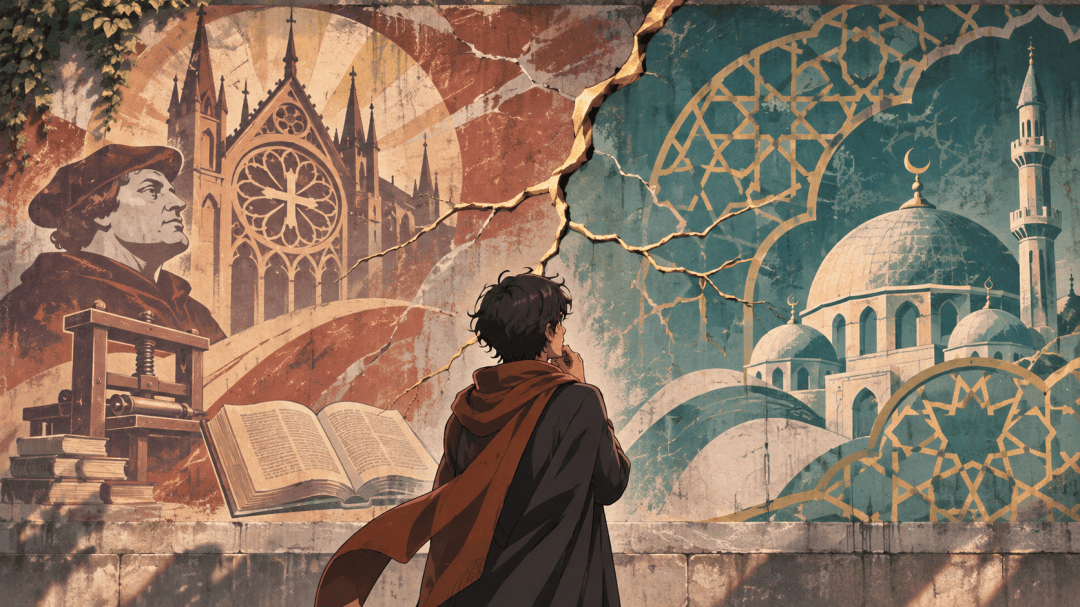
In 1517, a monk and university professor in Saxony named Martin Luther circulated ninety-five propositions attacking the sale of indulgences, certificates that promised to reduce a soul’s time in purgatory in exchange for money. He wanted a debate among theologians. What he started was the breakup of Western Christianity.
To see why that mattered, it helps to know what Western Christianity was at the time. For roughly a thousand years, nearly everyone in Latin Europe belonged to one church, headed by the pope in Rome. That church did not only teach doctrine. It decided what Scripture meant, administered the sacraments through which Christians believed they were saved, ran courts, owned a large share of the land, and crowned or rebuked kings. Scripture mattered enormously, but it reached ordinary people through the church’s liturgy, its priests, and its tradition of interpretation. The question “what does the Bible really teach?” had an institutional answer.
Luther rejected that answer. Summoned before the emperor at the Diet of Worms in 1521, he refused to recant unless he was shown his error from Scripture and plain reason, and he argued that popes and councils had contradicted themselves and erred. The principle behind this stance came to be called sola scriptura: Scripture alone is the final authority, and every church tradition must answer to it. Reformers pointed to texts such as this one:
All scripture is inspired by God and profitable for teaching, for reproof, for correction, and for training in righteousness, that the man of God may be complete, equipped for every good work. —2 Tim. 3:16-17
Notice what Luther was not doing. He was not rejecting God. He was not doubting that the Bible was the word of God. He was a devout man who believed the church had buried the gospel under human inventions, and he wanted to uncover it. Rejecting the authority of an institution does not necessarily undermine belief in God or Scripture, and for the early reformers it intensified both.
That is the setup, and here is the dilemma. If the church no longer decides what Scripture means, who does? Luther’s answer was that the text is clear enough for believers to read it rightly. But within a few years the reformers disagreed with each other on baptism, the nature of the Eucharist, church government, and the relation of faith to works. Luther and the Swiss reformer Huldrych Zwingli met at Marburg in 1529 and could not agree on whether Christ is bodily present in the bread and wine, which was enough to keep their movements apart. Anabaptists rejected infant baptism and, in some cases, the authority of the state. Calvin built a Reformed tradition in Geneva that differed from both Lutherans and Anabaptists. The English crown created a church of its own. Each group read the same book and each claimed it as its own.
This essay argues that the dilemma is what made the Reformation a driver of secularization. The Reformation did not secularize Europe by rejecting Christianity. It did so by multiplying competing claims about what Christianity truly taught. Its founders never intended a secular society. But once many groups claimed exclusive access to scriptural truth and no mechanism existed to settle the disagreement, societies were pushed to separate political legitimacy from theological correctness.
The resulting conflicts gradually made religious neutrality, political toleration, independent scientific inquiry, and secular institutions necessary for keeping social order. The historian Brad Gregory built the most developed version of this case in The Unintended Reformation, and this essay follows his central insight while taking it in a different direction. The second half applies the framework to Islam. That half is an internal critique, written from within the Islamic tradition’s own questions about authority, and it asks which stage of the European story Muslim societies now resemble.
When the Monopoly Breaks
A monopoly on interpretation can survive disagreement at the edges, but it cannot survive a rival with equal standing. Before the Reformation, heretics existed, and the church dealt with them by persuasion, discipline, or force. After the Reformation, the dissenters were princes, cities, and whole kingdoms, with armies, printing presses, and their own theologians. No faction could eliminate the others, and no neutral court existed to which all of them would defer. Each side thought the other was damning souls, which means each side thought that tolerating the other was complicity in damnation. A person who believes that error leads to eternal hell has a strong motive to suppress it, and a strong conscience about doing so.
Three Exits from Religious Conflict
The result was a century and a half of religious violence. The German Peasants’ War of 1524-25 mixed social grievance with scriptural claims. The Anabaptist takeover of Münster in 1534-35 ended in massacre and gave every established church a reason to fear radical readers of the Bible. France endured eight wars of religion between 1562 and 1598, including the St. Bartholomew’s Day massacre of 1572, in which thousands of Protestants were killed. The Thirty Years’ War from 1618 to 1648 devastated central Europe, killing a large share of the population in some German regions.
When no faction can dominate the others, there are three possible exits. The first is perpetual war, which is where the first century after Luther lived. The second is state-imposed uniformity, and Europe reached it first. The Peace of Augsburg in 1555 established that each prince would choose Lutheranism or Catholicism for his territory, and his subjects would follow or emigrate. The principle came to be summarized as cuius regio, eius religio: whose realm, his religion. Notice what this settlement did and did not do. It did not declare that religious truth is a private matter. It declared that the question of truth would be answered within each state by the ruler, because no larger authority could answer it for everyone. It excluded Calvinists and Anabaptists, which is one reason the peace failed, and the Thirty Years’ War broke out partly over those exclusions. The Peace of Westphalia in 1648 extended recognition to Calvinists and tightened the principle.
The third exit is liberalism, in which each faction argues its case and a system is devised where differing views coexist on their own merits. This exit was reached slowly, and mostly by people who did not want it. In the Dutch Republic, toleration grew from the fact that the cities needed merchants more than they needed doctrinal purity. In England, after a civil war, a regicide, a restoration, and a second revolution, Parliament passed the Toleration Act of 1689, and John Locke argued in his Letter Concerning Toleration that civil government has no competence to judge which religion saves souls. Pierre Bayle went further and argued that even an erring conscience has rights. These were not ideals that Europeans started with. They were arguments assembled after the alternatives had been exhausted. The path from Luther to Locke took over a century and a half, and it took longer still before toleration became a principle rather than a truce.
From Toleration to Secularization
Toleration alone is not secularization, but it set the conditions for it. Once the state could not enforce a single theology, it needed some other basis for its legitimacy. Rulers began to ground authority in law, contract, and the maintenance of order, and they began to treat confessional disputes as matters that the state would manage rather than settle. The language of public life shifted from “what does God command?” to “what can we all live with?” Because Christians disagreed about what God commanded, the second question gradually replaced the first in the places where the two had to be answered together.
The same logic applied to knowledge. When the interpretation of Scripture was contested, appeals to Scripture lost their power to close arguments about the natural world. The condemnation of Galileo shows that the Catholic Church still tried to close such arguments, and the Protestant churches had their own versions of the same impulse. But in a Europe divided into rival confessions, there was always another jurisdiction where a book could be printed and an experiment could be defended. The Royal Society, founded in 1660, took as a founding principle that it would not discuss religion or politics, because its members came from opposing camps and the society could not survive if it chose a side. Neutrality here was a practical device for cooperation among people who could not agree on theology, and only later did it harden into a principle.
This is the sequence at the center of the argument. Conflict came first, then exhaustion, then neutrality as a way of keeping the peace, and only afterward the secular institutions that neutrality made possible. Nobody in the sequence set out to remove God from public life. Each step was a response to the fact that the previous arrangement could not hold.
The Strongest Objection
Historians dispute how much of this the Reformation caused. The printing press spread dissent and literacy but also spread Catholic devotion. The rise of the centralizing state would have weakened the church’s jurisdiction with or without Luther, and the Scientific Revolution had intellectual roots in medieval natural philosophy and Renaissance humanism. Catholic France became one of the most aggressively secular states in Europe without a Protestant majority, which suggests that the Reformation is not necessary for secularization. Some sociologists add that secularization is better explained by prosperity, urbanization, and education than by anything that happened in the sixteenth century.
Much of this is fair. The Reformation was one cause among several, and it interacted with the others. Without the printing press, Luther would have been a local controversy, and without competitive states, the dissenters would have been crushed or contained. The thesis here does not claim that the Reformation was sufficient. It claims that it supplied something the other forces lacked: a permanent, unresolvable disagreement about religious truth among groups that were too powerful to eliminate. That condition is what turned neutrality from a convenience into a necessity. French secularism does not refute the point, because it arose as a reaction against a church that had allied itself with the throne, in a country that had already lived through the religious wars and the Edict of Nantes and its revocation. The model of a society that runs without a single enforced theology had been built elsewhere first, and the Reformation was a large part of the reason it existed to be copied.
Applying the Framework to Islam
Islam has no church, no pope, and no sacramental priesthood, so the comparison has to be made carefully. The analogy is not between Rome and any Muslim institution. It is between the function Rome served and the function that the classical Islamic scholarly tradition served. For roughly a millennium, the answer to “what does the Quran and the Prophet’s example teach?” was given by a class of scholars working within recognized schools of law and theology. That class never held a monopoly on paper, but it held one in practice, and its decline is the subject of the rest of this essay.
Unity That Is Demographic, Not Authoritative
Start with the fact that seems to count against the comparison. Sunni Muslims are roughly 90 percent of the world’s Muslims, and Sunni Islam has been far more unified than Christianity ever was. There was no equivalent of Luther’s break, no century of confessional war over the nature of the sacraments, and no sixteenth-century fracture into hundreds of denominations. If the argument were that Islam is about to repeat the Reformation, this fact would be a serious objection.
But the unity is demographic. It tells us how many people call themselves Sunni and says nothing about whether they share a single source of authority. Sunnis are divided among four surviving legal schools, the Hanafi, Maliki, Shafi’i, and Hanbali, and among three theological schools, the Ash’ari, the Maturidi, and the Athari. They are divided between Sufi orders that venerate saints and anti-Sufi movements that call the same practices innovation. They are divided among Salafis, who reject the legal schools in favor of direct appeal to the earliest sources; Islamists, who hold that the state must be organized around Islamic law; traditionalists in the great seminaries; and modernists who reread the sources through contemporary categories. No body speaks for all of them. The Amman Message of 2004, a statement signed by hundreds of scholars recognizing the validity of the major Sunni and Shia schools, shows both the desire for a common arbiter and its absence, since it declared agreement and enforced nothing.
Here the distinction matters. Sunni diversity is old. The four schools have existed for more than a thousand years, and for most of that time they managed their differences. The tradition even made a virtue of disagreement: jurists treated well-founded differences of opinion, ikhtilaf, as legitimate and sometimes as a mercy. The schools recognized each other, a student could move between them, and the system of ijaza, the certificate by which a teacher licensed a student to transmit a text or issue legal opinions, created chains of authority running back through named scholars to the early community. Consensus among scholars, ijma’, served as a distributed arbiter. No single office could close a dispute, but the system as a whole could, over time, marginalize a position that the scholarly class rejected.
Print, Literacy, and the Internet
The argument is that this arbiter is eroding, and that the erosion is the real parallel with the Reformation. Print was the first stage. Muslim societies adopted printing late, and in the Ottoman world the printing of religious texts was long restricted, but by the nineteenth century printed Qurans, hadith collections, and legal manuals were circulating widely. Mass literacy was the second. When reading is the privilege of a trained class, the class controls interpretation, and when millions can read, they cannot be prevented from forming their own opinions. The internet is the third, and the most radical. A teenager with a phone can now hear a dozen preachers a day, access every major hadith collection and commentary in searchable form, and find a community that agrees with whatever conclusion he reaches. None of this requires a teacher, a chain of transmission, or years of study.
Many movements in modern Islam are, in structure, versions of sola scriptura. The Salafi demand to return to the Quran and the practice of the first generations, bypassing the legal schools, claims authority directly from the text, as Luther claimed it against Rome. The thinkers of the Islamic modernist movement, from Muhammad Abduh onward, argued that the schools were human constructions and that the sources could be read afresh. The Quran-alone movements go further and reject the hadith literature as a binding source, a position that most of the tradition treats as outside the bounds. All of them ground their legitimacy in the same move, which is that a believer who reads the text has standing to say what it means. The Quran itself warns against the outcome. In sura 3, it commands believers wa-i’taṣimū bi-ḥabli llāhi jamī’an wa lā tafarraqū, to hold fast to God’s rope together and not divide, and sura 6 condemns alladhīna farraqū dīnahum wa-kānū shiya’an, those who split their religion into sects. Like the reformers, the Muslims who read these verses often come away certain that their own reading is the unified one.
Where Muslim Societies Sit on the Map
The question this raises is where Muslim societies sit on the three-exit map. The evidence suggests that the Muslim world has examples of all three, and the first two are easy to find.
Take war. The Sunni-Shia division is the oldest and largest fracture in Islam, and it has produced sustained conflict at several points, from the Ottoman-Safavid wars of the sixteenth and seventeenth centuries to the sectarian violence in Iraq after 2003, the war in Syria, and the conflict in Yemen. Equally important for this argument is the violence among Sunnis. The Islamic State declared most other Sunni groups apostates and killed more Muslims than non-Muslims. In Egypt, the military overthrew an elected Muslim Brotherhood government in 2013 and then repressed it with force. These are conflicts in which each side claims the text and denies the other’s right to do so, which is the structure of the wars of religion.
Take state-imposed uniformity. Saudi Arabia enforces a specific interpretation of Hanbali teaching, and for decades exported it. Egypt funds and supervises al-Azhar, the most prestigious Sunni institution, and uses it as an instrument of state policy. Iran has enforced Twelver Shiism since the Safavid shah Isma’il imposed it on a largely Sunni population in 1501, and its clerical establishment now holds ultimate political power. The Ottoman Empire made the Hanafi school its official law. In each case, the ruler decides which version of the faith is correct for the territory, which is the logic of cuius regio, eius religio. The Islamic world also has a precedent in this mode, since the mihna of the ninth century saw the caliph al-Ma’mun impose the Mu’tazili doctrine that the Quran was created, and it ended when the policy provoked a backlash led by Ahmad ibn Hanbal and was abandoned. State-enforced orthodoxy is not new in Islam, and it has failed before.
What a Liberal Arrangement Would Require
The third exit is where the analogy needs the most care. A liberal arrangement in a Muslim context would require several things that the current situation mostly lacks. It would require that no single school or movement be enforced as the law of the state, so that Hanafis, Salafis, Sufis, modernists, and Shia could argue their case in public without fear of the courts. It would require the legal right to dissent, which includes the right to leave the faith and to criticize its interpretations, because without exit and criticism, pluralism is only a truce among incumbents. It would require institutions that could keep the peace among believers without claiming to decide which of them is right. Some Muslim-majority societies have partial versions of this. Indonesia, Tunisia after 2011, and, in different ways, Turkey for much of the twentieth century have operated with a degree of religious pluralism, and the Ottoman millet system gave non-Muslim communities legal autonomy. But the millet system tolerated communities, not individuals, and it protected groups within a Muslim state rather than limiting the state’s claim to enforce religious truth. That is closer to a medieval arrangement than to Locke.
Where the Analogy Holds and Where It Breaks
Now compare the cases, because the analogy holds in some places and breaks in others. It holds on the central mechanism. In both cases, a broad technological and social change put the text in the hands of people outside the interpretive class, and in both, the result was a proliferation of claimants with no agreed way to adjudicate between them. It holds on the exits. The same three outcomes are visible, and the same pressure pushes societies from the first toward the second and, rarely and slowly, toward the third.
It breaks in several places. Islam’s central religious category is law, and the law covers contracts, inheritance, criminal punishment, and the structure of government. That means disagreements among Muslims are not only about private belief, as the Eucharist was, but about what the state should do, and that gives every dispute a direct political stake. The Reformation split a church while the state remained a separate institution, but in much of the Muslim world, the question of who may interpret the law and the question of who may rule are the same question. It breaks on the missing center. There was a pope to rebel against, and when Luther rebelled the target was clear.
The caliphate, which served as a symbolic center for Sunni Islam, was abolished in 1924, and no replacement was ever recognized, so the monopoly was already gone before the new media arrived. Fragmentation has been proceeding without a central institution to resist. It breaks on colonialism. European powers drew borders, built modern states, and in many cases dismantled or captured the institutions of religious scholarship. Muslim societies were pulled into the modern world by outside force and not through a gradual internal process, and the resulting states were often built by military officers who saw religion as a rival and treated it as something to be managed. Europe’s states were forged in the wars of religion, but many Muslim states were forged after colonial rule, which means the relationship between religion and the state was settled by different actors for different reasons. And it breaks on time. Europe needed more than a century from Luther’s break to the first durable settlement and longer to reach toleration as a principle. The mass-media transition in the Muslim world is recent, and nothing in the European case tells us how long the process will take here.
Stages, Not Timelines
For that reason, this essay does not predict a timeline. It says which stage each case resembles. Parts of the Muslim world resemble Europe in the century of confessional war, with factions that cannot defeat each other and will not recognize each other. Parts resemble the era of cuius regio, in which the ruler fixes the confession and suppresses rivals, and which has the same weakness, since it holds only while the ruler is strong enough to enforce it. A few places are experimenting with something closer to the third exit, and they are the ones to watch.
The lesson from Europe is that the fragmentation of authority is not itself the problem, and neither is any one reading of the text. The problem is the absence of a mechanism that lets people who are certain they are right live alongside people who are certain they are wrong. Europe found that mechanism by running out of alternatives, and the people who built it did not set out to separate politics from theology. If the Muslim world’s authority is fragmenting, as the evidence suggests, the choice that follows is the one Europe faced: continued conflict, enforced uniformity that holds until the enforcer weakens, or an arrangement in which each faction argues its case and the state declines to decide among them. Europe made that third choice late, under pressure, and at enormous cost. Whether and how Muslim societies make it is not a question the Reformation can answer, but it is the question the Reformation makes unavoidable.


