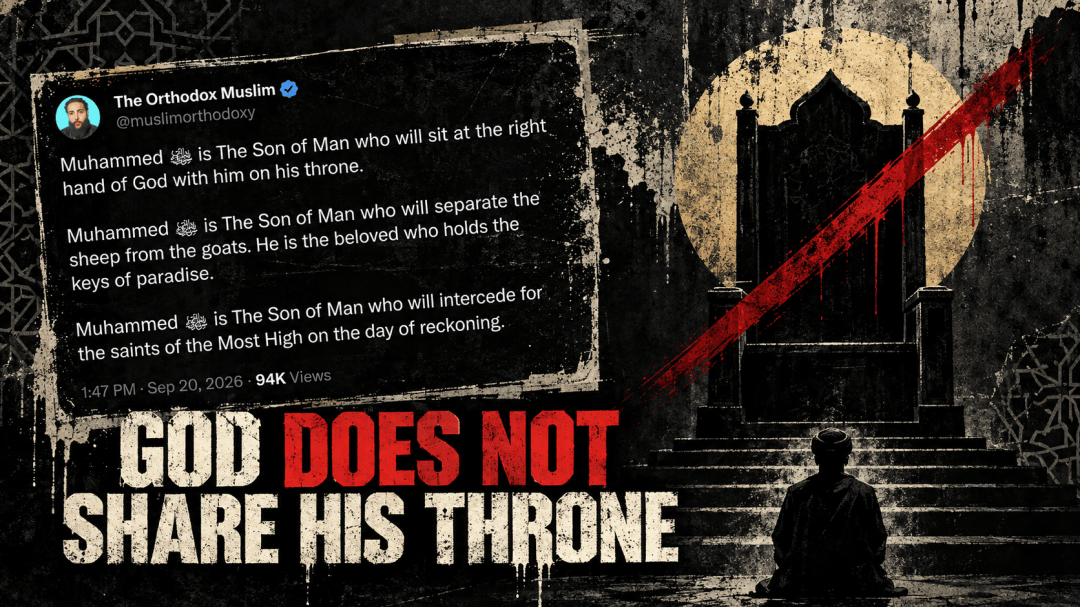
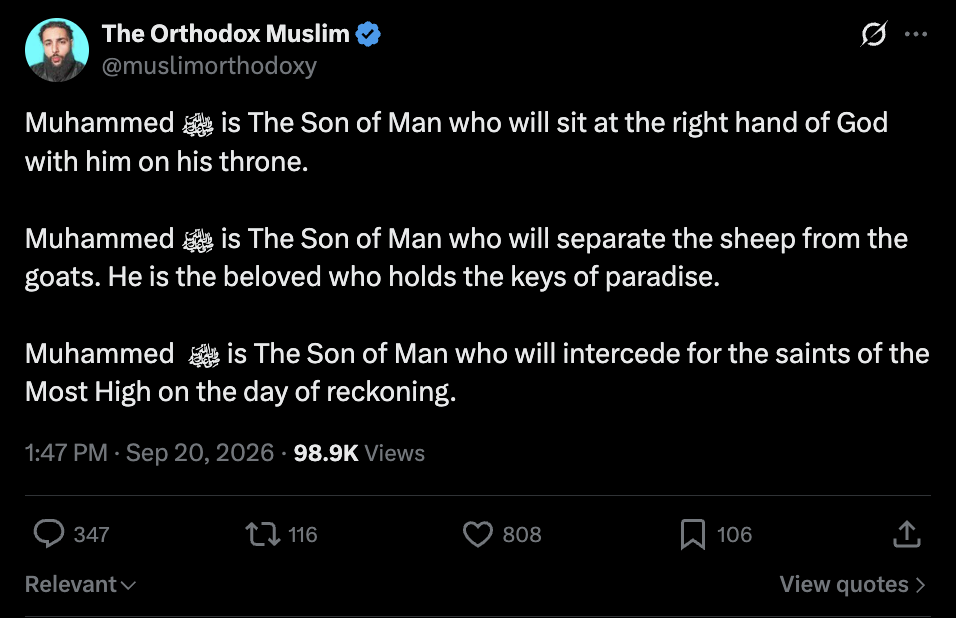
Let’s be clear about what is and isn’t being argued here, because the whole trick depends on you not looking closely.
This is not a dispute about whether Muhammad is “the son of man.” In its plain, original sense, “son of man” simply means son of Adam—a human being. It is one of the most ordinary phrases in all of scripture. In that sense every one of us is a son of man, and so was Muhammad. There is nothing there to argue about.
The problem is everything he has bolted onto the phrase. He is not using “Son of Man” to mean “a human being.” He is using it exactly the way Christian theology uses it—as a loaded title lifted from Daniel 7 and the Gospels, a title that smuggles in a specific package of claims: a figure enthroned beside God, who judges all mankind, and who intercedes on the last day. Those three claims are the entire point. The title is just the wrapping paper.
And there is an oversight in his own source worth flagging at the very start. Daniel 7—the origin of the whole “Son of Man” motif—does not actually say “the Son of Man.” It says “one like a son of man”: “with the clouds of heaven there came one like a son of man” (Daniel 7:13, RSV). The Aramaic is kebar enash—like a human being. It is a simile, not a title. In the vision, four beasts rise from the sea—a lion, a bear, a leopard, a fourth horror—and then appears a figure who is not a beast but looks human. “Like a son of man” is describing a shape, not crowning an office. The capital-letter title “The Son of Man” is a later reading poured back into a verse that never carried it. And even there, the dominion “was given to him” by the Ancient of Days (Daniel 7:14)—granted, not shared—and handed, in Daniel’s own interpretation, to “the saints of the Most High,” a people, not a deity (7:18, 7:27). Every thread of the passage points the same way: human, delegated, under God.
Read honestly, “son of man” means mortal—a son of Adam, formed from dust. That is the very reason a person can do none of the things on his list. The phrase he reached for to exalt Muhammad is the phrase that sinks him: a son of Adam does not sit on God’s throne, does not judge the world, and does not intercede for anyone.
So set the label aside and look only at the claims underneath it. Every single one is Christian theology about Jesus, transplanted onto Muhammad:
Enthronement beside God is Jesus before the high priest: “the Son of man seated at the right hand of Power” (Matthew 26:64).
Separating the sheep from the goats is Jesus judging the nations: “as a shepherd separates the sheep from the goats” (Matthew 25:32).
Holding the keys is the risen Christ: “I have the keys of Death and Hades” (Revelation 1:18).
Interceding for the saints of the Most High is Jesus in Paul’s letter, “who indeed intercedes for us” (Romans 8:34), with “the saints of the Most High” taken from Daniel 7:18.
He has taken the exact fabricated claims Christianity makes about Jesus and swapped in the name Muhammad. This is a find-and-replace.
And that is the bitter irony, because the single greatest charge the Quran levels against the Christians is precisely this: that they took a human messenger and raised him as divine.
[4:171] O people of the scripture, do not transgress the limits of your religion, and do not say about GOD except the truth. The Messiah, Jesus, the son of Mary, was no more than a messenger of GOD… So believe in GOD and His messengers. Do not say, “Trinity.” You shall refrain from this for your own good. GOD is only one god. Be He glorified; He is much too glorious to have a son.
Out of a desire to outbid the Christians—our man outranks your man—he has reproduced their error down to the letter. He commits the very blasphemy the Quran condemns them for, only with a new name attached. What he is uttering is not devotion. It is shirk.
Take his three implications one at a time.
Claim 1: A man seated on God’s throne
God shares His throne with no one. This is not a fine theological point; it is the foundation of the entire Quran. To make his first claim work, these are the verses “The Orthodox Muslim” has to erase:
[17:111] And proclaim: “Praise be to GOD, who has never begotten a son, nor does He have a partner in His kingship, nor does He need any ally out of weakness,” and magnify Him constantly.
[25:2] The One to whom belongs all sovereignty of the heavens and the earth. He never had a son, nor does He have any partners in sovereignty. He created everything in exact measure; He precisely designed everything.
God has no partner in His mulk (dominion), and, as 18:26 adds in its final phrase, وَلَا يُشْرِكُ فِي حُكْمِهِ أَحَدًا (wa lā yushriku fī ḥukmihi aḥadā)—”and He shares His command with no one.” Not His throne, not His kingship, not His rule—with no one.
[18:26] Say, “GOD is the best knower of how long they stayed there.” He knows all secrets in the heavens and the earth. By His grace you can see; by His grace you can hear. There is none beside Him as Lord and Master (waliyyin), and He never permits any partners to share in His kingship/command (ḥukmihi).
The Arabic is exact. In all three verses, the word is شَرِيك (shareek)—a partneror associate—from the root sh-r-k, the same root as shirk, the one unforgivable sin if maintained until death (4:48, 4:116).
[4:36] You shall worship GOD alone—do not associate anything with Him.You shall regard the parents, the relatives, the orphans, the poor, the related neighbor, the unrelated neighbor, the close associate, the traveling alien, and your servants. GOD does not like the arrogant show-offs.
Now, a careful reader might push back here with another verse:
[3:26] Say, “Our god: possessor of all sovereignty. You grant sovereignty to whomever You choose, You remove sovereignty from whomever You choose. You grant dignity to whomever You choose, and commit to humiliation whomever You choose. In Your hand are all provisions. You are Omnipotent.”
Doesn’t this prove God gives kingship to people—so why not to Muhammad? It does prove the first part, and it demolishes the second. There is a world of difference between God granting authority and someone sharing in God’s own sovereignty, and this verse is built on exactly that difference. The kingship in 3:26 is a loan: God gives it and, in the same breath, “removes sovereignty from whomever You choose.” It is worldly, delegated, and revocable, handed out alongside provisions and dignity in this life. The one who receives it is a steward holding a trust, never a co-owner—God alone remains Mālik al-Mulk, the Possessor of all sovereignty. Saul, David, Joseph, and Solomon all received this kind of mulk; not one of them became a shareek fī l-mulk, a partner in God’s dominion. A governor handed a province he can be dismissed from at any moment is not the partner of the king who handed it to him.
So receiving authority from God is not the sin. The sin is claiming a share in His divine rule. And the post claims far more than a worldly kingdom—it seats Muhammad on God’s throne “on the day of reckoning.” For that specific day, the Quran cancels every grant and returns all sovereignty to God alone:
[40:16] That is the day when everyone will be completely exposed; none of them will hide anything from GOD. To whom belongs all sovereignty on that day? To GOD, the One, the Supreme.
Even Solomon, granted the greatest kingship in all of scripture (38:35), never sat on God’s throne, never judged mankind, and never held anyone’s fate. Delegated authority has never once included those prerogatives. To answer “He shares His command with no one” by seating a man beside Him on the Day of Judgment is not a different interpretation. It is a direct contradiction.
Claim 2: A man who “separates the sheep from the goats” and holds the keys
To “separate the sheep from the goats” means to judge—to decide who enters paradise and who does not. This claim hands final judgment to Muhammad. But the Quran tells us plainly what Muhammad could and could not do.
While he was alive, Muhammad could judge only by the Quran—never by his own opinion. God commanded him:
[5:48] …You shall judge among them in accordance with GOD’s revelations, and do not follow their wishes if they differ from the truth that came to you…
[4:105] We have sent down to you the scripture, truthfully, in order to judge among the people in accordance with what GOD has shown you. You shall not side with the betrayers.
He was a judge only in the ordinary sense—one who applies the law he was handed. He was never the Lawgiver, and never the source of the verdict. He had no independent power at all, not even over his own fate:
[7:188] Say, “I possess no power to benefit myself, or harm myself. Only what GOD wills happens to me. If I knew the future, I would have increased my wealth, and no harm would have afflicted me. I am no more than a warner, and a bearer of good news for those who believe.”
A man who admits he cannot benefit or harm himself is not going to be sorting mankind into the saved and the damned.
On the Day of Judgment, the verdict belongs to God alone—and the messengers say so themselves:
[5:109] The day will come when GOD will summon the messengers and ask them, “How was the response to you?” They will say, “We have no knowledge. You are the Knower of all secrets.“
As for “the keys of paradise”—that is Revelation 1:18 about Jesus, not anything in the Quran. In the Quran the keys are God’s, and no creature holds them:
[6:59] …With Him are the keys to all the secrets; none knows them except He.…
Claim 3: A man who intercedes on the day of reckoning
This is the heart of it, and the clearest case of a doctrine that lives only in the Hadith and stands in flat opposition to the Quran.
The Quran’s default statement is that there is no intercession on that day:
[2:48] Beware of the day when no soul can avail another soul, no intercession will be accepted, no ransom can be paid, nor can anyone be helped.
[2:254] O you who believe, you shall give to charity from the provisions we have given to you, before a day comes where there is no trade, no nepotism, and no intercession. The disbelievers are the unjust.
And where the Quran does mention intercession, it strips it from every creature and returns it to God:
[39:44] Say, “All intercession belongs to GOD.” To Him belongs all sovereignty of the heavens and the earth, then to Him you will be returned.
The few verses that seem to allow an exception do not describe pleading for anyone. They describe testimony—being permitted to speak, and only to speak the truth:
[20:109] On that day, intercession will be useless, except for those permitted by the Most Gracious, and whose utterances He approves.
[43:86] None of those whom they idolize beside Him possess any power to intercede, except who bear witness to the truth, and they fully know.
So the only “intercession” the Quran permits is a witness confirming what is already true. It changes no one’s outcome; it only ratifies a decision God has already made.
Now look at what Muhammad’s testimony on the Day of Judgment in the Quran actually is. It is not a plea for his followers. It is a complaint against them:
[25:30] The messenger said, “My Lord, my people have deserted this Quran.“
The man they imagine begging God to admit his devotees is, in the Quran itself, the man who stands up and accuses them of abandoning the very book he delivered. Far from interceding, the messenger disowns them—exactly the pattern the Quran describes elsewhere:
[17:56] Say, “Implore whatever idols you have set up beside Him.” They have no power to relieve your afflictions, nor can they prevent them. [17:57] Even the idols that they implore are seeking the ways and means towards their Lord. They pray for His mercy, and fear His retribution. Surely, the retribution of your Lord is dreadful.
[30:12] On the Day when the Hour comes to pass, the guilty will be shocked.[30:13] Their idols will have no power to intercede on their behalf; on the contrary, they will disown their idols.
Everyone on that day—messengers included—is worried about his own neck, not anyone else’s (see also 34:40–41 and 70:8–14). The grand intercessor pulling his people out of the fire is nowhere in the Quran. He comes entirely from the Hadith, and he contradicts the book he claims to serve.
The Confession Buried in the Post
Step back and notice what the three claims share. Not one of them is in the Quran. All three come from the Hadith, and all three are contradicted by the Quran the moment you open it. The throne-sharing, the final judgeship, the grand intercession—these are traditions inherited, repeated, and then defended over the plain words of the scripture.
That is exactly what 25:30 is describing. To “desert the Quran” does not mean to burn it or stop reciting it. It means to leave its rulings behind for something else while keeping it on the shelf. A man who answers “God shares His kingship with no one” by insisting “Muhammad sits on the throne” has deserted the Quran in the precise sense the verse means.
And so we end where we began. He called Muhammad “the son of man,” and he was right—Muhammad was a son of Adam, a mortal messenger. That is the whole point. Being a son of Adam is exactly why he holds no throne, no gavel, and no keys. In straining to prove Muhammad greater than the Christians’ Jesus, “The Orthodox Muslim” has only made himself a Christian with a new object of worship: same throne, same judge, same intercessor for the saints—only the name over the door has changed. He has fallen into the identical idolatry the Quran spent its entire length warning against.
The Quran’s answer to the Christians and to him is one and the same sentence:
There is none beside Him as Lord and Master, and He shares His command with no one.
God has no partner in His dominion. Not for Jesus. Not for Muhammad. Not for any son of Adam who ever lived.
God doesn’t share His throne. That is shirk. Muhammad can’t benefit or harm even himself (7:188), or intercede for anyone else. On the DoJ, he will say he has no knowledge of what happened after him (5:109) and will testify:
What you're uttering is a blasphemy. God has no partner in His dominion (17:111). There is none beside Him, and He shares His command with no one (18:26). On the Day of Judgment, Muhammad will not intercede and will disown those who idolized him (17:56-57, 34:40-41, 30:13-14). pic.twitter.com/u1YXFwdZyn