
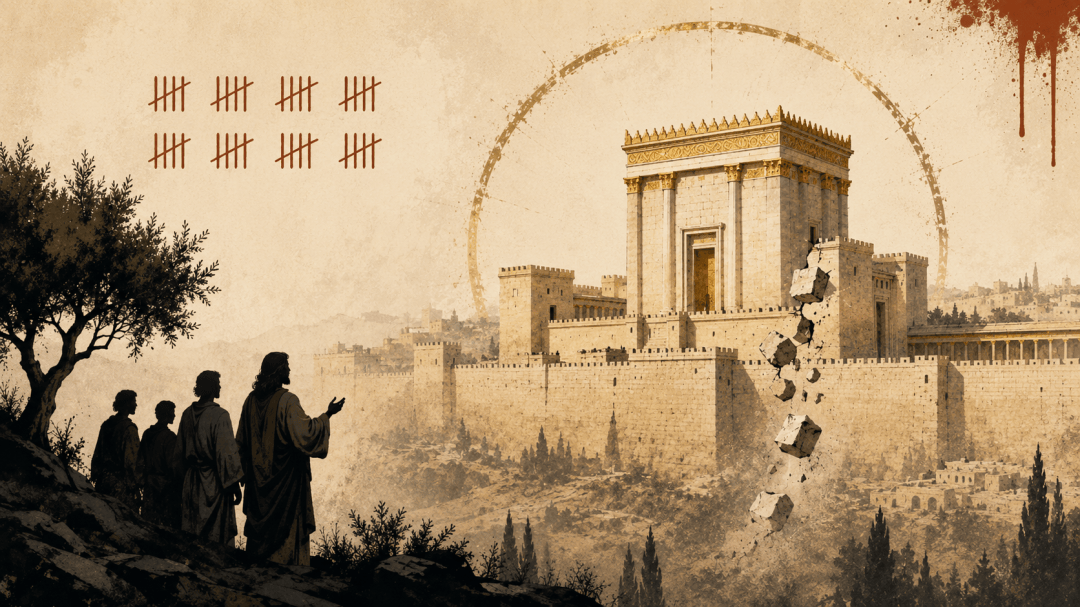
In the final week of his public life, Jesus stood with his disciples on the Mount of Olives, looking across the Kidron Valley toward the most magnificent building any of them would have seen in their lives. Herod’s Temple was still under construction, a project decades in the making, its retaining walls built from limestone blocks so massive that some weighed hundreds of tons. To a group of Galilean followers, most of them fishermen and laborers, the sight was overwhelming. One of them said what any visitor might say: Teacher, look at these stones, look at these buildings.
The reply was not what they expected.
Do you see all these great buildings? Jesus answered. Not one stone here will be left on another; every one will be thrown down (Mark 13:2).
The same prediction appears in Matthew 24, Mark 13, and Luke 21—the discourse scholars call the Olivet Discourse, because it was delivered on that hillside overlooking the city. Luke preserves a second, even more pointed moment. Days earlier, as Jesus approached Jerusalem, he is said to have wept over it and spoken words that read now like a military forecast:
The days will come upon you when your enemies will build an embankment against you and encircle you and hem you in on every side. They will dash you to the ground, you and the children within your walls. They will not leave one stone on another (Luke 19:43–44).
For anyone reading these lines after the fact, the description is uncomfortably precise. Roman siege warfare did exactly this—embankments, encirclement, the systematic dismantling of walls. Whatever one concludes about the origin of the prophecy, its content maps onto the historical catastrophe that followed with unusual exactness. And that catastrophe arrived, by one reasonable reckoning, exactly forty years later.
The First Temple: Why the Loss Cut So Deep
To understand why the destruction of the Temple was not merely a building’s demolition but a civilizational rupture, it helps to remember that this had happened once before.
The First Temple was built by Solomon in the mid-tenth century BCE, around 960 BCE, on Mount Moriah in Jerusalem. It housed the Ark of the Covenant and functioned as the singular center of Israelite worship—the one place where sacrifice could legitimately be offered. For nearly four centuries it stood as the physical anchor of the nation’s identity and its covenant with God.
That first structure was destroyed in 586 BCE by Nebuchadnezzar II of Babylon, who besieged Jerusalem, burned the Temple, breached the city walls, and carried much of the population into exile. The Babylonian Exile that followed was the defining trauma of the Hebrew Bible, the event that reshaped Israelite religion into something portable, text-centered, and capable of surviving without a homeland. When the Persians under Cyrus permitted the exiles to return, a Second Temple was rebuilt and dedicated around 516 BCE under Zerubbabel—more modest than Solomon’s, but a restoration of the sacred center nonetheless.
This is the crucial context: for the Jewish world of the first century, the phrase the Temple could be destroyed was not abstract. It had a precedent seared into collective memory, complete with a date, a foreign army, and generations of exile. To predict a second destruction was to invoke the deepest catastrophe the nation knew.
The Second Temple and Herod’s Grandeur
By the time Jesus stood on the Mount of Olives, the Second Temple had been transformed almost beyond recognition. Herod the Great, the Roman client-king, had launched a colossal renovation and expansion beginning around 20 BCE. He doubled the size of the Temple Mount, constructing the enormous platform whose western retaining wall survives today as the Western Wall. The work was still ongoing during Jesus’s lifetime; the Gospel of John records the remark that the Temple had already been under construction for forty-six years (John 2:20), and it would not be fully completed until the early 60s CE—only a few years before its destruction.
This is part of what makes the prophecy so striking to later readers. Jesus was said to have predicted the total ruin of a structure that was, at that very moment, being finished at staggering expense. The building was newer and grander than it had ever been. To predict its fall was to predict the fall of something that looked, by every worldly measure, permanent.
The Destruction: History and Severity
The end came during the First Jewish–Roman War, which erupted in 66 CE when tensions between the Jewish population and Roman administration boiled over into open revolt. Rome responded with overwhelming force. The general Vespasian led the initial campaign; when he was proclaimed emperor in 69 CE, command passed to his son Titus, who laid siege to Jerusalem in the spring of 70 CE.
Our principal source for what followed is Flavius Josephus, a Jewish commander who defected to the Romans and later wrote The Jewish War. His account is vivid and horrifying, and though his numbers are almost certainly inflated, the general picture is corroborated by the archaeological record and by Roman sources.
The siege was catastrophic in its severity. Titus surrounded the city and built a wall of circumvallation—the very embankment-and-encirclement tactic Luke’s Gospel describes. Trapped inside were not only the city’s residents but enormous crowds of pilgrims who had come for Passover. As supplies ran out, famine set in. Josephus describes conditions so extreme that starving inhabitants fought over scraps, and he records at least one account of a mother who killed and ate her own child—a horror that deliberately echoes the curses of Deuteronomy for covenant breach. Bodies piled up faster than they could be buried or thrown over the walls.
When the Romans finally breached the defenses, the fighting moved to the Temple itself. According to Josephus, Titus claimed he wished to spare the sanctuary, but in the chaos of battle a soldier hurled a burning torch, and the Temple caught fire. The gold fittings melted and ran down into the gaps between the stones; the soldiers, seeking the melted gold, then pried the stones apart one from another—a grimly literal fulfillment of not one stone left upon another. The Temple burned on the ninth or tenth of the Hebrew month of Av, the same date on which tradition holds the First Temple had fallen to Babylon. That day, Tisha B’Av, remains the great day of mourning in the Jewish calendar.
The human toll was staggering. Josephus claims more than a million died and nearly a hundred thousand were taken captive; modern historians regard the death figure as exaggerated but still place the losses in the hundreds of thousands, a demographic and spiritual devastation for the Jewish people. The captives and the Temple’s treasures—the great menorah, the table of showbread, the silver trumpets—were paraded through Rome in Titus’s triumph. That parade is carved in stone on the Arch of Titus, which still stands in the Roman Forum, showing Roman soldiers carrying the menorah aloft. The sacrificial system, unbroken for centuries, ceased. It has never resumed.
Dating the Crucifixion
To measure the span between the prophecy and its fulfillment, we need a date for the crucifixion—and here the evidence narrows the field considerably.
Several fixed points constrain the possibilities. Pontius Pilate governed Judea from 26 to 36 CE, so the execution must fall within that window. The Gospels place the crucifixion on a Friday, at or near Passover, which falls on the 14th–15th of the Hebrew month of Nisan. Combining the requirement of a Friday with the astronomical calculation of when Nisan 14 or 15 fell on a Friday during Pilate’s tenure leaves two serious candidates:
- Friday, April 7, 30 CE
- Friday, April 3, 33 CE
Scholars are genuinely divided between these two, and each has able defenders. The 33 CE date appeals to some because of astronomical arguments and a possible lunar eclipse; the 30 CE date is favored by others on chronological grounds relating to the start of Jesus’s ministry and the reign of Tiberius. Both remain live options in serious scholarship, and honesty requires acknowledging that the question is not settled.
But if we adopt the earlier of the two—April, 30 CE—a remarkable arithmetic emerges.
Forty Years
From April, 30 CE, to the burning of the Temple in the late summer of 70 CE is a span of exactly forty years.
The number is not incidental. In the biblical imagination, forty years is the length of a generation. Israel wandered forty years in the wilderness until the generation that had rebelled died off and a new one entered the land. Forty days, forty years—the number recurs throughout Scripture as a full measure of testing, waiting, and reckoning.
This gives fresh weight to one of the most debated lines in the Olivet Discourse. After foretelling the Temple’s fall, Jesus added:
Truly I tell you, this generation will not pass away until all these things have happened (Matthew 24:34; Mark 13:30; Luke 21:32).
Read against a 30 CE crucifixion, the statement is strikingly precise. One biblical generation—forty years—after the prophecy was spoken, the Temple lay in ashes. The people who heard the warning as young adults would have lived to see it come true, and no longer.
For readers in the tradition, this alignment has long been taken as a mark of the prophecy’s authenticity: a specific prediction, delivered when the Temple was at its architectural peak, fulfilled within the exact generational span the speaker himself named. For historians, the same alignment invites a more cautious observation—that the number forty carries deep theological resonance, and that the Gospels reached their written form in the decades bracketing 70 CE, when the destruction was recent memory. Both readings can hold the same facts in view. What is not in dispute is the shape of the thing: a warning about stones thrown down, and, four decades later, stones thrown down.
The Weight of the Symmetry
Whatever one makes of prophecy, the historical sequence is arresting in its symmetry. A Second Temple that had itself replaced a First Temple destroyed on the ninth of Av fell to a second empire on that same calendar day. A prediction of total ruin, spoken over a building that looked eternal, found its fulfillment—if we date the crucifixion to 30 CE—forty years to the season: one generation, exactly as the generation that heard it was passing away.
The religion that had centered on its altar reinvented itself around the synagogue, the study of Torah, and the rabbinic tradition, much as the exiles of 586 BCE had once learned to carry their faith without a building. The early Christian movement, for its part, read the destruction as vindication and as a sign, and built its own theology of a temple made not of stones but of people.


