
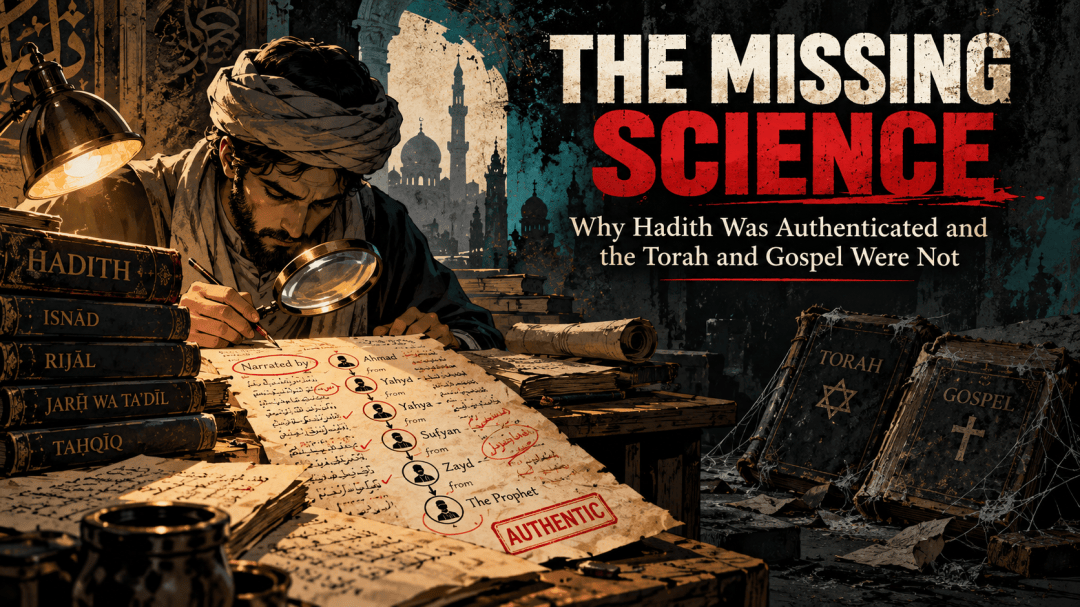
Every religious community has to settle what counts as authority. For Muslims the first answer is the Quran, the scripture revealed through Muhammad. Sunni Islam adds a second source: hadith, the reports of what Muhammad said and did, collected and written down generations after his death. This article traces how that second source rose until it rivaled the first, and then asks a question Sunni scholarship has never satisfactorily answered. Why did Muslim scholars build an elaborate science to authenticate statements attributed to Muhammad, yet make no comparable effort to recover the Torah and the Gospel, which the Quran itself calls revelation from God?
What the First Muslims Did
The earliest community appears to have worked to keep the Quran distinct. The hadith literature itself preserves the memory: the Prophet is reported to have told his companions not to write anything down from him except the Quran, Abu Bakr is reported to have burned a collection of reports he had gathered, and Umar is reported to have restricted the circulation of reports and to have been rebuked for reading from a copy of the Torah. These reports come from the very corpus in question, so they carry that corpus’s uncertainty. But the picture they paint is consistent. The Prophet and the first four caliphs guarded the Quran’s unique authority, kept it from being confused with other writings, and discouraged Muslims from preoccupying themselves with competing religious texts, even ones with a claim to divine origin.
Abū Saʿīd al-Khudrī reported that the Messenger of God had said: “Write nothing down on my authority. Whoever records anything but the Qur’an on my authority must erase what he has written.” (Sahih Muslim 3004)
Another account reads:
“We asked the Prophet for permission to write down [the things he said and did], but he did not grant it.” (Jamiʿ al-Tirmidhi 2665)
Zayd ibn Thābit once went to see Muʿāwiyah ibn Abī Sufyān and asked him about a certain hadith, whereupon Muʿāwiyah instructed someone to write it down. In response Zayd said to him “The Messenger of God has commanded us not to write down any hadiths about him.” (Sunan Abi Dawud 3647)
We read the following from the book, “Reviving the Balance: The Authority of the Qur’an and the Status of the Sunnah,” by Alalwani, Taha Jabir, p.120.
“During the era of the rightly guided Caliphs, it was clear to Abū Bakr, ʿUmar ibn al-Khaṭṭāb and other Companions and jurists well-versed in the Qur’an that it was not permissible to write hadiths down or to narrate excessive numbers of them lest people be distracted from the Qur’an, which should be the primary foundation upon which Muslim character is based on the levels of intellect, emotion and conduct.
Al-Ḥākim related in his sanad on the authority of al-Qāsim ibn Muhammad that ʿĀʾishah said:
My father (Abū Bakr) collected 500 hadiths that had been narrated on the authority of the Messenger of God. He tossed and turned that night, and the next morning he said to me, “Bring me all the hadiths in your possession.” So I brought them to him, whereupon he called for a fire to be lit, and burned them. After this, ʿUmar ibn al-Khaṭṭāb addressed the people, saying, “O people, I have been informed that there are books among you. The books most pleasing to God are those that are the fairest and most accurate. Therefore, any of you who has a book in his possession must bring it to me so that I can make an assessment of it.” Thinking that he simply wanted to examine the books and correct them in light of established facts, the people brought them to ʿUmar without hesitation. When he received them, however, he burned them…”
How Hadith Rose
What followed ran in the opposite direction. Abu Hanifa (d. 767) reasoned from the Quran and from reason, and treated reports attributed to the Prophet with caution. The proto-Sunni scholars who condemned him were candid about why. Ibn Qutayba said they did not object to his use of reasoned opinion, since everyone used it; they objected that when a hadith came to him, he set it aside for something else.
Al-Shafi’i (d. 820) reversed the order of priority. He made the Sunnah an independent source of revelation standing beside the Quran, though he still insisted that it could never abrogate the Quran. Ibn Hanbal (d. 855) pushed further. He held that even a weak hadith was preferable to juristic opinion, and his Musnad gathered roughly forty thousand reports. Within a few generations of Abu Hanifa, the reports had gone from suspect to supreme.
Maxims attributed to early scholars show where the process ended: “The Sunnah rules over the Quran, but the Quran does not rule over the Sunnah,” and “The Quran needs the Sunnah more than the Sunnah needs the Quran.” In practice, most Sunnis came to let hadith cancel or override what the Quran says. The penalty for adultery is the plainest example. The Quran gives a flogging, and the stoning penalty drawn from hadith stands in its place. Yet the Quran asks a pointed question of anyone who elevates another source beside it (Sura 45:6): “In which Hadith, other than GOD and His revelations, do they believe?”
The Inconsistency
Now consider what Sunni scholars did with the books the Quran actually endorses. The Quran acknowledges the Torah and the Gospel as revelations from God (3:3, 5:44, 5:46). It describes them as guidance and light (5:44, 5:46), it tells the people of the Gospel to judge by what God revealed in it (5:47), and it tells the Prophet that if he is in doubt about what was revealed to him (10:94), he should ask those who have been reading the scripture before him. Their original divine authority is not in dispute. So where is the comparable effort to recover and authenticate their original contents?
There is none. Sunni scholars spent centuries sorting authentic statements attributed to Muhammad from fabricated ones. They built a discipline of narrator biography, chain criticism, and graded collections for material the Quran never authorized as a source of law. For the Torah and the Gospel, they offered a doctrine of corruption and then moved on.
The standard reply is that the earlier scriptures were corrupted beyond recovery. But the same scholars believed the hadith corpus was also a mixture of authentic material and later fabrication, and they did not conclude from this that the project was hopeless. They concluded the opposite and went to work. Nor can the difficulty explain the gap. The method of hadith criticism did not exist until they invented it. They lived alongside Jews and Christians who held manuscripts in Hebrew, Aramaic, Greek, and Syriac, and they had every tool they needed to begin. What differed was not the difficulty but the priority.
The Question
This is an internal critique, and it asks nothing of the reader except to hold Sunni premises consistently. Both traditions were understood to contain genuine material mixed with later fabrication. One was treated as worth a lifetime of labor and was raised to a level of religious authority that the Quran never grants it. The other was largely set aside, though it came, by the Quran’s own testimony, from God.
Why such an extraordinary effort to recover what Muhammad allegedly said, but no comparable effort to recover what God admittedly revealed?


