
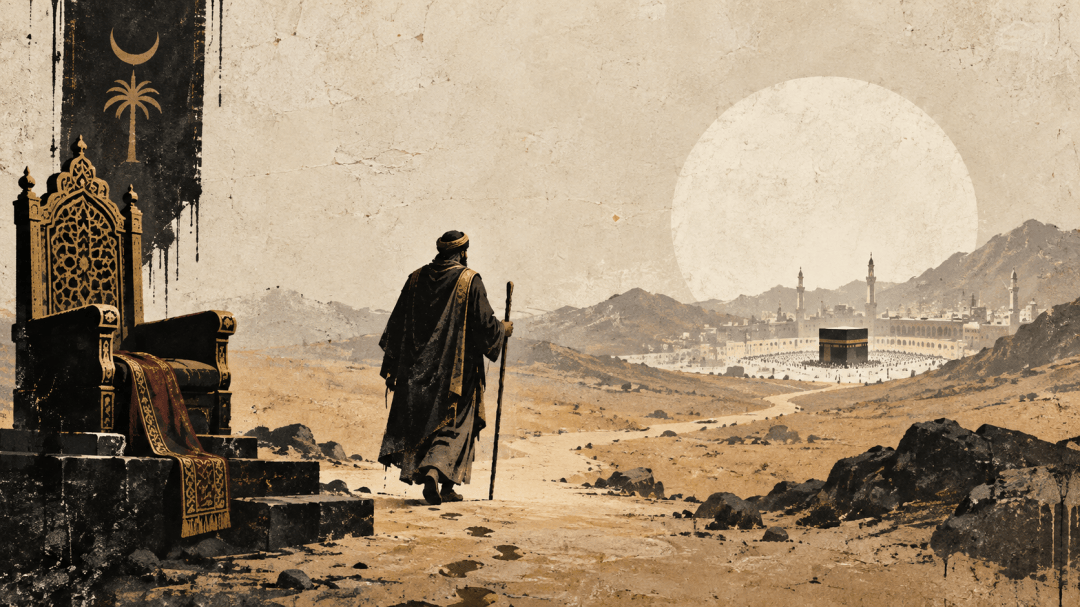
Harun al-Rashid and the Sovereign Who Stopped Going to Mecca
An interesting paradox lies buried in the long history of the caliphate. The office existed, in part, to guard the Hajj—to protect the roads to Mecca, to provision the pilgrim caravans, to keep the sanctuary open to the community. Yet across nearly thirteen centuries and half a dozen dynasties that claimed the title, the number of reigning caliphs who actually stood on the plain of Arafat as pilgrims themselves is vanishingly small, and it dwindles to nothing after a single, well-documented endpoint.
That endpoint is the Abbasid caliph Harun al-Rashid, who performed the pilgrimage in the year 802—and, so far as the historical record attests, was the last man to do so while occupying the office. Every caliph who came after him, down to the final Ottoman claimant abolished in 1924, either could not or would not make the journey. The guardianship of the pilgrimage outlived the pilgrim caliph by more than a thousand years.
A caliph who alternated war and worship
To understand why Harun’s pilgrimages matter, it helps to see how central they were to the way he governed and to the way he wished to be seen. The tenth-century historian al-Masudi, writing in The Meadows of Gold roughly a century and a half after Harun’s death, preserved a portrait that later chroniclers echoed: across his reign, the caliph either made the pilgrimage to Mecca or campaigned against the frontier enemy in almost every year. When he could not go himself, he is said to have dispatched hundreds of proxies at his own expense, and when he did go, he traveled with a retinue of scholars and their sons in tow.
Two details from that portrait deserve emphasis. First, al-Masudi records that Harun would perform the pilgrimage on foot—an austerity, the historian notes, that no caliph before him had undertaken. For the ruler of the wealthiest state on earth, a man whose Baghdad shimmers through the Thousand and One Nights, to walk the final stretches of the pilgrim road was a deliberate performance of humility, a public statement that at the sanctuary the Commander of the Faithful was a servant like any other.
Second, and more revealing still, is a detail transmitted through al-Tabari: on his frontier campaigns Harun wore a cap inscribed with the words Ghazi Hajj—”warrior and pilgrim.” The two words fused the twin ideals by which he wanted his reign measured. Jihad on the Byzantine frontier and Hajj to Mecca were, in his self-presentation, a single rhythm of legitimacy, one turned outward toward the empire’s edge and the other inward toward its spiritual center. He would raid the Anatolian marches one year and walk to the Kaaba the next, and the alternation itself was the message.
There is a story, probably embellished in the retelling but instructive all the same, in which Harun’s officers clear the space around the Kaaba so that the caliph may circumambulate undisturbed, and a Bedouin pushes past them anyway. Rebuked, the man answers that God has made ruler and ruled equal in that place, and quotes the Quranic verse declaring the Sacred Mosque open equally to the resident and the visitor. Harun, chastened, orders the man left alone. Whatever its historical core, the anecdote survived because it captured something real about what the pilgrimage did to the office: at Mecca, however briefly, the machinery of sovereignty was supposed to fall silent.
The pilgrimage of 802
Harun’s final pilgrimage was also his most consequential, and it fixed a political disaster in the most sacred setting available to him.
By 802 the caliph had resolved to settle the succession among his sons in advance, hoping to forestall the fratricidal struggles that had shadowed earlier transfers of power. During the pilgrimage of that year—an event sometimes dated to the turn into early 803 in the Western calendar—he assembled his heirs and the leading men of the state at the Great Mosque in Mecca and had them commit to an elaborate settlement. His eldest son, al-Amin, would inherit the caliphate and the empire’s western heartland; his second son, al-Ma’mun, would receive the vast eastern provinces of Khurasan and a guarantee of the succession after his brother. The terms were written into formal documents, and the brothers swore before the Kaaba to uphold them. The arrangement is remembered as the Mecca settlement.
The oaths did not hold. Within a few years of Harun’s death in 809, al-Amin and al-Ma’mun were at war, and the conflict—the so-called Fourth Fitna—gutted the caliphate’s cohesion. Baghdad was besieged, al-Amin was killed, and the centralized authority that Harun had brought to its height never fully recovered. The pilgrimage of 802 thus stands at a hinge: the last time a reigning caliph performed the rite, and the occasion on which he unknowingly set in motion the unraveling of the very power that had let him perform it.
After 802, Harun did not return. His last years were consumed by rebellion in the east, and he died at Tus, far from Mecca, in 809. When the annual pilgrimage needed a leader in those closing years, he sent a deputy—a member of the Abbasid house named al-Abbas ibn Musa led the Hajj in 805—rather than going in person. The pattern that would define the next thousand years had already begun: the caliph as sponsor and protector of the pilgrimage, no longer as participant in it.
Why the tradition died with him
The disappearance of the pilgrim caliph was not a matter of declining individual piety. It was structural, and it followed directly from what happened to the office after Harun.
The caliphate that Harun commanded was mobile, wealthy, and genuinely his own. He could leave his capital for months, cross the desert with an army and a court, and return to a throne that was still waiting for him. That freedom did not survive the ninth century. His grandson’s generation introduced a standing corps of Turkish military slaves whose commanders soon became the real power in the state; within decades caliphs were being enthroned and murdered at the pleasure of their own guard. By the tenth century Baghdad’s caliphs were pensioners of the Buyid dynasty (934–1062), which directly controlled Baghdad from 945 to 1055, and later of the Seljuks (c. 1037–1194), who entered Baghdad in 1055 and reduced the Abbasid caliph to largely nominal political authority. A ruler who cannot safely spend a night outside his palace cannot spend a season on the pilgrim road. The Hajj requires an absence measured in months, and absence had become the one luxury a later caliph could not afford.
The rival dynasties that claimed the title fared no better on this particular count. The Fatimids (909–1171), the Ismaili Shia caliphs who ruled from Cairo and for a time controlled the Hijaz itself, are not recorded as having performed the pilgrimage in person; their later caliphs were largely captives of their own viziers, boys enthroned and managed by strongmen. The Umayyad caliphs of Córdoba (929–1031) and the Almohad caliphs of the Maghrib (1121–1269) sat at the far western edge of the Islamic world, an ocean of desert and sea away from Mecca. And the shadow-caliphs of the Abbasid line who survived in Mamluk Cairo (1250–1517) after Baghdad’s fall in 1258 were ceremonial figures kept for the legitimacy their name conferred, with neither the power nor the independence to undertake anything so grand.
The guardians who never went
The sharpest form of the paradox belongs to the Ottomans, and it is worth dwelling on because it makes the pattern impossible to dismiss as accident.
After Selim I defeated the Mamluks and took control of Mecca and Medina in 1517, the Ottoman sultans adopted the title Khadim al-Haramayn—Servant, or Custodian, of the Two Holy Mosques. The claim to the caliphate rested heavily on that guardianship. Ottoman apologists had to work around the classical requirement that the caliph descend from the Prophet’s tribe; their answer was that the caliphate belonged to whoever was strong enough to defend the faith and its sanctuaries, and control of the pilgrimage cities was the physical proof of that strength. The sultan poured resources into the Hajj—the annual caravans, the surre processions of gifts sent to the holy cities, the upkeep of the mosques.
And yet, across four centuries of that custodianship, not one reigning Ottoman sultan ever performed the Hajj. They protected the pilgrimage, financed it, and drew their deepest legitimacy from it, without ever joining it. Some sent locks of their hair to be interred near the Prophet’s tomb in lieu of their persons. The obligation the sultans imposed on every Muslim of means, they discharged by proxy.
The reasons were the same ones that had grounded the later Abbasids, now hardened into fixed doctrine. A sultan absent for the better part of a year risked returning to find another man on his throne; the sixteenth-century fear of dethronement ran so deep that some sultans hesitated even to attend the nearest Friday prayers. The senior religious authorities reinforced the constraint, holding that the state could not be left, in effect, headless while its ruler crossed Arabia. The custodianship of the sanctuary had become a reason to stay home rather than a reason to go.
The one Ottoman who seems to have seriously intended the pilgrimage supplies the cautionary tale that fixed the taboo. The young sultan Osman II announced in 1622 a plan to make the Hajj—an announcement widely read as a pretext to travel into Anatolia and Syria and raise a new army to break the power of the Janissary corps. The Janissaries understood the threat, rose against him, and had him deposed and killed. His fate became the standard illustration, cited for generations afterward, of why a sitting sovereign did not undertake the journey. The pilgrimage that had once been the crowning act of a caliph’s piety had become, for his distant successors, a fatal ambition.
What the silence means
Read across the whole span, the record tells a story less about religion than about the transformation of a kind of power.
Harun al-Rashid could walk to Mecca because he was, in a full and personal sense, the sovereign—his authority moved with his body, and the state followed where he went. The caliphs and sultans who came after him could not, because the office had detached from the person who held it. Real power migrated to viziers, to slave-soldier commanders, to sultans who kept a caliph as an ornament, and finally to a court apparatus that needed its sovereign physically present as a hostage to his own throne. The more the caliphate became a symbol to be guarded, the less its holder could act as a free man—and the Hajj, which demands precisely the freedom to disappear from the center for a while, fell out of reach.
So for over a thousand years after Harun al-Rashid’s pilgrimage of 802, the men who called themselves Commander of the Faithful and Servant of the Two Holy Mosques presided over the greatest gathering in the Muslim world without ever walking into it. The office that had been built, among other things, to lead the pilgrimage ended its history having spent most of that history watching it from a distance.


