
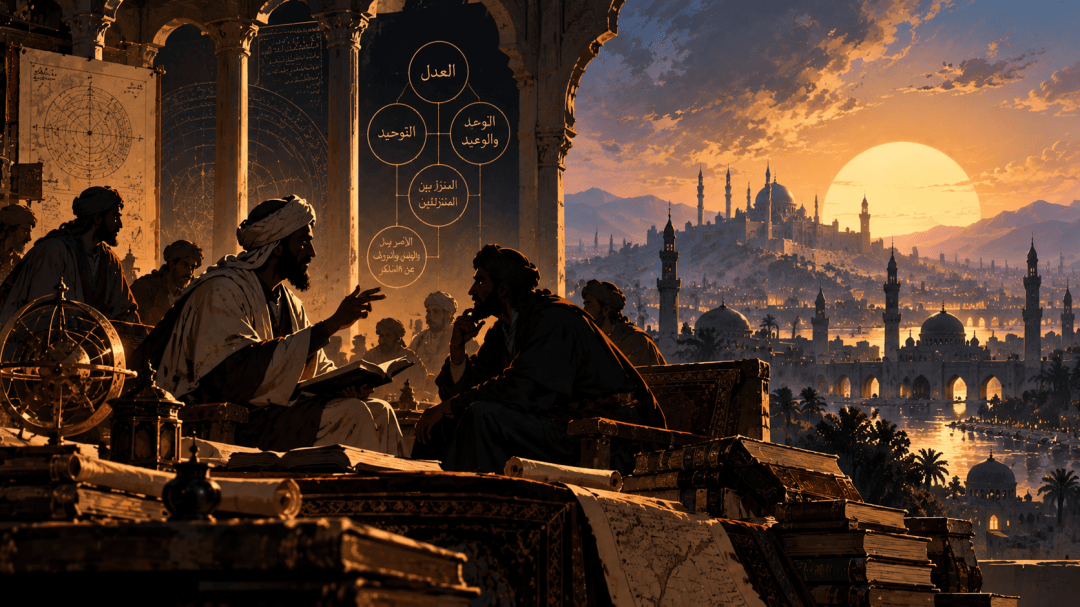
When the Prophet Muhammad died in 632, the Muslim community numbered in the tens of thousands and lived mostly in western Arabia. Within about a century, it ruled a territory stretching from Spain to the borders of India. The man who held supreme authority over this empire was called the caliph, an Arabic word meaning “successor,” meaning successor to Muhammad as leader of the community. The first four caliphs were close companions or relatives of the Prophet. After the fourth, ʿAlī ibn Abī Ṭālib, the office passed to a dynasty: the Umayyads, a powerful Meccan clan who ruled from Damascus from 661 to 750.
That rapid expansion created a problem no one had planned for. Muslims now governed millions of people who had other religions and other intellectual traditions: Christians trained in Greek logic, Jews with their own legal and theological schools, Zoroastrians, Buddhists, and philosophers of various kinds. These neighbors asked pointed questions. Is God one or many? If God controls everything, how can He justly punish people for sins He caused? Does God have a body, since the Quran speaks of His hand, His face, and His sitting on a throne? Muslims needed answers that could survive a debate, and they needed them while arguing with each other about something even more urgent: who had the right to rule.
The Muʿtazila are the best-known group of Muslim thinkers who tried to settle these questions by argument. Their answer, in short, was that God is perfectly just and perfectly one, that human reason can verify this, and that revelation and reason never truly contradict each other. That position made them heroes to some and heretics to others, and for about thirty years in the ninth century it made them the intellectual arm of an imperial government. The dilemma they faced was how far reason can go in explaining a God who revealed Himself in a book. Their history is the story of how they answered, who they convinced, who they alienated, and how their school finally faded from the Sunni world while surviving in odd corners of the Shiʿite one.
A word on sources before the story begins. Most Muʿtazilite writings from the first two centuries are lost. What survives is mostly fragments quoted by later authors, and many of those authors were opponents. Much of this history therefore rests on reconstruction, and some of its best-known episodes, including the story of how the school got its name, are doubted by modern historians. The discussion below flags those places.
The Fault Lines: Civil War, Sin, and Free Will
The first Muʿtazilite arguments grew out of a civil war. In 656 the third caliph, ʿUthmān, was murdered by rebels. His clansman Muʿāwiya, who governed Syria from Damascus, demanded that ʿAlī, the new caliph, punish the killers. ʿAlī and Muʿāwiya agreed to submit the dispute to arbitration, and the arbiters ruled in Muʿāwiya’s favor. A faction of ʿAlī’s own supporters were furious that he had agreed to arbitrate at all, since they believed it meant letting men decide what only God could decide. They walked out on him and became known as the Khawārij, “the seceders” or Kharijites. ʿAlī’s remaining partisans were called the Shiʿa, the “party” of ʿAlī, and they became the root of Shiʿite Islam, as distinct from the Sunni majority.
The Kharijites drew a harsh conclusion: faith shows itself in actions, and a Muslim who commits a grave sin, such as murder or adultery, has left the community and is no longer a believer. Many other Muslims recoiled from this. They argued that only God can judge what is in a person’s heart, so the community should postpone (the Arabic is irjāʾ) judgment about the sinner’s status and accept anyone who professes Islam. These were the Murjiʾa. The question mattered politically because the Umayyad rulers were accused of grave sins by their critics. Was the caliph still a Muslim, and was it still lawful to obey him?
A second quarrel concerned free will. The Umayyads, in effect, taught that whatever happens, including their own rule, happens by God’s decree. Their opponents answered that this makes God the author of tyranny and injustice. Those who defended human freedom were called the Qadariyya, from qadar, meaning power or capacity, because they said humans have the capacity to choose their own acts. Their opponents, the Jabriyya or Mujbira, said that all human action is rooted in God’s decree. One of the earliest voices on the freedom side was the pious and ascetic preacher al-Ḥasan al-Baṣrī (d. 728), who lived in Basra, the garrison city in southern Iraq that was then one of the main intellectual centers of the empire. In a famous letter to the caliph ʿAbd al-Malik (r. 685–705), al-Ḥasan argued from the Quran that humans are created free and are morally responsible for what they do. Historians have noted that this was theology with a political edge: if human beings are responsible for their acts, then the injustices of the state belong to the rulers, not to God.
Origins in Basra: Wāṣil and ʿAmr
Islamic tradition places the birth of the Muʿtazila in al-Ḥasan al-Baṣrī’s teaching circle. The story goes that someone asked al-Ḥasan whether a grave sinner should be called a believer or an unbeliever. While al-Ḥasan hesitated, a student named Wāṣil ibn ʿAṭāʾ (d. 748) spoke up and said the sinner is neither, but occupies an “intermediate position between the two positions” (al-manzila bayn al-manzilatayn). Wāṣil then withdrew from the circle, and other students followed, including ʿAmr ibn ʿUbayd (d. 762). The name Muʿtazila is said to come from this withdrawal (iʿtazala), so it means roughly “those who withdrew” or “the separatists.”
Many historians doubt the story. The British historian W. Montgomery Watt, whose work on early Islamic thought remains standard, regarded the derivation of the name from al-Ḥasan’s circle as fictional, and he thought ʿAmr was better known in his own time than Wāṣil. There are other explanations of the name, and it may have first been applied by outsiders. What is solid is this: Wāṣil and ʿAmr were real figures active in Basra in the last decades of Umayyad rule, both were mawālī (singular mawlā), meaning non-Arab converts attached as “clients” to an Arab tribe, and both took positions on sin, justice, and free will that later Muʿtazilites claimed as their own. Both men also belonged to the milieu of critics who found Umayyad claims of divine sanction for their rule unconvincing. It is worth noting that being a mawlā in this period meant being a second-class member of a society dominated by Arab elites, which may help explain the attraction of an outlook that put reason and moral responsibility, rather than lineage or tribal power, at the center.
The next link in the chain is Ḍirār ibn ʿAmr (d. around 815), who lived in the early Abbasid period and may or may not have studied under Wāṣil. Ḍirār was a rationalist who gave reason a role in understanding divine truth, but he was an independent thinker who actually sided with the determinists on free will, which may be why later Muʿtazilite biographers mention him so little. He was also accused of zandaqa, a charge of irreligion that could carry the death penalty, though the accusation did not stick. In his time, in other words, the Muʿtazilite school had not yet taken a definite shape.
The Five Principles
By the early ninth century the Muʿtazilites were organizing their teaching around five “fundamentals” (al-uṣūl al-khamsa), and a treatise on the five is attributed to the Basran thinker Abū l-Hudhayl al-ʿAllāf, who is in many ways the real founder of the school in its formal shape. The five are worth stating plainly, because everything else in this history revolves around them.
The first is divine unity (tawḥīd). God is absolutely one and absolutely unlike His creation. He has no body, no location, and cannot be seen, so verses that speak of His hand, His face, or His sitting on a throne must be read as figures of speech. The Muʿtazilites went further and argued that God’s attributes, such as knowledge and power, cannot be separate eternal things alongside God, because that would mean more than one eternal being. Wāṣil is reported to have said that whoever calls an attribute eternal has posited two gods. They applied the same logic to the Quran: if God’s speech is an eternal thing separate from God, there are two eternals, so the Quran as a book must have been created in time. This claim would soon become the center of a political crisis.
The second is divine justice (ʿadl). God never does evil and never commands it. He does not create human wrongdoing, then punish people for it. Human beings create their own acts and are responsible for them. The Muʿtazilites also held that good and evil can be known by reason, so that God’s commands are just because they are good, not good merely because God commanded them. This is the old philosophical puzzle Plato posed in the Euthyphro about whether the gods love what is holy because it is holy or whether it is holy because the gods love it. The Muʿtazilites came down on the first side.
The third is the promise and the threat (al-waʿd wa-l-waʿīd). God has promised paradise to the obedient and hell to the unrepentant, and He will keep His word. Nobody escapes judgment by relying on a vague hope of divine leniency. The fourth is the intermediate position already mentioned: a grave sinner who has not repented is neither a full believer nor an unbeliever, and has a distinct status in this world, though in the next he is condemned. The fifth is commanding the good and prohibiting evil, the duty of every Muslim to take active responsibility for the moral life of the community.
Scholars disagree about which of these came first. The German-Australian historian Wilferd Madelung argued that justice was the most urgently debated issue in the earliest period, because it was bound up with the Qadarite attack on Umayyad rule, and that divine unity, which now sits first on the list, was historically the last to take shape. Early figures such as Jahm ibn Ṣafwān (d. 745) used the doctrine of absolute divine unity as a weapon against Buddhists and others, and also against Muslims who took the Quran’s language about God’s body literally.
The Abbasid Revolution and the Two Schools
In 750, a revolution overthrew the Umayyads. The victors were the Abbasids, a family descended from the Prophet’s uncle ʿAbbās, who claimed a closer connection to the Prophet than the Umayyads had. They moved the center of the empire from Syria to Iraq, and in 762 the caliph al-Manṣūr founded a new capital, Baghdad, on the Tigris. The Abbasids ruled as nominal heads of the Muslim world until the Mongols destroyed Baghdad in 1258, though as we will see, in practice their real power was far shorter-lived.
The new capital brought scholars, translators, poets, and debaters together under the patronage of the court. The Abbasid age is when Greek philosophy and science were translated into Arabic on a large scale, and when the practice of kalām matured. Kalām is an Arabic word meaning “speech” or “disputation,” and it names the discipline of defending religious doctrine by reasoned argument. Its practitioners were the mutakallimūn. The Muʿtazilites were the first major school of them, and for much of the ninth century they set the terms of the debate.
By the end of the eighth century, the Muʿtazila had split into two main branches, one in Basra and one in Baghdad. Basra was the older and more prestigious, home to Abū l-Hudhayl, and its thinkers tended toward the Sunni majority view on the question of who should lead the community after Muhammad. The Baghdad branch, led by the poet and theologian Bishr ibn al-Muʿtamir, was closer to the Abbasid court and leaned toward ʿAlī in political reflection on the first civil war. The two schools wrote refutations of each other. Bishr, for example, attacked the views of Abū l-Hudhayl, and later Muʿtazilite authors would spend centuries cataloging the disagreements between the branches. Other important figures of this period include the Basran Ibrāhīm al-Naẓẓām, who developed an unusual doctrine that the Quran’s inimitability lay in God deflecting the Arabs from producing anything like it rather than in the text’s own qualities, and the great Arabic prose writer al-Jāḥiẓ (d. 868 or 869), who was a literary champion of the school.
It matters that the Muʿtazila were never a single church with a creed. The Basrans and Baghdadis disagreed on matters of substance, such as how much religious knowledge is immediate and intuitive versus reached by inference, and the individual thinkers within each branch disagreed with each other. They also were a school of theology, not of law. Most Muʿtazilites followed the Ḥanafī school of Islamic jurisprudence, which gave considerable weight to the judge’s own reasoned opinion, but some, like the later ʿAbd al-Jabbār, were Shāfiʿī jurists, and the Ḥanafī school also had many members who opposed Muʿtazilite theology. Law and theology were separate affiliations in this period, and they did not always line up.
The Miḥna: A Theology Backed by the State
The Muʿtazilite moment of greatest power, and the episode that most shaped their reputation, was the inquisition known as the miḥna, meaning “trial” or “examination.”
The caliph al-Maʾmūn (r. 813–833) was a fascinated patron of learning and a man with strong theological opinions that he intended to apply to government. He had come to power after a civil war against his own brother. Early in his reign, he named as his heir ʿAlī al-Riḍā, the eighth Imam of the Shiʿa, a descendant of ʿAlī. The Imam died not long afterward, and the broader public resistance to giving power to the Shiʿa put an end to the plan, but it shows how far al-Maʾmūn was willing to go. The Baghdad Muʿtazilites, such as Bishr, supported his ideas.
In 833, a few months before his death, al-Maʾmūn instructed his governor in Baghdad to examine the state-appointed judges (qāḍīs) and require them to publicly affirm the Muʿtazilite doctrine that the Quran, as God’s speech, was created (khalq al-Qurʾān). The test was a single question about the Quran, and those who gave the wrong answer risked their positions or worse. The policy was continued by his successors al-Muʿtaṣim (r. 833–842) and al-Wāthiq (r. 842–847). Most scholars gave in, at least outwardly. A few did not. The most famous was Aḥmad ibn Ḥanbal (d. 855), the spiritual leader of the “People of Hadith” (ahl al-ḥadīth), the scholars who built their authority on collecting and transmitting the reported sayings and deeds of the Prophet. Ibn Ḥanbal and the traditionalists argued that the Quran was the uncreated speech of God and that speculating beyond what the texts say was dangerous. He was imprisoned and, according to the tradition, beaten, and he became a folk hero for refusing to yield.
The Muʿtazilites wanted to protect God’s absolute unity, and asked why they should accept the idea of an eternal book alongside an eternal God. That was a sincere theological argument. But a doctrine enforced by a test of loyalty at the court was a different thing from a doctrine argued in a debate. The miḥna turned the Muʿtazila into associates of state coercion, and the traditionalists into defenders of the common believer against an elite.
The reversal came under al-Mutawakkil, who took power in 847 and ended the examination within a few years. Historians give dates between about 848 and 851. The Muʿtazila, especially in Baghdad, fell out of favor and became the object of popular resentment. Madelung has argued, based on a surviving letter from Ibn Ḥanbal to al-Maʾmūn, that the traditionalist dogma of an eternal, uncreated Quran was itself hammered out in response to the inquisition, and that Ibn Ḥanbal’s personal authority did more than anyone’s to make it the settled belief of the great majority of Sunnis.
The Classical Age: Systematization Under Pressure
In the later ninth and tenth centuries, the Muʿtazilites were attacked from two directions. Traditionalists on the right rejected the whole enterprise of rational theology. On the left stood philosophers, non-Muslim thinkers, and freethinkers such as Ibn al-Rāwandī (d. around 910), who attacked prophecy and scripture and was accused of atheism. The Muʿtazilites responded by systematizing, and this is when their doctrines were refined into the textbook form that survives.
On the Baghdad side, the key figure was Abū l-Qāsim al-Balkhī (d. 929), who taught in Baghdad and then in Khurasan and Transoxiana, the northeastern lands of the empire in what is now Iran, Afghanistan, and Central Asia, where he trained a generation. On the Basran side, the school’s classical age was established by a father and son known as “the Two Masters”: Abū ʿAlī al-Jubbāʾī (d. 915) and his son Abū Hāshim (d. 933). Later Basran writers cite them first on nearly every topic, and followers of Abū Hāshim’s line were known as the Bahshamiyya. A quarrel between Abū Hāshim and his father’s loyal students became so heated that one of them accused him of unbelief.
It was in the circle of al-Jubbāʾī that the school’s most consequential defection occurred. Abū l-Ḥasan al-Ashʿarī (d. 935) studied under al-Jubbāʾī in Basra and remained among his senior pupils into mature adulthood. Then he left to found a rival school of kalām, which took his name, the Ashʿariyya. The famous story is that he and his teacher quarreled over free will, but the reasons are “buried in incongruous legends.” A more recent view is that al-Ashʿarī concluded that Muʿtazilite doctrine as a whole, including the created Quran, was contrary to Islam as interpreted by scholars like Ibn Ḥanbal. What he built was a middle path: he kept the rational tools of kalām but turned them to the defense of the traditionalist positions on an eternal Quran, God’s total power over His creatures, and the narrow limits of human reason in knowing God’s will. On free will, he proposed that humans “acquire” (kasb) their acts from God at the moment of acting, preserving divine omnipotence while giving humans some role. A contemporary in Central Asia, Abū Manṣūr al-Māturīdī (d. 944), founded a similar school, the Māturīdiyya, that became influential among Ḥanafī jurists on the northeastern frontier. These two schools together became the main theological identity of Sunni Islam.
The Buyids and ʿAbd al-Jabbār
Politics changed radically in the tenth century. The Abbasid caliphs lost real control of most of their territory. In 945, a family of Shiʿite military commanders from the mountainous region of Daylam, the Buyids (Buwayhids), took Baghdad and held the caliph, a Sunni, as a figurehead until 1055. The Abbasid line continued in name. Meanwhile, a rival Shiʿite caliphate, the Fatimids, was founded in North Africa in 909 and moved to Egypt in 969. And in 941, according to Twelver Shiʿite belief, the twelfth Imam went into complete “occultation,” leaving the community without a living Imam to guide it. Twelver Shiʿite scholars now had to build doctrine through argument, and many found the Muʿtazilites congenial allies, so much so that the Twelvers and the Zaydīs, another Shiʿite branch, adopted Muʿtazilite theology in large part.
The Buyid courts and viziers became patrons of the learned, and Iran and Khurasan became centers of kalām debate. A pupil of Abū Hāshim, Abū ʿAbdallāh al-Baṣrī (d. 977), led the Basran school from Baghdad. And his student, Qāḍī ʿAbd al-Jabbār, became its last great teacher.
ʿAbd al-Jabbār ibn Aḥmad al-Hamadhānī was born around 932 to 937, of Persian peasant stock, in the village of Asadābād in western Iran. He began as a student of Hadith and Shāfiʿī law, made the pilgrimage to Mecca twice, studied in Basra and then in Baghdad, and started dictating his monumental summary of Muʿtazilite theology, al-Mughnī (“The Book That Suffices”), around 970. The Buyid vizier al-Ṣāḥib ibn ʿAbbād, a literary connoisseur famous for his evening gatherings of poets and intellectuals of every sect, invited him to the city of Rayy, near modern Tehran, and in 977 appointed him chief judge (qāḍī al-quḍāt) of the surrounding region, later extending his jurisdiction to provinces in the east. The Mughnī ran to twenty volumes, and defends divine unity, justice, and the rest of the five principles with a thoroughness no earlier writer had matched.
His fortunes depended on his patron. When Ibn ʿAbbād died in 995, ʿAbd al-Jabbār lost his post, and reportedly his books were confiscated, perhaps because he refused to pray over the body of the worldly vizier. He kept teaching in Rayy and died there in 1024. His students included Sunnis and Shiʿites, among them the Twelver leader al-Sharīf al-Murtaḍā (d. 1044), with whom he disagreed on the Quran’s miraculous nature, and the Zaydī Imam al-Muʾayyad Billāh (d. 1020). In the mourning procession at his funeral, Shiʿite dignitaries took the front row and his own Sunni pupils stood behind them, which says something about who his real constituency had become.
The Fall of the Buyids and the Eclipse of the School
ʿAbd al-Jabbār died about thirty years before the political world that had sheltered him ended. The destruction came in stages. In 1029 Maḥmūd of Ghazna, a Sunni Turkish ruler in what is now Afghanistan, took Rayy from the Buyids, expelled Shiʿites and Muʿtazilites, and confiscated and burned their books. The Seljuqs, another Sunni Turkish dynasty, defeated the Ghaznavids and took Rayy in 1042. In 1055, their leader Ṭughril Beg entered Baghdad and ended Buyid control of the caliphate. Sunni rule was restored across the heartlands, and the new regime backed the Ashʿarī school.
The shift was not only dynastic. In the mid-eleventh century, a communal conflict broke out in Nishapur, a major city in Khurasan, in which the Ḥanafī and Muʿtazilite elite, with the sanction of a Seljuq vizier, persecuted Shāfiʿī and Ashʿarī families. That is a useful reminder that the Muʿtazilites were not only victims. When they held power, they too persecuted. But the days when Muʿtazilite elites could oppress their rivals were ending. The eleventh century was also when Sunni Islam acquired the institutions that would carry it for centuries, above all the madrasas, endowed colleges of law. Ashʿarism became the working theology of many of them, and a century after ʿAbd al-Jabbār, the great theologian al-Ghazālī (d. 1111) wrote works that were copied and studied across the Muslim world.
The Muʿtazilites did not vanish at once. Sunni Muʿtazilites went on teaching and commenting on the classical works of the Two Masters, al-Balkhī, and ʿAbd al-Jabbār for at least two more centuries. ʿAbd al-Jabbār’s students Abū Rashīd al-Nīsābūrī and Ibn Mattawayh wrote commentaries, and another pupil, Abū l-Ḥusayn al-Baṣrī (d. 1044), took a more philosophical approach that some Bahshamiyya found excessive, so that by the late twelfth century the school itself had two competing branches. The Quran commentator al-Zamakhsharī (d. 1144), whose al-Kashshāf is still among the classic commentaries read across the Muslim world, was a Muʿtazilite from Khwarazm, a region south of the Aral Sea. His Sunni rival Fakhr al-Dīn al-Rāzī complained that Muʿtazilite debaters in Khwarazm drove him out of the region, and the school appears to have persisted there for another three centuries, though little is said of it elsewhere.
The better-documented afterlife was among the Zaydīs. The Zaydīs are a branch of Shiʿite Islam named for Zayd ibn ʿAlī (d. 740), a great-grandson of ʿAlī who led a failed revolt against the Umayyads and who, in Zaydī tradition, studied with Wāṣil. They are politically activist but theologically moderate, and they eventually took up Muʿtazilite theology, especially the Bahshamī line. They settled in the mountains south of the Caspian Sea and, from 898, in northern Yemen. In the twelfth century, the Zaydī Imam al-Mutawakkil ʿalā llāh (proclaimed 1137, d. 1160) made Yemen a stronghold of Muʿtazilite learning. His scholars traveled to Iraq and Iran around 1150, returned with a large number of books by 1159, and organized a campaign to refute a rival Zaydī conservative movement. Zaydī Muʿtazilism lasted in the Caspian region until the rise of the Safavid dynasty in Iran in the sixteenth century, and in northern Yemen into the twentieth.
What happened in 1258 deserves care. The Mongol sack of Baghdad ended the Abbasid caliphate and destroyed a good deal of the city’s intellectual infrastructure, and it is common to read it as the moment the Muʿtazila died. The historical record does not support so tidy a story. By the end of the Abbasid age, the school had already stopped being an intellectual force in the main centers of Muslim learning. It survived in small and remote outposts afterwards, and it was not the Mongols but the long process of institutional change in the eleventh and twelfth centuries, combined with Sunni political patronage of Ashʿarism and Māturīdism, that pushed it to the margins. In the following century, the Hanbalī reformer Ibn Taymiyya (d. 1328) attacked the entire enterprise of Greek-influenced kalām, including the Ashʿarī version, which shows that the traditionalist current the Muʿtazila had provoked never went away.
Rediscovery
The Muʿtazila owe much of their modern fame to a lucky find. Medieval Muʿtazilite writings, copied and kept by the Zaydī communities in Yemen, sat largely unread in mosque and private collections in Ṣanʿāʾ. In 1950, a team of Egyptian scholars, sent by the Minister of Education, the writer Ṭāhā Ḥusayn, traveled to Yemen and microfilmed what they found, including six of the twenty volumes of ʿAbd al-Jabbār’s al-Mughnī. More volumes surfaced in the following years, and the Egyptian Ministry of Culture published the surviving volumes between 1960 and 1969. Until then, historians had known the school mainly through its enemies. Now, for the first time in centuries, they could read a leading Muʿtazilite in his own words.
The rediscovery coincided with a wider modern argument about whether Islam can accommodate rationalism. In the nineteenth century, reformers such as the Egyptian scholar Muḥammad ʿAbduh (d. 1905–6) argued that Muslims had fallen into blind imitation and that Islam should be reconciled with modern science and reason. ʿAbduh was accused by opponents of favoring Muʿtazilism over the Ashʿarī doctrine of his own school, and he answered that he was giving up blind acceptance of tradition. In the late twentieth century, the Indonesian scholar Harun Nasution wrote a popular account of Muʿtazilite thought that became a symbol of modernist theology in Southeast Asia. Today the word “Muʿtazilite” is used in many Muslim countries both as an insult and as a badge of honor, usually with only loose connection to the historical school.
What We Can and Cannot Say
Reduced to its main outline, the history is this. The Muʿtazila began in Iraq in the final decades of Umayyad rule, in debates over sin, human freedom, and divine justice that were never separate from the politics of who deserved to rule. The founding story, in which Wāṣil withdraws from al-Ḥasan al-Baṣrī’s circle, is traditional and probably embellished. In the Abbasid age they divided into Basran and Baghdadi schools, rose to power through the patronage of al-Maʾmūn, and overreached with the miḥna, which gave their traditionalist enemies a martyr in Ibn Ḥanbal. They survived the loss of caliphal favor and entered a creative classical age, produced the great synthesis of ʿAbd al-Jabbār under Shiʿite Buyid protection, and then lost their institutional base when Sunni Turkish dynasties restored the caliphate’s authority and backed Ashʿarī theology. After that, they lived on in Khwarazm for a time and in Zaydī Shiʿite communities for centuries, preserved in manuscripts until twentieth-century scholars brought them back into view.
Three cautions apply. The school’s early history rests on fragments and hostile reports. Its internal diversity was real, so any statement beginning “the Muʿtazila believed” should be read as a generalization. And the modern use of the name often tells us more about the present than the past.
Principal source: Richard C. Martin and Mark R. Woodward, with Dwi S. Atmaja, Defenders of Reason in Islam: Muʿtazilism from Medieval School to Modern Symbol (Oxford: Oneworld, 1997), especially chapter 2, supplemented by standard background on early Islamic political history.


