More than a thousand years and an ocean of language separate the Roman lawyer Cicero from the Arabic scripture of the Quran. Yet stand them side by side and something remarkable happens: they begin to sound like two witnesses describing the same courtroom exhibit.
In the sixteenth section of the second book of his dialogue On the Laws, Cicero lays down a challenge that is at once philosophical and almost indignant. How, he asks, can anyone be arrogant enough to grant himself reason and intelligence while denying it to the heavens? How can the vast machinery of the sky be thought to run with no mind behind it? And what are we to make of a person who watches the stars wheel overhead, the day give way to night, the seasons return on schedule, and the earth push up fruit for his table—and feels no impulse to give thanks? Such a person, Cicero says, hardly deserves to be called human.
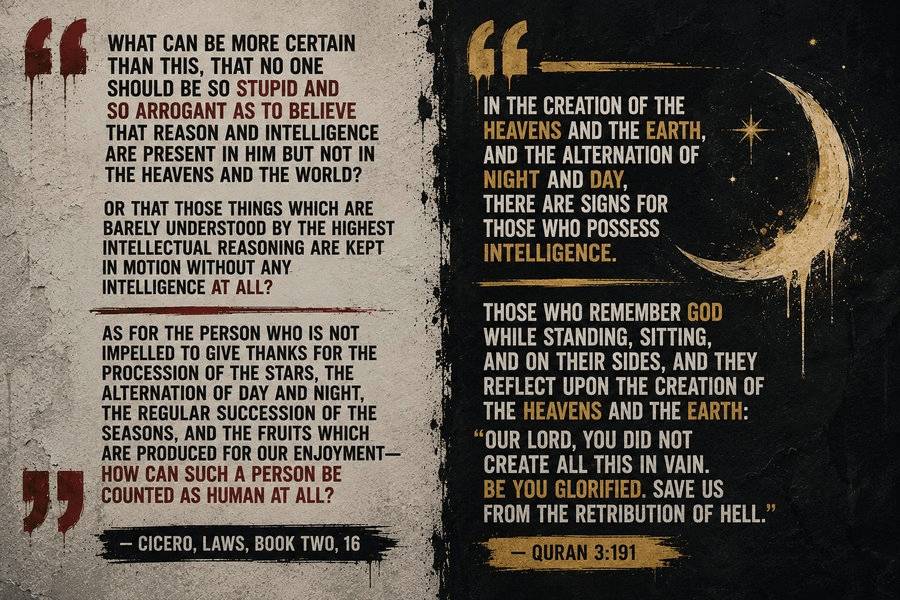
“What can be more certain than this, that no one should be so stupid and so arrogant as to believe that reason and intelligence are present in him but not in the heavens and the world? Or that those things which are barely understood by the highest intellectual reasoning are kept in motion without any intelligence at all? As for the person who is not impelled to give thanks for the procession of the stars, the alternation of day and night, the regular succession of the seasons, and the fruits which are produced for our enjoyment—how can such a person be counted as human at all?” — Cicero, Laws, Book Two, 16
This is the classical “argument from design,” the intuition that order implies an orderer. What is striking is that the Quran, which arose in a completely different world, makes the very same argument its signature. It calls the phenomena of nature ayat—signs—and returns to them again and again, not as decoration but as evidence. Where Cicero reasons like a philosopher building a case, the Quran presses the case like a prosecutor addressing a distracted jury: Will you not use your reason? Will you not reflect? The overlap is close enough, point for point, that it is worth walking through Cicero’s argument and letting the Quranic verses answer each claim in turn.
In the creation of the heavens and the earth, and the alternation of night and day, there are signs for those who possess intelligence. They remember GOD while standing, sitting, and on their sides, and they reflect upon the creation of the heavens and the earth: “Our Lord, You did not create all this in vain. Be You glorified. Save us from the retribution of Hell. (3:190-191)
Reason in the part, but not in the whole?
Cicero’s opening move is a reductio. It would be absurd, he argues, for a human being to suppose that intelligence lives inside his own small skull but is entirely absent from the immense, coordinated cosmos that produced him. The part cannot outclass the whole.
The Quran turns this same absurdity into a recurring refrain. It does not simply assert that God exists; it invites the reader to think his way there, closing dozens of passages with a variant of afala taʿqilun—”do you not then reason?” The order of the cosmos is offered as data for the intellect. “In the creation of the heavens and the earth, and in the alternation of night and day, there are signs for people of understanding” (3:190). The verse that follows describes exactly the kind of person Cicero has in mind—one who studies the sky and concludes, “Our Lord, You did not create this in vain” (3:191). The same logic drives 30:8, which asks whether people have not thought within themselves about how carefully the heavens and the earth were made. And in a passage that could serve as a caption for Cicero’s whole argument, the reader is dared to search the sky for a single flaw:
He created seven universes in layers. You do not see any imperfection in the creation by the Most Gracious. Keep looking; do you see any flaw? Look again and again; your eyes will come back stumped and conquered. (67:3-4)
A cosmos in precise motion
Cicero next refuses the idea that celestial motion could be sustained “without any intelligence at all.” The heavens do not merely move; they move with a regularity that our highest reasoning can barely follow. Motion this exact, he implies, is not the fingerprint of accident.
Here the Quran is almost technical. It describes the sun and the moon each “floating in an orbit” (21:33)—a single clause that captures the idea of bodies held on fixed paths. It elaborates in Sura 36: the sun runs toward a destination appointed for it, the moon passes through measured phases, and then comes the line that reads like a law of celestial traffic—the sun is not permitted to overtake the moon, nor does the night outrun the day; each floats in its own orbit (36:38–40).
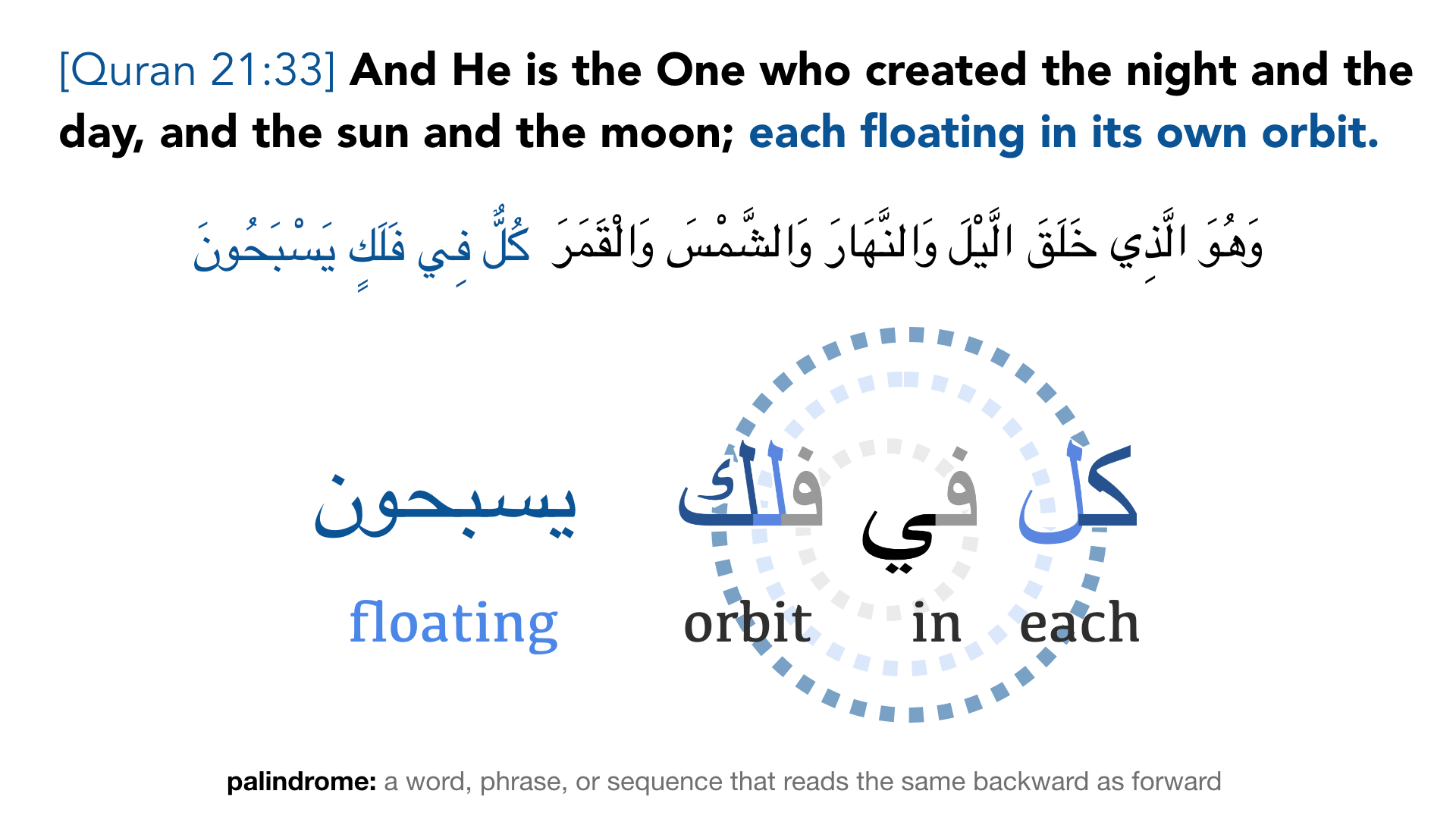
The point is precision, and the Quran names it directly: “The sun and the moon follow an exact calculation” (55:5). This precision is not confined to the sky. It is presented as the operating principle of everything: “We created all things in measure” (54:49); God “created everything and proportioned it exactly” (25:2). Even the earth is described as bringing forth all things in balanced, weighed proportion (15:19), and the heavens themselves are raised together with a mizan, a scale or balance that must not be violated (55:7).
Cicero senses an intelligence behind motions “barely understood by the highest intellectual reasoning”; the Quran gives that intelligence a vocabulary of measure, proportion, and balance.
The procession of the stars
Cicero singles out the march of the stars as a spur to wonder. The Quran treats the same celestial bodies as both marvel and utility. They are “subjected” to a divine command—the sun, the moon, and the stars all governed by His command (7:54)—and elsewhere the stars are described as set in place to guide travelers through the darkness of land and sea (6:97). What is a source of navigation for the sailor is, for the reflective mind, a source of evidence.
The alternation of day and night
Of all the natural cycles, the turning of day into night is the one both texts reach for first. For Cicero it is a self-evident wonder. For the Quran it is perhaps the single most repeated sign. It anchors the great catalog of 2:164, where the creation of the heavens and earth, the alternation of night and day, the ships that sail, the rain that revives dead land, and the winds that steer the clouds are gathered together as “signs for people who use reason.” It reappears in 10:6 and again in 45:5, each time attached to a call to think. The cycle is not random but tightly engineered:
The sun is never to catch up with the moon—the night and the day never deviate—each of them is floating in its own orbit. (36:40)
The regular succession of the seasons
Cicero’s phrase “the regular succession of the seasons” points to nature’s dependable rhythm—the reliability that lets a farmer plant in confidence. The Quran expresses this through the water cycle, its favorite image of ordered renewal. Rain is sent down on schedule, the dead earth stirs back to life, and the whole pattern is repeatedly offered “as a sign for people who reason” (45:5; cf. 30:24). One passage makes the analogy explicit: just as God revives the parched land season after season, so too will He raise the dead—”that you may take heed” (7:57). Regularity, in the Quran, is never mere routine; it is a rehearsal and a reminder.
The fruits produced for our enjoyment
Cicero ends his list of wonders on a homely, human note: the fruits that the earth produces “for our enjoyment.” The Quran also lingers on this very topic. It walks the reader through the process step by step—water from the sky, then greenery, then grain in clusters, date palms, gardens of grapes, olives, and pomegranates, “alike and yet unalike”—and then says, plainly, look at the fruit as it forms and ripens: in that are signs (6:99). The same inventory recurs in 6:141 and 16:10–11, always ending in an appeal to reflect. Sura 13 adds a detail of quiet sophistication: neighboring plots, watered by the same rain, yield different flavors—identical inputs, distinct outputs, a difference that points beyond the mechanism to a chooser (13:4).
But the Quran’s sharpest treatment of the fruit is a set of questions aimed straight at complacency. “Have you considered the seed you sow? Is it you who make it grow, or are We the grower? Have you considered the water you drink? Did you send it down from the clouds, or did We?” (56:63–70). This is Cicero’s argument stripped to its nerve. The food on the table did not manufacture itself; someone should notice, and someone should be appreciative.
The test of gratitude—and of humanity
Which brings both texts to their shared conclusion, and to their most arresting parallel. Cicero says that a person unmoved to gratitude by all this order can scarcely “be counted as human at all.” He is not merely calling such a person impolite. He is saying that to possess reason and yet fail to use it on the most obvious evidence available is to fall short of what a human being is.
The Quran issues the identical verdict, in language even more startling. Describing those who have eyes but do not see and ears but do not hear, it concludes:
We have committed to Hell multitudes of jinns and humans. They have minds with which they do not understand, eyes with which they do not see, and ears with which they do not hear. They are like animals; no, they are far worse—they are totally unaware. (7:179)
The judgment returns almost verbatim:
Do you think that most of them hear, or understand? They are just like animals; no, they are far worse. (25:44)
For both Cicero and the Quran, the failure to read the signs is not a small intellectual lapse. It is a kind of self-demotion out of the fully human.
And for both, the fitting human response is thanks. The Quran makes appreciation—shukr—a central duty and even a hinge of destiny:
Your Lord has decreed: “The more you thank Me, the more I give you.” But if you turn unappreciative, then My retribution is severe. (14:7)
It reminds the reader that the very faculties Cicero prizes were themselves gifts.
GOD brought you out of your mothers’ bellies knowing nothing, and He gave you the hearing, the eyesight, and the brains, that you may be appreciative. (16:78)
And in the invocation of Sura 55, after each blessing named, the question tolls like a bell:
Which of your Lord’s favors will you deny?
The convergence, and one honest difference
It would be too tidy to pretend the two texts are saying precisely the same thing. Cicero writes from within a Stoic tradition that tended to fold the divine into the cosmos itself, treating the ordered world as in some sense already the god. The Quran points firmly through the order to a Creator distinct from it—a personal will who measures, proportions, sends the rain, and to whom gratitude is personally owed. The difference matters. But it should not obscure how much these voices agree on, and how early and how independently they reached that agreement.
Both hold that the order of nature is legible. Both hold that the human intellect is equipped to read it, and is in fact answerable for reading it. And both hold that the natural, healthy response of a sound mind to the wheeling stars, the turning day, the returning seasons, and the ripening fruit is not indifference but appreciation. The Quran gives this intuition a name—fitra, the innate disposition on which human beings were created (30:30). Cicero has no such word, but he is describing the same thing when he says the unappreciative can barely be called human. Strip away the centuries and the languages, and a Roman senator and the divine scripture are pointing at the same sky and asking the same quiet, insistent question: You can see all this. Will you not think? And will you not give thanks?


