
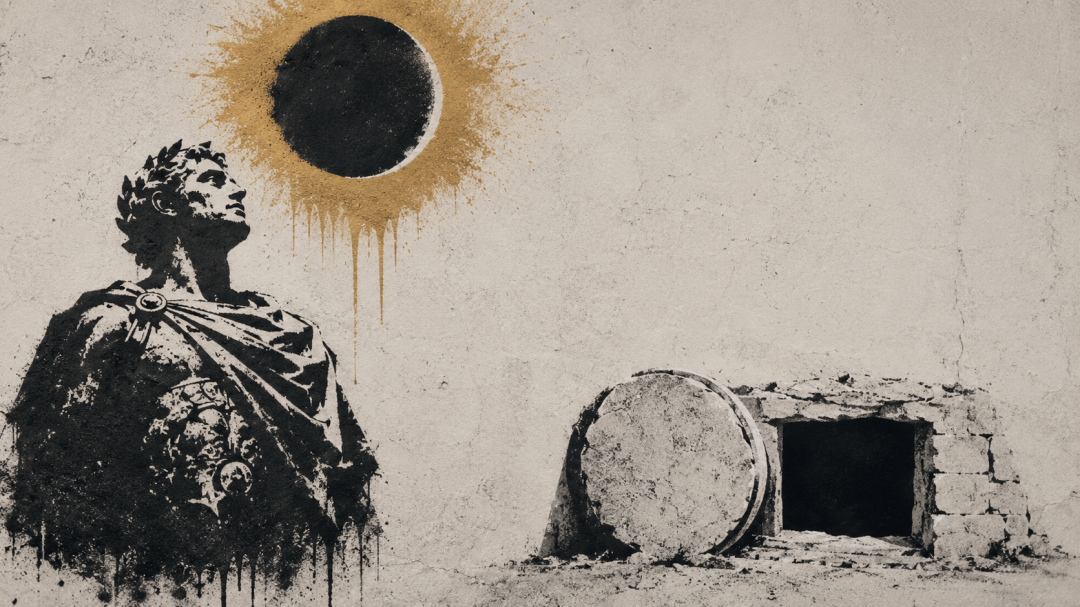
When a great man’s corpse could not be produced, the ancient Mediterranean did not conclude that it had been mislaid. It concluded that he had been taken. A body that vanished was a body that had been received among the gods, and the absence itself served as the proof. This was not a stray superstition but a settled narrative convention with recognizable parts, and the Romans and Greeks who told these stories knew the parts by heart.
Romulus and the eclipse
Cicero gives the type-case with unusual clarity. In the second book of the Republic he has Scipio recount that Romulus, after a reign of thirty-seven years, disappeared during a sudden eclipse of the sun, and that “it was assumed that he had been admitted to the company of the gods, an idea which could never have gained currency for any human being who had not possessed an outstanding reputation for valor and integrity” (Republic 2.17). The detail is doing precise work. The king does not die in bed and receive a funeral; he is subtracted from view under a darkened sun, and the darkness is the sign. Cicero then does something revealing: he marvels that the story stuck at all, given that Romulus lived in a literate, comparatively sophisticated age rather than in the credulous dawn when “the mind was prone to fabricate myths” (2.18). He is half-aware that he is describing a mechanism—the machinery by which men become gods—and he is impressed that it still ran smoothly so late.
Livy supplies the missing furniture. In his account, the king is reviewing troops at the Goat’s Marsh when a violent storm wraps him in cloud and removes him from sight; when the air clears, the throne is empty (Livy 1.16). Then comes the indispensable witness. Proculus Julius stands before the assembly and swears that Romulus descended to him from the sky, radiant and larger than life, and charged him with a message: Rome is to be the head of the world, and the king is now the god Quirinus. Livy, like Cicero, cannot resist recording the cynical alternative that circulated alongside the pious one—that the senators had torn Romulus apart with their own hands and hidden the pieces. The rumor of murder is not an embarrassment the tradition suppressed; it is a standard feature. The vanished body invites two readings, ascension or foul play, and the culture kept both on file.
The furniture of translation
Once the pattern is visible in Romulus, it is visible everywhere. Classicists call this narrative type “translation”—the bodily removal of a hero to the divine realm—and its inventory is stable across centuries.
Aeneas walks the same road. Livy reports that after a battle by the river Numicus he was nowhere to be found, and that men afterward called him Jupiter Indiges, “whether it is right to name him god or man” (Livy 1.2). Ovid makes the mechanism explicit: the river washes away everything mortal in him, and what remains is divine (Metamorphoses 14.581-608). Virgil, for his part, does not narrate the disappearance but promises it in advance, when Jupiter foretells that Aeneas will be carried up to the stars of heaven (Aeneid 1.259-260). The apotheosis is assumed; only the staging differs by author.
Heracles ends the same way. On the pyre atop Mount Oeta the mortal part of him burns off, and no bones are found in the ashes—an absence read at once as ascent to Olympus (Ovid, Metamorphoses 9.239-272; Diodorus Siculus 4.38). Aristeas of Proconnesus drops dead in a fuller’s shop, but when the owners return to fetch the body, it is gone; the man is later seen alive far away and reappears generations later (Herodotus 4.14-15). Cleomedes of Astypalaea, hunted after a killing, hides in a chest; when it is broken open, he is not inside, and the Delphic oracle pronounces him “last of the heroes” (Plutarch, Romulus 28; Pausanias 6.9). Plutarch, telling the Cleomedes story precisely to illuminate Romulus, also recalls that Alcmene’s corpse vanished from the bier on the way to burial, a stone left in its place. Even the Hebrew scriptures carried adjacent cases the Hellenistic world could read on sight: Enoch, who “was not, for God took him,” and Elijah, swept up in a chariot of fire—translated without dying at all.
The list could run longer, but the parts are already clear. The genre supplies a missing body; prodigies of darkness, storm, or earthquake to mark the moment; an ascension; a credible witness who reports the appearance and carries away a commission; a record of the man’s benefactions to justify the honor; and, very often, a skeptical counter-story of murder or fraud held in reserve. The ancients were not naive about this equipment. The philosopher Empedocles was said to have thrown himself into Etna precisely so that his disappearance would be taken for divinity—until the volcano coughed up one of his bronze sandals and exposed the trick (Diogenes Laertius 8.69). A culture that tells that joke understands the convention it is joking about.
The same grammar over Jesus
The passion and resurrection narratives are built from this same inventory, and to a gentile audience in the Eastern Empire they would have been legible on sight.
The death is marked by the standard prodigy. Darkness covers the land for three hours (Mark 15:33; Matthew 27:45); Luke specifies that the sun’s light failed, using the very verb—eklipontos—from which we get eclipse (Luke 23:45). No solar eclipse is astronomically possible at Passover, which falls at the full moon, and early Christian critics already knew it; the darkness is not a weather report but a portent, the same portent that hung over the Goat’s Marsh. Matthew stacks the prodigies higher still, adding an earthquake and tombs breaking open (27:51-53).
Then the body goes missing. The tomb is found empty, the corpse unaccounted for. As with Romulus, a rival explanation is preserved right beside the pious one: Matthew records that the authorities paid the guards to say the disciples had stolen the body while they slept (28:11-15)—the murder-and-concealment rumor in its Judean key. Witnesses see the risen figure and receive a commission to carry the news, exactly Proculus Julius’s role. And in Luke’s second volume the sequence is completed by a visible ascension into the sky (Acts 1:9-11), with two figures in white interpreting the event for the onlookers, as such figures always do.
None of this required the evangelists to invent a form. The form was to hand. What they were telling gentile readers, in the only vocabulary those readers possessed for the claim, was that this man had joined the gods.
Why the four accounts do not agree
This is also the most economical explanation for a fact that has troubled harmonizers for two thousand years: the four empty-tomb narratives cannot be reconciled in their details. Mark sends three women and has them meet one young man inside the tomb, then flee and say nothing to anyone (16:1-8). Matthew sends two women, stages an earthquake, and has a single angel address them from atop the stone. Luke has a larger group of women meet two men in dazzling clothes. John sends Mary Magdalene alone, has her find the stone already moved, and later has her meet two angels and then Jesus himself. In three accounts, the stone is already open when the women arrive; in Matthew, an angel rolls it back before them. In one version, the women stay silent; in the others, they report at once. The appearances happen in Galilee in Matthew and are confined to Jerusalem in Luke, where the risen Jesus orders the disciples not to leave the city. A guard at the tomb exists only in Matthew, because only Matthew needs to answer the theft rumor.
Defenders of the accounts read this divergence as the fingerprint of independent testimony—different witnesses noticing different things. But independent witnesses to a single event converge on its core and drift apart at the edges; here the divergence runs straight through the major elements, and every version is nonetheless assembled from the same small kit of parts. That is not what remembered events look like. It looks like a shared convention when four authors reach for it separately. Each evangelist performs the same cultural task—elevating Jesus to divine status in terms a Hellenistic reader would grasp—and each furnishes the scene with the standard equipment in his own arrangement. The agreement is at the level of genre; the contradiction is at the level of fact.
The absence as proof
Set the resurrection narratives back among their neighbors, and they stop looking anomalous. The missing body, the darkened sun, the witness with a message, the ascent, the counter-rumor of theft: this is the recognized ancient grammar of apotheosis, and Romulus models every piece of it in a text Cicero composed a generation before the Gospels. In that world an empty tomb did not raise a question demanding a supernatural answer. It supplied the answer. The body was gone because the man had been taken up—and for readers who had heard the story of Quirinus, of Aeneas, of Heracles, no further argument was needed. The absence was the proof.


