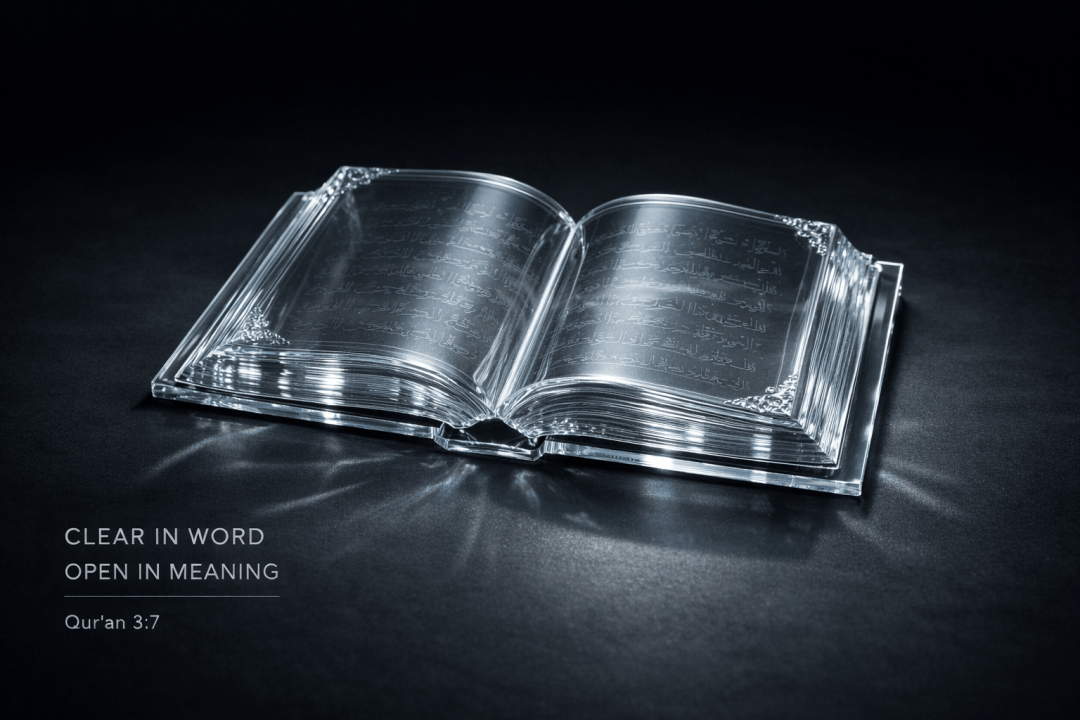
The Quran repeatedly describes itself as a clear book (kitābun mubīn): 12:1, 26:2, 27:1, 28:2, 43:2, 44:2. But clarity of expression is not the same thing as clarity of meaning. These are two distinct categories that are often collapsed, and the confusion between them has generated centuries of interpretive controversy.
Consider a simple example: someone says, “Follow me.” The words could not be plainer. But the command is carrying two entirely different meanings simultaneously. It may be a physical instruction—keep pace, come this way, don’t fall behind. Or it may be an intellectual and spiritual one—accept what I am saying, embrace this line of thinking, submit to this guidance. Same words, identical phrasing, two completely different commands. And unlike mere vagueness, both meanings are fully alive in the utterance at once. The context may resolve it, or it may not. Sometimes the speaker intends both.
The Quran operates in precisely this register. Its diction is often economical to the point of severity—a verse will arrive in crisp, unambiguous Arabic and then immediately open onto a field of interpretive questions that scholars have been navigating for fourteen centuries. This is not a defect in the text. It may, in fact, be the point. A book that forecloses all interpretation would produce readers; a book that demands interpretation produces contemplators. While the former would eliminate much controversy, the latter may be why the book has had such lasting power.
What follows is a series of examples illustrating just how deliberate the Quran can be in saying something unmistakably clear—and simultaneously open. The purpose of this article is not to adjudicate between these readings or advocate for any single interpretive lens, but simply to trace the pattern itself across a range of examples.
Straightforward vs. Multi-Meaning (3:7)
The Quran does not leave us to infer this quality from observation alone—it announces it directly. Perhaps no verse makes this more explicit than 3:7, which informs us that the text is composed of two distinct categories of verses: those that are muḥkamāt—clear, decisive, and unambiguous—described as the umm al-kitāb, the very foundation of the scripture, and those that are mutashābihāt—verses of multiple meanings, resemblance, and interpretive possibility. The open-endedness of certain passages, in other words, is not a gap in the text. It is a feature declared by the text itself.
[3:7] He sent down to you this scripture, containing straightforward verses—which constitute the essence of the scripture—as well as multiple-meaning or allegorical verses. Those who harbor doubts in their hearts will pursue the multiple-meaning verses to create confusion, and to extricate a certain meaning. None knows the true meaning thereof except GOD and those well founded in knowledge. They say, “We believe in this—all of it comes from our Lord.” Only those who possess intelligence will take heed.
هُوَ ٱلَّذِىٓ أَنزَلَ عَلَيْكَ ٱلْكِتَـٰبَ مِنْهُ ءَايَـٰتٌ مُّحْكَمَـٰتٌ هُنَّ أُمُّ ٱلْكِتَـٰبِ وَأُخَرُ مُتَشَـٰبِهَـٰتٌ فَأَمَّا ٱلَّذِينَ فِى قُلُوبِهِمْ زَيْغٌ فَيَتَّبِعُونَ مَا تَشَـٰبَهَ مِنْهُ ٱبْتِغَآءَ ٱلْفِتْنَةِ وَٱبْتِغَآءَ تَأْوِيلِهِۦ وَمَا يَعْلَمُ تَأْوِيلَهُۥٓ إِلَّا ٱللَّهُ وَٱلرَّٰسِخُونَ فِى ٱلْعِلْمِ يَقُولُونَ ءَامَنَّا بِهِۦ كُلٌّ مِّنْ عِندِ رَبِّنَا وَمَا يَذَّكَّرُ إِلَّآ أُو۟لُوا۟ ٱلْأَلْبَـٰبِ
What makes 3:7 particularly striking is that the verse is itself an example of the very phenomenon it describes. The verse contains a mutashābih (multi-meaning) moment at its own core—a hinge point in the Arabic that is grammatically unresolvable without punctuation, and Arabic scripture carries none. The question turns on where one ends the preceding clause, and since the rules of tajwīd leave the pause at that juncture genuinely open, both readings remain grammatically and recitatively valid.
Option 1—God and those well-founded in knowledge know the correct understanding:
“None knows the true meaning thereof except GOD and those well-founded in knowledge. They say, ‘We believe in this—all of it comes from our Lord.'”
Option 2—Only God knows the correct understanding:
“None knows the true meaning thereof except GOD. And those well-founded in knowledge, they say, ‘We believe in this—all of it comes from our Lord.'”
| Transliteration | Arabic | Option #1 | Option #2 |
| wamā | وَمَا | And not | And not |
| yaʿlamu | يَعْلَمُ | [he] knows | [he] knows |
| tawīlahu | تَأْوِيلَهُۥٓ | its interpretation/ determination | its interpretation/ determination |
| illā | إِلَّا | except | except |
| l-lahu | ٱللَّهُ | God | God. |
| wal-rāsikhūna | وَٱلرَّٰسِخُونَ | and those well-founded | And those well-founded |
| fī | فِى | in | in |
| l-ʿil’mi | ٱلْعِلْمِ | [the] knowledge. | [the] knowledge. |
| yaqūlūna | يَقُولُونَ | They say | they say |
The difference between these two readings is not trivial. In the first, individuals who are blessed with deep knowledge are granted genuine access to the meaning of the ambiguous verses. In the second, they are not—their virtue lies precisely in their willingness to believe without resolution. That a verse about interpretive humility should itself demand interpretive humility is, depending on your reading, either a remarkable coincidence or a very deliberate one.
Physically Clean or Spiritually Pure
The Quran elsewhere presents another verse that carries the same dual quality—clear in its wording, open in its meaning.
[56:77] This is an honorable Quran.
[56:78] In a protected book.
[56:79] None can grasp it except the sincere ( al-muṭahharūn).لَّا يَمَسُّهُۥٓ إِلَّا ٱلْمُطَهَّرُونَ
The verse turns on a single word: al-muṭahharūn (ٱلْمُطَهَّرُونَ). The root ṭahara (طهر) carries two distinct but related meanings—physical cleanliness and spiritual purity—and the word here can legitimately be read as either. The two readings yield two entirely different commands with entirely different implications.
If al-muṭahharūn means physically clean, the verse becomes a ritual instruction: one must be in a state of ritual purity—having performed ablution—before touching the Quran. This is the reading that has dominated traditional jurisprudence, and it forms the basis of the widespread practice of requiring wuḍūʾ before handling the physical text. On this reading, the verse is primarily concerned with the body and its ceremonial state.
The traditional reading extends further still. Because the same root ṭahara appears in the context of menstruation, some jurists have inferred that menstruating women are likewise prohibited from touching the Quran:
[2:222] They ask you about menstruation: say, “It is harmful; you shall avoid sexual intercourse with the women during menstruation; do not approach them until they are rid of it. Once they are rid of it, you may have intercourse with them in the manner designed by God. God loves the repenters, and He loves those who are clean (al-muṭahhareen).”
وَيَسْـَٔلُونَكَ عَنِ ٱلْمَحِيضِ قُلْ هُوَ أَذًى فَٱعْتَزِلُوا۟ ٱلنِّسَآءَ فِى ٱلْمَحِيضِ وَلَا تَقْرَبُوهُنَّ حَتَّىٰ يَطْهُرْنَ فَإِذَا تَطَهَّرْنَ فَأْتُوهُنَّ مِنْ حَيْثُ أَمَرَكُمُ ٱللَّهُ إِنَّ ٱللَّهَ يُحِبُّ ٱلتَّوَّٰبِينَ وَيُحِبُّ ٱلْمُتَطَهِّرِينَ
But this inference is itself contested. The verse does not say that menstruating women are unclean as persons—it says that menstruation is harmful and that sexual intercourse during that period is prohibited. The al-muṭahharīn whom God loves at the end of the verse can be read as those who abstain from intercourse during menstruation, or more broadly as those who maintain cleanliness generally. The extension of this to a prohibition on touching the Quran is a juristic inference built on top of an already ambiguous term—an interpretation layered onto an interpretation.
Alternatively, if al-muṭahharūn means spiritually pure, the verse becomes something altogether different—a statement of fact, rather than a command, about who is capable of truly apprehending the Quran’s meaning. On this reading, the verse is not about touching a physical book at all, but about the inner condition required for genuine understanding. The insincere, the arrogant, and the corrupt of heart may hold the pages in their hands, but the text will not open itself to them. This reading aligns closely with the preceding verse’s use of the word sincere and with the broader Quranic theme that only those who approach the text with humility and integrity can access its deeper meaning.
The Arabic does not choose between these readings. Al-muṭahharūn holds both simultaneously. So while the traditionalists have largely defaulted to understanding this as physical cleanliness, the spiritual one, arguably more consistent with the surrounding context, persists as an equally valid alternative. And the juristic extension to menstruating women illustrates precisely how interpretive momentum works: one ambiguous word becomes the foundation for a second inference, which becomes the foundation for a legal ruling, which becomes tradition—each step moving further from a text that never quite said any of it.
Salat (Contact Prayer)
Few obligations in the Quran are mentioned more frequently or emphasized more consistently than the Contact Prayer. It is commanded repeatedly, described as a defining characteristic of the believers, and singled out as one of the first duties incumbent upon those who submit to God:
[2:2] This scripture is infallible; a beacon for the righteous;
[2:3] who believe in the unseen, observe the Contact Prayers (Salat), and from our** provisions to them, they give to charity.
Yet, for all its emphasis, the Quran’s instructions regarding how, when, and in what manner the prayer is to be performed offer numerous examples of the Quran’s open-endedness in interpretation. The following examples illustrate that the obligation itself is unambiguous—and that much of what surrounds its practical execution is not. The disputes are not peripheral to the prayer; they concern its most basic mechanics: how to prepare for it, which prayer is most important, what the prayers are called, and when in the day they are to be performed. In each case, the Quran speaks clearly yet leaves much room for debate regarding its interpretation.
Wash or Wipe
Few verses illustrate the Quran’s capacity for productive ambiguity more vividly—or with more real-world consequence—than the ablution verse. The question of whether believers are commanded to wash or wipe their feet during wudu has been one of the most bitterly contested points of practical jurisprudence in Islamic history, dividing not just scholars but entire traditions. And the dispute traces directly back to the Arabic of a single verse.
[5:6] O you who believe, when you observe the Contact Prayers (Salat), you shall: (1) wash your faces, (2) wash your arms to the elbows, (3) wipe your heads, and (4) your feet to the ankles. If you were unclean due to sexual orgasm, you shall bathe. If you are ill, or traveling, or had any digestive excretion (urinary, fecal, or gas), or had (sexual) contact with the women, and you cannot find water, you shall observe the dry ablution (Tayammum) by touching clean dry soil, then rubbing your faces and hands. GOD does not wish to make the religion difficult for you; He wishes to cleanse you and to perfect His blessing upon you, that you may be appreciative.
يَـٰٓأَيُّهَا ٱلَّذِينَ ءَامَنُوٓا۟ إِذَا قُمْتُمْ إِلَى ٱلصَّلَوٰةِ فَٱغْسِلُوا۟ وُجُوهَكُمْ وَأَيْدِيَكُمْ إِلَى ٱلْمَرَافِقِ وَٱمْسَحُوا۟ بِرُءُوسِكُمْ وَأَرْجُلَكُمْ إِلَى ٱلْكَعْبَيْنِ وَإِن كُنتُمْ جُنُبًا فَٱطَّهَّرُوا۟ وَإِن كُنتُم مَّرْضَىٰٓ أَوْ عَلَىٰ سَفَرٍ أَوْ جَآءَ أَحَدٌ مِّنكُم مِّنَ ٱلْغَآئِطِ أَوْ لَـٰمَسْتُمُ ٱلنِّسَآءَ فَلَمْ تَجِدُوا۟ مَآءً فَتَيَمَّمُوا۟ صَعِيدًا طَيِّبًا فَٱمْسَحُوا۟ بِوُجُوهِكُمْ وَأَيْدِيكُم مِّنْهُ مَا يُرِيدُ ٱللَّهُ لِيَجْعَلَ عَلَيْكُم مِّنْ حَرَجٍ وَلَـٰكِن يُرِيدُ لِيُطَهِّرَكُمْ وَلِيُتِمَّ نِعْمَتَهُۥ عَلَيْكُمْ لَعَلَّكُمْ تَشْكُرُونَ
| 1 | yāayyuhā | يَـٰٓأَيُّهَا | O |
| 2 | alladhīna | ٱلَّذِينَ | those who |
| 3 | āmanū | ءَامَنُوٓا۟ | [they] believed! |
| 4 | idhā | إِذَا | When |
| 5 | qum’tum | قُمْتُمْ | you [all] stand up |
| 6 | ilā | إِلَى | for |
| 7 | l-ṣalati | ٱلصَّلَوٰةِ | the Contact Prayer (Salat), |
| 8 | fa-igh’silū | فَٱغْسِلُوا۟ | then wash [you all] |
| 9 | wujūhakum | وُجُوهَكُمْ | your faces, |
| 10 | wa-aydiyakum | وَأَيْدِيَكُمْ | and your hands |
| 11 | ilā | إِلَى | to |
| 12 | l-marāfiqi | ٱلْمَرَافِقِ | the elbows, |
| 13 | wa-im’saḥū | وَٱمْسَحُوا۟ | and wipe [you all] |
| 14 | biruūsikum | بِرُءُوسِكُمْ | of your heads, |
| 15 | wa-arjulakum | وَأَرْجُلَكُمْ | and your feet |
| 16 | ilā | إِلَى | to |
| 17 | l-kaʿbayni | ٱلْكَعْبَيْنِ | the ankles. |
The verse lists four actions for wudu in sequence: wash the face, wash the arms to the elbows, wipe the head, and then the feet to the ankles. The controversy lives entirely in that fourth item. The Arabic word for feet, arjulakum (أَرْجُلَكُمْ), appears in the accusative case. This is the grammatical crux. In Arabic, a noun’s case ending determines what it is connected to syntactically, and arjulakum can be read as coordinating with either of the two preceding verbs—wash (ighsilū) or wipe (imṣaḥū). If it connects to the wash command, the feet must be washed. If it connects to the wipe command, the feet need only be wiped. Both constructions are grammatically legitimate, and classical Arabic grammarians acknowledged as much even when they disagreed on which reading to follow.
The Sunni majority position, codified across all four major legal schools, is that the feet must be washed. The Shia position, by contrast, holds that wiping is sufficient—and points to the structural logic of the verse as support, noting that arjulakum falls closer in the sequence to the wipe command and that requiring a full wash where a wipe suffices would contradict the verse’s own closing statement that God does not wish to make the religion difficult. Both camps have marshaled centuries of scholarship and grammatical analysis in defense of their reading. Neither has dislodged the other.
What is remarkable is not that scholars disagree—it is that the Arabic of the verse genuinely supports both positions without privileging either. A text engineered to be unambiguous on so practical a matter of daily worship would simply have used a clearer construction. The fact that it did not is, by now, a familiar signature.
The Middle Prayer
Having commanded the obligation of the Contact Prayer (Salat), the Quran singles out one prayer above the rest—the middle prayer.
[2:238] You shall consistently observe the Contact Prayers, especially the middle prayer, and devote yourselves totally to God.
حَٰفِظُوا۟ عَلَى ٱلصَّلَوَٰتِ وَٱلصَّلَوٰةِ ٱلْوُسْطَىٰ وَقُومُوا۟ لِلَّهِ قَٰنِتِينَ
The problem is immediate: middle is a relational term. It only acquires meaning once the boundaries of the set it sits within are established. And the Quran has not established those boundaries with any precision. The number of daily prayers, and the times at which they fall, remains a matter of interpretive inference—which means the identity of the middle prayer is doubly underdetermined. You cannot locate the center of a sequence whose total length is still in dispute.
Even setting aside the question of how many prayers are obligatory, the word wusṭā (وُسْطَىٰ)—middle—carries its own ambiguity. Middle of what, exactly? It could mean the middle prayer in a numerical sequence, whichever one falls at the center of however many prayers one observes. It could mean the prayer that falls at the middle of the day—solar noon, the point at which daylight is evenly divided. It could refer to the prayer at sunset, understood as the threshold between day and night, the middle point between two realms rather than two endpoints.
Moreover, wusṭā (وُسْطَىٰ) need not mean simply “middle.” It could carry a qualitative rather than temporal meaning—the prayer that is most central in importance, most deserving of vigilance, regardless of when it falls. This is because the same root can carry the sense of what is best, most balanced, or most excellent. In the parable of the ruined garden, the man who had warned his companions against their wrongdoing is called awsatuhum—the most balanced, or best, among them (68:28). That matters because it shows that wusṭā does not by itself settle the question temporally. Therefore, the “middle prayer” could be the prayer in the middle of a sequence, but it could also mean the prayer of greatest importance or excellence. The ambiguity lies in the word itself.
Salat al-ʿIshāʾ
Two of the Salat are mentioned by name in the following verse of the Quran.
[24:58] O you who believe, permission must be requested by your servants and the children who have not attained puberty (before entering your rooms). This is to be done in three instances—before the Dawn Prayer, at noon when you change your clothes to rest, and after the Night Prayer. These are three private times for you. At other times, it is not wrong for you or them to mingle with one another. GOD thus clarifies the revelations for you. GOD is Omniscient, Most Wise.
يَـٰٓأَيُّهَا ٱلَّذِينَ ءَامَنُوا۟ لِيَسْتَـْٔذِنكُمُ ٱلَّذِينَ مَلَكَتْ أَيْمَـٰنُكُمْ وَٱلَّذِينَ لَمْ يَبْلُغُوا۟ ٱلْحُلُمَ مِنكُمْ ثَلَـٰثَ مَرَّٰتٍ مِّن قَبْلِ صَلَوٰةِ ٱلْفَجْرِ وَحِينَ تَضَعُونَ ثِيَابَكُم مِّنَ ٱلظَّهِيرَةِ وَمِنۢ بَعْدِ صَلَوٰةِ ٱلْعِشَآءِ ثَلَـٰثُ عَوْرَٰتٍ لَّكُمْ لَيْسَ عَلَيْكُمْ وَلَا عَلَيْهِمْ جُنَاحٌۢ بَعْدَهُنَّ طَوَّٰفُونَ عَلَيْكُم بَعْضُكُمْ عَلَىٰ بَعْضٍ كَذَٰلِكَ يُبَيِّنُ ٱللَّهُ لَكُمُ ٱلْـَٔايَـٰتِ وَٱللَّهُ عَلِيمٌ حَكِيمٌ
The verse establishes three private times requiring permission before entry: before the Dawn Prayer (Ṣalāt al-Fajr), at the noon rest, and after the Night Prayer (Ṣalāt al-ʿIshāʾ). The structure is clear. But the identity of ʿIshāʾ is not as settled as tradition assumes, and the verse itself creates a problem for the conventional understanding.
In standard practice, Ṣalāt al-ʿIshāʾ is the late-night prayer performed after the last light of sunset has fully disappeared—typically when the sun is approximately 18° below the horizon—and its window extends until dawn. If this is correct, then “after ʿIshāʾ” and “before Fajr (Dawn)” collapse into the same window. The gap between them disappears, and what the verse presents as three distinct private times effectively reduces to two. This is an internal tension that the traditional reading does not comfortably resolve.
The confusion is compounded by the word itself. ʿIshāʾ does not inherently mean “late night prayer.” The root carries the primary meaning of evening—the later portion of the day as it transitions toward night, which, depending on the season and latitude, can occur well before full darkness. If ʿIshāʾ is understood as an evening prayer performed around sunset rather than after full darkness, the three distinct private windows the verse describes are preserved, and the internal conflict disappears entirely.
This ambiguity in terminology was recognized early, as evidenced by the hadith literature, which shows the community was already entangled in disputes over the name and timing of this prayer. Two reports in Sahih Muslim record a concern that the Bedouin term ʿAtama was displacing the Quranic name ʿIshāʾ because ʿAtama linguistically matched the appropriate time, even though the Quran refers to it as ʿIshāʾ.
Abdullah b. ‘Umar reported: I heard the Messenger of Allah (ﷺ) as saying: Let the bedouin not gain upper hand over you in regard to the name of your prayer. See I (The night prayer should be called) ‘ʿIshāʾ (and the bedouins call it Atama (because) they milk their camels late.
وَحَدَّثَنِي زُهَيْرُ بْنُ حَرْبٍ، وَابْنُ أَبِي عُمَرَ، قَالَ زُهَيْرٌ حَدَّثَنَا سُفْيَانُ بْنُ عُيَيْنَةَ، عَنِ ابْنِ أَبِي لَبِيدٍ، عَنْ أَبِي سَلَمَةَ، عَنْ عَبْدِ اللَّهِ بْنِ عُمَرَ، قَالَ سَمِعْتُ رَسُولَ اللَّهِ صلى الله عليه وسلم يَقُولُ “ لاَ تَغْلِبَنَّكُمُ الأَعْرَابُ عَلَى اسْمِ صَلاَتِكُمْ أَلاَ إِنَّهَا الْعِشَاءُ وَهُمْ يُعْتِمُونَ بِالإِبِلِ ” .
Sahih Muslim 644a
https://sunnah.com/muslim:644a
Ibn ‘Umar said: The Messenger of Allah (ﷺ) said: Let the bedouin not prevail over you In regard to the name of your prayer, i. e. night prayer, for it is mentioned ‘ʿIshā‘ in the Book of Allah (i. e. the Qur’an). (The bedouin call it ‘Atama because) they make delay in milling their she-camels.
وَحَدَّثَنَا أَبُو بَكْرِ بْنُ أَبِي شَيْبَةَ، حَدَّثَنَا وَكِيعٌ، حَدَّثَنَا سُفْيَانُ، عَنْ عَبْدِ اللَّهِ بْنِ أَبِي لَبِيدٍ، عَنْ أَبِي سَلَمَةَ بْنِ عَبْدِ الرَّحْمَنِ، عَنِ ابْنِ عُمَرَ، قَالَ قَالَ رَسُولُ اللَّهِ صلى الله عليه وسلم “ لاَ تَغْلِبَنَّكُمُ الأَعْرَابُ عَلَى اسْمِ صَلاَتِكُمُ الْعِشَاءِ فَإِنَّهَا فِي كِتَابِ اللَّهِ الْعِشَاءُ وَإِنَّهَا تُعْتِمُ بِحِلاَبِ الإِبِلِ ” .
Sahih Muslim 644b
https://sunnah.com/muslim:644b
The distinction between the two terms is significant. ʿAtamah (العَتَمَة) derives from the root ʿ–t–m (ع ت م), referring specifically to the deepening and thickening of darkness after twilight has fully faded—a distinctly later and darker moment than what ʿIshāʾ literally denotes. The Bedouin association of this prayer with the deep night of camel milking was already pulling the practice away from the Quranic term and toward a later timing. The reports, whatever one makes of their attribution, serve as historical markers: the confusion over what ʿIshāʾ means and when it falls was live enough in the early community that someone felt the need to address it.
The breadth of the term ʿIshāʾ is further confirmed by a report in Sunan al-Nasāʾī, which refers to this prayer not simply as ʿIshāʾ but as al-ʿIshāʾ al-ākhirah—the later ʿIshāʾ:
Qutaybah informed us. He said: Abū al-Aḥwaṣ narrated to us, from Simāk, from Jābir ibn Samurah, who said: The Messenger of God (peace and blessings be upon him) used to delay the late evening prayer (al-ʿIshāʾ al-ākhirah).[1]
أَخْبَرَنَا قُتَيْبَةُ، قَالَ حَدَّثَنَا أَبُو الأَحْوَصِ، عَنْ سِمَاكٍ، عَنْ جَابِرِ بْنِ سَمُرَةَ، قَالَ كَانَ رَسُولُ اللَّهِ صلى الله عليه وسلم يُؤَخِّرُ الْعِشَاءَ الآخِرَةَ .
Sunan an-Nasa’i 533
https://sunnah.com/nasai:533
The qualifier ākhirah—later or last—is not decorative. It is necessary precisely because ʿIshāʾ on its own is too broad to be unambiguous. The commentary on this hadith makes this explicit:
[1] It is described as the later ‘Isha’ prayer because the Maghrib prayer is sometimes called ‘Isha’ prayer, but it is the first ‘Isha’. Some scholars are of the opinion that it is disliked to call Maghrib ‘Isha’ without qualifying it as the first ‘Isha’. See Fath Al-Bari.
As the commentator notes, some scholars considered it disliked to call Maghrib simply ʿIshāʾ without specifying it as the first. The term, in other words, naturally encompasses the entire evening period from sunset onward—broad enough that two distinct prayers can both claim it as their name.
This is further complicated by the fact that the term Maghrib—now universally used in Muslim practice to refer to the sunset prayer—never appears in the Quran as a prayer name at all. In Classical Arabic, Maghrib derives from the root gh-r-b (غ ر ب), meaning “to set” or “to go away,” and refers to “the west” or “the place where the sun sets.” As a liturgical label, the term is linguistically peculiar: taken at its classical meaning, Ṣalāt al-Maghrib would translate literally as “the West Prayer” or “the Prayer of the Place of Setting”—a directional and geographical designation, not a temporal or devotional one.
The sunset prayer, in other words, acquired its name from the tradition rather than from the text, while the Quran’s own vocabulary for the evening prayers, as we have seen, is ʿIshāʾ—a term broad enough to encompass what the tradition eventually divided into two separate prayers and named independently of the scripture that supposedly mandated them.
Now we turn to the related but distinct term ʿIshiyy (العَشِيّ), which shares the same root as ʿIshāʾ but carries its own range of meaning. The Quran uses al-ʿashiyy consistently in contrast to morning or sunrise, establishing it as the latter portion of the day before darkness falls. In the account of Solomon, the horses are displayed to him bil-ʿashiyi—in the evening—and he watches until the sun is hidden by the veil, placing ʿashiyy firmly in the pre-darkness transition:
[38:30] To David we granted Solomon; a good and obedient servant.
[38:31] Recall, it was displayed to him in the evening well-bred horses.
[38:32] He then said, “I enjoyed the material things more than I enjoyed worshiping my Lord, until it (the sun) was hidden by the veil.
| 1 | idh | إِذْ | Recall |
| 2 | ʿuriḍa | عُرِضَ | it was displayed / presented |
| 3 | ʿalayhi | عَلَيْهِ | to him |
| 4 | bil-ʿashiyi | بِٱلْعَشِىِّ | in the afternoon / evening |
| 5 | l-ṣāfinātu | ٱلصَّـٰفِنَـٰتُ | the well-bred (beautiful) |
| 6 | l-jiyādu | ٱلْجِيَادُ | [the] horses. |
This pattern holds consistently across every other Quranic usage of al-ʿashiyy, where it appears paired with either morning (ٱلْإِبْكَـٰرِ or بِٱلْغَدَوٰةِ) or sunrise (ٱلْإِشْرَاقِ), marking it as the counterpart to those times—the bookend of the day before night arrives, not after:
[3:41] He said, “My Lord, give me a sign.” He said, “Your sign is that you will not speak to the people for three days, except through signals. Commemorate your Lord frequently; and glorify in the evening (bil-ʿashiyy) and the morning (wal-ibkār).”
قَالَ رَبِّ ٱجْعَل لِّىٓ ءَايَةً قَالَ ءَايَتُكَ أَلَّا تُكَلِّمَ ٱلنَّاسَ ثَلَـٰثَةَ أَيَّامٍ إِلَّا رَمْزًا وَٱذْكُر رَّبَّكَ كَثِيرًا وَسَبِّحْ بِٱلْعَشِىِّ وَٱلْإِبْكَـٰرِ
[38:18] We committed the mountains in his service, glorifying with him in the evening (bil-ʿashiyy) and the sunrise (wal-ishrāq).
إِنَّا سَخَّرْنَا ٱلْجِبَالَ مَعَهُۥ يُسَبِّحْنَ بِٱلْعَشِىِّ وَٱلْإِشْرَاقِ
[40:55] Therefore, be patient, for GOD’s promise is true, and ask forgiveness for your sin, and glorify and praise your Lord in the evening (bil-ʿashiyy) and morning (wal-ibkār).
فَٱصْبِرْ إِنَّ وَعْدَ ٱللَّهِ حَقٌّ وَٱسْتَغْفِرْ لِذَنۢبِكَ وَسَبِّحْ بِحَمْدِ رَبِّكَ بِٱلْعَشِىِّ وَٱلْإِبْكَـٰرِ
[6:52] And do not dismiss those who implore their Lord in the morning (bil-ghadāh) and the evening (wal-ʿashiyy), devoting themselves to Him alone. You are not responsible for their reckoning, nor are they responsible for your reckoning. If you dismiss them, you will be a transgressor.
وَلَا تَطْرُدِ ٱلَّذِينَ يَدْعُونَ رَبَّهُم بِٱلْغَدَوٰةِ وَٱلْعَشِىِّ يُرِيدُونَ وَجْهَهُۥ مَا عَلَيْكَ مِنْ حِسَابِهِم مِّن شَىْءٍ وَمَا مِنْ حِسَابِكَ عَلَيْهِم مِّن شَىْءٍ فَتَطْرُدَهُمْ فَتَكُونَ مِنَ ٱلظَّـٰلِمِينَ
[18:28] You shall force yourself to be with those who worship their Lord in the morning (bil-ghadāh) and the evening (wal-ʿashiyy), seeking Him alone. Do not turn your eyes away from them, seeking the vanities of this world. Nor shall you obey one whose heart we rendered oblivious to our message; one who pursues his own desires, and whose priorities are confused.
وَٱصْبِرْ نَفْسَكَ مَعَ ٱلَّذِينَ يَدْعُونَ رَبَّهُم بِٱلْغَدَوٰةِ وَٱلْعَشِىِّ يُرِيدُونَ وَجْهَهُۥ وَلَا تَعْدُ عَيْنَاكَ عَنْهُمْ تُرِيدُ زِينَةَ ٱلْحَيَوٰةِ ٱلدُّنْيَا وَلَا تُطِعْ مَنْ أَغْفَلْنَا قَلْبَهُۥ عَن ذِكْرِنَا وَٱتَّبَعَ هَوَىٰهُ وَكَانَ أَمْرُهُۥ فُرُطًا
In every instance, al-ʿashiyy is the counterpart to dawn or sunrise—it is the latter half of the day, the pre-darkness hours, not the post-darkness ones. ʿAshiyy is not night; it is the approach of night.
Yet the semantic range of this root stretches further still. A report in Sahih Muslim uses ʿashiyy to refer not to the evening at all, but to the midday and afternoon prayers:
ʿAmr al-Nāqid and Zuhayr ibn Ḥarb narrated to me, both from Ibn ʿUyaynah.
ʿAmr said: Sufyān ibn ʿUyaynah narrated to us. Ayyūb narrated to us; he said: I heard Muḥammad ibn Sīrīn say: I heard Abū Hurayrah say:The Messenger of God (peace and blessings be upon him) led us in one of the two afternoon prayers (ṣalātay al-ʿashiyy)—either Ẓuhr or ʿAṣr—and he gave the salām after two rakʿahs. Then he went to a wooden trunk at the front (qiblah side) of the mosque and leaned against it, appearing upset. Among the people were Abū Bakr and ʿUmar, but they hesitated to speak. Some people hurried out, saying, “Has the prayer been shortened?” Then a man known as Dhū al-Yadayn stood and said, “O Messenger of God, has the prayer been shortened, or did you forget?” The Prophet (peace be upon him) looked to his right and to his left and said, “What is Dhū al-Yadayn saying?” They replied, “He is correct. You only prayed two rakʿahs.” So he prayed two more rakʿahs and gave salām. Then he said takbīr, prostrated, said takbīr and raised his head, then said takbīr and prostrated again, then said takbīr and raised his head. And I was informed from ʿImrān ibn Ḥuṣayn that he said: “And he gave salām.”
حَدَّثَنِي عَمْرٌو النَّاقِدُ، وَزُهَيْرُ بْنُ حَرْبٍ، جَمِيعًا عَنِ ابْنِ عُيَيْنَةَ، – قَالَ عَمْرٌو حَدَّثَنَا سُفْيَانُ بْنُ عُيَيْنَةَ، – حَدَّثَنَا أَيُّوبُ، قَالَ سَمِعْتُ مُحَمَّدَ بْنَ سِيرِينَ، يَقُولُ سَمِعْتُ أَبَا هُرَيْرَةَ، يَقُولُ صَلَّى بِنَا رَسُولُ اللَّهِ صلى الله عليه وسلم إِحْدَى صَلاَتَىِ الْعَشِيِّ إِمَّا الظُّهْرَ وَإِمَّا الْعَصْرَ فَسَلَّمَ فِي رَكْعَتَيْنِ ثُمَّ أَتَى جِذْعًا فِي قِبْلَةِ الْمَسْجِدِ فَاسْتَنَدَ إِلَيْهَا مُغْضَبًا وَفِي الْقَوْمِ أَبُو بَكْرٍ وَعُمَرُ فَهَابَا أَنْ يَتَكَلَّمَا وَخَرَجَ سَرَعَانُ النَّاسِ قُصِرَتِ الصَّلاَةُ فَقَامَ ذُو الْيَدَيْنِ فَقَالَ يَا رَسُولَ اللَّهِ أَقُصِرَتِ الصَّلاَةُ أَمْ نَسِيتَ فَنَظَرَ النَّبِيُّ صلى الله عليه وسلم يَمِينًا وَشِمَالاً فَقَالَ “ مَا يَقُولُ ذُو الْيَدَيْنِ ” . قَالُوا صَدَقَ لَمْ تُصَلِّ إِلاَّ رَكْعَتَيْنِ . فَصَلَّى رَكْعَتَيْنِ وَسَلَّمَ ثُمَّ كَبَّرَ ثُمَّ سَجَدَ ثُمَّ كَبَّرَ فَرَفَعَ ثُمَّ كَبَّرَ وَسَجَدَ ثُمَّ كَبَّرَ وَرَفَعَ . قَالَ وَأُخْبِرْتُ عَنْ عِمْرَانَ بْنِ حُصَيْنٍ أَنَّهُ قَالَ وَسَلَّمَ .
Sahih Muslim 573a
https://sunnah.com/muslim:573a
Here ʿashiyy is applied to Zuhr and Asr—the noon and afternoon prayers—reflecting its classical Arabic usage as the latter half of the day from midday onward, encompassing far more than just the twilight hours. This is not an anomaly; it is the word’s actual semantic range in action.
Taken together, both ʿIshāʾ and ʿIshiyy share the same root and the same fundamental ambiguity: neither term maps cleanly onto a single fixed point in the day. ʿIshāʾ spans from sunset through deep night; ʿIshiyy spans from midday through twilight. The hadith literature, rather than resolving the question of when Ṣalāt al-ʿIshāʾ falls, only confirms that the early community itself could not agree—and that the disagreement is rooted in the genuine breadth of the Arabic, not in later confusion or scholarly failure. The word was always this wide and deliberately used by the author of the Quran when a less ambiguous term could have been used to eliminate this confusion.
Both Ends of The Day
The Quran commands believers to perform the Contact Prayer (Salat) at ṭarafayi l-nahāri—”both ends (or boundaries) of the day”—yet never explicitly defines what those ends are. The expression is geometrically intuitive but practically ambiguous. A day has two edges, but where exactly does each edge begin and end? Does the first end of the day mean dawn, when the sky first lightens? Or sunrise, when the sun actually clears the horizon? Or even solar noon, when the sun is at its apex of the day? And does the second end mean the afternoon decline of the sun, sunset, or the moment darkness fully settles? The verse does not say.
[11:114] You shall observe the Contact Prayers (Salat) at both ends of the day, and during the night. The righteous works wipe out the evil works. This is a reminder for those who would take heed.
وَأَقِمِ ٱلصَّلَوٰةَ طَرَفَىِ ٱلنَّهَارِ وَزُلَفًا مِّنَ ٱلَّيْلِ إِنَّ ٱلْحَسَنَـٰتِ يُذْهِبْنَ ٱلسَّيِّـَٔاتِ ذَٰلِكَ ذِكْرَىٰ لِلذَّٰكِرِينَ
The verse also adds a third prayer window—”during the night”—without specifying how many prayers that entails or when within the night they fall. Would sunset signify night? Or is this when there is total darkness?
Commands
The Quran’s productive ambiguity extends equally into its commands. Some of the most consequential disputes in legal history trace back not to disagreements about what the Quran says happened, but about what the Quran is telling believers to do. The following examples illustrate how a divine command can be unmistakably clear in its instruction while remaining genuinely open as to its precise application.
Cut or Sever the Hand
The Quran prescribes a physical punishment for theft, but the precise nature of that punishment hinges on a single word. The command uses the verb qaṭaʿa (قطع), instructing that the hand of the thief should be qaṭ. The problem is that qaṭaʿa carries a range of meaning that the translation must choose between, and that choice has enormous practical consequences.
[5:38] The thief, male or female, you shall sever/cut their hands as a punishment for their crime, and to serve as an example from GOD. GOD is Almighty, Most Wise.
وَٱلسَّارِقُ وَٱلسَّارِقَةُ فَٱقْطَعُوٓا۟ أَيْدِيَهُمَا جَزَآءًۢ بِمَا كَسَبَا نَكَـٰلًا مِّنَ ٱللَّهِ وَٱللَّهُ عَزِيزٌ حَكِيمٌ
The same root appears elsewhere in the Quran in contexts that illuminate its range. In 5:33, qaṭaʿa is used in the context of crucifixion and severing of limbs as a form of capital punishment—clearly indicating amputation. But in 12:31, the same root describes the women at the governor’s wife’s feast who, upon seeing Joseph, qaṭaʿa their hands—not severing them, but cutting themselves with the knives they were holding in distracted amazement. And in 12:50, the same word appears again in a similar domestic context carrying the same non-amputative sense. The word, in other words, can mean anything from a superficial cut to complete severance depending on context—and in 5:38, the context does not resolve which is intended.
Sex Slaves
Twice the Quran addresses the permissible boundaries of sexual relations, and twice it uses the same construction to define the second permissible category beyond one’s spouse.
[23:5 & 70:29] And they guard their chastity.
[23:6 & 70:30] Only with their spouses, or “malkat aymānuhum“ (do they have sexual relations); they are not to be blamed.وَٱلَّذِينَ هُمْ لِفُرُوجِهِمْ حَـٰفِظُونَ
إِلَّا عَلَىٰٓ أَزْوَٰجِهِمْ أَوْ مَا مَلَكَتْ أَيْمَـٰنُهُمْ فَإِنَّهُمْ غَيْرُ مَلُومِينَ
The expression mā malakat aymānuhum (مَا مَلَكَتْ أَيْمَـٰنُهُمْ) literally means “what their right hands possess”—a construction that is itself already figurative and therefore open. The expression in the Quran is used in various ways, including for servants, subordinates, and captives. But it also signifies a common-law or contractual union that falls outside the formal marriage structure. Each of these readings is linguistically defensible. None is forced on the text.
The stakes of this ambiguity are not academic. The majority interpretation throughout Islamic history has understood the expression to permit sexual relations with one’s slaves or captives, and this reading was used to justify practices with serious human consequences across centuries of Islamic civilization. Those who argue against this reading point to the numerous contradictions such an understanding creates within the Quran itself—the prohibition on aggression (2:190), the declaration that oppression is worse than murder (2:191), the command that only mutually acceptable transactions are permitted (4:29), and the explicit instruction to be kind to those under one’s care (4:36). There is also a structural problem: the verse frames the permission as a mutual one, mirroring the mutuality of the spousal relationship listed alongside it—yet if mā malakat aymānuhum means “what their right hand possesses,” the permission runs only one way, meaning the servant would be sinning even in a consensual encounter since their right hand possesses nothing. An alternative reading understands the expression through the root malaka (م ل ك), which carries the meaning of marriage and covenant alongside possession, and aymān (أَيْمَـٰنُهُمْ), which can mean oaths rather than right hands—rendering the phrase as something closer to a common-law union sealed by mutual pledge rather than a license for exploitation.
What is notable for the purposes of this article is not which interpretation is correct, but the fact that the author of the Quran selected this particular expression at precisely the point where precision would have mattered most. A text intent on foreclosing the possibility of sexual exploitation had other options available—clearer, more restrictive language that would have left no room for the slave-concubine reading. Instead, the same multi-meaning expression appears twice, in two separate surahs, in identical constructions. Whether the ambiguity is a permission, a test, or a reflection of the social realities the text was navigating, the door was left open.
Dietary Prohibition & Dedication
The Quran establishes its dietary prohibitions in four passages that are largely consistent with one another, listing the same core categories of forbidden food:
[2:173] He only prohibited for you the dead animal, the blood, the flesh of swine, and what was dedicated to other than GOD.
[5:3] Prohibited for you are the dead animal, the blood, the flesh of swine, and what was dedicated to other than GOD.
[6:145] Say, “I do not find in what was revealed to me anything forbidden for a person who eats it, except for a dead animal, running blood, the flesh of swine—which is unclean—or a sinful offering dedicated to other than GOD.”
[16:115] He only prohibited for you the dead animal, the blood, the flesh of swine, and what was dedicated to other than GOD. If one is forced to eat these, without being deliberate or malicious, then GOD is Forgiver, Most Merciful.
The first three categories are concrete and unambiguous—carrion, blood, and meat of pigs leave little room for interpretive dispute. The fourth category, however, is a different matter. The Arabic expression mā uhilla bihi li-ghayri Allāh (مَا أُهِلَّ بِهِۦ لِغَيْرِ ٱللَّهِ)—literally “that over which other than God’s name has been invoked”—is specific enough to be clear in its prohibition while remaining open enough to generate genuine disagreement about its scope.
The traditional understanding confines the prohibition to animal slaughter. On this reading, the expression refers exclusively to meat from animals over which a name other than God’s was pronounced at the moment of slaughter—a practice common in pre-Islamic Arabia where animals were sacrificed to idols or other deities. The prohibition is therefore ritual in nature: it concerns the dedication of the slaughter, not the food category itself. Plant-based foods, grains, and anything not requiring slaughter fall entirely outside its scope, since there is no act of consecration attached to their production.
A broader reading, however, notes that the verb uhilla (أُهِلَّ)—from the root meaning to proclaim, declare, or raise one’s voice—is not inherently limited to the act of slaughtering animals. It can refer to any food that is formally dedicated, offered, or consecrated to a deity as part of a religious rite. On this reading, food offered at religious festivals, blessed in the name of other gods, or produced as part of a non-Islamic devotional practice could fall under the same prohibition—regardless of whether it involves meat. This would extend the restriction to, for example, food offerings at non-Abrahamic religious ceremonies, prasad distributed at Hindu temples, or any product ritually consecrated to a deity.
The practical stakes of this distinction are not trivial. In religiously plural societies, the question of whether Muslims may eat food that has been blessed or offered in a non-Islamic religious context—but that contains no meat—turns entirely on how broadly one reads this expression. The standard position has generally kept the prohibition narrow, applying it only to slaughtered animals. But the verse can be read as leaving the boundary of what was dedicated to other than God without a ceiling, and different readers have drawn the line in different places.
Biblical Clarification
The Quran states that one of its functions is to settle disputes among the Children of Israel.
[27:76] This Quran settles many issues for the Children of Israel; issues that they are still disputing.
إِنَّ هَٰذَا ٱلْقُرْءَانَ يَقُصُّ عَلَىٰ بَنِىٓ إِسْرَٰٓءِيلَ أَكْثَرَ ٱلَّذِى هُمْ فِيهِ يَخْتَلِفُونَ
Did Israel the Man or Israel the People Restrict Food?
The Quran makes a striking historical claim about the origins of certain dietary restrictions among the Children of Israel, tracing them not to the Mosaic law but to an earlier, self-imposed prohibition:
[3:93] All food was lawful for the Children of Israel, except what Israel imposed upon himself/itself before the Torah was revealed. Say, “Bring the Torah and read it, if you are truthful.”
The verse is clear in its assertion—some food restrictions predated the Torah and were not divinely mandated but self-imposed. What it leaves open is the identity of the subject. The Arabic Isrāʾīl (إِسْرَٰٓءِيل) appears without further qualification, and the pronoun that follows—”upon himself” (ʿalā nafsihi)—is third-person singular masculine, which grammatically can point to the individual or the collective. This has led to two distinct readings that produce very different historical and theological implications.
The first reading understands Isrāʾīl as referring to the patriarch Jacob himself—the man whose name was changed to Israel after his wrestling with the angel according to the Bible. On this reading, Jacob personally prohibited certain foods for himself, likely as a vow or act of personal devotion, and his descendants subsequently adopted the restriction as a communal practice. This reading also aligns with certain rabbinic traditions that trace the prohibition of the sciatic nerve (gid ha-nasheh) to Jacob’s injury during his nighttime struggle, as recorded in Genesis 32.
Therefore to this day the people of Israel do not eat the sinew of the thigh that is on the hip socket, because he touched the socket of Jacob’s hip on the sinew of the thigh. (Genesis 32:32)
The second reading understands Isrāʾīl as a collective reference to the Children of Israel as a people—that the community itself, at some point prior to the revelation of the Torah, adopted certain food restrictions of their own accord rather than by divine command.
The Quran’s response to this ambiguity is itself notable. Rather than clarifying which Isrāʾīl is meant, it immediately issues a challenge: bring the Torah and read it, if you are truthful. The implication is that the Torah itself would confirm the Quran’s claim—that the restriction preceded the divine legislation rather than originating from it. But the challenge sidesteps rather than resolves the grammatical question.
Whether it was one man’s vow or a people’s custom that the Torah later absorbed, the verse leaves undetermined—and that ambiguity carries real weight for how one understands the relationship between human practice and divine revelation in the formation of religious law.
Kill Yourselves
After the Children of Israel fashioned the molten calf and were confronted by Moses, he issued the following command:
[2:54] Recall that Moses said to his people, “O my people, you have wronged yourselves (anfusakum)by worshiping the calf. You must repent to your Creator. You shall kill yourselves/your ego (anfusakum). This is better for you in the sight of your Creator.” He did redeem you. He is the Redeemer, Most Merciful.
وَإِذْ قَالَ مُوسَىٰ لِقَوْمِهِۦ يَـٰقَوْمِ إِنَّكُمْ ظَلَمْتُمْ أَنفُسَكُم بِٱتِّخَاذِكُمُ ٱلْعِجْلَ فَتُوبُوٓا۟ إِلَىٰ بَارِئِكُمْ فَٱقْتُلُوٓا۟ أَنفُسَكُمْ ذَٰلِكُمْ خَيْرٌ لَّكُمْ عِندَ بَارِئِكُمْ فَتَابَ عَلَيْكُمْ إِنَّهُۥ هُوَ ٱلتَّوَّابُ ٱلرَّحِيمُ
The verse uses the word anfusakum (أَنفُسَكُم) twice—a form of the root nafs, which carries a remarkably wide semantic range: self, soul, ego, mind, or inner being. This alone introduces interpretive latitude into the passage. But the ambiguity runs deeper than vocabulary.
| 5 | yāqawmi | يَـٰقَوْمِ | “O my people! |
| 6 | innakum | إِنَّكُمْ | Indeed, you [all] (have) |
| 7 | ẓalamtum | ظَلَمْتُمْ | [you all] wronged |
| 8 | anfusakum | أَنفُسَكُم | yourselves |
| 9 | bi-ittikhādhikumu | بِٱتِّخَاذِكُمُ | by your taking up (worshiping) |
| 10 | l-ʿij’la | ٱلْعِجْلَ | the calf. |
| 11 | fatūbū | فَتُوبُوٓا۟ | So repent [you all] |
| 12 | ilā | إِلَىٰ | to |
| 13 | bāri-ikum | بَارِئِكُمْ | your Creator, |
| 14 | fa-uq’tulū | فَٱقْتُلُوٓا۟ | and kill [you all] |
| 15 | anfusakum | أَنفُسَكُمْ | yourselves/ your egos. |
The expression “kill yourselves” appears elsewhere in the Quran in meaningfully different contexts—used in 4:66 for literal self-destruction, and in 2:85 in the sense of killing some among yourselves, suggesting internal communal violence rather than individual suicide. The range of the expression is further illustrated when the Samaritan who built the calf later uses the same root to describe his own inner motivation, saying “this is what my mind (nafsī) inspired me to do” (20:96). Whether Moses was commanding literal death, collective purging, or a kind of ego-annihilation in repentance—the text itself in isolation, as it stands, does not foreclose any of these readings.
Ismail or Isaac
One of the longstanding disputes between Muslims and the people of previous scripture concerns which son Abraham was commanded to sacrifice. The Quran never explicitly names the son in the context of the sacrifice itself, but the narrative structure can imply that it was Ismail rather than Isaac, as Isaac is only introduced after the sacrifice account concludes. However, Ismail is never explicitly mentioned in the passages, and not even once in the entire chapter.
[37:99] He (Abraham) said, “I am going to my Lord; He will guide me.”
[37:100] “My Lord, grant me righteous children.”
[37:101] We gave him good news of a good child.
[37:102] When he grew enough to work with him, he said, “My son, I see in a dream that I am sacrificing you. What do you think?” He said, “O my father, do what you are commanded to do. You will find me, GOD willing, patient.”
[37:103] They both submitted, and he put his forehead down (to sacrifice him).
[37:104] We called him: “O Abraham.
[37:105] “You have believed the dream.” We thus reward the righteous.
[37:106] That was an exacting test indeed.
[37:107] We ransomed him by substituting an animal sacrifice.
[37:108] And we preserved his history for subsequent generations.
[37:109] Peace be upon Abraham.
[37:110] We thus reward the righteous.
[37:111] He is one of our believing servants.
[37:112] And we gave him the good news about the birth of Isaac, to be one of the righteous prophets.
[37:113] We blessed him and Isaac. Among their descendants, some are righteous, and some are wicked transgressors.
The sequencing is deliberate but not conclusive. The Quran presents the sacrifice, completes it, and then announces Isaac as a separate glad tiding—which most Muslim interpreters read as confirmation that the son on the altar was Ismail. But the text never says so outright, and the argument rests entirely on narrative inference rather than explicit statement. The name is conspicuously absent precisely where it would settle the question.
Who Inspired the Dream: God or Satan
The identity of the son is not the only unresolved dimension of this passage. There is also the question of who gave Abraham the dream in the first place. The traditions diverge sharply here. In Genesis, the command comes directly from God. In the Book of Jubilees, it is Mastema—a figure analogous to Satan—who, much like in the prologue to Job, is permitted by God to test Abraham by planting the dream. The Quran, characteristically, takes no explicit position. It neither directly attributes the dream to God nor to an adversarial figure. Abraham acts on the vision; the text ratifies his obedience. The origin of the dream is left in silence—which is itself, depending on one’s reading, either an omission or a statement.
Crucifixion of Jesus
One of the most consequential claims in Christian theology concerns the crucifixion of Jesus—what happened, and what it accomplished. One might expect the Quran, given the significance of the dispute, to resolve the matter with precision. Instead, the passage most directly addressing it is itself a source of ongoing controversy.
[4:157] And for claiming that they killed the Messiah, Jesus, son of Mary, the messenger of GOD. In fact, they never killed him, they never crucified him—they were made to think that they did. All factions who are disputing in this matter are full of doubt concerning this issue. They possess no knowledge; they only conjecture. For certain, they never killed him. [4:158] Instead, GOD raised him to Him; GOD is Almighty, Most Wise.
The verse is unambiguous that the Jews did not crucify Jesus—but what actually occurred is left open, and that opening has generated a remarkable range of interpretations. Some propose a substitution hypothesis, in which someone resembling Jesus was crucified in his place. But 3:55 complicates this by indicating that God himself terminated Jesus’s life directly.
[3:55] Thus, GOD said, “O Jesus, I am terminating your life, raising you to Me, and ridding you of the disbelievers. I will exalt those who follow you above those who disbelieve, till the Day of Resurrection. Then to Me is the ultimate destiny of all of you, then I will judge among you regarding your disputes.
Others have reached for a gnostic reading—that Jesus was a phantom and never possessed a physical body capable of being crucified. The Quran forecloses this quietly but firmly: Jesus ate food (5:75), which is offered precisely as evidence of his corporeal humanity. A third interpretation holds that the Quran is not denying the crucifixion itself but denying that it constituted a death, on the grounds that the Quran elsewhere states that martyrs cannot be considered dead—they are alive with God (2:154, 3:169). Since Jesus died in service to his mission, this reading argues, the ordinary category of death simply does not apply to him.
Jesus Second Coming
The Quran contains no verse explicitly affirming a second coming of Jesus. In fact, 5:109 establishes a general principle that the messengers themselves have no knowledge of what occurred after their departure from the world.
[5:109] The day will come when GOD will summon the messengers and ask them, “How was the response to you?” They will say, “We have no knowledge. You are the Knower of all secrets.”
Jesus is then addressed specifically in 5:110-118, where he testifies about his ministry and confirms that he has no awareness of what transpired after his life ended.
[5:117] “I told them only what You commanded me to say, that: ‘You shall worship GOD, my Lord and your Lord.’ I was a witness among them for as long as I lived with them. When You terminated my life on earth, You became the Watcher over them. You witness all things.”
Against this backdrop, 4:159 introduces a peculiar statement that has divided interpreters:
[4:159 — Sahih International] And there is none from the People of the Scripture but that he will surely believe in him before his death. And on the Day of Resurrection he will be a witness against them.
The majority of translators render the verse in a way that implies the death of Jesus has not yet occurred—that every person among the People of the Book will believe in him before he dies, pointing toward a future return and death. Yusuf Ali, Pickthall, and Sahih International all read it this way.
Rashad Khalifa, however, renders it differently:
[4:159 — Rashad Khalifa] Everyone among the people of the scripture was required to believe in him before his death. On the Day of Resurrection, he will be a witness against them.
In this reading, the verse is a past obligation—the People of the Book were required to believe in Jesus before his death as part of their covenant at that time, and their failure to do so will be held against them on the Day of Resurrection.
The Arabic of the verse is worth examining directly:
وَإِن مِّنْ أَهْلِ ٱلْكِتَـٰبِ إِلَّا لَيُؤْمِنَنَّ بِهِۦ قَبْلَ مَوْتِهِۦ وَيَوْمَ ٱلْقِيَـٰمَةِ يَكُونُ عَلَيْهِمْ شَهِيدًا
The key phrase is qabla mawtihi—“before his death.” The pronoun -hi means “his,” but the verse does not explicitly say whose death it refers to.
One possibility is that it refers to Jesus. On that reading, the verse means that the People of the Book will believe in Jesus before Jesus himself dies. This is why the verse is often used to support the idea that Jesus is still alive and will return before his death.
The other possibility is that the pronoun refers to each individual among the People of the Book. On that reading, the verse means that each person will be required to believe in Jesus before that person dies. In that case, the verse is about individual accountability, not about Jesus returning in the future.
Both readings are grammatically possible. The verse says “before his death,” but the Arabic itself does not explicitly identify whose death is meant.
| 1 | wa-in | وَإِن | And not |
| 2 | min | مِّنْ | from / any / among |
| 3 | ahli | أَهْلِ | (the) people (of) |
| 4 | l-kitābi | ٱلْكِتَـٰبِ | the scripture |
| 5 | illā | إِلَّا | unless |
| 6 | layu’minanna | لَيُؤْمِنَنَّ | surely they will believe |
| 7 | bihi | بِهِۦ | in him |
| 8 | qabla | قَبْلَ | before |
| 9 | mawtihi | مَوْتِهِۦ | his death. |
Jesus as a Word of God
The Quran offers a striking designation for Jesus that it applies to no other prophet—it calls him kalimah (كَلِمَة), a Word of God.
[3:45] The angels said, “O Mary, GOD gives you good news: a Word from Him whose name is ‘The Messiah, Jesus the son of Mary.’ He will be prominent in this life and in the Hereafter, and he will be from those closest to Me.”
[4:171] O people of the scripture, do not transgress the limits of your religion, and do not say about GOD except the truth. The Messiah, Jesus, the son of Mary, was a messenger of GOD, and His word that He had sent to Mary, and a spirit from Him.
The designation sits in considerable tension with itself. On one hand, the surrounding context of both verses is explicitly corrective—addressed to Christians who have elevated Jesus beyond what the Quran considers appropriate, warning against transgressing the limits of religion and asserting that God is one. The intent appears to be a reduction of Christological claims, not an endorsement of them.
On the other hand, the title itself is remarkable. The Quran calls Jesus God’s word—not a word, but His word—and adds in 4:171 that he is also a spirit from Him. No other human being in the Quran receives either of these designations. Moses is not called God’s word. Abraham is not called a spirit from Him. The titles are unique to Jesus, and their uniqueness is difficult to explain away entirely.
Interpreters have generally understood kalimah to mean that Jesus was brought into existence by God’s spoken command—kuun (كُن), “Be”—and that calling him a Word simply means he was the product of divine speech rather than human reproduction. On this reading, the title is about the mechanism of his creation, not his ontological status. The same logic applies to rūḥ min hu—spirit from Him—which is read as a reference to the divine breath that animated him, consistent with how the Quran describes the creation of Adam.
Christian interpreters, by contrast, have read these titles as Quranic confirmation of the Logos theology of the Gospel of John—where the Word is not merely a command but a divine person, pre-existent and sent into the world. On this reading, the Quran inadvertently preserves a high Christology even while arguing against it, deploying titles whose theological weight the text cannot fully contain.
A third reading focuses on the word kalimah itself, noting that in the Quran it is used elsewhere to mean a decree, a promise, or a divine declaration—suggesting that Jesus as kalimah may signify that he represents a fulfillment of God’s covenantal word to Israel rather than anything about his personal nature.
Each of these readings is defensible. The Quran provides the title and then moves on, offering no elaboration of what it means for Jesus—and only Jesus—to bear it. Whether that silence is an invitation or a boundary is, characteristically, left to the reader.
If God Had a Son, Who Would One Worship?
Another verse makes a striking conditional statement while leaving its object deliberately unresolved.
[43:81] Proclaim: “If the Most Gracious did have a son, I would still be the foremost worshiper.”
قُلْ إِن كَانَ لِلرَّحْمَـٰنِ وَلَدٌ فَأَنَا۠ أَوَّلُ ٱلْعَـٰبِدِينَ
The ambiguity here is compact but significant. The verse states that the speaker would be the foremost worshiper—but worshiper of whom? If God had a son, one could read this as: I would be the foremost worshiper of that son, an acknowledgment that a divine son would himself be worthy of worship. Or it could be read in the opposite direction: even if God had a son, I would still be the foremost worshiper of God—my devotion to the Most Gracious is unconditional and would not be redirected regardless. Both readings are grammatically sound, and neither requires forcing the Arabic. The verse leaves the object of worship unnamed, and that silence is the point. Whether it is a rhetorical affirmation of pure monotheism or a hypothetical concession to the logic of divine sonship, the text holds both possibilities open without resolving them.
The use of “We”
One of the most immediately striking features of the Quran to a first-time reader is that God frequently refers to himself in the first-person plural. The text that opens with the declaration that there is no god but God—the most uncompromising monotheistic statement in any scripture—then proceeds to have that same God say “We created,” “We sent down,” “We commanded,” throughout. The tension is obvious, and the Quran never explicitly resolves it.
The Arabic plural of divine self-reference—naḥnu (نَحْنُ) and its associated verb forms—appears hundreds of times across the text. What it signifies has generated no shortage of interpretation. The major positions can be summarized as follows.
The most common traditional explanation is that the plural is a royal we—the same majestic plural used by monarchs and rulers throughout the ancient world to convey authority, sovereignty, and grandeur rather than numerical multiplicity. On this reading, the plural carries no implication of more than one being; it is a grammatical convention of power, and God employs it for the same reason that kings did. This is the position of the majority of classical Muslim scholars, and it requires no modification to the Quran’s strict monotheism.
A second interpretation holds that the plural reflects God’s address through agents such as angels—that when God says “We,” he is speaking as the source of a divine action that is carried out by intermediaries. The plurality is real, but it is a plurality of agency rather than of divine persons. God wills; the angels execute; the action is attributed to both. This reading finds some support in verses where divine actions are described in the plural in one place and attributed to angels elsewhere in the text.
A third reading, advanced by some scholars of comparative religion, notes that the Quran was revealed into a cultural and linguistic environment steeped in Ancient Near Eastern literary conventions, where divine plurality was a standard feature of sacred speech—from the Elohim of the Hebrew Bible to the council-language of Mesopotamian religious texts. On this view, the plural is not theologically significant but stylistically inherited—a convention the Quran adopted without endorsing its original polytheistic implications.
Moreover, Christian interpreters have historically pointed to the divine plural as an implicit opening toward Trinitarian theology—evidence, they argue, that even the Quran’s own language gestures toward a plurality within the Godhead. Muslim scholars have rejected this reading uniformly, but its persistence as an interpretation demonstrates that the plural genuinely sustains it as a grammatical possibility, even if not a theological one the Quran intends.
What is notable for the purposes of this article is that the Quran—a text that goes to extraordinary lengths to establish divine unity—never pauses to explain why it uses the plural. It simply does. The reader is left to interpret, and the interpretations, as we have seen, diverge considerably. A text committed to foreclosing misunderstanding about the nature of God would have had every reason to clarify. The fact that it does not is, by now, a familiar pattern.
Conclusion
The examples collected in this article span jurisprudence, theology, history, and ritual practice. They touch on questions as intimate as how to wash before prayer and as consequential as whether Jesus will return to earth. They involve single words, pronoun antecedents, case endings, and the placement of pauses that no written punctuation can fix. What they share is a common structure: a text that is pellucid in its expression and irreducibly open in its meaning.
This is not the profile of a careless text. A book produced by accident or haste would generate ambiguity randomly—clustered in difficult passages, absent from simple ones. What we find instead is something more deliberate: the ambiguity appears precisely at the points that matter most, in the vocabulary that carries the heaviest legal and theological weight, in the constructions that would require only a single additional word to resolve. The Quran had other options available at every turn. It did not take them.
The Quran itself told us this from the beginning. As we saw in 3:7, the text openly declares that it contains two categories of verse—the clear and foundational, and the multiple-meaning—and then issues a warning about what the latter will reveal about the reader. Those with doubt and perversity in their hearts, the verse says, will pursue the ambiguous passages not in search of truth but in search of division—to extract a particular meaning, to win an argument, to justify a position already held. The multi-meaning verses are not a flaw in the design; they are a diagnostic tool built into it. The disputes that have erupted over every example in this article—over feet and ablution, over the timing of prayers, over the identity of a son and the nature of a prophet—are not incidental to the Quran’s ambiguity. They are its anticipated consequence, and the text predicted them.
What one makes of this is, fittingly, a matter of interpretation. For some, the open-endedness is a divine mercy—a text flexible enough to speak across centuries, cultures, and circumstances without becoming the prisoner of any single moment in history. For others, it is precisely the test that 3:7 describes: a trial of the reader’s moral and intellectual integrity, separating those who approach the text with humility from those who mine its ambiguities to extract conclusions the foundation of the scripture does not support.
But perhaps the deepest lesson 3:7 offers is contained in the response it prescribes for those well-founded in knowledge: not a declaration of the correct interpretation, but a declaration of surrender. “We believe in this—all of it comes from our Lord.” The verse suggests that the appropriate posture before the ambiguous passages is not conquest but relinquishment—that the true meaning belongs to God, and that the reader who acknowledges this limitation may, paradoxically, be the one most prepared to receive understanding. Certainty closes; humility opens. The reader who insists they have resolved what fourteen centuries could not may have already demonstrated, by that very insistence, that they have not.
What this article has not done—and has deliberately not done—is adjudicate between these readings. The purpose here has been only to trace the pattern: to show that the Quran’s self-description as a clear book is entirely accurate, and that clarity of expression and clarity of meaning are two different things entirely. The text says what it says with precision and economy. What it means is another matter—and the fact that it remains another matter, across centuries and civilizations and oceans of scholarship, may be the most deliberate design of all.


