
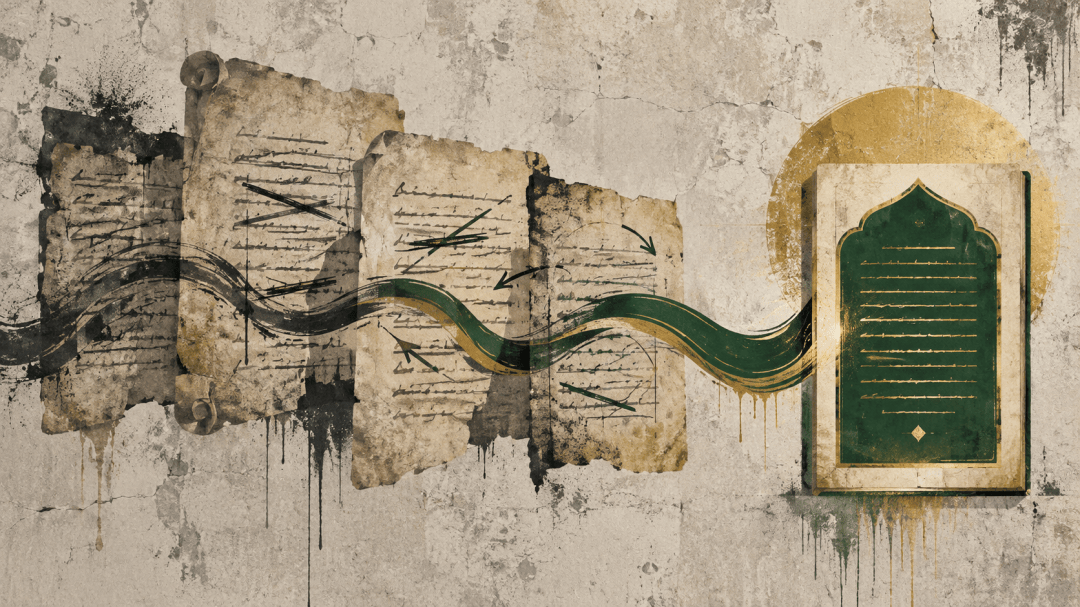
Why “The Quran Contradicts the Bible” Misreads the Bible
One of the most common objections raised against the Quran is that it “contradicts the Bible.” The Quran, the critic says, retells the stories of Adam, Noah, Abraham, Moses, and Jesus, but changes details, so it cannot be from God.
The objection sounds forceful until you ask a simple question: which Bible? Because long before the Quran was revealed, the biblical tradition was already doing exactly what the critic complains about. It told the same story more than once. It revised earlier accounts. It reassigned actions from one agent to another. And it left the differing versions sitting side by side in the same book.
This is not a hostile reading invented by skeptics. It is visible on the page, in any modern translation, to anyone willing to read two passages side by side. What follows uses the New Revised Standard Version so the differences can be seen plainly, without the archaic phrasing of older translations obscuring the point.
The Torah tells the same story twice—and disagrees with itself
Two creations, two orders
Open Genesis and the pattern begins immediately. In Genesis 1, God makes the animals first and then, on the same final day, makes humanity—male and female together—as the last act of creation. In Genesis 2, the sequence is reversed: the man is formed first (2:7), then the plants and the garden, then the animals are formed and brought to him (2:19), and only at the very end is the woman made (2:22). One account puts humans after the animals; the other puts the man before them.
Genesis 1:24-27 24 God said, “Let the earth produce living creatures after their kind, livestock, creeping things, and animals of the earth after their kind;” and it was so. 25 God made the animals of the earth after their kind, and the livestock after their kind, and everything that creeps on the ground after its kind. God saw that it was good. 26 God said, “Let’s make man in our image, after our likeness. Let them have dominion over the fish of the sea, and over the birds of the sky, and over the livestock, and over all the earth, and over every creeping thing that creeps on the earth.” 27 God created man in his own image. In God’s image he created him; male and female he created them.
Genesis 2:7 The LORD God formed man from the dust of the ground, and breathed into his nostrils the breath of life; and man became a living soul.
Genesis 2:18-23 18 The LORD God said, “It is not good for the man to be alone. I will make him a helper comparable to him.” 19 Out of the ground the LORD God formed every animal of the field, and every bird of the sky, and brought them to the man to see what he would call them. Whatever the man called every living creature became its name. 20 The man gave names to all livestock, and to the birds of the sky, and to every animal of the field; but for man there was not found a helper comparable to him. 21 The LORD God caused the man to fall into a deep sleep. As the man slept, he took one of his ribs, and closed up the flesh in its place. 22 The LORD God made a woman from the rib which he had taken from the man, and brought her to the man. 23 The man said, “This is now bone of my bones, and flesh of my flesh. She will be called ‘woman,’ because she was taken out of Man.”
The flood: two of each, or seven?
God tells Noah in Genesis 6:19 to bring “two of every kind” of living thing onto the ark. A chapter later, in Genesis 7:2, the instruction is to take “seven pairs of all clean animals” and only one pair of the unclean. Two of everything, or fourteen of the clean kinds? Both commands appear within the same flood narrative.
Genesis 6:19-20 19 Of every living thing of all flesh, you shall bring two of every sort into the ship, to keep them alive with you. They shall be male and female. 20 Of the birds after their kind, of the livestock after their kind, of every creeping thing of the ground after its kind, two of every sort will come to you, to keep them alive.
Genesis 7:2-3 2 You shall take seven pairs of every clean animal with you, the male and his female. Of the animals that are not clean, take two, the male and his female. 3 Also of the birds of the sky, seven and seven, male and female, to keep seed alive on the surface of all the earth.
One story told three times.
A man travels to a foreign land, fears he will be killed because of his beautiful wife, and passes her off as his sister; the ruler takes her, God intervenes, and the ruler rebukes the man. This story is told of Abraham and Sarah in Egypt (Genesis 12), told again of Abraham and Sarah in Gerar (Genesis 20), and told a third time of Isaac and Rebekah in Gerar (Genesis 26). Three versions of a single episode, preserved together.
Genesis 12:11-13 11 When he had come near to enter Egypt, he said to Sarai his wife, “See now, I know that you are a beautiful woman to look at. 12 It will happen that when the Egyptians see you, they will say, ‘This is his wife.’ They will kill me, but they will save you alive. 13 Please say that you are my sister, that it may be well with me for your sake, and that my soul may live because of you.”
Genesis 20:2 Abraham said about Sarah his wife, “She is my sister.” Abimelech king of Gerar sent, and took Sarah.
Genesis 26:7 The men of the place asked him about his wife. He said, “She is my sister,” for he was afraid to say, “My wife,” lest, he thought, “the men of the place might kill me for Rebekah, because she is beautiful to look at.”
Who bought Joseph? In Genesis 37:36 it is the Midianites who sell Joseph in Egypt to Potiphar. Two verses later, in Genesis 39:1, it is the Ishmaelites from whom Potiphar buys him. The seam between two versions of the sale is left unsmoothed.
Genesis 37:36 The Midianites sold him into Egypt to Potiphar, an officer of Pharaoh’s, the captain of the guard.
Genesis 39:1 Joseph was brought down to Egypt. Potiphar, an officer of Pharaoh’s, the captain of the guard, an Egyptian, bought him from the hand of the Ishmaelites that had brought him down there.
When was God’s name known?
Genesis 4:26 says that already in the time of Enosh, generations before Abraham, “people began to invoke the name of the LORD”—that is, the name YHWH. But Exodus 6:3 has God tell Moses that to Abraham, Isaac, and Jacob “by my name ‘The LORD’ I did not make myself known.” Either the name was in use from the earliest generations or it was withheld until Moses. The two verses cannot both be simply true.
Genesis 4:26 26 A son was also born to Seth, and he named him Enosh. At that time men began to call on the LORD’s name.
Exodus 6:2-3 2 God spoke to Moses, and said to him, “I am the LORD. 3 I appeared to Abraham, to Isaac, and to Jacob, as God Almighty; but by my name the LORD I was not known to them.”
None of this is a secret. For more than a century, biblical scholars have explained these seams with the Documentary Hypothesis, often abbreviated JEDP. The Torah, on this view, was woven together from several earlier sources—one that prefers the divine name YHWH (J), one that prefers Elohim (E), the distinct legal voice of Deuteronomy (D), and a later Priestly source (P). When two sources told the same story differently, the editors frequently kept both. That is why we get two creation orders, two flood commands, and one wife-and-sister episode told three times. The contradictions are not accidents of a careless copyist; they are the visible fingerprints of a book that was built out of earlier retellings.
The Bible’s own method: retell and correct
Here is the part critics rarely notice. Retelling an earlier story and changing it is not something done only to the Bible from outside. It is something the Bible does to itself.
David is introduced twice
Stay with the story of David and the pattern repeats. David is introduced to the reader twice, and the two introductions do not fit together. In 1 Samuel 16, he is already a capable young man brought into Saul’s court as a skilled musician; he enters the king’s service, becomes his armor-bearer, and Saul “loved him greatly” (16:21). By the next chapter, he is a stranger again. In the Goliath episode of 1 Samuel 17, he is an unknown shepherd boy who happens to be delivering food to his brothers—and after he kills the giant, Saul, who supposedly already knew and loved him, has to ask his commander, “Whose son is this young man?” (17:55), and then asks David directly, “Whose son are you, young man?” (17:58). A king cannot both cherish David as his own armor-bearer and, a chapter later, have no idea who he is. Two separate accounts of how David entered the story have been stitched together, and both kept.
1 Samuel 16:21-23 21 David came to Saul and stood before him. He loved him greatly; and he became his armor bearer. 22 Saul sent to Jesse, saying, “Please let David stand before me, for he has found favor in my sight.” 23 When the spirit from God was on Saul, David took the harp and played with his hand; so Saul was refreshed and was well, and the evil spirit departed from him.
1 Samuel 17:55-58 55 When Saul saw David go out against the Philistine, he said to Abner, the captain of the army, “Abner, whose son is this youth?” Abner said, “As your soul lives, O king, I can’t tell.” 56 The king said, “Inquire whose son the young man is!” 57 As David returned from the slaughter of the Philistine, Abner took him and brought him before Saul with the head of the Philistine in his hand. 58 Saul said to him, “Whose son are you, you young man?” David answered, “I am the son of your servant Jesse the Bethlehemite.”
Who really killed Goliath?
The death of Goliath is told twice as well, and the second telling hands the credit to someone else entirely. Everyone knows the version in 1 Samuel 17, where the shepherd David topples the giant with a sling. But 2 Samuel 21:19 states, without any mention of David, that a man named Elhanan “killed Goliath the Gittite.” Two heroes, one giant.
Here, we can watch a later biblical author catch the problem and repair it. When the Chronicler—whose book retells much of Samuel and Kings—reaches that same verse in 1 Chronicles 20:5, he quietly changes the victim: now Elhanan kills “Lahmi the brother of Goliath.” The awkward claim that someone other than David killed Goliath has been edited into the safe claim that Elhanan killed Goliath’s brother. That is not a copyist’s slip. It is a deliberate correction of one scripture by a later one—which brings us to the sharpest case of all.
1 Samuel 17:49-50 49 David put his hand in his bag, took a stone and slung it, and struck the Philistine in his forehead. The stone sank into his forehead, and he fell on his face to the earth. 50 So David prevailed over the Philistine with a sling and with a stone, and struck the Philistine and killed him; but there was no sword in David’s hand.
2 Samuel 21:19 There was again war with the Philistines at Gob, and Elhanan the son of Jaare-Oregim the Bethlehemite killed Goliath the Gittite, the staff of whose spear was like a weaver’s beam.
1 Chronicles 20:5 5 Again there was war with the Philistines; and Elhanan the son of Jair killed Lahmi the brother of Goliath the Gittite, the staff of whose spear was like a weaver’s beam.
God, or Satan?
Consider the census. In 2 Samuel 24:1, God himself is angry with Israel and incites David to take a census: “he incited David against them.” The Chronicler retells the identical episode in 1 Chronicles 21:1—but now the instigator is no longer God. It is Satan: “Satan stood up against Israel, and incited David to count the people of Israel.”
Set those two verses side by side and the method is unmistakable. A later author took an older sacred text, found a theological difficulty in it—the idea that God would incite the very sin he then punishes—and corrected it by transferring the act to Satan. Same story, revised. This is not a marginal case. It is one of the most respected books of the Hebrew Bible reworking another book of the Hebrew Bible, and the revision is precisely the kind of thing the Quran is accused of doing.
2 Samuel 24:1 1 Again the LORD’s anger burned against Israel, and he moved David against them, saying, “Go, count Israel and Judah.”
1 Chronicles 21:1 1 Satan stood up against Israel, and moved David to take a census of Israel.
Jubilees: the same habit, just outside the canon
Move to the apocryphal and pseudepigraphal literature and this becomes the dominant literary mode. The book of Jubilees, a second-century BCE Jewish work, retells Genesis and Exodus from beginning to end—and it corrects the older text in exactly the same way Chronicles did, using a figure it calls Prince Mastema (a Satan figure).
The binding of Isaac. Who tested Abraham?
In Genesis 22, it is God who tests Abraham by commanding the sacrifice of his son. Jubilees found the same theological difficulty the Chronicler found, and solved it the same way. In Jubilees 17:16, it is Prince Mastema who comes before God and provokes the test: he challenges God to command Abraham to offer Isaac “and Thou wilt see if he will do this command.” The instigation has been lifted off of God and placed on Satan—just as with David’s census.
Jubilees 17:16 And the prince Mastema came and said before God, “Behold, Abraham loves Isaac his son, and he delights in him above all things else; bid him offer him as a burnt-offering on the altar, and Thou wilt see if he will do this command, and Thou wilt know if he is faithful in everything wherein Thou dost try him.”
Who killed the firstborn of Egypt?
In Exodus 12:29, it is the LORD who strikes down every firstborn in Egypt. Jubilees retells the Passover night in 49:2 and reassigns the killing: on that night “all the powers of Mastema had been let loose to slay all the first-born in the land of Egypt.” What the Torah credited to God directly, Jubilees credits to the forces of Satan.
The point is not whether Jubilees is scripture. The point is that revising, softening, and reassigning the events of earlier revelation was a normal, expected feature of how this tradition handled its own sacred history. A retelling that changes who did what was not treated as forgery. It was treated as interpretation.
Jubilees 49:2 For on this night—the beginning of the festival and the beginning of the joy—ye were eating the passover in Egypt, when all the powers of Mastema had been let loose to slay all the first-born in the land of Egypt, from the first-born of Pharaoh to the first-born of the captive maid-servant in the mill, and to the cattle.
Four Gospels, one Jesus, several stories
Now apply the same lens to the New Testament, and the pattern holds. The Christian scriptures do not contain one life of Jesus. They contain four, and the four do not agree.
Whose son was Joseph?
Matthew and Luke both trace Jesus’s line through Joseph, and they name a different father for him at once:
Matthew 1:16 16 Jacob became the father of Joseph, the husband of Mary, from whom was born Jesus, who is called Christ.
Luke 3:23 23 Jesus himself, when he began to teach, was about thirty years old, being the son (as was supposed) of Joseph, the son of Heli,
Jacob, or Heli? From David onward the two genealogies run through different sons and different names entirely.
When was Jesus born?
Matthew places the birth in the reign of Herod the Great, who died in 4 BCE. Luke ties it to the census under Quirinius, which took place in 6 CE—about ten years later:
Matthew 2:1 1 Now when Jesus was born in Bethlehem of Judea in the days of King Herod, behold, wise men from the east came to Jerusalem, saying,
Luke 2:1-2 1 Now in those days, a decree went out from Caesar Augustus that all the world should be enrolled. 2 This was the first enrollment made when Quirinius was governor of Syria.
The two datings are roughly a decade apart, and the surrounding scenes share almost nothing: Matthew has magi and a murderous Herod; Luke has a census, shepherds, and a manger.
On what day did Jesus die?
In Mark, the Last Supper is the Passover meal, and Jesus is crucified the day after it is eaten:
Mark 14:12 12 On the first day of unleavened bread, when they sacrificed the Passover, his disciples asked him, “Where do you want us to go and prepare that you may eat the Passover?”
In John, Jesus dies before the Passover meal is eaten. At his trial the authorities have not yet eaten it, and he is condemned on the day of Preparation for the Passover:
John 18:28 28 They led Jesus therefore from Caiaphas into the Praetorium. It was early, and they themselves didn’t enter into the Praetorium, that they might not be defiled, but might eat the Passover.
John 19:14 14 Now it was the Preparation Day of the Passover, at about the sixth hour. He said to the Jews, “Behold, your King!”
Mark places the crucifixion on the day of Passover; John places it the day before. The two cannot both be the calendar of the same week.
What were his last words?
The three Gospels that record a final utterance record three different ones:
Mark 15:34 34 At the ninth hour Jesus cried with a loud voice, saying, “Eloi, Eloi, lama sabachthani?” which is, being interpreted, “My God, my God, why have you forsaken me?”
Luke 23:46 46 Jesus, crying with a loud voice, said, “Father, into your hands I commit my spirit!” Having said this, he breathed his last.
John 19:30 30 When Jesus therefore had received the vinegar, he said, “It is finished!” Then he bowed his head and gave up his spirit.
Who was at the empty tomb?
The number and identity of the figures the women meet shift from Gospel to Gospel—one young man, two men, two angels:
Mark 16:5 5 Entering into the tomb, they saw a young man sitting on the right side, dressed in a white robe; and they were amazed.
Luke 24:4 4 While they were greatly perplexed about this, behold, two men stood by them in dazzling clothing.
John 20:12 12 and she saw two angels in white sitting, one at the head and one at the feet, where the body of Jesus had lain.
Four authors retelling one story, each shaping it toward his own emphasis, each differing from the others in detail. This is the same thing the Torah does with creation and the flood, the same thing Chronicles does with Samuel, the same thing Jubilees does with Genesis and Exodus.
So what exactly is the objection?
Here the argument turns back on the critic. The charge that “the Quran contradicts the Bible” quietly assumes there is a single, seamless, internally consistent Bible for the Quran to contradict. There is not. The biblical tradition is, from Genesis to the Gospels, a tradition of retelling: taking the sacred past and telling it again, with variation, with correction, with different emphases, and often with the earlier and later versions preserved together.
The honest Christian reply to all of this is harmonization: the two creation stories are complementary rather than contradictory; ancient writers did not demand modern precision; Chronicles is theological interpretation, not error. Grant the principle. But notice what it costs. The moment you say that a later sacred author may retell an earlier story, reassign an act from God to Satan, reorder events, and adjust details to serve a deeper theological truth—and that this is legitimate revelation rather than corruption—you have described the Quran’s relationship to the earlier scriptures exactly. You cannot extend that generosity to Chronicles and Jubilees and the four Gospels and then withhold it from the Quran. And where the difference is not a matter of emphasis but of who acted—God or Satan, on which day, by whose hand—”complementary” stops being a satisfying answer for anyone’s text, the Bible’s included.
The Quran, in other words, is doing nothing the biblical tradition had not already been doing for centuries. It retells the sacred history. It confirms what was true in it. And it corrects what had drifted.
The Quran as the benchmark
For the Muslim, this is where the discussion should end up. The Quran does not merely take its place as one more retelling in a long chain. It presents itself as the final and authoritative one—the criterion by which the earlier accounts are to be measured. It describes its own relationship to the previous scriptures directly:
[Quran 5:48] Then we revealed to you this scripture, truthfully, confirming previous scriptures, and superseding (muhaymin) them. You shall rule among them in accordance with GOD’s revelations, and do not follow their wishes if they differ from the truth that came to you. For each of you, we have decreed laws and different rites. Had GOD willed, He could have made you one congregation. But He thus puts you to the test through the revelations He has given each of you. You shall compete in righteousness. To GOD is your final destiny—all of you—then He will inform you of everything you had disputed.
The word rendered “criterion,” muhaymin, carries the sense of a guardian, an overseer, a standard that tests and safeguards. The Quran is not judged by the earlier books; it judges them—affirming what remains true and correcting what does not.
And the reason it can serve as that benchmark is its preservation. Where the earlier revelations passed through generations of retelling, editing, and reassigning—the very process traced above—the Quran carries a different guarantee:
[Quran 15:9] Absolutely, we have revealed the reminder, and, absolutely, we will preserve it.
So the objection collapses on its own terms. If retelling the sacred past with correction disqualified a revelation, the Bible would be the first casualty—two creations, two floods, a giant killed by David in one book and by Elhanan in another, a census incited by God in one book and by Satan in another, a firstborn slain by the LORD in one text and by Mastema’s forces in another, and four Gospels that cannot agree on the day their central event took place. The Quran is not an intruder into a settled and unanimous scripture. It is the completion and the correction of a tradition that was never settled or unanimous to begin with—and, for those who receive it as the preserved word of God, the standard against which all the earlier tellings are finally read.


