
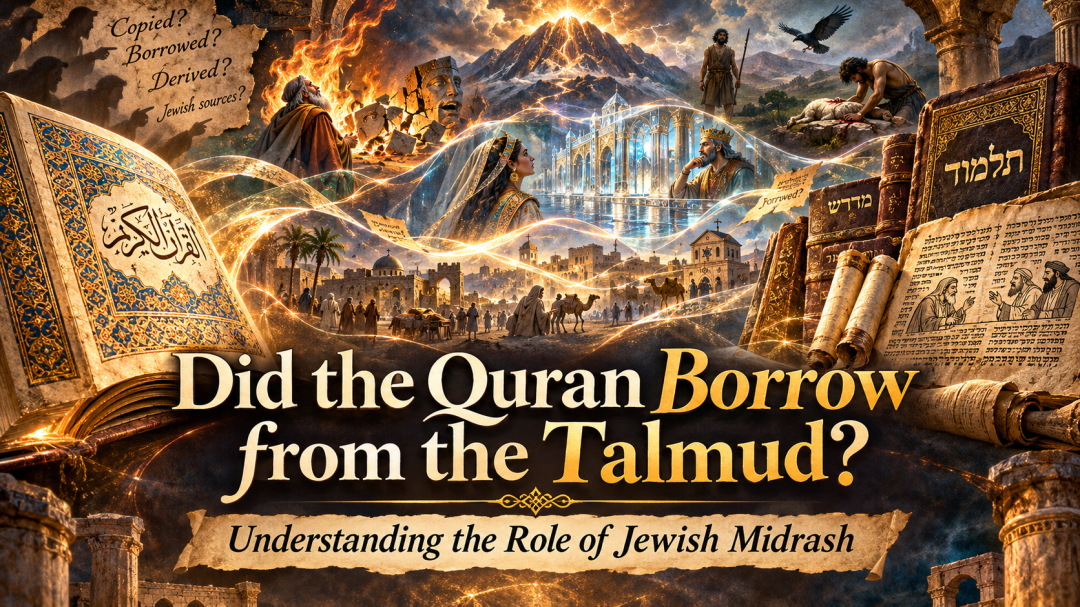
Few claims about the Quran are repeated as confidently as this one: Muhammad borrowed from the Talmud. It appears in polemical pamphlets, in internet debates, and in more serious scholarship that should know better than to use so blunt an instrument. The claim usually arrives with a short list of “proofs”—Abraham in the furnace, Cain and the raven, the mountain held over Israel, the Queen of Sheba at Solomon’s palace—each said to have been lifted from rabbinic books.
Some of these parallels are real, and some are striking. But the formulation itself is a muddle. It treats the Talmud as if it were a single book of a single kind, written at a single time, and it treats any resemblance between a Quranic verse and a rabbinic sentence as a footprint left by a thief. This article argues that three distinctions have been collapsed: a library with a genre, preservation with origin, and similarity with dependence. Once they are pulled apart, the most famous “Talmudic borrowings” turn out to be something more interesting, and something much harder to reduce to a slogan: evidence of the Quran’s participation in the world of late-antique Jewish biblical interpretation, known as Midrash.
This is not an attempt to make the parallels disappear. They will not. The aim is better categories, and the better questions those categories allow.
A map of the rabbinic library
Rabbinic Judaism produced an enormous literature between roughly the second and the seventh centuries CE. The vocabulary is easily blurred, so it is worth being exact.
The Mishnah (Hebrew, “repetition” or “teaching”) is a collection of rabbinic legal traditions arranged by topic and edited in the Galilee around 200 CE, traditionally by Rabbi Judah the Patriarch. It is written in a terse, rabbinic Hebrew. It is mostly concerned with halakhah—the Hebrew term for Jewish law, from a root meaning “to walk” or “to go,” hence “the way one walks.” Halakhah covers ritual, civil law, criminal procedure, purity, festivals, and much else. The Mishnah has six “orders” divided into tractates; “Sanhedrin” is the tractate on courts and capital cases.
The Gemara (Aramaic, from a root meaning “to learn” or “to complete”) is the vast body of rabbinic discussion that gathered around the Mishnah in the following centuries. It quotes the Mishnah line by line, asks what it means, tests it against other traditions, resolves apparent contradictions, and wanders. And it does wander: the Gemara is full of narratives, scriptural interpretation, theology, medicine, folklore, magic, biography, and jokes. Much of this non-legal material is called aggadah (Aramaic and Hebrew, “telling” or “narration”)—the rabbinic category for the non-halakhic: stories, ethics, homilies, legends.
The Talmud is simply Mishnah plus Gemara, bound together. There are two Talmuds. The Jerusalem (or Palestinian) Talmud, the Yerushalmi, was compiled in the Galilee, probably around 400 CE (its name is misleading; it has little to do with Jerusalem). The Babylonian Talmud, the Bavli, grew in the rabbinic academies of Mesopotamia and reached its final shape considerably later—conventionally the sixth or seventh century, with the precise stages of its editing still debated. When people say “the Talmud,” they almost always mean the Bavli. When they cite a Talmudic passage, they usually mean a Mishnah or a Gemara passage, and these are different kinds of material from different periods.
Midrash (Hebrew, from darash, “to seek, to inquire”) names two things at once. It is an activity: reading Scripture closely, asking what an odd word, a redundant phrase, a missing detail, or a moral difficulty is trying to teach, and answering with an interpretation that often expands the text. And it is a body of literature in which such interpretation was collected—works like Genesis Rabbah (a verse-by-verse midrash on Genesis, composed in Palestine around the fifth century), Leviticus Rabbah, Exodus Rabbah, the Mekhilta on Exodus, Sifra on Leviticus, and Sifre on Numbers and Deuteronomy. Midrash that deals with law is called midrash halakhah; midrash that deals with narrative and theology is midrash aggadah.
Now the crucial point: these categories overlap. The Talmud is not a genre; it is a container. The Bavli contains halakhic argument, but it also contains rabbinic sermons, dozens of biblical interpretations, and extended midrashic units. A midrash can sit inside the Talmud. A legal Mishnah can quote a midrashic argument to justify a rule. To say “the Quran parallels the Talmud” is like saying “this essay resembles something in the library.” The statement is true, and almost worthless, until you ask which section.
Better questions
The usual question is: Does something like this appear in the Talmud? The better question is:
What kind of tradition is the Quran actually interacting with?
Two broad routes can be distinguished.
Route one: Scripture → interpretation/expansion → Midrash. A biblical text raises a problem. A word is strange, a detail is missing, a character acts without explanation, a verse seems redundant. Interpreters supply an answer, often in narrative form: Abraham must have had a reason to leave his father’s house, so he must have rejected idolatry; how did he come to be in “Ur of the Chaldeans,” so he must have been rescued from “the fire of the Chaldeans.” The result is an expansion of the biblical story that readers and hearers absorb as part of the story.
Route two: rabbinic teaching or ruling → preservation and debate → Mishnah/Gemara/Talmud. A rabbinic authority states a rule. Others dispute it. Later editors arrange the debate. The product is a record of legal reasoning, with named authorities and competing opinions.
If a Quranic parallel enlarges a biblical narrative, fills a gap, resolves an ambiguity, deepens a character, or explains an unusual wording, then the first route describes it, and the comparison belongs with midrashic traditions—wherever the written evidence for those traditions happens to survive, including (but not limited to) the Talmud. If the parallel concerns a legal ruling, a ritual practice, or a point of rabbinic legal reasoning, the second route applies, and a comparison with the Mishnah, Gemara, and halakhic literature is the right one.
Only after sorting examples this way can we ask the further question that matters most:
When the Quran shares material with rabbinic literature, are we looking at dependence on a text, participation in an older interpretive tradition, independent development from the same biblical problem, or the Quran’s deliberate reformulation of an existing Jewish interpretation?
The answer will not be the same for every example. Let us test the framework.
The test case: Quran 5:32 and Mishnah Sanhedrin 4:5
No parallel is cited more often than this one, and none better exposes the problem with the category “Talmud.”
The verse comes in sura 5 (al-Māʾida), immediately after the story of the two sons of Adam (5:27–31), whom the Quran does not name but whom Jewish and Christian readers identify as Cain and Abel:
Because of that, we decreed for the Children of Israel that anyone who kills a person—unless it be for murder or corruption on earth—shall be regarded as having killed all the people. And anyone who saves a life shall be regarded as having saved the lives of all the people. Our messengers went to them with clear proofs, but most of them, after all this, are still transgressing.
مِنْ أَجْلِ ذَٰلِكَ كَتَبْنَا عَلَىٰ بَنِي إِسْرَائِيلَ أَنَّهُ مَن قَتَلَ نَفْسًا بِغَيْرِ نَفْسٍ أَوْ فَسَادٍ فِي الْأَرْضِ فَكَأَنَّمَا قَتَلَ النَّاسَ جَمِيعًا وَمَنْ أَحْيَاهَا فَكَأَنَّمَا أَحْيَا النَّاسَ جَمِيعًا ۚ وَلَقَدْ جَاءَتْهُمْ رُسُلُنَا بِالْبَيِّنَاتِ ثُمَّ إِنَّ كَثِيرًا مِنْهُم بَعْدَ ذَٰلِكَ فِي الْأَرْضِ لَمُسْرِفُونَ (Quran 5:32)
Note the key words: nafs (“a soul, a person, a life”), the “as if” construction fa-kaʾannamā, and the opening min ajli dhālika, “because of that” or “on account of that.” The “that” points straight back to Cain’s murder of Abel.
The parallel text is Mishnah Sanhedrin 4:5. The context is a legal one. The Mishnah is describing how judges must admonish witnesses in capital cases before they testify, warning them that their words may send a human being to death. To impress the gravity of this on them, the Mishnah turns to Genesis:
מָצִינוּ בְקַיִן שֶׁהָרַג אֶת אָחִיו, שֶׁנֶּאֱמַר: קוֹל דְּמֵי אָחִיךָ צֹעֲקִים אֵלַי (בראשית ד:י). אֵינוֹ אוֹמֵר דַּם אָחִיךָ אֶלָּא דְּמֵי אָחִיךָ, דָּמוֹ וְדַם זַרְעִיּוֹתָיו.
We find that Cain killed his brother, as it is said, “The voice of the bloods of your brother cries out to me” (Gen 4:10). It does not say “the blood (dam) of your brother,” but “the bloods (demei) of your brother”—his blood and the blood of his descendants.
The Hebrew Bible’s phrase, in the RSV, reads: “The voice of your brother’s blood is crying to me from the ground” (Gen 4:10). But the Hebrew noun is in the plural construct form, demei, literally “bloods of.” The Mishnah notices the plural and asks why. Its answer: Cain did not merely kill one man; he destroyed Abel’s entire potential line, all the descendants who would have come from him. The Mishnah then draws the moral:
לְפִיכָךְ נִבְרָא אָדָם יְחִידִי, לְלַמֶּדְךָ שֶׁכָּל הַמְאַבֵּד נֶפֶשׁ אַחַת מַעֲלֶה עָלָיו הַכָּתוּב כְּאִלּוּ אִבֵּד עוֹלָם מָלֵא; וְכָל הַמְקַיֵּם נֶפֶשׁ אַחַת מַעֲלֶה עָלָיו הַכָּתוּב כְּאִלּוּ קִיֵּם עוֹלָם מָלֵא.
Therefore a human being was created singly, to teach that whoever destroys a single soul, Scripture imputes it to him as though he had destroyed a full world; and whoever sustains a single soul, Scripture imputes it to him as though he had sustained a full world.
It is critical to note that many printed editions of the Sanhedrin 37a add the words “of Israel” after “a single soul,” so that the saying values only the life of an Israelite. The oldest and best manuscripts of the Mishnah, such as the Kaufmann manuscript, lack those words, and the manuscript picture is mixed enough that the universal reading is widely regarded as the more original. The Yerushalmi parallel is at Yerushalmi Sanhedrin 4:9, and a related tradition also appears in Avot de-Rabbi Natan, version A, ch. 31. So the rabbinic tradition itself was divided over whether the saying covers only Israel or all humanity. The Quran settles that dispute. It addresses the principle to the Children of Israel, as a decree written for them, and then states its scope without restriction: whoever kills a person has killed all the people, and whoever saves a life has saved all the people. This is the opposite of passive copying, but the author of the Quran is setting the record straight on the matter.
[27:76] This Quran settles many issues for the Children of Israel; issues that they are still disputing.
إِنَّ هَٰذَا ٱلْقُرْءَانَ يَقُصُّ عَلَىٰ بَنِىٓ إِسْرَٰٓءِيلَ أَكْثَرَ ٱلَّذِى هُمْ فِيهِ يَخْتَلِفُونَ
Abraham, the idols, and the fire
The Bible’s Abraham does not smash idols, and the Bible’s Abraham is not thrown into a furnace. Yet the Quran’s Abraham does both.
Then he made them into pieces, except the biggest one among them, that they may refer to it.
فَجَعَلَهُمْ جُذَاذًا إِلَّا كَبِيرًا لَهُمْ لَعَلَّهُمْ إِلَيْهِ يَرْجِعُونَ (Quran 21:58)
We said, “O fire, be cool and safe for Abraham.”
قُلْنَا يَا نَارُ كُونِي بَرْدًا وَسَلَامًا عَلَىٰ إِبْرَاهِيمَ (Quran 21:69)
(See also 6:74–83; 19:41–50; 26:69–89; 29:16–27; 37:83–98.)
Where does this come from? The rabbinic path is clear, and it is a path of midrash. Genesis 11:28 (RSV) says that Haran “died in the presence of his father Terah in the land of his birth, in Ur of the Chaldeans.” In Hebrew: וַיָּמָת הָרָן עַל־פְּנֵי תֶרַח אָבִיו בְּאֶרֶץ מוֹלַדְתּוֹ בְּאוּר כַּשְׂדִּים. And in Genesis 15:7 God says: “I am the LORD who brought you from Ur of the Chaldeans.” The interpretive hook is the word ur. In Hebrew, ur also means “fire” (compare Isaiah 24:15, where the plural urim is generally taken to mean “flames” or “lights,” though that verse is itself disputed). The rabbinic interpreters read: God brought Abraham out of “the fire of the Chaldeans.” What fire? And why did Haran die “in the presence of” his father? Midrash answers with a story.
Genesis Rabbah 38:13 supplies one. Terah is an idol-seller. Abraham, left in charge of the shop, smashes the idols except for the largest, and puts the axe in its hand. When Terah returns and asks what happened, Abraham says the idols quarreled over a food offering and the largest destroyed the rest. Terah protests that idols have no knowledge, and Abraham replies: let your ears hear what your mouth says. Terah hands Abraham over to Nimrod, who proposes fire-worship; Abraham answers that water is mightier than fire, and so on, until Abraham is cast into the furnace and is saved; Haran, who had hedged, is consumed. The “fire of the Chaldeans” has become a literal furnace.
The shape of the Quranic account is recognizably the same: smashing, the large idol left standing, the logic that idols cannot speak, the fire, the rescue. There are real differences: the Quran gives no shop, no flour offering, no scene with Haran, no named Nimrod. Its Abraham is also the son of a man called Āzar (6:74), not Terah, and the entire story is framed as an argument in prophetic monotheism rather than as a legend about a family.
Now the chronology, because it is the central matter. Genesis Rabbah is a midrash, not the Talmud. A short reference to Abraham and the furnace also appears in the Babylonian Talmud at Pesachim 118a, in an aggadic aside where the angel Gabriel offers to cool the furnace. That is a Talmudic text, but a much lighter one. And the story is far older than either. Jubilees 12 (a Jewish work composed in the second century BCE) already contains an Abram who burns an idol-temple, with Haran dying in the flames as he tries to rescue the idols (Jubilees 12:12–14). The Apocalypse of Abraham (a Jewish text from around the first or second century CE, preserved in Slavonic) opens with Abraham, the son of an idol-maker, destroying idols. So the Abraham-and-the-idols legend circulated for centuries before anyone compiled Genesis Rabbah.
This case, then, is a clear instance of the second hypothesis: participation in an older interpretive tradition. “Borrowed from the Talmud” is wrong on genre (it is midrash), wrong on corpus (the main witness is Genesis Rabbah, not the Talmud), and wrong on chronology (the tradition is far older than any rabbinic compilation).
The mountain over Israel: a Talmudic parallel that is still midrash
The Quran says in 2:63:
Recall that we made a covenant with you, and raised Mount Sinai above you: “You shall uphold what we have given you with firmness, and bear in mind what is therein, that you may attain salvation.”
وَإِذْ أَخَذْنَا مِيثَاقَكُمْ وَرَفَعْنَا فَوْقَكُمُ الطُّورَ خُذُوا مَا آتَيْنَاكُم بِقُوَّةٍ وَاذْكُرُوا مَا فِيهِ لَعَلَّكُمْ تَتَّقُونَ (Quran 2:63; cf. 2:93; 4:154; 7:171)
Sura 7:171 adds a vivid image: the mountain hangs over them like a canopy (ẓulla), and they think it is about to fall.
[7:171] We raised the mountain above them like an umbrella, and they thought it was going to fall on them: “You shall uphold what we have given you, strongly, and remember the contents thereof, that you may be saved.”
وَإِذْ نَتَقْنَا ٱلْجَبَلَ فَوْقَهُمْ كَأَنَّهُۥ ظُلَّةٌ وَظَنُّوٓا۟ أَنَّهُۥ وَاقِعٌۢ بِهِمْ خُذُوا۟ مَآ ءَاتَيْنَٰكُم بِقُوَّةٍ وَٱذْكُرُوا۟ مَا فِيهِ لَعَلَّكُمْ تَتَّقُونَ
Read in translation, the Bible has no such scene. Exodus 19:17 says that Moses brought the people out to meet God and “they took their stand at the foot of the mountain.” But the Hebrew phrase there is וַיִּתְיַצְּבוּ בְּתַחְתִּית הָהָר, and the word taḥtit is built on the root that means “under” and “beneath.” Elsewhere, it is the word for the lowest place: Ezekiel 31:14, 16, and 18 use it for the “nether world” to which the great tree is brought down. Deuteronomy 4:11 describes the same event with a related word: “you came near and stood at the foot of the mountain, while the mountain burned with fire to the heart of heaven.” The Hebrew is וַתַּעַמְדוּן תַּחַת הָהָר, and taḥat is the ordinary Hebrew preposition for “under,” the same word that separates the waters “under the firmament” from those above it in Genesis 1:7. So even though it is typically translated as “at the foot of the mountain,” the literal reading is “under the mountain.”
The Quranic scene is therefore not an invention from nothing. It is a literal reading of a Hebrew word that the biblical text itself leaves open. That is the first thing to see, and it cuts against any simple story of borrowing: the Quran does not need a rabbinic book to tell it what Exodus 19:17 says.
The second thing is that the rabbis read the word the same way. The Babylonian Talmud, Shabbat 88a (also Avodah Zarah 2b) takes up exactly this word:
אָמַר רַב אַבְדִּימִי בַּר חָמָא בַּר חַסָּא: מְלַמֵּד שֶׁכָּפָה הַקָּדוֹשׁ בָּרוּךְ הוּא עֲלֵיהֶם אֶת הָהָר כְּגִיגִית, וְאָמַר לָהֶם: אִם אַתֶּם מְקַבְּלִים הַתּוֹרָה מוּטָב, וְאִם לָאו שָׁם תְּהֵא קְבוּרַתְכֶם.
Rav Avdimi bar Ḥama bar Ḥasa said: This teaches that the Holy One, blessed be He, overturned the mountain upon them like a tub, and said to them: If you accept the Torah, good; and if not, there will be your burial.
Rav Avdimi’s argument is the lexical one. He starts from be-taḥtit and concludes that the people were standing under the mountain because God held it over them. Again, we see that the Quran is giving commentary to something that is based on the understanding of the verses of the Tanak that is also encompassed in the Talmud. Giving clarity to which interpretation the Quran is adhering to: that the Children of Israel were not just at the foot of the mountain, but were underneath the mountain.
Cain’s raven and Solomon’s palace: where the dating collapses
A good argument also knows when to stop. Two much-cited parallels show why.
The raven. In Quran 5:31, immediately before our verse 5:32, God sends a raven to show Cain how to bury his brother:
Then GOD sent a raven, scratching the ground, to show him how to cover his brother’s corpse. He said, “Woe to me; I could not even be like this raven, and cover my brother’s corpse.” He became one of the remorseful.
فَبَعَثَ اللَّهُ غُرَابًا يَبْحَثُ فِي الْأَرْضِ لِيُرِيَهُ كَيْفَ يُوَارِي سَوْأَةَ أَخِيهِ ۚ قَالَ يَا وَيْلَتَىٰ أَعَجَزْتُ أَنْ أَكُونَ مِثْلَ هَٰذَا الْغُرَابِ فَأُوَارِيَ سَوْأَةَ أَخِي ۖ فَأَصْبَحَ مِنَ النَّادِمِينَ (Quran 5:31)
The usual rabbinic parallel is Pirqe de-Rabbi Eliezer 21, where a raven buries its dead companion and Adam (not Cain) learns from it. The problem is chronology. Pirqe de-Rabbi Eliezer is a late midrashic work, generally dated to the eighth or ninth century, and it contains material that seems to postdate the rise of Islam (it mentions Ishmael’s wives by names resembling Aisha and Fatima). It is, in other words, later than the Quran. The existence of a raven tradition in an earlier form is possible, and Genesis Rabbah 22:8 contains related material about Adam and Eve not knowing what to do with Abel’s body. But the written parallel cannot be the source, and it may even reflect Islamic influence on Jewish storytelling. And the Quran’s raven teaches Cain, while Pirqe de-Rabbi Eliezer’s raven teaches Adam. This is an example where the claim “borrowed from the Talmud” fails twice: it is not in the Talmud, and the surviving text is probably too late.
Solomon and the glass floor. Sura 27 recounts Solomon and the Queen of Sheba. The queen is told to enter a palace whose floor is glass:
She was told, “Enter the palace.” When she saw it, she thought it was a body of water, and she bared her legs. He said, “It is a palace paved with crystal.” She said, “My Lord, I have wronged my soul; I submit with Solomon to GOD, Lord of the universe.”
قِيلَ لَهَا ادْخُلِي الصَّرْحَ ۖ فَلَمَّا رَأَتْهُ حَسِبَتْهُ لُجَّةً وَكَشَفَتْ عَن سَاقَيْهَا ۚ قَالَ إِنَّهُ صَرْحٌ مُّمَرَّدٌ مِّن قَوَارِيرَ ۗ قَالَتْ رَبِّ إِنِّي ظَلَمْتُ نَفْسِي وَأَسْلَمْتُ مَعَ سُلَيْمَانَ لِلَّهِ رَبِّ الْعَالَمِينَ (Quran 27:44)
The Hebrew Bible’s account (1 Kings 10:1–13) mentions the queen’s “hard questions” and has no glass floor and no hoopoe. The parallels are in the Second Targum to Esther (a targum is an Aramaic paraphrase of Scripture), where a hoopoe carries messages and the queen lifts her skirt, revealing hairy legs. But the Second Targum is a very late composition, dated variously from the seventh century to the eleventh, and its relationship to the Quran may well run in either direction. This is not a Talmudic text at all. And the best statement of the evidence is humble: the Quran and the Second Targum share a legend about Solomon, whose origin is unknown.
The tale of Moses and his companion in sura 18 (18:60–82) is sometimes presented as borrowed from a Jewish story of Rabbi Joshua ben Levi and Elijah. That story is attested only in medieval collections and has strong affinities with the Alexander Romance and with Christian sources as well. Here the evidence is too uncertain, and the direction of influence too open, to say anything stronger than: a widely circulating narrative type.
Halakhah: where law is the real question
If we want to test the Quran’s relationship to the legal side of the rabbinic library, we should look at a legal example. Consider Quran 5:45, concerning retaliation:
We decreed for them therein: the life for the life, the eye for the eye, the nose for the nose, the ear for the ear, the tooth for the tooth, and for the wounds, equitable retaliation. If one forfeits it, it will be an atonement for him. Those who do not rule in accordance with GOD’s revelations are the unjust.
وَكَتَبْنَا عَلَيْهِمْ فِيهَا أَنَّ النَّفْسَ بِالنَّفْسِ وَالْعَيْنَ بِالْعَيْنِ وَالْأَنفَ بِالْأَنفِ وَالْأُذُنَ بِالْأُذُنِ وَالسِّنَّ بِالسِّنِّ وَالْجُرُوحَ قِصَاصٌ ۚ فَمَن تَصَدَّقَ بِهِ فَهُوَ كَفَّارَةٌ لَّهُ ۚ وَمَن لَّمْ يَحْكُم بِمَا أَنزَلَ اللَّهُ فَأُولَٰئِكَ هُمُ الظَّالِمُونَ (Quran 5:45)
The Quran says this is what was “decreed for them” in the Torah, and the language tracks Exodus 21:23–25 (RSV): “you shall give life for life, eye for eye, tooth for tooth, hand for hand, foot for foot.” The rabbinic legal tradition famously handled this differently. Mishnah Bava Kamma 8:1 lists five categories of payment for bodily injury, and the Gemara at Bavli Bava Kamma 83b–84a argues from Scripture that “an eye for an eye” means monetary compensation, not literal retaliation.
So what do we learn? The Quran’s passage is closer to the written Torah’s wording than to the rabbinic halakhic reinterpretation. It does not engage the Mishnah’s or the Gemara’s legal reasoning at all. This is a useful reminder that where the Quran touches law, it cannot be assumed to have drunk from the rabbinic legal stream. The one place where the Quran might resonate with a rabbinic emphasis is the concluding note about forgoing retaliation as atonement, but that is a general ethical echo, not evidence of textual dependence.
Which brings us to the shape of the whole picture. In the best-known “Talmudic” parallels, the Quran is interacting with biblical narrative as interpreted, not with rabbinic law as argued. That is the signature of Midrash, not of Mishnah and Gemara.
Compilation is not origin
The second great confusion in the “borrowing” claim is chronological. A parallel found in a rabbinic text that was compiled after the Quran cannot be a source for the Quran, the reasoning goes; one found in an earlier text can. This reasoning is too crude in both directions. At least three different dates must be kept apart:
| Question | What it asks | Example |
|---|---|---|
| Date of compilation | When was the work put into its final form? | Mishnah, c. 200 CE; Yerushalmi, c. 400; Genesis Rabbah, c. fifth century; Bavli, conventionally sixth to seventh century with stages of editing debated; Pirqe de-Rabbi Eliezer, c. eighth to ninth century |
| Date of the tradition | How old is an individual saying or story inside it? | The idol-smashing Abraham is already in Jubilees (second century BCE) and the Apocalypse of Abraham (first to second century CE), long before Genesis Rabbah |
| Date of the earliest manuscript | When is the oldest surviving physical copy? | The Mishnah’s oldest complete manuscripts are medieval (the Kaufmann manuscript is generally dated to the eleventh or twelfth century), with older fragments from the Cairo Genizah; the only complete manuscript of the Bavli (Munich 95) is dated 1342 |
Three consequences follow.
First, a late compilation can contain an early tradition. That a text was edited in the sixth century does not mean every line was composed then. A saying attributed to a third-century sage may well be older than the book that preserves it, though attributions are not always reliable and must be judged case by case.
Second, a late manuscript is not a late tradition. Most rabbinic works survive in manuscripts from the Middle Ages. If manuscript date determined origin, we could say that nothing in the Talmud existed before the fourteenth century. No one argues that. But then the converse holds too: the earliest witness to a tradition is not the tradition itself. The Quran is, by this standard, an earlier datable witness to some traditions than any surviving rabbinic manuscript. That does not prove the Quran is the origin of anything, but it shows that “the written rabbinic version is earlier, therefore it is the source” is bad logic when the written version’s date is not the tradition’s date.
Third, the converse danger is real too. Pirqe de-Rabbi Eliezer’s raven shows that a text can look like an ancient midrash while being post-Quranic. Chronology cuts in every direction, and the honest conclusion in many cases is: dating uncertain or disputed.
And, finally, a text-based parallel does not automatically establish that the Quran borrowed from that particular written text. Ancient Jewish biblical interpretation did not live only in books. It was preached in synagogues, chanted in liturgy, taught in households, translated orally into Aramaic or other vernaculars, told as stories, and passed among Jews, Christians, and those who lived among them. The surviving rabbinic books are snapshots of something that lived outside the books too.
A shared world of interpretation
What picture emerges when we reason this way? It is the picture of a late-antique interpretive environment stretching across Palestine, Syria, Mesopotamia, and Arabia, in which biblical stories circulated in a variety of forms, Jewish and Christian alike. Rabbinic midrash is one of its richest written expressions. Targums, synagogue poetry (piyyut), the Syriac homilies of Ephrem and Jacob of Serugh, and apocryphal writings like Jubilees all participate. The Quran, in this view, does not step into this environment as an outsider with a stolen notebook; it speaks within it, to an audience that already knows the stories.
Within such an environment, what can legitimately be inferred from a parallel?
- A shared tradition can be inferred when the same specific interpretive solution to a biblical problem appears in two places (the “bloods” and the single soul; the fire of the Chaldeans; the mountain at Sinai). Such matches are not trivial.
- Direct literary dependence cannot be inferred from similarity alone. For that one would need additional evidence: verbal correspondence unlikely to be accidental, a clear chronological priority, and some account of how the text reached its audience.
- Independent development is sometimes plausible. Biblical oddities are shared by everyone who reads the Bible. A reader who notices the plural “bloods” in Genesis 4:10, or the strange “underside of the mountain” in Exodus 19:17, may reach similar conclusions independently, though when the conclusions are as elaborate as an idol-smashing Abraham, independence becomes less likely than shared transmission.
- Deliberate reformulation is visible whenever the Quran changes the tradition: dropping the burial ultimatum at Sinai, universalizing the saying about one life, turning Abraham’s story into an argument for divine unity. This is the opposite of passive copying.
Scholars working on these questions—Abraham Geiger in the nineteenth century (whose Was hat Mohammed aus dem Judenthume aufgenommen? started the modern conversation), Heinrich Speyer in the twentieth, and more recently Gabriel Said Reynolds, Holger Zellentin, Joseph Witztum, and Michael Pregill, among others—have each handled the evidence differently. What they increasingly share is attention to the kind of tradition at issue and to the Syriac Christian as well as Jewish environments in which it circulated. The old question “what did Muhammad take from the Jews?” is giving way to “how does the Quran read the Bible within its world?”
Midrash, not Hadith
One more conceptual question sharpens the point. When the Quran reproduces or reformulates a tradition known from Jewish interpretive literature, how does it treat that tradition? Does it present it as an independent authority, a source to be cited alongside Scripture, the way later Muslims treated Hadith?
The evidence of 5:32 suggests not. The Quran does not say “the rabbis taught.” It does not name an authority. It does not argue from “it is reported that.” Instead, it says “we decreed for the Children of Israel” (katabnā ʿalā Banī Isrāʾīl)—it attributes the principle to divine writing addressed to Israel, folding it directly into its own account of sacred history. The rabbinic teaching (“Scripture imputes it to him”) has become a Quranic decree. That is exactly what midrash does with Scripture: it does not cite the interpretation as an outside authority but weaves it into the story as part of what the story means.
The Quran’s explicit statements about Jewish scholarly authority point the same way, with one qualification. Sura 9:31 criticizes taking “rabbis and monks” (aḥbār and ruhbān) as lords besides God, so the Quran does not grant scholars an authority of their own. Sura 5:48 calls the Quran a muhaymin, a “guardian” or “overseer,” over earlier scripture, which puts the earlier books under the Quran’s judgment rather than beside it. And sura 3:93 challenges Jewish interlocutors to “bring the Torah and recite it,” which sends the argument back to Scripture.
That last verse needs care, because it does not reject oral argument. The challenge is that a claim must be supported by Scripture, and an interpretation that can be shown to rest on Scripture passes the test. The Torah the Quran refers to is also broader than the word usually implies today. It is not limited to what later readers would call the Five Books of Moses; the Quran uses the term for the revelation held by the Jews as a whole, so “bring the Torah” asks for the scriptural basis of a claim, not for a particular scroll. Read this way, 3:93 gives no ground for treating every rabbinic tradition as foreign, and it does not require the Quran to ignore interpretive material. What it rules out is a tradition that stands on its own authority without a scriptural anchor, and that is a standard midrash claims to meet, since midrash presents itself as drawing its meaning from the biblical text. The Quran’s posture is therefore not that of a text treating rabbinic traditions as independent legislative sources. It is the posture of a text that tests traditions against Scripture and absorbs those that hold.
This is why Midrash is often a more illuminating comparison than Hadith. The Quran reads biblical history through its own lens, and the interpretive material it shares with Jewish tradition is internalized, redirected, and made to serve its own theological arguments. The Quran’s critics in its own day apparently saw it differently—the Quran itself records the accusation that “a human being is teaching him” (16:103) and that these are “tales of the ancients” (25:5)—but the Quran’s reply in each case is to deny the charge, not to cite a source.
Where the examples fall
Applying the two routes to our cases:
| Example | Quranic text | Nearest rabbinic parallel | Genre | Dating | Best description |
|---|---|---|---|---|---|
| One life, all life | 5:32 | Mishnah Sanhedrin 4:5; Yerushalmi Sanhedrin 4:9; Bavli Sanhedrin 37a | Midrash on Gen 4:10 inside a halakhic Mishnah | Mishnah c. 200 CE; tradition possibly older | Reformulation of a shared tradition on Cain and Abel; dependence on the Mishnah as a written text is possible but unproven |
| Abraham, idols, fire | 21:51–70, etc. | Genesis Rabbah 38:13; Bavli Pesachim 118a; earlier Jubilees 12; Apocalypse of Abraham | Aggadic midrash on Gen 11:28 (“Ur”) | Tradition predates all rabbinic compilations | Participation in an older interpretive tradition; not “from the Talmud” |
| Mountain over Israel | 2:63; 7:171 | Bavli Shabbat 88a; Avodah Zarah 2b | Aggadic midrash on Exod 19:17, inside the Talmud | Attributed to a third- to fourth-century sage; Bavli later | Closest case to a Talmudic parallel, yet still midrash; reformulated, not copied |
| Cain’s raven | 5:31 | Pirqe de-Rabbi Eliezer 21 | Aggadic midrash | Probably eighth to ninth century; later than the Quran | Possible shared older tradition; the written parallel cannot be the source |
| Solomon and the queen | 27:15–44 | Second Targum to Esther | Targumic expansion | Late and disputed | Shared legend; direction uncertain |
| Retaliation | 5:45 | Mishnah Bava Kamma 8:1; Bavli Bava Kamma 83b–84a | Halakhah | Mishnah c. 200 CE | Quran follows the written Torah’s wording; no engagement with rabbinic legal reasoning |
The pattern is plain. Almost every strong example is midrashic. Almost none is purely “Talmudic” in the sense of belonging to the Talmud’s distinctive layer of legal debate.
Conclusion
The Quran certainly engages traditions that are also preserved in rabbinic literature. To deny that is to ignore the evidence of Genesis Rabbah, of the Mishnah’s plural “bloods,” of the Talmud’s overturned mountain. The parallels are striking, and some are specific enough that coincidence is hard to believe.
But the claim that the Quran “borrowed from the Talmud” confuses a library with a genre, preservation with origin, and textual similarity with textual dependence. The Talmud is a container that holds halakhah, midrash, narrative, and more. The strongest parallels are not with its legal debates but with its biblical interpretation—and the same interpretive traditions are found outside the Talmud, in older and younger works alike. A surviving rabbinic text is a witness to a tradition, not necessarily its point of origin. A resemblance between the Quran and a rabbinic source may point to a shared tradition, a common biblical problem, or a deliberate reworking, and which of these it is must be argued case by case, not asserted with a slogan.
The better question, then, is not Did the Quran borrow from the Talmud? It is the one with which we began: What kind of tradition is the Quran interacting with, and what does it do with it? In most of the famous examples, the answer is: it is interacting with the world of Jewish biblical interpretation, and it takes what it finds there into a retelling of sacred history that is recognizably its own.
Principal references
Qurʾan: 2:63; 3:93; 5:27–33; 5:45; 5:48; 6:74–83; 7:171; 9:31; 16:103; 18:60–82; 19:41–50; 21:51–70; 25:4–5; 26:69–89; 27:15–44; 29:16–27; 37:83–98.
Hebrew Bible (RSV): Genesis 4:8–10; 11:28; 15:7; Exodus 19:17; 21:23–25; 1 Kings 10:1–13; Isaiah 24:15.
Rabbinic literature: Mishnah Sanhedrin 4:5; Mishnah Bava Kamma 8:1; Yerushalmi Sanhedrin 4:9; Bavli Sanhedrin 37a; Bavli Shabbat 88a; Bavli Avodah Zarah 2b; Bavli Pesachim 118a; Bavli Bava Kamma 83b–84a; Genesis Rabbah 22:8, 38:13; Pirqe de-Rabbi Eliezer 21; Avot de-Rabbi Natan A31; Second Targum to Esther.
Other ancient sources: Jubilees 12; Apocalypse of Abraham 1–8.
Muslim tradition: al-Bukhārī, Ṣaḥīḥ, no. 3461.
Modern scholarship (a starting list): Abraham Geiger, Was hat Mohammed aus dem Judenthume aufgenommen? (1833); Heinrich Speyer, Die biblischen Erzählungen im Qoran (1931); Günter Stemberger, Introduction to the Talmud and Midrash; Gabriel Said Reynolds, The Qurʾān and Its Biblical Subtext (2010); Holger Zellentin, The Qurʾān’s Legal Culture (2013); Michael Pregill’s studies of Jewish and Islamic exegetical traditions; Joseph Witztum’s work on the Qurʾān and Syriac tradition.


