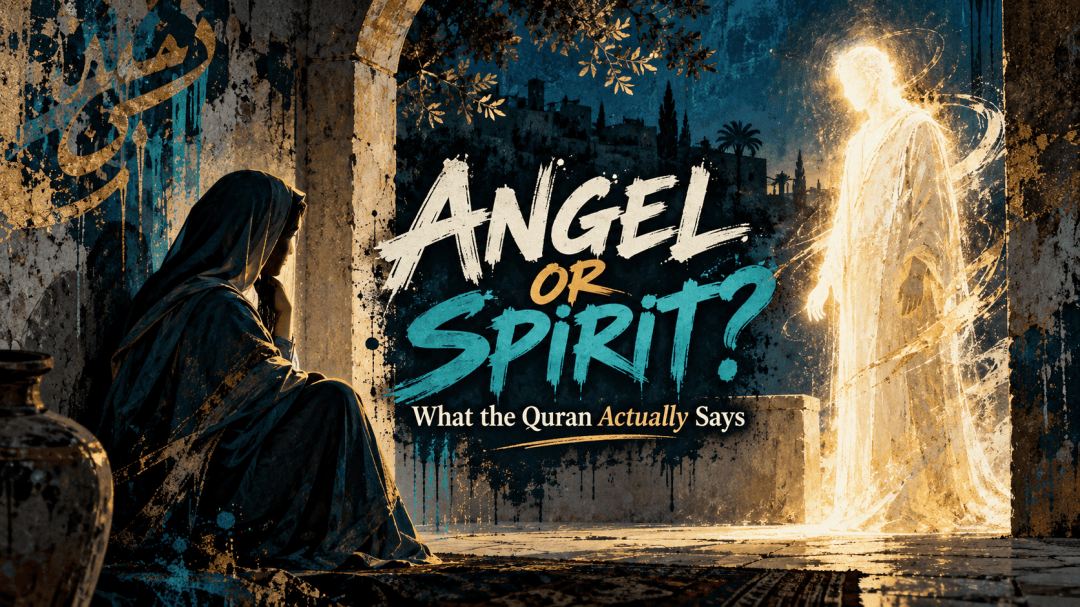
The Quran describes a remarkable encounter in which a heavenly being appears to Mary to announce the birth of Jesus. Traditionally, Muslims identify this being as the angel Gabriel. But a closer reading of the Quran reveals an important distinction: the Quran never explicitly identifies the being who appeared to Mary as an angel. Instead, it calls him a Spirit (rūḥ).
The Spirit Who Appeared as a Man
In Sura Mary, the Quran describes Mary withdrawing from her family when God sends a mysterious being to her:
[19:17] She secluded herself from them behind a barrier. Then we sent to her Our Spirit (رُوحَنَا), who appeared to her as a fully formed human being.
فَٱتَّخَذَتْ مِن دُونِهِمْ حِجَابًا فَأَرْسَلْنَآ إِلَيْهَا رُوحَنَا فَتَمَثَّلَ لَهَا بَشَرًا سَوِيًّا
Mary is understandably alarmed by the stranger’s appearance and seeks God’s protection. The being responds:
[19:19] He said, “I am only a messenger of your Lord (رَسُولُ رَبِّكِ), to grant you a pure son.”
قَالَ إِنَّمَآ أَنَا۠ رَسُولُ رَبِّكِ لِأَهَبَ لَكِ غُلَٰمًا زَكِيًّا
Two details are significant. First, God calls the being Our Spirit (rūḥanā), not an angel (malak). Second, the being identifies himself as a messenger (rasūl), describing his function rather than identifying himself as an angel. Neither designation requires that the being be classified as an angel.
But Doesn’t the Quran Say Angels Spoke to Mary?
Yes. Elsewhere, the Quran describes angels addressing Mary:
[3:42] The angels (الْمَلَائِكَةُ) said, “O Mary, God has chosen you, purified you, and chosen you above the women of the worlds.”
[3:45] The angels (الْمَلَائِكَةُ) said, “O Mary, God gives you good news of a Word from Him. His name is the Messiah, Jesus, son of Mary, distinguished in this world and the Hereafter, and among those brought near.”
Here, the Quran explicitly uses al-malāʾikah, the plural of malak, meaning angels.
This creates an interesting textual distinction. Sura 3 attributes the announcement to angels collectively, while Sura 19 describes a single Spirit appearing to Mary in human form.
Are these two descriptions of the same encounter? Possibly. But the Quran does not explicitly state that the Spirit of 19:17 is one of the angels mentioned in Sura 3.
Where Does Gabriel Enter the Picture?
The standard identification of this Spirit as Gabriel (Jibrīl) is based on interpretation. The Quran identifies Gabriel by name elsewhere:
[2:97] Say, “Anyone who opposes Gabriel should know that he has brought down this (Quran) into your heart, in accordance with GOD’s will, confirming previous scriptures, and providing guidance and good news for the believers.”
[2:98] Anyone who opposes GOD, and His angels, and His messengers, and Gabriel and Michael, should know that GOD opposes the disbelievers.
What makes these verses particularly interesting is that it sets Gabriel apart from the other angels. We see this occur for another time in the following verse.
[66:4] If the two of you repent to GOD, then your hearts have listened. But if you band together against him, then GOD is his ally, and so is Gabriel and the righteous believers. Also, the angels are his helpers.
The Quran also refers to the Holy Spirit (rūḥ al-qudus) bringing down revelation. See also 26:193-194.
[16:102] Say, “The Holy Spirit has brought it down from your Lord, truthfully, to assure those who believe, and to provide a beacon and good news for the submitters.”
These passages provide a basis for associating Gabriel with the Spirit, as they appear to serve the same function. However, neither Gabriel nor the word malak appears in the account of the Spirit’s appearance to Mary in Sura 19.
The distinction matters because the Quran is capable of identifying angels explicitly when it intends to do so. Yet in its detailed account of Mary’s encounter, it deliberately uses the term rūḥ. Nevertheless, the Quran explicitly tells us that the knowledge we have regarding the rūḥ, which can also be revelation, is limited.
[17:85] They ask you about the revelation (rūḥ). Say, “The revelation comes from my Lord. The knowledge given to you is minute.”
وَيَسْـَٔلُونَكَ عَنِ ٱلرُّوحِ قُلِ ٱلرُّوحُ مِنْ أَمْرِ رَبِّى وَمَآ أُوتِيتُم مِّنَ ٱلْعِلْمِ إِلَّا قَلِيلًا
Conclusion
The question is not whether the Quran teaches that angels communicated with Mary. It clearly does. The question is whether the Quran explicitly identifies the particular being who appeared to her in human form as an angel.
It does not.
The text identifies that being as God’s Spirit (rūḥ), who appears as a human and declares himself a messenger of God. Identifying him specifically as Gabriel, or equating him with an angel, requires an additional interpretive step. That interpretation may be true, but it should not be confused with what the passage explicitly says.


