
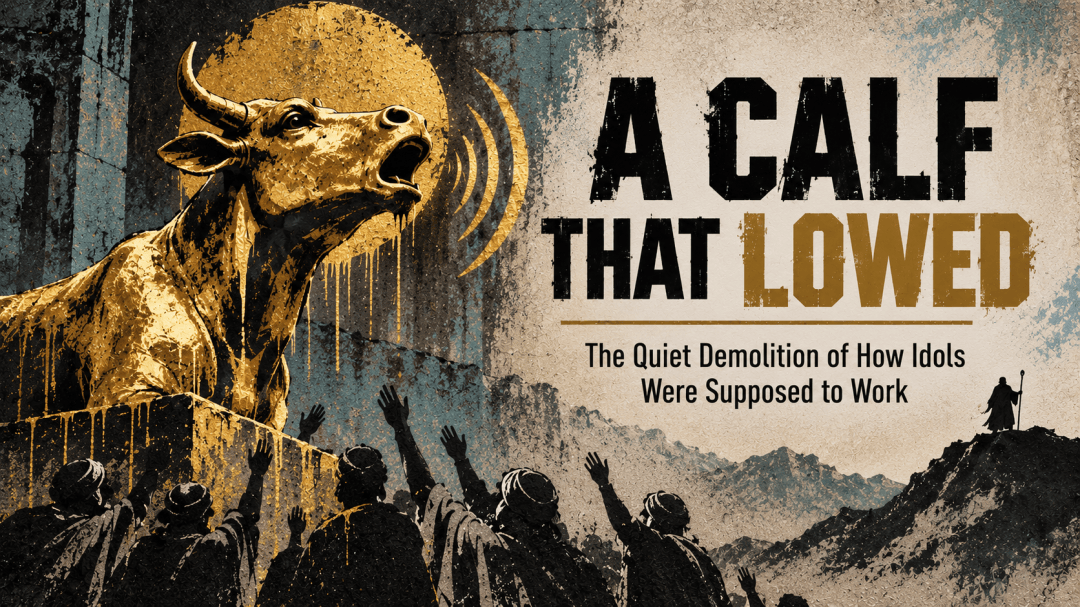
The Quran’s account of the golden calf includes a subtle detail that the Book of Exodus omits. The calf, we are told, was a body that made the sound of a calf.
It is easy to read past this as a piece of narrative color, a miraculous flourish. It is anything but. To an audience formed by the religious world of the ancient Near East—and above all by Egypt, out of which these people had just walked—a statue that made a sound was not a curiosity. It was the whole point. Sound was the signature of a working idol.
The Text and Its Strange Precision
Two passages carry the account. The first states the fact and immediately undercuts it:
[7:148] During his absence, Moses’ people made from their jewelry the statue of a calf, complete with the sound of a calf Did they not see that it could not speak to them, or guide them in any path? They worshiped it, and thus turned wicked.
The second gives the scene at Sinai, with Moses’s people explaining themselves after the fact:
[20:88] He produced for them a sculpted calf, complete with a calf’s sound. They said, “This is your god, and the god of Moses.” Thus, he forgot. [20:89] Could they not see that it neither responded to them, nor possessed any power to harm them, or benefit them?
The Arabic of 20:88 is compact and deliberate: ‘ijlan jasadan lahu khuwār—”a calf, a body, having a lowing.” Two words do the heavy lifting. Khuwār (خُوَار) is not a generic noise; it is the specific lowing of cattle, the moo of a living animal. And jasad (جَسَد) means a body in the sense of a mere physical form, a carcass, a hull without a soul. The verse sets them side by side: a lifeless body that nonetheless emits the cry of a living thing.
Notice, too, what the immediate rebuttal targets. It does not simply say the calf was false. It asks whether the people could not see that the thing failed three specific tests: it could not return them speech (qawl), it held no power to harm or benefit, and it could not guide. Those three are not a random list. They are, in the Quran’s theology, exactly the functions that distinguish the true God from an object.
How an Idol Was Supposed to Work
Modern readers tend to assume ancient people were naive—that they mistook statues for gods in some simple, childish way. The reality was more sophisticated and, in its own terms, more coherent. Across Egypt and Mesopotamia, the cult image was not thought to be the god by virtue of being carved. It became a vessel the god could inhabit, and it became one only through ritual. A block of stone or a casting of metal was, until then, just material. The rites made it live.
In Egypt this was the Opening of the Mouth, a ceremony performed on statues and on mummies alike. Priests touched the mouth and eyes of the figure with ritual implements—an adze, the forked flint blade—reciting formulae that gave the image the capacity to breathe, to see, to eat the offerings laid before it, and to speak. Before the ritual, the statue was matter. After it, the divine presence could dwell there and act through it. The senses were switched on; the mouth, in particular, was opened so the thing could receive and respond.
Mesopotamia had a close parallel in the twin rites of mīs pî (“washing of the mouth”) and pīt pî (“opening of the mouth”), a multi-day consecration that “birthed” a manufactured statue into a living god. The most revealing feature of that ritual is what it required the craftsmen to say. Having just made the image with their own hands, the artisans symbolically renounced the work—their tools were bound and cast into the river, and they swore that they had not made it, that the god had been born of the gods, not of men. The whole ideology depended on erasing the human hand. A god that people could remember manufacturing was no god. So the manufacture had to be ritually denied.
The crucial point is that the worshiper did not necessarily believe the statue, as a piece of wood, stone, or metal, was itself the full identity of the god. The image was the body or dwelling place through which the deity became present. What mattered was the transition: something human hands had fashioned was believed to become inhabited, animated, and capable of manifesting divine life. And it was the sound that indicated that the image had crossed the threshold from artifact to confirmation that the god had arrived.
This is the world the sound of the calf is speaking to. A golden figure that lows is not a magic trick inserted for wonder. It is the ancient criterion of a working idol, met in full view. To people who carried Egypt in their bones, the khuwār would have read as certification: the ritual had succeeded, the vessel was alive, the god had arrived.
Why a Calf, and Why It Had to Speak
The choice of a calf sharpens the point, because the bull was not an arbitrary shape to a people fresh out of the Nile valley. Egyptian religion was saturated with the divine bovine. At Memphis, the living Apis bull was venerated as the manifestation of Ptah, a specific animal chosen by its markings, and when it died, it was mummified with a king’s honors, and a new incarnation was sought. Heliopolis had its Mnevis bull, tied to the sun-god. The cow-goddess Hathor presided over, among much else, the turquoise mines of Sinai itself—the very region where this episode unfolds. The bull and the cow were among the most natural available forms for a god to take, and the Israelites did not invent the impulse. The Quran shows them absorbing it directly: earlier in the same sura, having just crossed the sea, they pass a people devoted to their idols and ask Moses to make them a god of the same kind (7:138). The calf is the answer to that request.
[7:138] We delivered the Children of Israel across the sea. When they passed by people who were worshiping statues, they said, “O Moses, make a god for us, like the gods they have.” He said, “Indeed, you are ignorant people.
Gold matters here as well. In Egyptian theology the flesh of the gods was gold and their bones silver; gold was not merely precious but the very substance of divinity, incorruptible and radiant like the sun. A calf of gold was therefore, to that imagination, a figure made of god-stuff in the form of a god-animal. Add the lowing—the seal of a living presence—and every box on the ancient checklist is ticked. Divine material, divine form, divine animation. By the logic they had inherited, this was not a poor imitation of a god. It was a textbook one.
That is what makes the Quran’s response so pointed. It does not deny the phenomenon or pretend the people were simply stupid. It concedes that the object appeared to pass the test—and then it changes the test.
The Quran’s Reversal
The demolition works on three fronts, and each inverts something the ancient system took for granted.
First, it drives a wedge between sound and speech. The calf has khuwār, but 20:89 asks whether they could not see that it does not “return to them speech”—lā yarji’u ilayhim qawlan. A moo is not a word. Noise is not meaning. The ancient criterion treated any manifestation of life as evidence of divine presence, but the Quran refuses to let animal sound stand in for rational communication. A god, in the Quranic frame, is not merely a thing that makes noise; it is one that can address you, answer you, disclose something. The calf produces exactly the sound the ritual promised and remains, for that, entirely mute. It cannot say anything. It only lows.
The dramatic irony of the setting makes this almost unbearable. While the people below are marveling at a body that moos, Moses is on the mountain receiving the thing the calf can only counterfeit: actual speech from God. The tradition’s title for Moses is Kalīm Allāh, the one to whom God spoke directly, and the Quran states it plainly—God spoke to Moses (4:164). So the contrast is not abstract. At the very hour real divine speech is being given, the crowd has traded it for animal sound and called the trade an upgrade. They abandoned the God who speaks in words for a god that can manage a bovine grunt.
Second, it insists on jasad—body, only body. Whatever produced the sound, the thing itself never stopped being inert matter. The Quran’s word choice denies the animation outright. There was no indwelling presence, no life switched on; there was a hollow casting and a noise. The Quran doesn’t dwell on the how, implying the mechanism is beside the point. Whether by trick of acoustics or by the properties of the dust, the object remained an empty vessel in the form of a body. The lowing changed nothing about what it was.
Third, and most striking against the ancient background, the Quran does the opposite of the mīs pî priests. Where their ritual demanded that the human maker be erased—”I did not make it, the gods did”—the Quran will not stop naming the maker. The people made it from their own jewelry. The Samarian produced it. It came out of their own ornaments, melted in their own fire, shaped by a known hand. The text keeps the human fingerprints on the object precisely where the pagan ritual worked hardest to wipe them off. The whole ancient machinery of legitimacy ran on forgetting who did the casting. The Quran refuses the amnesia. You made this. You remember making it. And a thing you remember making is not your Lord.
Moses then declares that they will burn the calf and scatter it in the sea (20:97). A real god cannot be melted and thrown to the waves. The final proof of its nondivinity is simply that it can be destroyed by the very people who worshiped it, and that when destroyed it does nothing—no wrath, no rescue, no word. It cannot even protest. The god that lowed goes silent under the fire, because it was only ever a body.
What the Sound Was Meant to Prove
Seen this way, the khuwār is not a strange embellishment. It is the hinge of the whole account. The Quran includes it because it wants to engage idolatry at its strongest point, not its weakest. It takes the ancient world’s best evidence for a working god—an animated image that manifests the sound of life—grants that the evidence is there, and then shows that the evidence proves nothing that matters. Life-like is not alive. A sound is not a word. Presence performed is not presence possessed.
And this is why the calf functions in the Quran as the archetype of every idol, not merely as one historical lapse. The pattern it exposes recurs wherever people give ultimate devotion to something they themselves have made and lent the appearance of life and voice—an image, an institution, an ideology, a system of wealth that seems to speak and respond and reward. The test the Quran applies to the calf is the test it applies to all of them, and it is the same test each time: Can it return you a word? Can it guide you? Can it help or harm? The calf could low. What it could not do was answer. What it could not do was guide. What it could not do was benefit or harm. Those silences, beneath the convincing sound, are the entire anatomy of a false god.
Related Articles:


