
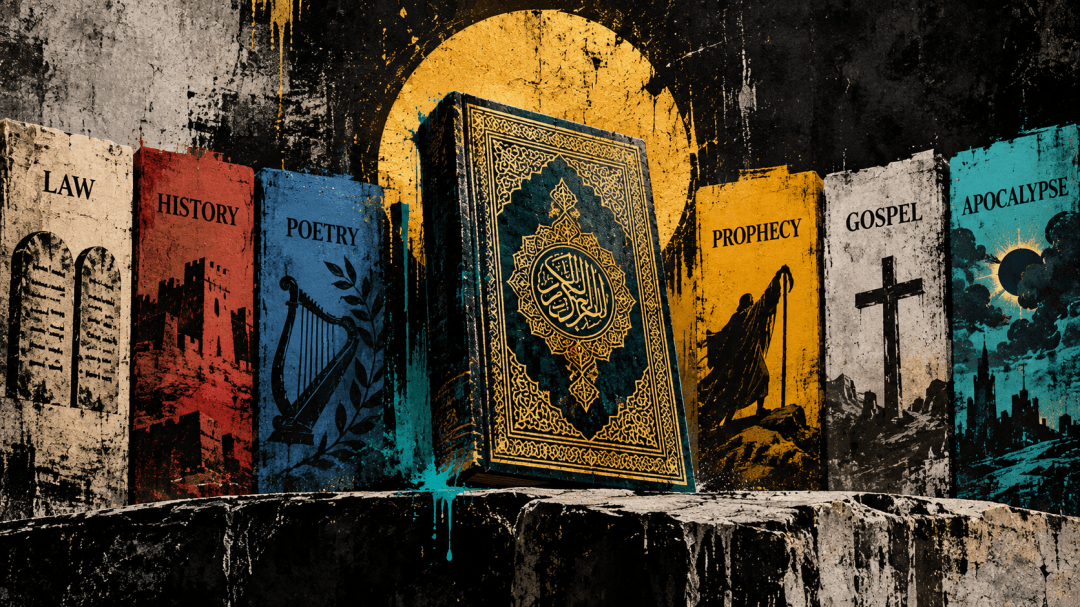
Every reader approaches a new text with a question, usually unspoken: What kind of thing is this? Genre is the first act of interpretation. We read a legal code differently from a love poem, a chronicle differently from a prophecy. Misjudge the genre and everything downstream goes wrong.
Readers coming to the Quran from the Bible face this problem acutely. The resemblances are everywhere—Moses, Abraham, Mary, judgment, mercy, covenant—and so the temptation is to slot the Quran into a familiar category. Is it a legal book like the Torah? A prophetic collection like Isaiah? A hymnal like the Psalms? A gospel? An apocalypse?
The honest answer is yes, in part, to each—and no, never completely. The Quran touches nearly every major biblical genre and then declines to be contained by any of them. That refusal is not a defect in the comparison. It is the most important thing the comparison reveals.
The Problem With Borrowed Categories
The Bible is not a single genre; it is a library. The Hebrew Bible alone contains law, narrative history, prophetic oracle, hymn, lament, proverb, philosophical dialogue, love poetry, and apocalyptic vision. The New Testament adds gospel, acts, epistle, and apocalypse. Each of these arose in a particular setting, was shaped by particular conventions, and was typically compiled by editors working with earlier material.
The Quran presents itself differently. It is not a library of books by different authors but a single voice, delivered over roughly two decades, collected into 114 sūras. So the question is not “which biblical book is the Quran most like?” but “which biblical modes of speech does it draw on, and how does it recombine them?”
Let us go through the candidates.
1. Law: Like the Torah, but Not a Code
The Quran contains legislation: inheritance, marriage and divorce, restitution, dietary restrictions, rules of fasting and pilgrimage, commercial ethics. Sūra 2 (al-Baqarah), sūra 4 (al-Nisā’), and sūra 5 (al-Mā’idah) are especially dense with such material. Here the kinship with the Pentateuch is real, and the Quran itself acknowledges it, presenting its rulings as continuous with earlier revelation.
But compare the form. Leviticus and Deuteronomy are organized as codes, with topics grouped, penalties specified, and case-law structures (“If a man does such-and-such, then…”) that anticipate courtroom application. The Quran’s legal material is scattered, brief, and embedded in other kinds of speech. A ruling on divorce may be followed immediately by an exhortation to God-consciousness, and then by a reflection on the limits of human knowledge. The legal verse almost always carries a moral or theological rider—”be mindful of God,” “God is Knowing, Wise”—that the Torah’s casuistic law rarely attaches so insistently.
The result is that the Quran functions as a source of law but is not a codified law book.
2. Narrative: Like Genesis and Kings, but Not History
The Quran retells stories familiar to Bible readers: Adam, Noah, Abraham, Lot, Joseph, Moses, David, Solomon, Jonah, Mary, Jesus. A reader coming from Genesis or Exodus will recognize the skeleton immediately.
What they will not recognize is the method. Biblical narrative is typically sequential and anchored in genealogy and chronology: this happened, then this, and these were the descendants. The Quranic narratives are fragmentary, recurring, and selective. Moses appears in dozens of places, but never in a continuous life-story from birth to death; each telling isolates a moment—the burning bush, the confrontation with Pharaoh, the encounter at the sea—and presses it into service for a specific argument.
The major exception, Joseph in sūra 12, is instructive. It is the one extended, sequential narrative, and the Quran itself marks it as exceptional, calling it the “best of stories” or translated alternatively as “the best history.” It reads far more like Genesis 37–50 than anything else in the book. But even here the retelling has a different purpose: the moral and theological payoff is foregrounded, and the story is framed by an address to the audience at its beginning and end.
So the Quran’s narratives are better described as homiletic retellings. They resemble the way a preacher or midrashist uses a story—compressed, allusive, assuming the audience already knows the outline—rather than the way a chronicler records it. The stories are arguments in narrative form.
3. Prophetic Oracle: Like Isaiah and Jeremiah, but Without the Frame
This is perhaps the closest cousin. The prophetic books of the Bible are filled with divine speech: warnings of judgment, calls to repentance, indictments of injustice and idolatry, promises of restoration. Large parts of the Quran, especially the earlier Meccan sūras, have the same thundering, urgent quality.
Yet there is a structural difference that matters enormously. In the Hebrew prophets, God’s speech arrives inside a human frame. “The words of Jeremiah, the son of Hilkiah”; “In the year that King Uzziah died I saw the Lord.” There is a narrator, a biographical setting, an introductory formula, and a prophet whose personality, anguish, and autobiography are woven into the text. The book is about the prophet and his message together.
The Quran largely removes this frame. The dominant voice is God’s own, often in the first-person plural or singular, addressing the audience directly, frequently through the command qul—”Say.” The messenger is repeatedly told what to say, what to answer, how to respond to objections. The human prophet is present as the recipient and as an occasional addressee, but he is not the narrator and the text is not his memoir. Compare the Psalmist’s or Jeremiah’s raw self-disclosure with the Quran’s strict reticence about its human medium.
So it is a prophetic book that has stripped away the biography. It keeps the oracle and drops the prophet’s story.
4. Hymn and Prayer: Like the Psalms, but Addressed Outward
The Psalter is Israel’s prayer book: praise, thanksgiving, lament, petition. The Quran contains prayers and doxologies too. The first sūra, al-Fātiḥah, is essentially a seven-verse prayer:
In the name of GOD, Most Gracious, Most Merciful. Praise be to GOD, Lord of the universe. Most Gracious, Most Merciful. Master of the Day of Judgment. You alone we worship; You alone we ask for help. Guide us in the right path; the path of those whom You blessed, not of those who deserve wrath, nor of the strayers.
This could sit comfortably in the Psalter. And the Quran contains many other petitions, praises of God’s names, and expressions of awe at creation, reminiscent of Psalms 104 or 148.
But the overwhelming majority of the Quran is not human speech to God; it is divine speech to humans. The Psalms move upward—from the worshiper to God—and are in that sense a record of human response. The Quran moves downward, and where it models human prayer it does so as a teaching: this is how you should speak. Even the Fātiḥah, though phrased as human speech, is placed in the book as divine instruction on how to pray. The Psalter gives voice to the human heart; the Quran gives the human heart its words.
5. Wisdom: Like Proverbs, Job, and Ecclesiastes, but Not Detached
Biblical wisdom literature observes the world and distills practical and philosophical insight. It speaks of the fear of the LORD as the beginning of knowledge (Proverbs 1:7, RSV), reflects on suffering (Job), and doubts the permanence of human achievement (Ecclesiastes).
The Quran shares the wisdom tradition’s appeal to observation: rain reviving dead land, the alternation of night and day, the structure of the human embryo, the ships on the sea. It also shares its moral realism about arrogance, greed, and the transience of worldly gain. Luqmān’s counsel to his son in sūra 31 reads very much like a father’s instruction in Proverbs.
The difference is that the Quran’s observations are rarely offered as neutral wisdom to be weighed. They are signs (āyāt)—the same word used for the verses of the book itself. Nature and scripture are parallel sets of signs, and the observer is not invited to ponder but summoned to a decision. Wisdom in the Bible often ends in a shrug of humility, as in Job’s conclusion or Ecclesiastes’ refrain; in the Quran the same observations function as evidence in a case.
6. Covenant and Treaty: Like Deuteronomy, but Perpetually Renewed
Scholars of the Hebrew Bible have long noted that Deuteronomy follows the structure of ancient Near Eastern suzerainty treaties: a preamble, a historical prologue recalling what the sovereign has done, stipulations, blessings and curses, and witnesses. The covenant is the master category.
The Quran is saturated with covenant language—mīthāq, ‘ahd—and the pattern of recalled benefaction, obligation, and consequence recurs constantly. The speech to the Children of Israel in sūra 2 is practically a covenant lawsuit in the prophetic mode. But the Quran does not organize itself around a single treaty document. Covenant is a thread, not a skeleton. It appears in the retelling of what God asked of earlier peoples and in the new obligations placed on the community now addressed, and it shifts constantly between past and present.
7. Apocalyptic: Like Daniel and Revelation, but Without the Code
Daniel and Revelation unveil the end of history through symbolic visions—beasts, horns, seals, trumpets—that must be interpreted. In Daniel, an angel explains the dream; in Revelation, the images are layered with numbers and figures that readers have been decoding for two thousand years.
The Quran has an equally vivid eschatology: the sun folded up, the stars scattered, the mountains set in motion, the earth shaken and made to disgorge its burdens, the weighing of deeds, paradise and hell described in sensory detail. Short Meccan suras such as 81, 82, 99, and 101 are pure cosmic upheaval, delivered in staccato rhythm. In atmosphere, the kinship with the apocalyptic imagination is unmistakable.
Here the Quran divides its material in two. On the Day of Reckoning itself—that it will come, that every soul will be judged, what awaits each outcome—the text is as plain as speech can be. No dream needs interpreting, and no angel stands by to translate an image into a political referent. But the signs that precede it are handled differently. They are named briefly and left underspecified: the release of Gog and Magog (18:94–99; 21:96), the creature brought out of the earth (27:82), and two figures tied to the end by indirect means—the sleepers of the cave, whose discovery is presented as proof that the Hour is beyond doubt (18:21), and Jesus, described as a sign of the Hour (43:61). Each arrives without a key, a timetable, or a chain of identifications. The reader is told that something is connected to the end and not told how.
Then there is 20:15, where God says the Hour is coming and that He “almost” keeps it hidden. The word is striking. It does not say fully hidden. Set beside verses declaring that knowledge of the Hour rests with God alone (7:187; 31:34), it describes a deliberate gap: the date is withheld, yet the surrounding signs are laid out just loosely enough to invite reflection. That invitation is why these passages have attracted centuries of speculation, and the openness reads as a feature of the text, not an oversight.
So the contrast with Daniel and Revelation is real but subtler than “decoded versus declarative.” Apocalyptic literature usually offers a cipher and a community of insiders who hold its solution. The Quran offers no cipher. It gives a certain destination and a set of open-ended markers along the road, and it presses the audience toward conduct while leaving the pondering to them.
8. Gospel and Sayings: Like the Teaching of Jesus, but Not a Biography
The New Testament gospels are narratives about a person. They record deeds, miracles, journeys, controversies, and sayings, and they present a life as the vehicle of revelation. Even the briefest gospel is built on a biographical spine: baptism, ministry, passion, resurrection.
The Quran inverts this. Muhammad is named only four times (3:144; 33:40; 47:2; 48:29), with one further reference under the name Ahmad (61:6). The events of his life that do surface—Badr and Uhud, the flight from Mecca with his companion in the cave, the change of prayer direction, the night journey, Hunayn—appear as passing allusions without the setting a biographer would supply. Beyond these, there are glimpses of conduct: gentleness toward his community, patience under mockery, correction for his own lapses. But there is never a sequence and never a portrait.
What the text offers instead is his voice. Over 300 times, the prophet is commanded with the word qul—”Say”—followed by the exact words he is to speak. This bears directly on reliability. The Gospels report Jesus’s words through narrators writing decades afterward, in Greek, rendering speech originally delivered in Aramaic, so every saying has passed through a chain of tellers. The qul passages are different in kind: the command and the words arrive together in the same text. On the text’s own terms, we can say definitively that these are the words the prophet spoke, and no later hand stands between the speaker and the page. The Quran preserves his speech and withholds his story, which makes it an anti-Gospel in the precise sense: the gospels make the messenger the message, while the Quran makes the message everything and leaves the messenger nearly invisible.
Strikingly, the fullest life-material in the book belongs to others. Moses is named well over a hundred times, Abraham dozens, and Joseph receives an entire sura. Pieces of the lives of Noah, Lot, Jonah, Mary, and Jesus are scattered through the text as well—Moses’s childhood and exile, Abraham’s confrontation with his father, Mary’s seclusion and Jesus’s birth. The Quran carries more biography of earlier prophets than of its own.
Additionally, the Quran does contain parable-like material, as in the similes of light in sura 24 or the extended comparison of a good word to a good tree in sura 14, and it contains the compact, aphoristic ethical teaching that echoes the Sermon on the Mount’s tone (compare Matthew 5:3–12, RSV, with the descriptions of the righteous in sura 25 or 23). But these are fragments within a different whole.
9. Epistle, but to Everyone
The New Testament letters are occasional documents, written to particular communities in response to particular situations, with greetings, arguments, and closing instructions. The Quran does show a similar responsiveness: many passages answer specific questions (“They ask you about…”) or react to concrete events in the community’s life, and sūra 33 or 49 read like community regulation.
Yet the Quran’s addressee shifts continually—to the prophet, to the believers, to the Children of Israel, to the disbelievers, to all of humanity—often within a single sūra. An epistle has one audience and one occasion. The Quran has many audiences and many occasions folded together, with no stable letter-form.
What Is Left After the Comparison
If we lay all these genres side by side, a pattern emerges. The Quran is not a mixture of biblical genres in the way an anthology is a mixture. It is something stranger: a single mode of address that continually passes through the registers of law, story, prophecy, prayer, wisdom, covenant, and apocalypse, without settling in any of them.
A few features are distinctive enough to name.
First, the unmediated divine voice. Almost no other scripture relies so heavily on God as the speaker, and almost none removes the human narrator so completely. The Bible’s genres are overwhelmingly testimonies about divine action and speech, edited by human hands into books. The Quran claims to be the speech.
Second, the self-referential character of the text. The Quran constantly talks about itself: it is a Book, a Reminder, a Criterion, a Recitation, a Light, a Healing. It tells the audience how to read it, what its purpose is, and how it relates to earlier scriptures. Few biblical books do this to the same degree. This self-awareness makes the Quran partly a meta-text, a scripture that comments on scripture.
Third, the thematic rather than chronological or topical arrangement. The suras are not arranged in the order of revelation or by subject. Generally, the ordering places the longer suras first, and within each sura themes recur, return, and interlock. Scholars debate the reason for this ordering of suras, as well as the ordering within individual suras. Whatever one thinks of the reasoning behind this, the point is that the Quran’s organizing logic is not that of a code, a chronicle, or a collection of oracles.
Fourth, the written and recited character. The Quran is a written text meant to be read aloud. The name Qur’ān comes from a root meaning to read out from something before you, and the text calls itself Kitāb, “Book,” again and again. Its opening command in sura 96 is “Read,” joined at once to the pen (96:3–5), and its source is a preserved tablet (85:21–22), a written archetype in the heavenly domain. The rhymed, rhythmic prose called saj’ serves recitation and memory, much as a Torah scroll is written and then chanted. The contrast with the Bible lies less in oral versus written than in how each came together.
Fifth, the rhetorical immediacy. The Quran argues. It anticipates objections, quotes the opposition, answers them, shifts tone from tender to severe in a breath, and addresses its audience as a living interlocutor. It is closer to a sustained, many-voiced address than to any single biblical form.
Why This Matters
It is easy to treat the Quran’s non-fit with biblical genres as a flaw—as if a “proper” scripture should organize itself as the Bible does. Critics sometimes make exactly this move, complaining that the Quran is disorganized, repetitive, or lacking narrative continuity. But that criticism assumes the genre it is supposed to be judged against. A text that deliberately works across genres, in a single authoritative voice, aimed at persuading a live audience, should be judged on its own terms.
For the reader, the practical lesson is this: do not ask which biblical book the Quran is. Ask instead what the Quran is doing when it adopts the voice of a lawgiver, a storyteller, a prophet, a psalmist, a sage. Each borrowed register is a tool, picked up for a moment and put down again. The unity of the book lies not in any single genre but in the voice that moves among them and the purpose that drives it.
That is why the comparison with the Bible, done carefully, ends up illuminating both sides. It shows how much shared vocabulary there is—and how differently that vocabulary is deployed. The Quran is neither a copy of the earlier scriptures nor a departure from them. It is a text that stands in their tradition while insisting on being read as something that belongs to no tradition’s template: a category of one.


