
Ezekiel was a priest of the Jerusalem temple who never served in it. In 597 BCE, the Babylonians deported him along with King Jehoiachin and the city’s elite, and he was settled among the exiles by the Chebar canal. In 593, he began to prophesy there. His audience believed Jerusalem could not fall, because God’s house stood inside it. Ezekiel’s task was to tell them it would fall, and that it deserved to. The city was destroyed in 586.
Chapter 23 is one of the ways he said it. Two sisters, Oholah and Oholibah, stand for Samaria and Jerusalem. Samaria, capital of the northern kingdom, courted Assyria and was destroyed by it in 722. Jerusalem watched this happen and did the same thing, first with Assyria, then with Babylon, and then with Egypt. The chapter is a history of Judah’s foreign alliances told as a history of sexual appetite. The immediate background is King Zedekiah’s revolt against Babylon, which depended on the hope of Egyptian help. Ezekiel wanted his listeners to understand that this hope was the same sin Jerusalem had been committing since its youth.
Readers who know the chapter only through polished translations are in for a shock when they meet the Hebrew. Verse 20 reads:
וַתַּעְגְּבָה עַל־פִּלַגְשֵׁיהֶם אֲשֶׁר בְּשַׂר־חֲמוֹרִים בְּשָׂרָם וְזִרְמַת סוּסִים זִרְמָתָם
Va-ta’agvah ‘al-pilagshehem asher besar-ḥamorim besaram ve-zirmat susim zirmatam.
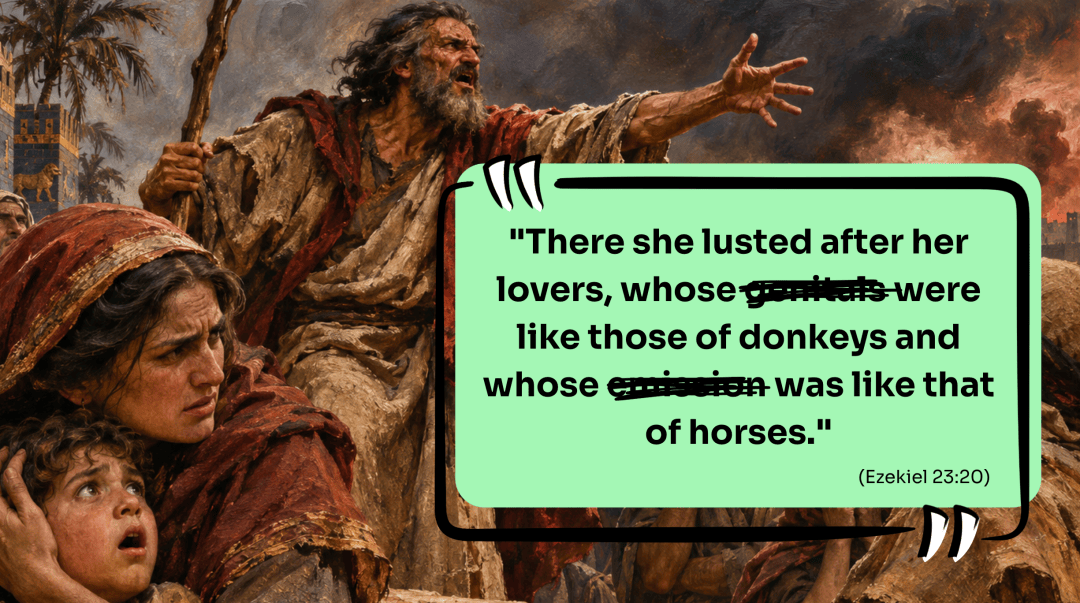
“There she lusted after her lovers, whose genitals were like those of donkeys and whose emission was like that of horses.” (Ezekiel 23:20)
Each piece matters. The verb ta’agvah is lust in its most physical sense, a word used for desire that has no restraint in it. Besar means flesh, and the Hebrew Bible uses it as a euphemism for the male organ, as in Leviticus 15 and in Ezekiel 16:26, where the Egyptians are already called “big of flesh.” Ḥamorim are male donkeys. Zirmah appears nowhere else in the Hebrew Bible. It is related to zerem, the word for a downpour or flood, and the sense is a gushing discharge. Susim are stallions. Put together, the verse says that Jerusalem lusted after men whose penises were like those of donkeys and whose ejaculation was like that of stallions. The RSV’s “members” and “issue” are polite Victorian-sounding stand-ins for something the Hebrew says without apology.
The verse does not name Egypt itself. The identification comes from the surrounding verses, where Oholibah remembers “the days of her youth, when she played the harlot in the land of Egypt” (23:19), and from verse 21, where the Egyptians are those who handled her breasts. The comparison to animals is also not a literal claim about anatomy. It is contempt. The prophet reduces Egypt’s men to beasts and reduces Jerusalem’s political alliance to an animal appetite, and he does it in the crudest register available to him.
Nor is this an isolated passage. The same chapter says that in Egypt “their breasts were squeezed, and there the nipples of their virginity were fondled” (Ezekiel 23:3). It describes Oholah’s lovers as horsemen and young men she craved. And it does not end with the images of desire. In verse 25, the lovers return as executioners who cut off the woman’s nose and ears, take her sons and daughters, and burn what is left. In verses 45 to 47, the assembly is told to stone her and cut her down with swords.
This is where the passage forces a question on anyone who calls the text a moral guide. A defender can say it is only an allegory, and that is true, since no one believes Oholah and Oholibah were real women. But an allegory still has to choose its vehicle. The prophet chose a woman as the symbol of the guilty city, made her desire the crime, made her body the evidence, and prescribed mutilation and public execution as the punishment. The men in the story are animals, and she is the one who answers for it. Ezekiel’s point about political loyalty could have been made without any of this, and it was not.
Readers should not look away from this. Whatever one concludes about the Bible, any account of it has to include chapter 23 as written, with the Hebrew words that translators have spent centuries softening.


