
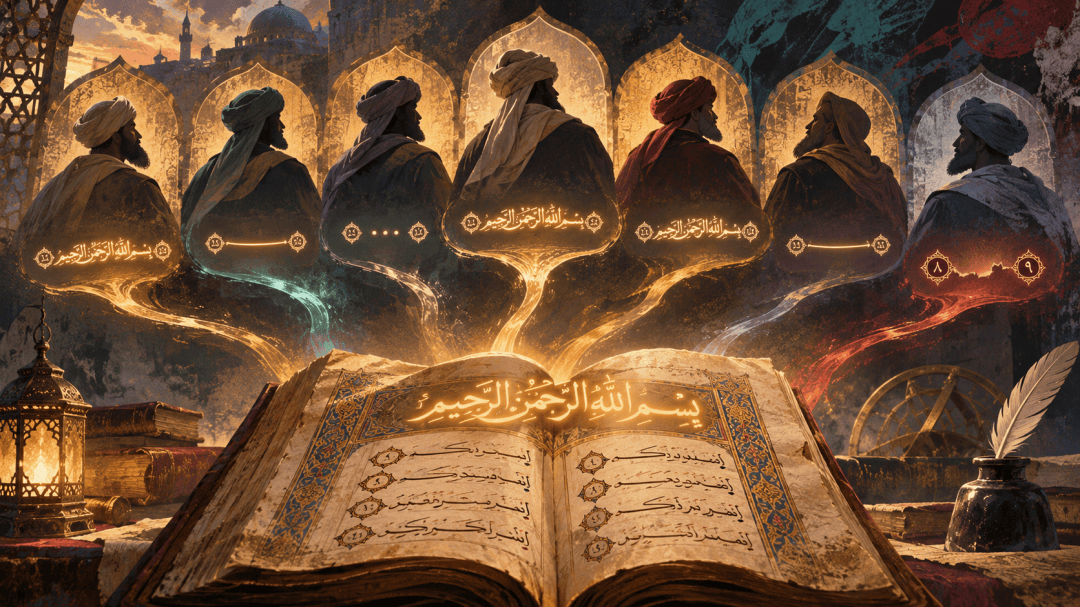
Abū ʿAmr al-Dānī (371–444 AH / 981–1053 CE) was an influential Andalusian scholar of Qur’anic recitation. His al-Taysīr fī al-Qirāʾāt al-Sabʿ (The Facilitation of the Seven Readings) became one of the foundational works on the seven canonical reading traditions (qirāʾāt) of the Quran.
| Region | Reader | First Transmitter | Second Transmitter |
|---|---|---|---|
| Medina | Nāfiʿ (d. 169 AH / 785 CE) | Qālūn (d. ca. 220 AH / 835 CE) | Warsh (d. 197 AH / 812 CE) |
| Mecca | Ibn Kathīr (d. 120 AH / 738 CE) | Qunbul (d. 280 AH / 904 CE) | al-Bazzī (d. 250 AH / 864 CE) |
| Basra | Abū ʿAmr (d. 154 AH / 770 CE) | al-Dūrī (d. 246 AH / 860 CE) | al-Sūsī (d. 261 AH / 874 CE) |
| Damascus | Ibn ʿĀmir (d. 118 AH / 736 CE) | Ibn Dhakwān (d. 242 AH / 856 CE) | Hishām (d. 245 AH / 859 CE) |
| Kufa | ʿĀṣim (d. 129 AH / 745 CE) | Shuʿbah (d. 174 AH / 809 CE) | Ḥafṣ (d. 180 AH / 796 CE) |
| Kufa | Ḥamzah (d. 156 AH / 773 CE) | Khalaf (d. 229 AH / 844 CE) | Khallād (d. 220 AH / 835 CE) |
| Kufa | al-Kisāʾī (d. 189 AH / 804 CE) | al-Dūrī (d. 246 AH / 860 CE) | Abū al-Ḥārith (d. 240 AH / 854 CE) |
In 2026, linguist Marijn van Putten published an English translation of this work, titled al-Dānī’s al-Taysīr fī al-qirāʾāt al-sabʿ: A Translation with Linguistic Commentary (Open Book Publishers). The translation provides valuable insight into the historical differences between the canonical reciters, including their pronunciation, grammar, and recitational practices.
One particularly interesting passage appears on page 83, in section U.6, titled “The tasmiyah.” Here al-Dānī documents disagreements concerning the recitation of the basmalah—the familiar formula “In the name of God, the Most Gracious, the Most Merciful” (bi-smi llāhi r-raḥmāni r-raḥīmi)—between surahs.
Al-Dānī explicitly acknowledges that the canonical readers disagreed over whether the basmalah should be recited between successive surahs of the Quran.
He writes:
U.6. The tasmiyah
(The readers) disagree in the saying of the tasmiyah¹⁶ between the sūrahs. Ibn Kaṯīr, Qālūn, ʿĀṣim and al-Kisāʾī say the tasmiyah between two sūrahs in the whole Qurʾān except between al-ʾAnfāl (Q8) and Barāʾah (= al-Tawbah, Q9). There is no disagreement in the absence of the saying of the tasmiyah between these two. The rest, for what I have recited for them, do not say the tasmiyah between sūrahs.
The companions of Ḥamzah connect the end of a sūrah with the beginning of the next (in one breath, without a pause). It is preferred in the tradition of Warš, ʾAbū ʿAmr and Ibn ʿĀmir to have a silence between two sūrahs without interruption (i.e., without drawing breath). Ibn Muǧāhid considers it (proper) to connect one sūrah to the next without dropping the ʾiʿrāb. He also considers it (proper) with a silence. (P:17)
Some of our masters, when reading in these traditions (i.e., Warš, ʾAbū ʿAmr and Ibn ʿĀmir), used to say the tasmiyah between al-Muddaṯṯir (Q74) and al-Qiyāmah (Q75), between al-Infiṭār (Q82) and al-Muṭaffifīn (Q83), between al-Faǧr (Q89) and al-Balad (Q90) and between al-ʿAṣr (Q103) and al-Humazah (Q104). And when reading in the manner of Ḥamzah, they used to introduce a silence between these pairs of sūrahs (without the tasmiyah). There is no report of that which is transmitted from them (i.e., from Warš, ʾAbū ʿAmr, Ibn ʿĀmir and Ḥamzah); it is only a matter of preference of the masters.
There is no disagreement in the saying of the tasmiyah at the beginning of the Fātiḥah (Q1) or at the beginning of each sūrah that a reciter begins on and has not connected with what is before it, in the tradition of those who separate (sūrahs with a tasmiyah) and of those who do not.
As for beginning at the start of a division of the Qurʾān which is in (the middle of) a sūrah, my teachers allow the reciter to choose between saying the tasmiyah and omitting it.
Separation (i.e., drawing breath) after the tasmiyah when one has connected it with the end of the (previous) sūrah is not allowed. Success comes from God.
16 Also known as the basmalah, i.e., to say bi-smi llāhi r-raḥmāni r-raḥīmi.
— Source: Abū ʿAmr al-Dānī, al-Taysīr fī al-qirāʾāt al-sabʿ, in Marijn van Putten, al-Dānī’s al-Taysīr fī al-qirāʾāt al-sabʿ: A Translation with Linguistic Commentary (Open Book Publishers, 2026), § U.6, p. 83. https://doi.org/10.11647/OBP.0475
According to this account, the reciters followed different practices:
- Ibn Kathīr, Qālūn (transmitting from Nāfiʿ), ʿĀṣim, and al-Kisāʾī: Recited the basmalah between suras, except between Surahs 8 and 9.
- The remaining traditions as transmitted by al-Dānī: Did not recite the basmalah between successive surahs.
- Hamzah: His transmitters joined the end of one surah directly to the beginning of the next without pausing.
- Warsh, Abū ʿAmr, and Ibn ʿĀmir: Preferred a brief silence between suras without reciting the basmalah.
Al-Dānī further records that some teachers introduced the basmalah between certain specific suras even within traditions that normally omitted it. Significantly, he acknowledges that these exceptions were not based on transmitted reports from the canonical readers themselves, but merely reflected the preferences of individual teachers.
Nevertheless, he reports agreement on reciting the basmalah at the beginning of al-Fātiḥah and when independently beginning the recitation of a sura.
Conclusion
Al-Dānī’s account demonstrates that the seven canonical Qur’anic reading traditions did not agree on the treatment of the basmalah. Some reciters pronounced it between suras, others omitted it, and others simply observed a brief silence.
More significantly, the status of the basmalah itself was historically disputed. Not all early authorities considered the basmalah at the beginning of each surah to be part of that sura’s revealed text. Some regarded it as an independent Quranic verse serving to separate suras, while others did not consider its repeated appearance at the beginning of suras to constitute Quranic revelation. Under the latter understanding, the basmalah functioned much like a surah title: a conventional marker identifying the beginning of a chapter rather than part of the revealed passage itself.
This distinction is important because it demonstrates that the boundaries between the Quranic revelation and the editorial or recitational conventions accompanying it were themselves subjects of disagreement within the Islamic tradition. Even among the canonical reciters, the treatment of the basmalah was not uniform.


