In Moses & Aaron and the Allegory of the Mind, we read a single prophetic narrative as a map of the mind’s internal architecture: Moses as the perceiving faculty that meets God directly, Aaron as the articulating faculty that renders the encounter into language, the Children of Israel as the flesh, the Samarian as the ego. That reading looked inward, at the parts of one mind working in relationship.
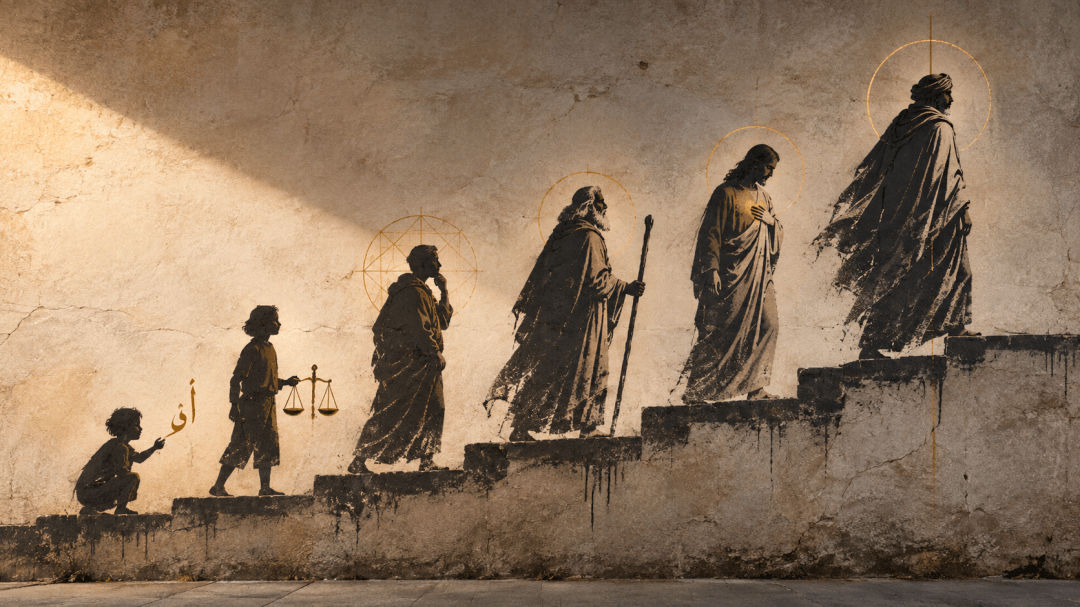
This essay looks outward, along the whole chain of prophecy, and asks a different question. If a single prophet’s story can diagram the structure of a mind, can the sequence of prophets diagram the development of the mind—the stages by which the human interior actually came to be what it is? The suggestion is bold, and it should be stated plainly before it is defended: the major prophets can be read as emblems of successive capacities of the human psyche, and the order in which they come traces the maturation of the human interior, from the first spoken name to the sealed, self-governing faculty of judgment.
This is an allegorical reading, not a claim that the Quran sets out a theory of neurocognitive evolution, and not a claim that Noah’s contemporaries were literally incapable of thought while Muhammad’s were not. It is a claim that revelation tracks the growth of the very faculty capable of receiving it—that God speaks to a maturing creature in the register that creature has become able to hear, and that the record of how He spoke is therefore also a record of what we were becoming. Read this way, the prophets are not only messengers. They are milestones.
The stages are these: Adam is language. Noah is morality. Abraham is reason. Moses is consciousness. Jesus is the heart. Muhammad is the criterion. Six capacities, and then a voice that falls silent on purpose.
Adam: Language
The Quran does not introduce the first human by his strength, his appearance, or even his obedience. It introduces him by a single capacity that the angels themselves lacked.
He taught Adam all the names, then presented them to the angels, saying, “Give Me the names of these, if you are right.” (Quran 2:31)
The Arabic is spare and total: ʿallama Ādama al-asmāʾa kullahā—He taught Adam the names, all of them. Not some names. Not the names of the things in front of him. The names as such—the capacity to attach a symbol to a reality and thereby to carry the reality in the mind when the thing itself is absent. This is language, and language is not one human trait among others. It is the threshold into the human. The angels have knowledge, but knowledge that is fixed and given. Adam has the generative thing: the power to name, and therefore to combine, to abstract, to imagine what is not present, to lie, to pray, to plan.
So Adam does not mark a shift within human history. He marks the shift into it. To be Adam is to be the animal that names—and the honor God commands the angels to show him is an honor paid to that capacity, the capacity that makes a creature able, in principle, to be addressed by its Maker at all. You cannot send a message to something that has no words to receive it. Language is the precondition of revelation.
It is also, from the very beginning, double-edged. The same power that lets a name point truly to a thing lets a name float free of any thing at all—and idolatry, the Quran will insist again and again, is finally nothing but names emptied of their referents, sounds worshipped in place of realities. The faculty that makes worship possible makes idolatry possible by the identical mechanism. Adam’s gift is the whole drama in miniature.
Noah: Morality
With Noah the register changes. Adam was given a capacity; Noah is given a charge. He is the first of the resolute messengers, the first to stand before a whole society with a sustained moral summons and a warning of consequence, and the covenant God takes from him is singled out for its weight.
We then inspired him: “Make the watercraft under our watchful eyes, and in accordance with our inspiration. When our command comes, and the atmosphere boils up, put on it a pair of every kind (of your domesticated animals), and your family, except those condemned to be doomed. Do not speak to Me on behalf of those who transgressed; they will be drowned. (Quran 23:27)
And the flood that follows is the first event in which the cosmos itself sorts humanity by conduct: the righteous carried, the wicked drowned. Morality, at Noah’s stage, becomes a principle that orders the world.
The decisive moment is easy to miss, and it is one of the most radical in scripture. When the waters rise, Noah pleads for his own son, and he is refused in terms that sever the oldest bond a human being knows:
He said, “O Noah, he is not of your family. It is unrighteous to ask Me for something you do not know.” (Quran 11:46)
He is not of your family. Not because the blood is wrong—the boy is Noah’s son—but because conduct has replaced kinship as the axis of moral desert. This is the birth of morality as a universal category rather than a tribal one. Before it, loyalty ran along lineage: my people, my blood, my dead. Noah is told, at the cost of his child, that righteousness is not inherited and does not follow the family line.
The believers are members of one family; you shall keep the peace within your family and reverence GOD, that you may attain mercy. (Quran 49:10)
It is the first appearance of the moral law as something that stands above the group and judges the group—the seed of every later distinction between what is merely ours and what is actually right. (Readers of the two-kinds-of-law essays will recognize this as the deep root of the universal, the obligation that would bind any moral agent anywhere, as against the particular customs of a single people.)
But notice how morality exists at this stage. Noah does not reason his way to the good, and he does not consult an inner conscience. He hears. God speaks; Noah builds the ark on command, warns on command, is corrected on command. The moral law at Noah’s stage is entirely exterior—a voice that issues directives and is obeyed.
Abraham: Reason
Between the command and the self stands a bridge, and its name is Abraham. He is the figure in whom the individual mind first reasons its way toward God, alone, against everyone he knows.
When he saw the sun rising, he said, “This must be my Lord. This is the biggest.” But when it set, he said, “O my people, I denounce your idolatry.” (Quran 6:78)
Abraham watches the star, then the moon, then the sun, and reasons past each one as it sets: what disappears cannot be the ground of all things. He does not receive this as a command shouted from a mountain. He works it out, and then he turns and confronts his own people with the conclusion, smashing their idols and daring them to notice that the gods they built cannot even defend themselves. Where Noah obeyed a voice, Abraham interrogates the world and follows the argument.
Such was our argument, with which we supported Abraham against his people. We exalt whomever we will to higher ranks. Your Lord is Most Wise, Omniscient. (Quran 6:83)
This is the emergence of reason as an individual faculty—the capacity to stand apart from the inherited command, to test it, and to arrive at conviction from the inside. It is the necessary preparation for what comes next, because you cannot have a self-conscious “I” until you first have an individual who can separate himself from the collective and its voices. Abraham is that individual. He is the interior beginning to detach from the tribe, reason beginning to detach from command. He does not yet complete the movement into full self-consciousness, but he makes it possible.
Moses: Consciousness
With Moses the interior arrives. This is the stage examined at length in the companion essay, and only its outline is needed here—but the outline, placed in this sequence, says something the earlier essay could not.
Moses is, in the Quran’s own insistence, the prophet God addressed directly:
And GOD spoke to Moses directly. (Quran 4:164)
The Arabic doubles the verb for emphasis—wa kallama Allāhu Mūsā taklīmā—God spoke to Moses a speaking. He still hears the voice, as Noah did. But something new is set beside the voice, and it changes everything:
We wrote for him on the tablets all kinds of enlightenments and details of everything. (Quran 7:145)
The tablets—al-alwāḥ. The Law is now written. And a written law is a different kind of object from a heard command. A command must be obeyed in the moment it is spoken; a text stands outside time, to be read, re-read, weighed, interpreted, and—crucially—disobeyed while still acknowledged. The moment the word is fixed on a surface, a gap opens between the word and the one who reads it, and into that gap steps the deliberating self. This is why Moses is the hinge of the whole sequence: he is the last prophet to fully hear and the first to fully carry the text. The written tablet is the instrument that breaks the old voice-driven mind and forces the birth of an interior “I” that must now decide for itself what to do with what it has read.
The Children of Israel give that gap its perfect expression in three words:
“We hear, but we disobey.” (Quran 2:93)
Samiʿnā wa ʿaṣaynā. This is the signature of consciousness itself. Noah’s world could not have said it, because in a world of heard command there is no space between hearing and doing. To hear and nonetheless disobey, to hold the command in mind as an object and refuse it, requires exactly the interior distance that the written Law creates. The sin is the proof of the faculty.
And over against Moses stands Pharaoh, who is the old order refusing to die—the god-king who claims to be the voice:
Proclaiming, “I am your Lord, most high.” (Quran 79:24)
Anā rabbukumu l-aʿlā. Pharaoh is the externalized authority in its final, tyrannical form, the human being who installs himself where the divine command used to sit and demands to be obeyed as a god. The Exodus, then, is the self’s liberation from bondage to the external voice, and the parting of the sea—as the companion essay argued—is the moment the mind achieves its differentiated structure, the two walls standing apart with a path between them where a person can finally move. That path is consciousness: the interior space, opened between command and act, where an “I” stands and chooses. Moses is the prophet of that opening.
Jesus: The Heart
Consciousness is a triumph and a wound. The same interior “I” that can weigh the Law and choose the good can also curve in on itself, justify itself, and set itself up as the measure of all things. The companion essay named this the Samarian—the ego that constructs a theology for what it already wanted. The characteristic disease of the Mosaic stage is precisely this pair: the ego that exalts itself, and its mirror image, the legalism that clings to the letter of the tablet and forgets what the tablet was for. Aaron, standing on the rule “do not divide the people” while the people divide themselves around an idol, is that legalism in one image. The Law can be kept perfectly and mean nothing.
Jesus answers exactly this. His work is to move morality from the tablet to the interior, from the letter to the living center. He explicitly loosens the exterior rule:
“I confirm previous scripture—the Torah—and I revoke certain prohibitions imposed upon you.” (Quran 3:50)
And the mark he leaves is not a new code but a new organ:
We sent Jesus the son of Mary, and we gave him the Injeel (Gospel), and we placed in the hearts of his followers kindness and mercy. (Quran 57:27)
The word is qulūb—hearts. What is placed there is raʾfah wa raḥmah, tenderness and mercy. This is the psychic capacity of the Jesus stage: empathy, compassion, self-transcendence—the ability to decenter the ego that consciousness created, to feel the reality of the other as one’s own, and to relocate the moral compass from the external stone into the interior heart. Where Moses gave a self that could obey the Law, Jesus gives a self that can transcend itself. It is the completion of the movement inward that Abraham began and Moses opened: first the individual reasons apart from the tribe, then the individual becomes a deliberating self, and now the deliberating self learns to overcome its own gravity.
There is a reason the scripture remembers Jesus as the Word—kalimatuhu, God’s word, “Be,” conveyed to Mary. The Word that Adam first received as the bare power of naming, and that Moses received written on stone, is now to be written on the heart and lived as a person.
[4:171] O people of the scripture, do not transgress the limits of your religion, and do not say about GOD except the truth. The Messiah, Jesus, the son of Mary, was a messenger of GOD, and His word that He had sent to Mary, and a revelation from Him. Therefore, you shall believe in GOD and His messengers. You shall not say, “Trinity.” You shall refrain from this for your own good. GOD is only one god. Be He glorified; He is much too glorious to have a son. To Him belongs everything in the heavens and everything on earth. GOD suffices as Lord and Master. (Quran 4:171)
But every stage carries its own shadow, and honesty requires naming this one too. The verse that records the mercy in the same breath records the failure:
But they invented hermitism which we never decreed for them. (Quran 57:27)
Rahbāniyya—the monastic flight from the world—was not commanded. It is the disease of the heart-stage exactly as legalism is the disease of the Law-stage: the inward turn, unbalanced, curdling into a retreat from the very world compassion was meant to serve. Where the Mosaic self risks worshipping the rule, the Jesus-self risks abandoning the field. Mercy that withdraws from the world helps no one. The stage that relocates morality to the heart can, left alone, lose the world entirely. Which is why the sequence is not yet finished.
Muhammad: The Criterion
The last prophet’s very first revelation is a single imperative, and in the context of this whole argument it lands like a thunderclap:
Read, in the name of your Lord, who created. (Quran 96:1)
Iqraʾ. Read. Adam was taught to name; Muhammad is commanded to read. The arc that opened with the bare spoken symbol closes with the fully internalized, literate engagement of the complete and written Word. And the scripture he brings is given a name that states the faculty it is meant to install:
Most blessed is the One who revealed the Statute Book to His servant, so he can serve as a warner to the whole world. (Quran 25:1)
The translation before us reads “Statute Book”; the Arabic is al-Furqān—the Criterion, from the root meaning to separate, to distinguish. The final capacity is discernment: the standing internal faculty that distinguishes truth from falsehood, right from wrong, the map from the territory, on its own. Not a new command to obey, not a new rule to keep, but the trained power of judgment itself.
And then, decisively, the voice announces that it will not come again:
He was a messenger of GOD and the final prophet. (Quran 33:40)
Khātam al-nabiyyīn—the seal of the prophets. Why does prophecy end here, and not before, and not later? The sequence answers the question. By the time of the seal, the human psyche possesses the entire toolkit that revelation has been developing across the whole chain: language from Adam, moral law from Noah, reason from Abraham, self-consciousness from Moses, the compassionate heart from Jesus, and now integrated discernment from Muhammad. The creature that once had to be told what to do, and obeyed a voice from above, has become a creature that can read the map and consult the compass for itself. The training is complete. The scaffolding comes down. There is no seventh stage delivered by an eighth prophet, because the faculty capable of standing without a prophet has finally been formed.
This is why the community of the final revelation is described not by an extreme but by a balance:
We thus made you an impartial community, that you may serve as witnesses among the people. (Quran 2:143)
Ummatan wasaṭan—a middle, balanced nation. The integration is the whole point. Not the legalism that clings to the letter (the Mosaic shadow), and not the world-fleeing hermitism that abandons the field (the shadow of the heart), but the mean that holds law and mercy together—the map and the compass in a single hand. And so the revelation can finally say what no earlier stage could:
Today, I have completed your religion. (Quran 5:3)
Al-yawma akmaltu lakum dīnakum. Completed—because the human being it addresses is, at last, complete enough to be left in charge.
The Stage With No Prophet
If revelation was the long education of a maturing mind, and the education is finished, then the next stage of the human interior is not a new capacity handed down from above. It is the test of whether we can actually operate the faculty we were given. The seal is not only a gift. It is a burden and an exam. The voice that told Noah what to do, that spoke to Moses directly, that placed mercy in the hearts of Jesus’s followers, has deliberately gone silent—not because it abandoned us, but because a creature kept forever on commands never grows up. The next stage is adulthood, with everything frightening that word contains.
And here the danger is precise, and it is the mirror image of the whole ascent. The natural gravity of the human mind, the moment the effort of self-governance becomes heavy, is to hand the criterion back—to find a new external voice to obey, a new Pharaoh to install where the discernment used to sit. We are extraordinarily good at this. We re-outsource our judgment to the crowd, to the ideology, to the party, to the religious leaders and scholars.
They have set up their religious leaders and scholars as lords, instead of GOD. Others deified the Messiah, son of Mary. They were all commanded to worship only one god. There is no god except He. Be He glorified, high above having any partners. (Quran 9:31)
The structure is the oldest one in this essay: a voice, not our own, issuing directives that spare us the labor of the interior. It is the return of Noah’s condition after the whole chain was spent lifting us out of it—a re-descent into a mind that hears and obeys and no longer reads for itself.
That is one possible next stage: relapse. The faculty was sealed in principle, and we quietly decline to use it, trading the difficult freedom of the criterion for the comfort of a command. The other possible next stage is the one the final revelation actually asks for—the slow, unforced work of using our hearing, eyesight, and brain and becoming the community God asks us to be, a humanity that has genuinely internalized the map and the compass and can walk the path between the walls without a voice to lean on.
You shall not accept any information, unless you verify it for yourself. I have given you the hearing, the eyesight, and the brain, and you are responsible for using them. (Quran 17:36)
Nothing guarantees which way it goes, and the Quran, characteristically, locates the outcome exactly where it locates all moral weight: not above us, but within.
GOD does not change the condition of any people unless they themselves make the decision to change. (Quran 13:11)
The prophets carried us from the first name to the criterion. What we do with the criterion is the one part of the sequence no prophet was sent to write. It was left blank on purpose. It is ours to determine.
Say, “What if GOD took away your hearing and your eyesight, and sealed your minds; which god, other than GOD, can restore these for you?” Note how we explain the revelations, and note how they still deviate! (Quran 6:46)
Related Articles:


