Ask a thoughtful person today whether the universe has a purpose, and you will often get a curious answer: not “yes” and not “no,” but something like “science has shown there isn’t one.” The stars are burning balls of gas. Life is chemistry that learned to copy itself. Meaning is something we invent to comfort ourselves. The universe simply is, and it is not for anything.
This feels like the mature, honest position—the view of someone who has looked reality in the face and refused to flinch. But it rests on a historical mistake so quiet that almost no one notices it. The purposelessness of the universe was never discovered. It was assumed, for practical reasons, and then the assumption hardened into a belief.
Understanding how that happened turns out to be the key to understanding one of the Quran’s most quietly radical claims about why anything exists at all.
How purpose got misplaced
For most of human history, the idea that things exist for something was not religion—it was simply how the world was understood. The Greek philosopher Aristotle taught that everything in nature has a telos, an end or goal built into its very structure. An acorn is for becoming an oak. An eye is for seeing. This was not sentimental; it was considered part of the physical description of a thing. To explain something, you had to say what it was for.
Then, roughly four hundred years ago, something changed—not in reality, but in method. The pioneers of modern science, men like Francis Bacon and Isaac Newton, made a deliberate choice. They decided that to study nature productively, they would ask only how things happen, never what for. How does a planet move? What force pulls the apple down? These questions could be measured, predicted, tested. The question “what is the planet for?” could not be put on a scale or into an equation, so they set it aside.
While this line of thinking expanded our understanding of physics, medicine, and engineering, notice what happened. Purpose was not refuted. It was excluded—ruled out of bounds, not because it was proven false, but because the new tools were not built to detect it. It is as though someone decided to study music using only a thermometer, found no temperature in a symphony, and concluded that music does not exist.
Over the centuries, people forgot that a choice had ever been made. They mistook the silence of the instrument for the silence of the world. “Science finds no purpose in the universe” quietly became “there is no purpose in the universe.” But no one ever proved this. It was never a finding. It was the shadow of a method, mistaken for a fact.
You cannot prove your own starting point
Once purpose was gone, philosophers who missed it tried to argue it back into existence—to prove, by pure logic, that life has meaning. These attempts have largely failed, and there is a deep reason why. It has to do with the nature of starting points.
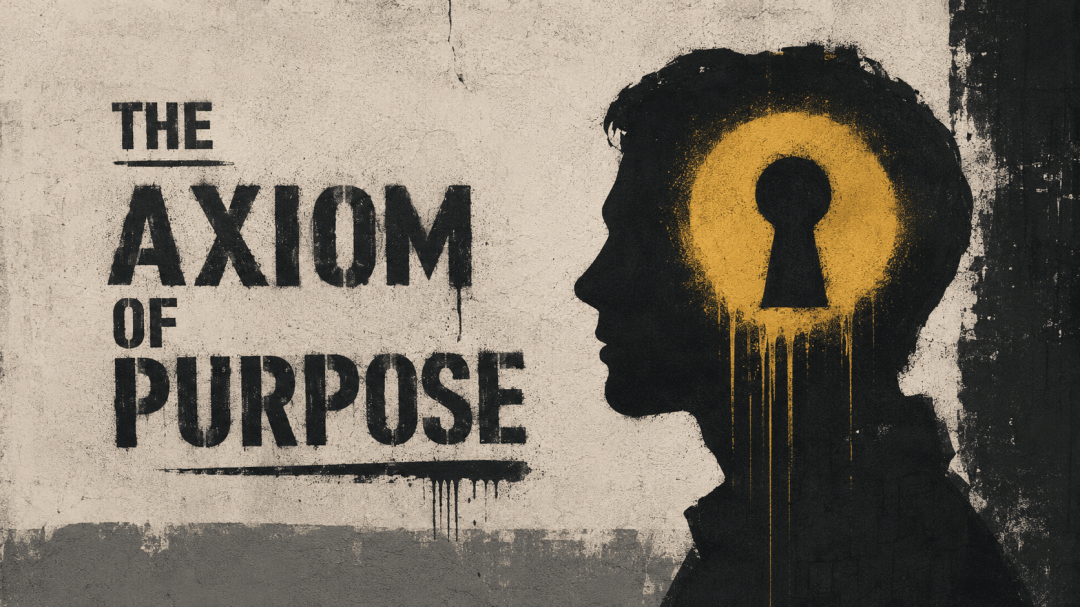
Every system of thought—every one, including mathematics and science—begins with claims it cannot prove. These are called axioms: foundational assumptions you simply accept, and then build everything else on top of. Geometry begins with the assumption that you can draw a straight line between two points. It does not prove this; it starts there. Physics begins with the assumption that the laws of nature are the same everywhere and do not change from day to day. It cannot prove this either—it would have to assume it in order to run the experiment. You cannot get underneath your own foundation to inspect it. If you could, it would not be the foundation.
This is why the philosophers failed. They were trying to prove purpose, but purpose is the kind of thing that can only ever be an axiom—a starting point, not a conclusion. Demanding a proof of it is like demanding a proof that straight lines exist before you are allowed to do geometry. The demand sounds rigorous, but it is confused. Some things are not the end of an argument. They are where argument begins.
And this is precisely where revelation does its work.
What the Quran posits
Look closely at how the Quran speaks about creation, and you notice it never argues that the universe has a purpose. It declares it. Over and over, in different suras, one small phrase appears: God did not create the heavens and the earth illā bil-ḥaqq—except bil-ḥaqq.
Rashad Khalifa translates this as “for a specific purpose,” and that captures part of it. But the Arabic word al-ḥaqq is richer than any single English word. It means, all at once: truth, reality, rightness, and that which is due or owed. Its opposite is bāṭil—falsehood, emptiness, the vain and the null. So when the Quran says creation was made bil-ḥaqq, it is saying several things in one breath: the universe is real (not an illusion), it is true (not a lie), it is right (not arbitrary), and it carries something owed—a purpose built in.
Watch how the text sets this up. It defines the claim first by what it rejects:
[44:38] We did not create the heavens and the earth, and everything between them, just to play.
[44:39] We created them for a specific purpose, but most of them do not know.
[44:40] The Day of Decision awaits them all.
The rejected word here is laʿib—play, idle amusement. The Quran’s first move about meaning is to slam a door on meaninglessness. The universe is not a game God is playing to pass the time. And notice what sits on the other side of the bil-ḥaqq in verse 39: the Day of Decision. The truthfulness of the world and the final reckoning are joined together, back to back. They are two sides of one claim. A real world is a world that counts—and a world that counts is a world that will be accounted for.
This is the axiom. A posited foundation, declared from outside the system, exactly the kind of thing philosophy discovered it could never generate from within.
The world you can measure is the world you answer to
Here is where the Quran’s vocabulary does something remarkable that is easy to miss in translation. Consider this verse:
[10:5] He is the One who rendered the sun radiant, and the moon a light, and He designed its phases that you may learn to count the years and to calculate (al-ḥisāb). GOD did not create all this, except for a specific purpose (bil-ḥaqq).
The word for “calculate” here is ḥisāb. It refers to arithmetic, astronomy, the counting of years by the moon’s phases—the measurable, law-governed order that lets human beings do science in the first place. The universe is calculable. You can count it. That is a gift.
But ḥisāb is also the exact word the Quran uses for the final Reckoning—yawm al-ḥisāb, the Day of Accounting. The same word carries both meanings. And this is not a pun. It is the whole worldview compressed into a single root. The faculty that lets you count the years is the faculty by which you will be held to account. The cosmos you can measure and the cosmos you are answerable to are not two different worlds. They are one world, and its name is ḥaqq.
This is the answer to the modern mistake. The scientific revolution split the world in two: a measurable outer world of facts, and a private inner world of meanings that supposedly aren’t “real.” The Quran refuses that split at the level of its vocabulary. The measurable and the meaningful share a root because they are the same reality, seen from two sides.
The same frame, turned toward you
So far this concerns the universe as a whole. But the Quran applies the identical logic to the human being—and it does so, tellingly, with the identical grammar:
[51:56] I did not create the jinns and the humans except to worship Me alone.
Notice the shape of the sentence: “I did not create… except to worship Me.” It is the same negative-and-exception frame used for the cosmos—”We did not create… except bil-ḥaqq.” The universe is made except in truth; the human is made except to worship. The purpose of man is stated in the very same mold as the purpose of everything else. This is not two separate teachings. It is one claim, narrowing from the whole of creation down to you.
And the two purposes are, on inspection, the same purpose. The word for worship, ʿibāda, means at root service, orientation, the turning of the whole self toward one’s Lord. To “worship God alone” is to orient the entire self toward the Real alone—which is exactly what living bil-ḥaqq means, now from the human side. The cosmos is made in truth and runs its course by nature. The human is made for worship and must run the same course by choice. Worship is simply the name for a human being living in alignment with the ḥaqq he was made in.
Here a skeptic will object, and the objection is worth stating plainly: “Created only to worship Me” sounds like a needy, vain God demanding tribute. The Quran heads this off in the very next breath:
[51:57] I need no provisions from them, nor do I need them to feed Me. [51:58] GOD is the Provider, the Possessor of all power, the Supreme.
God gains nothing from worship. He needs nothing. Which means “worship Me alone” cannot be a demand for tribute—it is a prescription for the creature’s own alignment. The command benefits the one who obeys it, not the One who issues it. It is, in the end, simply the instruction to live as what you actually are: a real thing, made in truth, for the truth.
And so, the purpose of man
If the human is made for this orientation, one question decides everything: is he forced into it, like a planet held in orbit, or does he choose it? The Quran’s answer is the hinge of the whole matter:
[33:72] We have offered the responsibility (freedom of choice) to the heavens and the earth, and the mountains, but they refused to bear it, and were afraid of it. But the human being accepted it; he was transgressing, ignorant.
The heavens, the earth, and the mountains keep their purpose automatically—they cannot do otherwise. The human being is the one creature offered something the mountains declined: the freedom to bear the trust, and so the freedom to fail it. This is why the rest of creation fulfills its purpose by nature while man must fulfill his by will. The whole moral weight of a human life rests here. A test only means something if the one taking it could have done otherwise.
[22:18] Do you not realize that to GOD prostrates everyone in the heavens and the earth, and the sun, and the moon, and the stars, and the mountains, and the trees, and the animals, and many people? Many others among the people are committed to doom. Whomever GOD shames, none will honor him. Everything is in accordance with GOD’s will.
Which is why the Quran, having ruled out purposelessness for the cosmos, rules it out just as firmly for the individual—and this is where a modern reader feels the wound, because the ache is rarely “the universe is meaningless” in the abstract; it is “I am meaningless.”
[23:115] Did you think that we created you in vain (ʿabathan), and that you would not be returned to Us?
[75:36] Does the human being think that he will go to nothing (sudā—aimlessly, purposeless)?
ʿAbath is futility; sudā is being left aimless, like an animal turned loose with nowhere to be. Both are the personal-scale version of “not in play.” You are no more an accident than the galaxies are.
What, then, is the human actually for? The Quran states the test directly:
[67:2] The One who created death and life for the purpose of distinguishing those among you who would do better. He is the Almighty, the Forgiving.
The standard is not who does more, but who does better—aḥsanu ʿamalan, best in deed. A qualitative standard, and one the Quran repeats elsewhere as a settled refrain, not a single remark. And notice that death is named before life, because the boundary is what gives the test its stakes; an examination with no end and no scoring would itself be a form of play, which has already been ruled out.
This test is not meant to be comfortable. The Quran is blunt about the medium it runs in:
[90:4] We created the human being to work hard (to redeem himself).
The word is kabad—toil, hardship, struggle. Life is designed to be effortful, and the passage that follows in the same sura spells out what the effort is for: freeing the enslaved, feeding the orphan and the destitute. The vocation is strenuous and moral, not a matter of quiet contemplation.
So the human purpose has three movements, and each mirrors the cosmos it belongs to. It is reflective: “Why do they not reflect on themselves?” (30:8)—you are the creature who can perceive the ḥaqq and arrive at it by thinking. It is moral: to be among those best in deed, since the entire apparatus of a real, measured, ending world exists to weigh how you live. And it is directed toward the return: “He designed you and perfected your design, then to Him is the final destiny” (64:3).
To live “in vain”—as though creation really were bāṭil—is, in this frame, not merely sad. It is to live against reality itself. Goodness is not a set of arbitrary rules laid over a neutral universe. Goodness is alignment with the way things actually are.
One purpose, seen from many sides
By now a fair reader might worry that the Quran has given too many answers. Creation is bil-ḥaqq, in truth. Man is made to worship. He bears a trust of freedom. He is put to a test. He is created in struggle. So which is it—truth, worship, freedom, testing, or struggle?
The answer is that these are not competing purposes. They are one purpose described from different angles, and seeing how they fit is itself a demonstration. Ḥaqq—truth—is the ground: the reality the whole arrangement rests on. Worship is the orientation: what it looks like to live in line with that ground. The trust of freedom is the precondition: what makes the orientation a genuine choice rather than a mechanism. The test is the procedure: how the choice gets weighed. And struggle is the medium: the difficulty through which the weighing actually happens. Pull on any one of these and the others come with it. Far from contradicting each other, they lock together into a single structure—which is exactly what you would expect if they were all describing one real thing.
How you know an axiom is true
But if purpose is an axiom, and axioms cannot be proven, a fair question remains: why accept this axiom rather than any other? Why the Quran’s ḥaqq and not some rival starting point, or none at all?
The answer is the same test we use for every foundational claim, including the ones in physics. We do not prove our axioms. We adopt them and see what follows. We ask: under this assumption, does the world become intelligible? Does everything fall into place? We accept the conservation of energy not because we proved it from something deeper, but because reality behaves as though it holds, and a coherent physics is built on it. An axiom earns its keep by the order it produces downstream.
The Quran actually depicts this very act of reasoning, and holds it up as the mark of the thoughtful:
[3:191] …they reflect upon the creation of the heavens and the earth: “Our Lord, You did not create all this in vain (bāṭilan). Be You glorified…”
That is not a proof handed down from above. It is a mind contemplating the order of creation and arriving at the conclusion that it cannot be meaningless. Revelation posits the axiom; reason, looking at the world, travels toward it and confirms it.
Apply that test now. Assume the universe is bil-ḥaqq—real, measured, finite, owed, ending in an accounting. Does the world make sense? The measurability of nature makes sense: it is ḥisāb, meant to be counted. The moral weight of a human life makes sense: it is a test, scored, with a term. The refusal of the human heart to believe it is meaningless makes sense: that refusal is a signal pointing back at the ḥaqq it was made in. The very fact that we can do science—that the cosmos is orderly enough to study—makes sense, because an orderly cosmos is exactly what “created bil-ḥaqq, not in play” would predict.
This is not revelation competing with physics. Revelation is not a better account of how the planets move—it never tried to be. It supplies the axioms of the layer physics deliberately set aside: the layer of what for, the very question the scientific method excluded on purpose four centuries ago. Physics answers how. It was never built to answer why, and its silence on the matter was a feature of the method, not a discovery about the world.
The philosophers were right to sense that a foundation was missing. They were only wrong about where it could come from. A foundation cannot be reasoned up from beneath—that is what makes it a foundation. It has to be given, from outside the system, and then tested by everything it holds up.
That is what revelation is for. Not to end our reasoning, but to give it somewhere to stand.
Appendix: Quran verses (for a specific purpose, bil-ḥaqq)
[10:5] He is the One who rendered the sun radiant, and the moon a light, and He designed its phases that you may learn to count the years and to calculate. GOD did not create all this, except for a specific purpose. He explains the revelations for people who know.
هُوَ ٱلَّذِى جَعَلَ ٱلشَّمْسَ ضِيَآءً وَٱلْقَمَرَ نُورًا وَقَدَّرَهُۥ مَنَازِلَ لِتَعْلَمُوا۟ عَدَدَ ٱلسِّنِينَ وَٱلْحِسَابَ مَا خَلَقَ ٱللَّهُ ذَٰلِكَ إِلَّا بِٱلْحَقِّ يُفَصِّلُ ٱلْءَايَٰتِ لِقَوْمٍ يَعْلَمُونَ
[14:19] Do you not realize that GOD has created the heavens and the earth for a specific purpose? If He wills, He can remove you, and substitute a new creation in your place.
أَلَمْ تَرَ أَنَّ ٱللَّهَ خَلَقَ ٱلسَّمَٰوَٰتِ وَٱلْأَرْضَ بِٱلْحَقِّ إِن يَشَأْ يُذْهِبْكُمْ وَيَأْتِ بِخَلْقٍ جَدِيدٍ
[15:85] We did not create the heavens and the earth, and everything between them, except for a specific purpose. The end of the world will come, so treat them with benign neglect.
وَمَا خَلَقْنَا ٱلسَّمَٰوَٰتِ وَٱلْأَرْضَ وَمَا بَيْنَهُمَآ إِلَّا بِٱلْحَقِّ وَإِنَّ ٱلسَّاعَةَ لَءَاتِيَةٌ فَٱصْفَحِ ٱلصَّفْحَ ٱلْجَمِيلَ
[16:3] He created the heavens and the earth for a specific purpose. He is much too High, far above any idols they set up.
خَلَقَ ٱلسَّمَٰوَٰتِ وَٱلْأَرْضَ بِٱلْحَقِّ تَعَٰلَىٰ عَمَّا يُشْرِكُونَ
[30:8] Why do they not reflect on themselves? GOD did not create the heavens and the earth, and everything between them, except for a specific purpose, and for a specific life span. However, most people, with regard to meeting their Lord, are disbelievers.
أَوَلَمْ يَتَفَكَّرُوا۟ فِىٓ أَنفُسِهِم مَّا خَلَقَ ٱللَّهُ ٱلسَّمَٰوَٰتِ وَٱلْأَرْضَ وَمَا بَيْنَهُمَآ إِلَّا بِٱلْحَقِّ وَأَجَلٍ مُّسَمًّى وَإِنَّ كَثِيرًا مِّنَ ٱلنَّاسِ بِلِقَآئِ رَبِّهِمْ لَكَٰفِرُونَ
[44:38] We did not create the heavens and the earth, and everything between them, just to play.
[44:39] We created them for a specific purpose, but most of them do not know.
[44:40] The Day of Decision awaits them all.وَمَا خَلَقْنَا ٱلسَّمَٰوَٰتِ وَٱلْأَرْضَ وَمَا بَيْنَهُمَا لَٰعِبِينَ
مَا خَلَقْنَٰهُمَآ إِلَّا بِٱلْحَقِّ وَلَٰكِنَّ أَكْثَرَهُمْ لَا يَعْلَمُونَ
إِنَّ يَوْمَ ٱلْفَصْلِ مِيقَٰتُهُمْ أَجْمَعِينَ
[45:22] GOD created the heavens and the earth for a specific purpose, in order to pay each soul for whatever it earned, without the least injustice.
وَخَلَقَ ٱللَّهُ ٱلسَّمَٰوَٰتِ وَٱلْأَرْضَ بِٱلْحَقِّ وَلِتُجْزَىٰ كُلُّ نَفْسٍۭ بِمَا كَسَبَتْ وَهُمْ لَا يُظْلَمُونَ
[46:3] We did not create the heavens and the earth, and everything between them except for a specific purpose, and for a finite interim. Those who disbelieve are totally oblivious to the warnings given to them.
مَا خَلَقْنَا ٱلسَّمَٰوَٰتِ وَٱلْأَرْضَ وَمَا بَيْنَهُمَآ إِلَّا بِٱلْحَقِّ وَأَجَلٍ مُّسَمًّى وَٱلَّذِينَ كَفَرُوا۟ عَمَّآ أُنذِرُوا۟ مُعْرِضُونَ
[64:3] He created the heavens and the earth for a specific purpose, designed you and perfected your design, then to Him is the final destiny.
خَلَقَ ٱلسَّمَٰوَٰتِ وَٱلْأَرْضَ بِٱلْحَقِّ وَصَوَّرَكُمْ فَأَحْسَنَ صُوَرَكُمْ وَإِلَيْهِ ٱلْمَصِيرُ
[67:2] The One who created death and life that He may distinguish (for the purpose) those among you who would do better. He is the Almighty, the Forgiving.
ٱلَّذِى خَلَقَ ٱلْمَوْتَ وَٱلْحَيَوٰةَ لِيَبْلُوَكُمْ أَيُّكُمْ أَحْسَنُ عَمَلًا وَهُوَ ٱلْعَزِيزُ ٱلْغَفُورُ


