In January of 49 BCE, a Roman general paused on the northern bank of an unremarkable stream. The Rubicon was shallow enough to wade and narrow enough to be overlooked by geography, but it marked the legal boundary of Italy proper—the line beyond which a commander was forbidden to lead an army under arms. To cross it was to declare war on the Republic. Julius Caesar crossed. Alea iacta est, he is said to have muttered—the die is cast—and with a few steps through cold water he made a decision that could never be unmade.
The phrase “crossing the Rubicon” survives precisely because a river is such a natural emblem of the threshold. A river has two banks, and to stand on one is to be one thing, to stand on the other is to be something else. Between them lies a passage that, once made, often cannot be reversed. Human imagination has reached for this image again and again: the Styx, the river of Greek myth separating the living from the realm of the dead; the Jordan that Israel crossed to enter the land of promise; the baptismal water through which a person is said to die to an old self and rise into a new one.
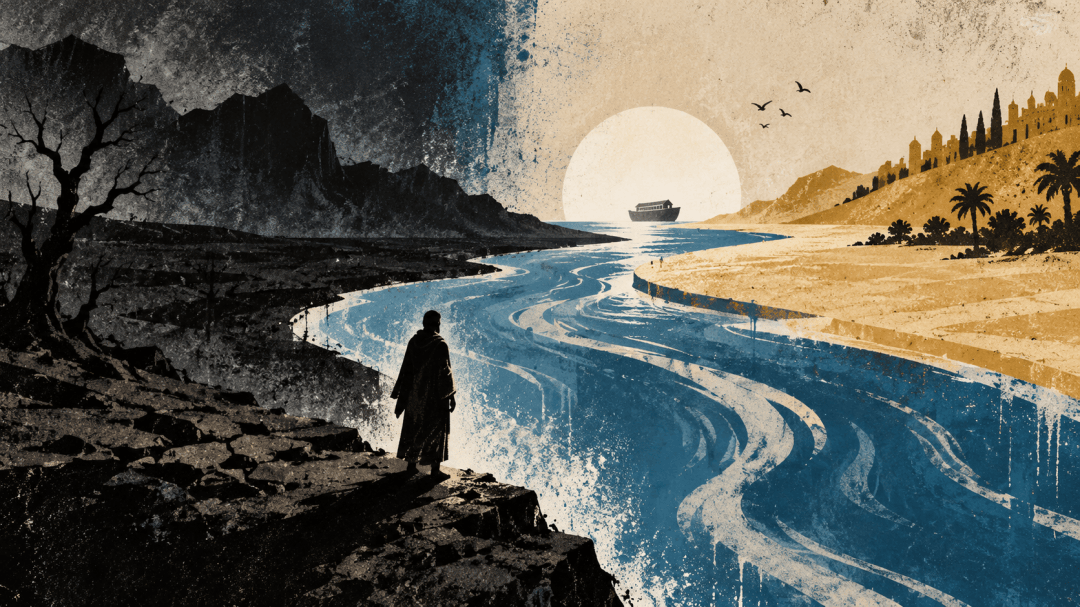
The Quran also returns again and again to people who reach the edge of the water and have to cross. In these stories, the water is never just part of the landscape. It becomes a test, a dividing line, a means of rescue, a passage into new understanding, or the beginning of a new world. Taken together, these crossings explore the same basic question: what changes when a person passes a point from which there is no going back?
The River That Winnows: Saul and His Soldiers
The Quran tells of Talut—Saul—appointed to lead the Israelites against the army of Goliath. As his forces march out, God announces a test, and the test is a river (2:249). Whoever drinks from it, Saul warns, is not with him; whoever refrains—save the one who scoops a single handful—belongs to him. When they reach the water, all but a few drink deeply. The army that crosses is a fraction of the army that set out. And even then, when the survivors catch sight of Goliath’s host, many lose heart, until those “certain that they would meet their Lord” remind them how often a small band has overcome a great one by God’s leave.
The river here is a filter. It does not merely separate one field from another; it separates the disciplined from the undisciplined, the resolved from the merely willing. What is striking is that crossing alone is not enough. The manner of crossing—whether a soldier can master his own thirst at the very moment his body screams for relief—is what reveals the heart. The man who gulps has already lost a battle, the interior one, before the first sword is drawn. The lesson is that God’s victories turn not on numbers but on devotion. The water is a device for exposing which is which.
The Waters of Pharaoh: Moses from the Nile to the Sea
One of the clearest examples of the use of rivers as a literary device is that of Pharaoh and Moses. This detail becomes especially striking in light of Pharaoh’s own language about Egypt and its waters. He boasts to his people, “O my people, do I not possess the kingship over Egypt, and these flowing rivers belong to me? Do you not see?” (43:51). The rivers are part of his claim to sovereignty. They flow through his kingdom, beneath his authority, and seem to testify to the greatness of his rule. Yet it is the river that first carries Moses safely into Pharaoh’s household, and later carries Pharaoh to his death.
Before Moses ever parts a sea, he is himself entrusted to water. As an infant, under Pharaoh’s decree condemning the sons of Israel to death, his mother is inspired to place him in a chest and cast him into the river (20:39; 28:7). The current carries the child directly into Pharaoh’s own household.
Years later, the symbolism returns on a far greater scale. Moses now leads the enslaved Israelites out of Egypt with Pharaoh’s troops at their backs, until they reach the sea with no road forward. Trapped between the water and the approaching army, the people give themselves up for lost. Moses is commanded to strike the sea with his staff, and it opens into a dry passage. The Israelites cross. Pharaoh follows. Then the waters return, swallowing him and his host (26:52–66; 2:50; 10:90).
The reversal is complete. The ruler who once pointed to Egypt’s waters as proof of his dominion discovers that they were never his to command. What Pharaoh imagines as part of his kingdom becomes, from beginning to end, an instrument of a sovereignty greater than his own. The same water therefore performs opposite works. For Moses, first as an infant and later as the leader of Israel, it becomes a means of deliverance. For Pharaoh, it becomes a grave. Israel enters the sea enslaved and emerges free, leaving bondage and fear on the far bank. Pharaoh enters as a king in pursuit and emerges dead, cursed for all of eternity to Hell.
His crossing is a Rubicon of ruin. He enters the parted sea believing he is still the master of events, but once he crosses the threshold, there is no coming back. When the water closes over him, he cries out that he believes in the God of the Children of Israel, only for the Quran to answer: now, after a lifetime of defiance? (10:90–91). The threshold has shut behind him. His body is preserved as a sign for those who come after.
Moses’s story begins with a mother opening her hands beside the Nile and ends with a tyrant losing his grip beneath the sea. The waters belong to neither of them. They are the threshold through which providence turns helplessness into deliverance and sovereignty into ruin.
The Sea of Hidden Knowledge: Moses and the Servant of God
Yet, this isn’t Moses’ only crossing that causes a transformation. In Sura 18 of the Quran, Moses vows to journey until he reaches “the junction of the two seas,” and there, marked by a fish that slips away into the water, he meets a servant of God endowed with a knowledge given directly from God (18:60–82). What follows is a series of acts that disturb Moses—the scuttling of a boat, and other deeds whose justice stays hidden until it is explained.
This is a crossing of a wholly different order: the passage from the world of visible law into the world of hidden wisdom. Moses is by God’s leave a lawgiver, a man who spoke with God, and to whom God’s commands were revealed. Yet at the sea-junction he must become a student, and a poor one—unable to hold his tongue, unable to withhold judgment on what he cannot yet understand. The scuttled boat is the first hard lesson that appearances deceive, that the visible surface of an act may conceal a mercy.
The unknown bank, in this story, is knowledge itself. Moses discovers that proficiency in the law does not make him proficient in all there is to know, and that deeper understanding requires him to surrender the very confidence that made him remarkable. The meeting of fresh water and salt water becomes a fitting image for that lesson. Fresh water is familiar, sustaining, and pleasant to drink; it represents the parts of life that make sense to us, the order we can recognize and understand. Salt water is different. It is bitter to the tongue and cannot satisfy thirst, much like the parts of life that seem harsh, confusing, or even unjust when we first encounter them. Moses must journey to the place where the two meet and learn that what tastes bitter from one side of the shore may still belong to a wisdom he cannot yet see.
The Water That Renews the World: Noah’s Ark
The Quran’s most total crossing is not over water but through it. When Noah’s people persist in corruption, the command comes to build the ark, and the earth is given up to the flood. Noah tells those who board, “Embark; in the name of God is its sailing and its mooring” (11:41). The old world drowns; the ark carries the remnant across the deluge until the waters are withdrawn at God’s word; it comes to rest upon the mountain, and its passengers are told to descend in peace (11:44–48).
Here the river-as-threshold expands to the scale of an entire age. The waters of judgment are also the waters of renewal—the same flood that ends a corrupt world washes the ground for a new one. The vessel of faith is the means of passage, and everything outside it is left behind, not on a far bank but beneath the surface. The crossing is the world’s own, from one dispensation into the next.
The Grammar of the Crossing
Set side by side, these episodes reveal how versatile the image of the crossing is in the Quran, and how consistent its underlying logic. The water tests the resolve of Saul’s soldiers. It delivers the oppressed and judges the oppressor at Moses’s sea. It carries providence in the current of the Nile. It initiates Moses into a knowledge beyond the law. It renews the whole earth in the flood of Noah. Five faces of a single symbol: examination, deliverance, providence, initiation, renewal.
Beneath all of them lies the same structure Caesar grasped at the Rubicon. A threshold is a place where one identity is surrendered on the near bank, and another claimed on the far one. The soldier who cannot master his thirst remains a slave to appetite; the one who crosses in faith becomes a victor against impossible odds. Israel enters the sea enslaved and emerges free. Pharaoh enters as a master and emerges as a drowned lesson. Moses enters as a lawgiver and emerges as a humbled student. Noah’s passengers enter one world and step out into another.
What the Quran presses on its reader is not whether the river will come—it always does—but who we will be when we reach the far side. Some crossings, like Caesar’s, cannot be uncrossed; the die, once cast at the water’s edge, stays cast. The near bank holds who we have been. The far bank holds who our choices will have made us. And the water between, in the Quran’s telling, is never neutral: it is the exact instrument by which the difference is revealed.


