

The hadith literature is usually presented as a record of what the Companions heard, saw, and practiced in the presence of the Prophet. Yet the same books preserve a large body of material in which Companions contradict, correct, rebuke, or flatly reject one another on questions of law, practice, and belief. These disputes are not found in obscure or disputed collections. They sit in the two books that Sunni tradition ranks highest, Sahih al-Bukhari and Sahih Muslim.
This article collects eighteen such cases. Each section gives the background of the dispute, the relevant reports in Arabic with an English rendering, the citation, and the outcome where the sources record one.
The purpose is evidentiary. Even if we accept every report below at face value, as authentic words of the Companions, then even the generation that lived beside the Prophet could not agree on basic matters: how to purify oneself, how to pray on a journey, whom one may marry, what a divorce means, whether a man was punished for his family’s grief. The disagreements that survive are only the ones someone happened to record. The reasonable inference is that many more existed that were never written down, and that the confident rulings later built on Companion practice rest on a far less unified foundation than is commonly assumed.
The point is not new, and it is not confined to polemical writing. Muhammad Zubayr Siddiqi, in his book, Hadith Literature: Its Origin, Development and Special Features, p. 106 states:
After the Prophet’s death, when people began to try and recall his words, several Companions were critical of some of the reporters, and rejected some of their reports. ʿAlī thus refused to accept a ḥadīth told by Maʿqil ibn Sinān.³ ʿAmmār ibn Yāsir once reported a ḥadīth of the Prophet with regard to the tayammum ablution, in a gathering of the Companions, and ʿUmar ibn al-Khaṭṭāb spoke up and said: ‘Fear God!’⁴—thereby indicating his disagreement with what ʿAmmār had reported. The Ṣaḥīḥ of Muslim contains a report in which Ibn ʿAbbās criticises several judgements of ʿAlī ibn Abī Ṭālib.⁵ When Maḥmūd ibn al-Rabīʿ reported in an assembly of the Companions that the Prophet had said that no-one who professed that there was no god but God would be sent to hellfire, Abū Ayyūb al-Anṣārī remarked that he did not think that the Prophet had ever said such a thing.⁶ Many other instances of the criticism of Companion-Narrators by their contemporaries (particularly ʿĀʾisha, ʿUmar, and Ibn ʿAbbās), may be easily discovered in works on ḥadīth and asmāʾ. These criticisms show that the Companions themselves were not above criticism.
For the record, I do not believe these statements or attributions actually go back to the Companions or the Prophet. The point here is an internal critique: even within the traditional corpus itself, the Companions are presented as disagreeing over the meaning and reliability of reports. And this is only what happened to be “preserved.” We have no way of knowing how they would have viewed the thousands of additional rules and regulations that the later Hadith corpus unlawfully introduced into the religion if they were alive today to witness this for themselves.
1. Did Muhammad See His Lord?
Disputants: Aisha on one side; Ibn Abbas (and, in a different form, Abu Dharr) on the other.
Context. Chapter 53 of the Quran describes a vision of the Prophet at the farthest boundary. Companions disagreed over what, or whom, he saw. Aisha denied that he saw God and called the claim a grave slander. Ibn Abbas reported that he saw his Lord with his heart.
Aisha’s position
Masruq said: I was reclining beside Aisha when she said, “Abu Aisha, three things—whoever claims even one of them has uttered an enormous slander against God.” I asked, “What are they?” She said, “Whoever claims that Muhammad saw his Lord has uttered an enormous slander against God.” … She added, “I was the first of this community to ask the Messenger of God about it, and he said: it was only Gabriel.”
عن مسروق قال: كنت متكئا عند عائشة فقالت: يا أبا عائشة، ثلاث من تكلم بواحدة منهن فقد أعظم على الله الفرية. قلت: ما هن؟ قالت: من زعم أن محمدا صلى الله عليه وسلم رأى ربه فقد أعظم على الله الفرية… فقالت: أنا أول هذه الأمة سأل عن ذلك رسول الله صلى الله عليه وسلم فقال: إنما هو جبريل
Ibn Abbas’s position
Ibn Abbas, commenting on the two verses, said: He saw him with his heart, twice.
عن ابن عباس: ﴿مَا كَذَبَ الْفُؤَادُ مَا رَأَىٰ﴾ ﴿وَلَقَدْ رَآهُ نَزْلَةً أُخْرَىٰ﴾ قال: رآه بفؤاده مرتين
Sahih Muslim, Book of Faith, no. 176.
Abu Dharr’s report
I asked the Messenger of God, “Did you see your Lord?” He said: “A light—how could I see him?”
سألت رسول الله صلى الله عليه وسلم هل رأيت ربك؟ قال: نور أنى أراه
Sahih Muslim, Book of Faith, no. 178.
2. Is the Dead Person Punished for the Weeping of the Living?
Disputants: Umar and his son Abdullah ibn Umar on one side; Aisha and Ibn Abbas on the other.
Context. Umar and Ibn Umar transmitted a statement attributed to the Prophet that the dead are punished by the weeping of their families. Aisha rejected the report outright, arguing that it contradicts the Quranic principle that no soul bears the sins of another.
The report of Umar and Ibn Umar
إن الميت ليعذب ببكاء أهله عليه
The dead person is indeed punished because of his family’s weeping over him.
Sahih al-Bukhari, Book of Funerals, nos. 1286–1287; Sahih Muslim, nos. 927–928.
Aisha’s rejection
إنما قال رسول الله صلى الله عليه وسلم: إنه ليعذب بخطيئته أو بذنبه، وإن أهله ليبكون عليه الآن… وذاك مثل قوله: إن رسول الله صلى الله عليه وسلم قام على القليب يوم بدر… حسبكم القرآن: ﴿وَلَا تَزِرُ وَازِرَةٌ وِزْرَ أُخْرَىٰ﴾
What the Messenger of God said was: “He is being punished for his sin or his wrongdoing, while his family weep over him now.” … Aisha added that the Quran is enough for you: “No soul bears the sins of another soul.”
Sahih al-Bukhari, no. 1288.
Her comment on the narrators
إنكم لتحدثوني عن غير كاذبين ولا مكذبين، ولكن السمع يخطئ
You are reporting from men who are neither liars nor to be called liars, but hearing can err.
Sahih Muslim, no. 931.
3. Shortening the Prayer While Traveling
Disputants: Uthman ibn Affan and Aisha (who prayed the full four rak’ahs while traveling) against Abdullah ibn Mas’ud, Ibn Umar, and others.
Context. The reports agree that the Prophet, Abu Bakr, and Umar shortened the prayer to two rak’ahs at Mina. Uthman, in the later years of his caliphate, prayed four. A Companion’s reaction to this is recorded.
Ibn Mas’ud’s reaction
Uthman led us in four rak’ahs at Mina. This was reported to Abdullah ibn Mas’ud, who said, “To God we belong and to him we return.” Then he said, “I prayed two rak’ahs with the Messenger of God at Mina, two with Abu Bakr, and two with Umar. I wish my share of the four were two that are accepted.”
صلى بنا عثمان بمنى أربع ركعات، فقيل ذلك لعبد الله بن مسعود فاسترجع، ثم قال: صليت مع رسول الله صلى الله عليه وسلم بمنى ركعتين، وصليت مع أبي بكر الصديق بمنى ركعتين، وصليت مع عمر بن الخطاب بمنى ركعتين، فليت حظي من أربع ركعات ركعتان متقبلتان
Sahih al-Bukhari, no. 1084 (also no. 1657); Sahih Muslim, no. 695.
Aisha’s own practice
When God made the prayer obligatory he made it two rak’ahs in residence and travel alike; the travel prayer was left as it was and the residence prayer increased.
فرض الله الصلاة حين فرضها ركعتين ركعتين في الحضر والسفر، فأقرت صلاة السفر وزيد في صلاة الحضر
Sahih al-Bukhari, no. 1090 (also no. 350); Sahih Muslim, no. 685.
Urwa, who narrated this from her, was asked why Aisha herself then prayed four while traveling. His answer:
She interpreted it as Uthman interpreted it.
تأولت كما تأول عثمان
Sahih Muslim, no. 685.
4. The Hajj Tamattu’ Dispute
Disputants: Uthman and Ibn al-Zubayr (against combining the umrah and hajj with a break between them) versus Ali, Ibn Abbas, and Sa’d ibn Abi Waqqas (for it).
Context. Tamattu’ means performing the umrah, leaving the state of pilgrim sanctity, and then entering it again for the hajj. Some Companions forbade it during their authority; others insisted the Prophet had practiced and permitted it.
Ali and Uthman
I was present when Uthman and Ali were together, and Uthman was forbidding the tamattu’ and the combining of the two. When Ali saw this, he declared, “At your service for umrah and hajj together,” and said, “I will not abandon the practice of the Prophet because of the words of anyone.”
شهدت عثمان وعليا رضي الله عنهما وعثمان ينهى عن المتعة وأن يجمع بينهما، فلما رأى علي أهل بهما: لبيك بعمرة وحجة، قال: ما كنت لأدع سنة النبي صلى الله عليه وسلم لقول أحد
Sahih al-Bukhari, no. 1563; Sahih Muslim, no. 1223.
Ibn Abbas and Ibn al-Zubayr
Ibn Abbas used to command the tamattu’, and Ibn al-Zubayr used to forbid it. The narrator said: I mentioned that to Jabir ibn Abdullah, who said, “The report passed through my own hands: we performed the tamattu’ with the Messenger of God.”
كان ابن عباس يأمر بالمتعة، وكان ابن الزبير ينهى عنها. قال: فذكرت ذلك لجابر بن عبد الله فقال: على يدي دار الحديث، تمتعنا مع رسول الله صلى الله عليه وسلم
Sahih Muslim, no. 1217.
Sa’d and Mu’awiya
Sa’d said: We did it [the tamattu’] while this man [Mu’awiya] was at that time a disbeliever in the houses of Mecca.
فعلناها وهذا يومئذ كافر بالعرش
Sahih Muslim, no. 1225.
5. Temporary Marriage (Mut’ah)
Disputants: Ibn Abbas (who permitted it) against Ali, Umar, and Ibn al-Zubayr.
Context. Temporary marriage was practiced in the early period. Reports say the Prophet permitted it for a time and then forbade it. Companions disagreed over whether the prohibition was final and who knew of it.
Ali’s rebuke of Ibn Abbas
Ali said to Ibn Abbas: The Prophet forbade the mut’ah and the flesh of domestic donkeys at the time of Khaybar.
أن عليا رضي الله عنه قال لابن عباس: إن النبي صلى الله عليه وسلم نهى عن المتعة وعن لحوم الحمر الأهلية زمن خيبر
Sahih al-Bukhari, no. 5115 (also no. 4216); Sahih Muslim, no. 1407.
Jabir’s report of practice after the Prophet
We used to contract a temporary marriage for a handful of dates or flour for a number of days in the time of the Messenger of God and Abu Bakr, until Umar forbade it in the affair of Amr ibn Huraith.
كنا نستمتع بالقبضة من التمر والدقيق الأيام على عهد رسول الله صلى الله عليه وسلم وأبي بكر، حتى نهى عنه عمر في شأن عمرو بن حريث
Sahih Muslim, no. 1405.
The reports disagree even on when it was forbidden
The reports that the Prophet forbade mut’ah do not agree on the occasion. Each places the prohibition at a different moment, and Jabir’s report places it after the Prophet’s death altogether.
| Claimed time of prohibition | Narrating Companion | Source |
|---|---|---|
| The day of Khaybar (7 AH) | Ali ibn Abi Talib | Sahih Muslim, no. 1407; Sahih al-Bukhari, no. 4216 |
| The conquest of Mecca (8 AH) | Sabra ibn Ma’bad | Sahih Muslim, no. 1406 |
| Permitted for three days at Awtas, then forbidden | Salama ibn al-Akwa’ | Sahih Muslim, no. 1405 |
| Never forbidden by the Prophet; practiced through Abu Bakr’s reign until Umar banned it | Jabir ibn Abdullah | Sahih Muslim, no. 1405 |
Outcome. One Companion says the matter was settled at Khaybar; another says it was permitted and then forbidden at Mecca; another says Awtas; another says the practice continued until the second caliph banned it. The dispute between Ibn Abbas and Ali is recorded as unresolved, and the reports that are supposed to settle it do not agree with one another.
6. Three Divorce Pronouncements in One Sitting
Disputants: the practice described by Ibn Abbas for the era of the Prophet and Abu Bakr versus the policy of Umar.
Context. If a man says “you are divorced” three times in one sitting, is that one divorce or three? According to Ibn Abbas, the early practice treated it as one. Umar changed this.
In the time of the Messenger of God, in the time of Abu Bakr, and for two years of Umar’s caliphate, a triple divorce counted as one. Then Umar ibn al-Khattab said: “People have become hasty in a matter in which they had a period of grace; why do we not enforce it on them?” So he enforced it on them.
كان الطلاق على عهد رسول الله صلى الله عليه وسلم وأبي بكر وسنتين من خلافة عمر طلاق الثلاث واحدة. فقال عمر بن الخطاب: إن الناس قد استعجلوا في أمر قد كانت لهم فيه أناة، فلو أمضيناه عليهم، فأمضاه عليهم
Sahih Muslim, Book of Divorce, no. 1472.
Outcome. By the account of a Companion, the ruling that later scholars treated as fixed was altered by one Companion’s policy decision against earlier practice. Ibn Abbas’s report remains in the canonical collection beside the later ruling.
7. Housing and Maintenance for the Irrevocably Divorced Woman
Disputants: Umar and Aisha against Fatima bint Qays.
Context. Fatima bint Qays reported that her husband divorced her irrevocably and that the Prophet awarded her no housing and no maintenance. Umar and Aisha rejected the report.
Umar’s rejection
We will not abandon the book of our Lord and the practice of our Prophet on the word of a woman. We do not know whether she remembered or forgot. She has housing and maintenance.
لا نترك كتاب ربنا وسنة نبينا صلى الله عليه وسلم لقول امرأة لا ندري لعلها حفظت أو نسيت، لها السكنى والنفقة
Sahih Muslim, no. 1480.
Aisha’s rejection
What is wrong with Fatima? Does she not fear God? Aisha meant her statement that there is no housing and no maintenance.
ما لفاطمة؟ ألا تتقي الله؟ يعني في قولها لا سكنى ولا نفقة
Sahih al-Bukhari, no. 5321–5322.
Outcome. A Companion’s testimony about a ruling of the Prophet was set aside by two other Companions on the grounds that she might have forgotten. The principle applied there, that a report may be rejected because the narrator might have misremembered, is the same one the Companions are asked to be exempt from.
8. Is Ghusl Required Without Ejaculation?
Disputants: Uthman, Ali, al-Zubayr, Talha, and Ubayy ibn Ka’b against Aisha; the Ansar against the Muhajirun.
Context. Does a person need a full bath after sexual intercourse if there was no ejaculation? The early answer from several senior Companions was no. Later reports reversed it.
The senior Companions
I asked Uthman: “What if a man has intercourse with his wife and does not ejaculate?” Uthman said, “He performs wudu as for prayer and washes his private part.” Uthman added, “I heard it from the Messenger of God.” I asked Ali, al-Zubayr, Talha, and Ubayy ibn Ka’b, and they commanded the same.
سألت عثمان بن عفان فقلت: أرأيت إذا جامع الرجل امرأته ولم يمن؟ قال عثمان: يتوضأ كما يتوضأ للصلاة ويغسل ذكره. قال عثمان: سمعته من رسول الله صلى الله عليه وسلم. فسألت عن ذلك عليا والزبير وطلحة وأبي بن كعب رضي الله عنهم فأمروه بذلك
Sahih al-Bukhari, no. 292.
Aisha’s ruling and the narrator’s note of disagreement
A group of the Muhajirun and the Ansar disagreed on this. The Ansar said: ghusl is only required with ejaculation. The Muhajirun said: when there is contact, ghusl is required. … Aisha said: “When he sits between her four limbs and the circumcised parts meet, ghusl is required.”
اختلف في ذلك رهط من المهاجرين والأنصار، فقال الأنصاريون: لا يجب الغسل إلا من الدفق أو من الماء، وقال المهاجرون: بل إذا خالط فقد وجب الغسل… قالت عائشة: إذا جلس بين شعبها الأربع ومس الختان الختان فقد وجب الغسل
Sahih Muslim, no. 349.
Outcome. The Companions did not share a single understanding of one of the most routine questions of ritual purity.
9. Tayammum for the Person in a State of Major Impurity
Disputants: Umar and Abdullah ibn Mas’ud against Ammar ibn Yasir and Abu Musa al-Ash’ari.
Context. If a person is in a state requiring ghusl and has no water, may he use dust? Umar said no, and one Companion contradicted him to his face.
Umar and Ammar
A man came to Umar and said, “I am in a state of major impurity and found no water.” Umar said, “Do not pray.” Ammar said: “Do you not remember, Commander of the Faithful, when you and I were on a raid and we became impure and found no water? You did not pray, but I rolled in the dust and prayed. The Prophet said: it would have been enough for you to strike the ground with your hands, blow, and wipe your face and hands.” Umar said, “Fear God, Ammar.” He replied, “If you wish, I will not narrate it.”
جاء رجل إلى عمر فقال: إني أجنبت فلم أجد ماء. فقال: لا تصل. فقال عمار: أما تذكر يا أمير المؤمنين إذ أنا وأنت في سرية، فأجنبنا فلم نجد ماء، فأما أنت فلم تصل، وأما أنا فتمعكت في التراب وصليت، فقال النبي صلى الله عليه وسلم: إنما كان يكفيك أن تضرب بيديك الأرض ثم تنفخ ثم تمسح بهما وجهك وكفيك. فقال عمر: اتق الله يا عمار. قال: إن شئت لم أحدث به
Sahih al-Bukhari, nos. 338 and 347; Sahih Muslim, no. 368.
Abu Musa and Ibn Mas’ud
Abu Musa said: “If a man were in a state of impurity and found no water for a month, would he not use dust and pray? What do you do with this verse of Surat al-Ma’ida: ‘and you find no water, then use clean earth’?” Abdullah replied, “If they were given this permission, they would soon use dust whenever the water was cold.”
لو أن رجلا أجنب فلم يجد الماء شهرا أما كان يتيمم ويصلي؟ فكيف تصنعون بهذه الآية في سورة المائدة: ﴿فَلَمْ تَجِدُوا مَاءً فَتَيَمَّمُوا صَعِيدًا طَيِّبًا﴾؟ فقال عبد الله: لو رخص لهم في هذا لأوشك إذا برد عليهم الماء أن يتيمموا بالصعيد
Sahih al-Bukhari, no. 346.
Outcome. The caliph acted on one understanding of the verse and the Prophet’s instruction while a fellow Companion reminded him of a contrary experience. The exchange ends without agreement.
10. What Interrupts the Prayer?
Disputants: Abu Dharr and Abu Hurayrah against Aisha.
Context. One report holds that a woman, a donkey, or a black dog passing in front of a praying person nullifies the prayer. Aisha rejected the report as an insult to women and as contrary to what she had seen.
The report of Abu Dharr
The prayer of a man is cut off, if there is nothing in front of him like the back of a saddle: a woman, a donkey, and a black dog.
يقطع صلاة الرجل، إذا لم يكن بين يديه كآخرة الرحل: المرأة والحمار والكلب الأسود
Sahih Muslim, no. 510.
Aisha’s objection
Have you made us equal to the dog and the donkey? I used to lie on the bed, and the Prophet would come and stand in the middle of the bed and pray. I disliked to be in front of him, so I would slip out from the foot of the bed.
أعدلتمونا بالكلب والحمار؟ لقد رأيتني مضطجعة على السرير فيجيء النبي صلى الله عليه وسلم فيتوسط السرير فيصلي، فأكره أن أسنحه، فأنسل من قبل رجلي السرير حتى أنسل من لحافي
Sahih al-Bukhari, nos. 511 and 514; Sahih Muslim, no. 512.
Outcome. The disagreement turns on what each Companion remembered or understood, and the sources record no resolution between them.
11. Fasting After Waking in a State of Major Impurity
Disputants: Abu Hurayrah against Aisha and Umm Salama.
Context. Abu Hurayrah taught that a person who wakes up in the morning still in a state requiring ghusl has no valid fast. The Prophet’s wives said he used to do exactly that and fast.
Aisha
The Messenger of God would wake up in a state of impurity from intercourse, not from a wet dream, and then fast.
كان رسول الله صلى الله عليه وسلم يصبح جنبا من جماع غير احتلام ثم يصوم
Sahih al-Bukhari, nos. 1925–1926; Sahih Muslim, no. 1109.
Abu Hurayrah’s response
He asked, “Did the two of them say it?” It was said, “Yes.” He said, “They know better.”
أهما قالتاه؟ قال: نعم. قال: هما أعلم
Sahih Muslim, no. 1109.
Outcome. In this case a retraction is recorded: Abu Hurayrah deferred to the wives and traced his earlier statement to a secondhand report. The case still shows that a ruling was taught to others, and in circulation, before it was corrected.
12. Did the Prophet Perform Umrah in Rajab?
Disputants: Abdullah ibn Umar against Aisha.
Context. This is a dispute over a historical fact rather than a legal ruling, but its effect on practice is direct. Ibn Umar stated that one of the Prophet’s umrahs fell in Rajab. Aisha heard him from her room and corrected him.
Mujahid said: Urwa ibn al-Zubayr and I entered the mosque, and there was Abdullah ibn Umar sitting by Aisha’s room… We asked him how many umrahs the Prophet performed. He said four, one of them in Rajab. … We heard Aisha brushing her teeth in the room. Urwa said, “Mother, do you not hear what Abu Abd al-Rahman says?” She asked what he said. He said, “He says the Prophet performed four umrahs, one in Rajab.” She said, “May God have mercy on Abu Abd al-Rahman. He never performed an umrah except that he [Ibn Umar] was a witness to it, and he never performed one in Rajab.”
دخلت أنا وعروة بن الزبير المسجد، فإذا عبد الله بن عمر جالس إلى حجرة عائشة… فقلنا: كم اعتمر النبي صلى الله عليه وسلم؟ قال: أربع، إحداهن في رجب… وسمعنا استنان عائشة في الحجرة، فقال عروة: يا أماه، ألا تسمعين ما يقول أبو عبد الرحمن؟ قالت: وما يقول؟ قال: يقول: إن النبي صلى الله عليه وسلم اعتمر أربع عمرات إحداهن في رجب. قالت: يرحم الله أبا عبد الرحمن، ما اعتمر عمرة إلا وهو شاهده، وما اعتمر في رجب قط
Sahih al-Bukhari, nos. 1775–1776; Sahih Muslim, no. 1255.
Outcome. According to the narration, Ibn Umar did not reply. The report leaves each position standing. Note that Aisha asserts Ibn Umar was a witness to all of the Prophet’s umrahs yet denies the one he asserted.
13. The Rules of Riba in Exchange
Disputants: Ibn Abbas (relying on Usama ibn Zayd) against Abu Sa’id al-Khudri and Ubada ibn al-Samit.
Context. Reports forbid unequal exchange of gold for gold, wheat for wheat, and so on. Ibn Abbas held that riba applies only to credit transactions, not to immediate unequal exchange, and cited a report from Usama.
Ibn Abbas, via Usama
I met Ibn Abbas and said to him: “This that you say about exchange, did you hear it from the Messenger of God or find it in the Book of God?” He said: “I did not hear it from the Messenger of God and I did not find it in the Book of God, but Usama ibn Zayd told me that the Prophet said: Riba is only in delayed exchange.”
لقيت ابن عباس فقلت له: أرأيت هذا الذي تقول في الصرف، أشيئا سمعته من رسول الله صلى الله عليه وسلم أم شيئا وجدته في كتاب الله عز وجل؟ فقال: لم أسمعه من رسول الله صلى الله عليه وسلم ولم أجده في كتاب الله، ولكن أخبرني أسامة بن زيد أن النبي صلى الله عليه وسلم قال: ألا إنما الربا في النسيئة
Sahih Muslim, no. 1596; Sahih al-Bukhari, no. 2178.
The opposing report
Gold for gold, silver for silver, wheat for wheat, barley for barley, dates for dates, salt for salt, like for like, hand to hand. Whoever gives more or asks for more has dealt in riba; the taker and giver are equal in it.
الذهب بالذهب، والفضة بالفضة، والبر بالبر، والشعير بالشعير، والتمر بالتمر، والملح بالملح، مثلا بمثل، يدا بيد، فمن زاد أو استزاد فقد أربى، الآخذ والمعطي فيه سواء
Sahih Muslim, no. 1584 (Abu Sa’id al-Khudri).
Outcome. One of the most learned Companions took a position on usury that the majority rejected, and in some narrations is said to have retracted it. The reports preserve him arguing it on the authority of a single Companion’s memory.
14. The Farewell Circumambulation for a Menstruating Woman
Disputants: Zayd ibn Thabit (and at first Ibn Umar) against Ibn Abbas.
Context. Is a woman in her period required to wait for the final circumambulation of the Kaaba before leaving Mecca after the pilgrimage? Pilgrims were generally commanded to make it the last act, and the question was whether an exemption applied.
The general command and the exemption
People were commanded that their last act be at the House, except that it was made lighter for the menstruating woman.
أمر الناس أن يكون آخر عهدهم بالبيت، إلا أنه خفف عن الحائض
Sahih al-Bukhari, no. 1755; Sahih Muslim, no. 1328.
Zayd and Ibn Abbas
Zayd ibn Thabit used to say that a menstruating woman should not depart until her last act is at the House. Ibn Abbas told him, “If not, then ask such-and-such woman of the Ansar whether the Messenger of God commanded her that.” Zayd returned to Ibn Abbas laughing and said, “I think you were right.”
كان زيد بن ثابت يقول: لا تنفر الحائض حتى يكون آخر عهدها بالبيت. فقال له ابن عباس: إما لا فسل فلانة الأنصارية هل أمرها بذلك رسول الله صلى الله عليه وسلم؟ فرجع زيد إلى ابن عباس يضحك وهو يقول: ما أراك إلا قد صدقت
Sahih al-Bukhari, nos. 1757–1758; Sahih Muslim, no. 1328.
Outcome. A senior Companion, expert in inheritance law and the person who compiled the Quran, issued a public ruling that was wrong by the standard of a Companion woman’s testimony.
15. Fighting Those Who Withheld the Zakat
Disputants: Umar ibn al-Khattab against Abu Bakr.
Context. After the Prophet’s death, several tribes refused to pay the zakat to the caliph. Abu Bakr resolved to fight them. Umar objected on the basis of a statement of the Prophet.
Umar’s objection
How can you fight the people when the Messenger of God said: “I was commanded to fight the people until they say there is no god but God; whoever says it has protected his wealth and his life from me except by its right, and his reckoning is with God”?
كيف تقاتل الناس وقد قال رسول الله صلى الله عليه وسلم: أمرت أن أقاتل الناس حتى يقولوا لا إله إلا الله، فمن قالها فقد عصم مني ماله ونفسه إلا بحقه، وحسابه على الله
Abu Bakr’s answer
By God, I will fight whoever separates the prayer from the zakat, for zakat is the due right on wealth. By God, if they withheld from me even a young goat that they used to pay to the Messenger of God, I would fight them over withholding it.
والله لأقاتلن من فرق بين الصلاة والزكاة، فإن الزكاة حق المال، والله لو منعوني عناقا كانوا يؤدونها إلى رسول الله صلى الله عليه وسلم لقاتلتهم على منعها
Umar’s conclusion
By God, it was only that I saw God had opened Abu Bakr’s chest to fighting, and I knew it was the truth.
فوالله ما هو إلا أن رأيت أن قد شرح الله صدر أبي بكر للقتال فعرفت أنه الحق
Sahih al-Bukhari, nos. 1399–1400; Sahih Muslim, no. 20.
Outcome. The two foremost Companions disagreed on whether to wage war, and each cited the Prophet’s statement or practice. The matter was settled by the authority of the caliph and by Umar’s change of mind, not by an agreed text.
16. The Inheritance of the Prophet and the Property at Fadak
Disputants: Fatima, the daughter of the Prophet, against Abu Bakr; later, Ali and al-Abbas before Umar.
Context. After the Prophet’s death, his daughter asked Abu Bakr for her inheritance from him. Abu Bakr replied with a statement he attributed to the Prophet. The reports record that she was angry and did not speak to him afterward.
Abu Bakr’s reply
Fatima, daughter of the Prophet, sent to Abu Bakr asking for her inheritance from the Messenger of God. … Abu Bakr said: The Messenger of God said, “We are not inherited from; what we leave is charity.” … Fatima shunned him and did not speak to him until she died.
أن فاطمة بنت النبي صلى الله عليه وسلم أرسلت إلى أبي بكر تسأله ميراثها من رسول الله صلى الله عليه وسلم… فقال أبو بكر: إن رسول الله صلى الله عليه وسلم قال: لا نورث، ما تركنا صدقة… فهجرته فاطمة فلم تكلمه حتى توفيت
Sahih al-Bukhari, nos. 3092–3093; Sahih Muslim, no. 1759.
The later dispute before Umar
Al-Abbas said, “Commander of the Faithful, judge between me and this one—a liar, a sinner, a betrayer, a traitor.” (Of Ali.)
فقال عباس: يا أمير المؤمنين، اقض بيني وبين هذا الكاذب الآثم الغادر الخائن
Sahih Muslim, no. 1757.
Outcome. The narrations preserve language from one Companion about another that later tradition would not tolerate. A statement attributed to the Prophet about his own estate was not known to his own daughter or to two of his closest relatives, and the only witness to it in Abu Bakr’s account was Abu Bakr himself.
17. Aisha’s Rejection of Abu Hurayrah’s Reports
Disputants: Aisha against Abu Hurayrah.
Context. Aisha is recorded rejecting reports that Abu Hurayrah attributed to the Prophet, on the ground that they contradicted the Quran or that he had misheard. Two cases are preserved with her reasoning.
Omens in the woman, the mount, and the house
Two men came to Aisha and said, “Abu Hurayrah reports that the Prophet used to say: bad omen is only in the woman, the mount, and the house.” She was enraged… then said: “By the one who sent down the Quran upon Abu al-Qasim, that is not how he used to say it. He used to say: the people of the Jahiliyya used to take omens from these things.” She then recited the verse that no calamity strikes the earth or yourselves except that it is in a record before it comes to pass (57:22).
دخل رجلان على عائشة فقالا: إن أبا هريرة يحدث أن النبي صلى الله عليه وسلم كان يقول: إنما الطيرة في المرأة والدابة والدار. فطارت شققا… ثم قالت: والذي أنزل القرآن على أبي القاسم ما هكذا كان يقول، ولكن كان يقول: كان أهل الجاهلية يتطيرون من ذلك
Musnad Ahmad, Musnad of Aisha (no. 25557 in the numbering used by the HadithCritic study; edition numbers vary).
A fair reading must add that a statement about ill omen in the house, the woman, and the horse is also recorded from Ibn Umar and Sahl ibn Sa’d (for example Sahih al-Bukhari, no. 2858; Sahih Muslim, no. 2225), so the dispute is not only between Aisha and one narrator. It is between Aisha and a whole stream of Companion reports.
The child of adultery
May God have mercy on Abu Hurayrah. He heard badly and so answered badly.
يرحم الله أبا هريرة، أساء سمعا فأساء إجابة
Aisha is reported to have said this about his transmission of the statement that the child of adultery is the worst of the three, and to have cited the verse that no soul bears the sins of another (6:164).
al-Hakim, al-Mustadrak (cited as no. 2910 by the HadithCritic study); the underlying statement is also in Sunan Abi Dawud, no. 3963. Verify the wording of Aisha’s reply in the printed edition.
Outcome. In both cases Aisha applies a test that appeals to the Quran and to her own knowledge of the Prophet, and rejects another Companion’s report as a mishearing. This is the mechanism the later critical tradition adopted, but applied here by a Companion to a Companion.
18. Restricting Transmission Itself
Disputants: Umar ibn al-Khattab against Companions who narrated freely, including Ibn Mas’ud, Abu al-Darda, Abu Mas’ud al-Ansari, and Abu Hurayrah.
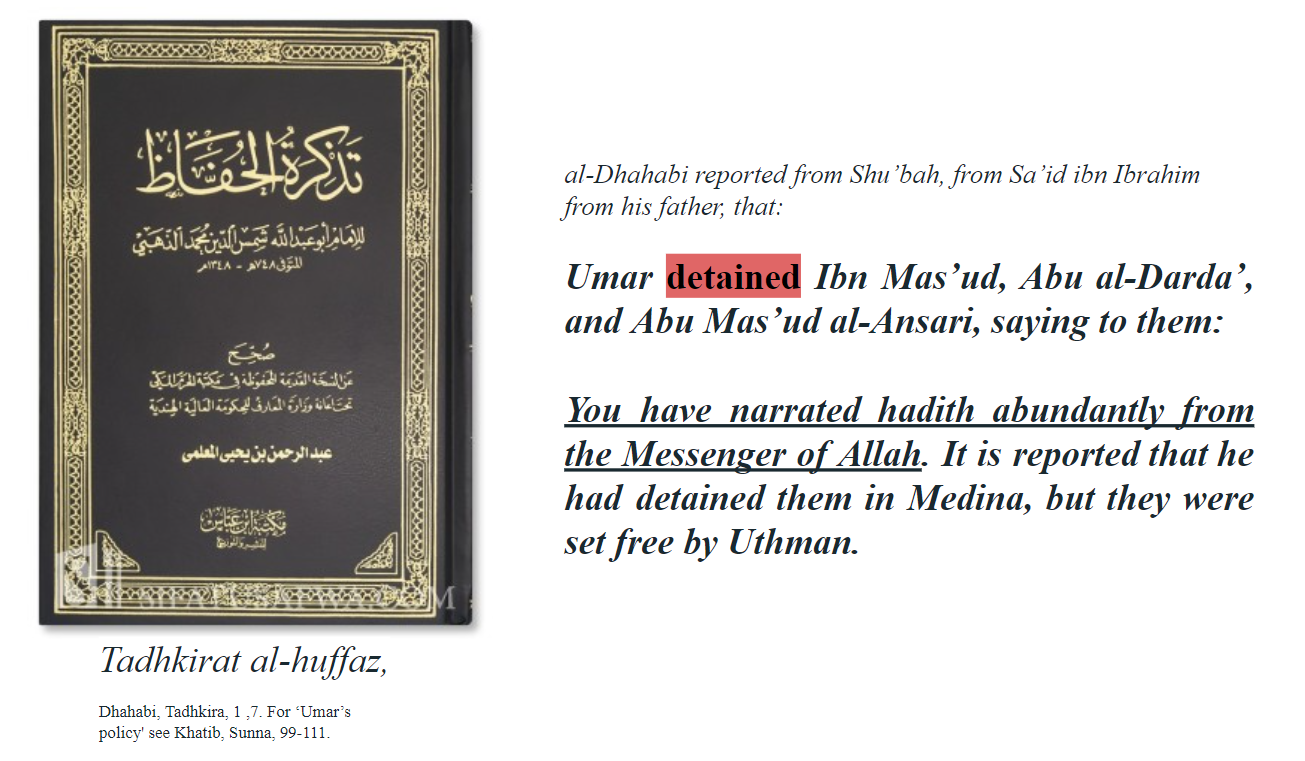
Context. This is not a dispute over one ruling. It is a dispute over whether, and how much, the Prophet’s words should be circulated at all. Reports preserved in the biographical literature, including al-Dhahabi’s Tadhkirat al-Huffaz, say that Umar kept prominent Companions in Medina and told them to narrate less. A report in the history of Abu Zur’a al-Dimashqi has him threatening Abu Hurayrah with being sent back to his tribal lands if he did not stop narrating from the Messenger of God.
In Tadhkirat al-huffaz, al-Dhahabi reported from Shu’bah, from Sa’id ibn Ibrahim from his father, that Umar detained Ibn Mas’ud, Abu al-Darda’, and Abu Mas’ud al-Ansari, saying to them: You have narrated hadith abundantly from the Messenger of Allah. It is reported that he had detained them in Medina, but they were set free by Uthman.
Ibn Sa’d, and Ibn Asakir reports from Mahmud ibn Labid that he said: I heard Uthman ibn Affan addressing people from over the pulpit: It is unlawful for everyone to narrate any hadith he never heard of during the time of Abu Bakr and that of Umar. Verily that which made me abstain from narrating from the Messenger of Allah was not to be among the most conscious of his Companions, but I heard him declaring: “Whoever ascribing to me something I never said, he shall verily occupy his (destined) abode in Fire.”
Outcome. The restriction did not prevail, and the volume of transmitted hadith grew enormously after the first generation. What matters for this reference is that the Companions did not share one view of the status of such transmission.
19. The Waiting Period of the Pregnant Widow
The Quran requires a woman whose marriage has ended to observe a waiting period, which it calls an interim, before she may marry again. For a widow, the rule is in the second sura:
Those who die and leave wives, their widows shall wait four months and ten days (before they remarry). (2:234)
وَٱلَّذِينَ يُتَوَفَّوْنَ مِنكُمْ وَيَذَرُونَ أَزْوَٰجًا يَتَرَبَّصْنَ بِأَنفُسِهِنَّ أَرْبَعَةَ أَشْهُرٍ وَعَشْرًا
Sura 65 deals with waiting periods in the context of divorce and gives different terms for women in other circumstances, including the pregnant:
As for those who do not menstruate, and discover that they are pregnant, their interim ends upon giving birth. (65:4)
وَأُو۟لَٰتُ ٱلْأَحْمَالِ أَجَلُهُنَّ أَن يَضَعْنَ حَمْلَهُنَّ
The dilemma arises when a man dies and leaves a pregnant wife who gives birth a few weeks later. She is a widow, so 2:234 seems to hold her to four months and ten days. She is pregnant, so 65:4 seems to release her at delivery. Neither verse mentions the other case, and the Companions did not agree on which one governs.
Ibn Abbas held that she must wait for the longer of the two periods. A Successor named Abu Salama ibn Abd al-Rahman asked him how that fit the verse about the pregnant, and Ibn Abbas answered that the verse applies only to divorce. Abu Hurayrah sided with Abu Salama. The dispute is recorded in the following report, which is also the Sunni argument that Hadith is needed to settle what the Quran leaves open:
Ibn Abbas was asked about a woman who gave birth twenty nights after her husband died: may she marry? He said, “No, only after the longer of the two periods.” Abu Salama said: I replied that God says, “As for those who are pregnant, their term is that they deliver their burden.” Ibn Abbas said, “That applies only to divorce.” Abu Hurayrah said, “I am with my nephew,” meaning Abu Salama. He sent his slave Kurayb to Umm Salama to ask whether this was the practice of the Messenger of God. Kurayb returned and said that she answered: yes, Subay’a al-Aslamiyya gave birth twenty nights after her husband died, and the Messenger of God told her to marry.
قِيلَ لاِبْنِ عَبَّاسٍ فِي امْرَأَةٍ وَضَعَتْ بَعْدَ وَفَاةِ زَوْجِهَا بِعِشْرِينَ لَيْلَةً أَيَصْلُحُ لَهَا أَنْ تَزَوَّجَ قَالَ لاَ إِلاَّ آخِرَ الأَجَلَيْنِ. قَالَ قُلْتُ قَالَ اللَّهُ تَبَارَكَ وَتَعَالَى ﴿وَأُولاَتُ الأَحْمَالِ أَجَلُهُنَّ أَنْ يَضَعْنَ حَمْلَهُنَّ﴾ فَقَالَ إِنَّمَا ذَلِكَ فِي الطَّلاَقِ. فَقَالَ أَبُو هُرَيْرَةَ أَنَا مَعَ ابْنِ أَخِي، يَعْنِي أَبَا سَلَمَةَ. فَأَرْسَلَ غُلاَمَهُ كُرَيْبًا فَقَالَ ائْتِ أُمَّ سَلَمَةَ فَسَلْهَا هَلْ كَانَ هَذَا سُنَّةً مِنْ رَسُولِ اللَّهِ صلى الله عليه وسلم، فَجَاءَ فَقَالَ قَالَتْ نَعَمْ، سُبَيْعَةُ الأَسْلَمِيَّةُ وَضَعَتْ بَعْدَ وَفَاةِ زَوْجِهَا بِعِشْرِينَ لَيْلَةً فَأَمَرَهَا رَسُولُ اللَّهِ صلى الله عليه وسلم أَنْ تَزَوَّجَ
Sunan al-Nasa’i, no. 3511; the same incident is in Sahih Muslim, no. 1485, and Sahih al-Bukhari, no. 4909.
The report that settled the room is the story of Subay’a herself, as Umm Salama related it. Abu al-Sanabil ibn Ba’kak proposed to her, and said she could not marry him until the longer of the two periods had passed. She delivered about ten days later and went to the Prophet, who told her to marry:
Narrated Um Salama: (the wife of the Prophet) A lady from Bani Aslam, called Subai’a, become a widow while she was pregnant. Abu As-Sanabil bin Ba’kak demanded her hand in marriage, but she refused to marry him and said, “By Allah, I cannot marry him unless I have completed one of the two prescribed periods.” About ten days later (after having delivered her child), she went to the Prophet (ﷺ) and he said (to her), “You can marry now.”
حَدَّثَنَا يَحْيَى بْنُ بُكَيْرٍ، حَدَّثَنَا اللَّيْثُ، عَنْ جَعْفَرِ بْنِ رَبِيعَةَ، عَنْ عَبْدِ الرَّحْمَنِ بْنِ هُرْمُزَ الأَعْرَجِ، قَالَ أَخْبَرَنِي أَبُو سَلَمَةَ بْنُ عَبْدِ الرَّحْمَنِ، أَنَّ زَيْنَبَ ابْنَةَ أَبِي سَلَمَةَ، أَخْبَرَتْهُ عَنْ أُمِّهَا أُمِّ سَلَمَةَ، زَوْجِ النَّبِيِّ صلى الله عليه وسلم أَنَّ امْرَأَةً مِنْ أَسْلَمَ يُقَالُ لَهَا سُبَيْعَةُ كَانَتْ تَحْتَ زَوْجِهَا، تُوُفِّيَ عَنْهَا وَهْىَ حُبْلَى، فَخَطَبَهَا أَبُو السَّنَابِلِ بْنُ بَعْكَكٍ، فَأَبَتْ أَنْ تَنْكِحَهُ، فَقَالَ وَاللَّهِ مَا يَصْلُحُ أَنْ تَنْكِحِيهِ حَتَّى تَعْتَدِّي آخِرَ الأَجَلَيْنِ. فَمَكُثَتْ قَرِيبًا مِنْ عَشْرِ لَيَالٍ ثُمَّ جَاءَتِ النَّبِيَّ صلى الله عليه وسلم فَقَالَ ” انْكِحِي ”.
Sahih al-Bukhari 5318
https://sunnah.com/bukhari:5318
Ibn Mas’ud took the opposite side from Ibn Abbas, and argued from the order of revelation rather than from the Prophet’s ruling. In the narration of Ibn Sirin, a member of a gathering in Kufa questioned the Subay’a report, and Ibn Sirin traced Ibn Mas’ud’s position through Abu Atiyya:
Sulayman ibn Harb and Abu al-Nuʿman said: Hammad ibn Zayd narrated to us, from Ayyub, from Muhammad [ibn Sirin], who said: “I was sitting in a gathering in which ʿAbd al-Rahman ibn Abi Layla was present, and his companions held him in great esteem. He mentioned the longer of the two waiting periods, so I narrated the hadith of Subayʿah bint al-Harith, which I had received from ʿAbd Allah ibn ʿUtbah. Some of his companions then made a gesture toward me [signaling their disapproval]. Muhammad [ibn Sirin] continued: “I noticed this and said, ‘I would indeed be audacious if I were to falsely attribute something to ʿAbd Allah ibn ʿUtbah while he is still in the vicinity of Kufa!’ “He [ʿAbd al-Rahman ibn Abi Layla] became embarrassed and said, ‘But his uncle [ʿAbd Allah ibn Masʿud] did not say that.’ “So I met Abu ʿAtiyyah, Malik ibn ʿAmir, and questioned him. He began narrating to me the hadith of Subayʿah. “I asked him, ‘Did you hear anything from ʿAbd Allah [ibn Masʿud] concerning this matter?’ “He replied: ‘We were with ʿAbd Allah [ibn Masʿud], and he said: “Would you impose the stricter ruling upon her and not grant her the concession? The shorter Surah of Women [Surah 65, al-Ṭalāq] was certainly revealed after the longer one [Surah 2, al-Baqarah]: ‘And those who are pregnant—their waiting period ends when they deliver their pregnancy.’” [Quran 65:4]’”
وَقَالَ سُلَيْمَانُ بْنُ حَرْبٍ وَأَبُو النُّعْمَانِ حَدَّثَنَا حَمَّادُ بْنُ زَيْدٍ، عَنْ أَيُّوبَ، عَنْ مُحَمَّدٍ، قَالَ كُنْتُ فِي حَلْقَةٍ فِيهَا عَبْدُ الرَّحْمَنِ بْنُ أَبِي لَيْلَى وَكَانَ أَصْحَابُهُ يُعَظِّمُونَهُ، فَذَكَرَ آخِرَ الأَجَلَيْنِ فَحَدَّثْتُ بِحَدِيثِ سُبَيْعَةَ بِنْتِ الْحَارِثِ عَنْ عَبْدِ اللَّهِ بْنِ عُتْبَةَ قَالَ فَضَمَّزَ لِي بَعْضُ أَصْحَابِهِ. قَالَ مُحَمَّدٌ فَفَطِنْتُ لَهُ فَقُلْتُ إِنِّي إِذًا لَجَرِيءٌ إِنْ كَذَبْتُ عَلَى عَبْدِ اللَّهِ بْنِ عُتْبَةَ وَهْوَ فِي نَاحِيَةِ الْكُوفَةِ. فَاسْتَحْيَا وَقَالَ لَكِنَّ عَمَّهُ لَمْ يَقُلْ ذَاكَ. فَلَقِيتُ أَبَا عَطِيَّةَ مَالِكَ بْنَ عَامِرٍ فَسَأَلْتُهُ فَذَهَبَ يُحَدِّثُنِي حَدِيثَ سُبَيْعَةَ فَقُلْتُ هَلْ سَمِعْتَ عَنْ عَبْدِ اللَّهِ فِيهَا شَيْئًا فَقَالَ كُنَّا عِنْدَ عَبْدِ اللَّهِ فَقَالَ أَتَجْعَلُونَ عَلَيْهَا التَّغْلِيظَ وَلاَ تَجْعَلُونَ عَلَيْهَا الرُّخْصَةَ. لَنَزَلَتْ سُورَةُ النِّسَاءِ الْقُصْرَى بَعْدَ الطُّولَى {وَأُولاَتُ الأَحْمَالِ أَجَلُهُنَّ أَنْ يَضَعْنَ حَمْلَهُنَّ}.
Sahih al-Bukhari 4910
https://sunnah.com/bukhari:4910
Later scholarly reports also list Ali with Ibn Abbas among those who held the longer-period position. I have not traced a primary citation for that, so check it before attributing it to him in print.
Several points stand out in these reports. Ibn Abbas and Abu Salama were both arguing from the Quran, one reading 65:4 as limited to divorce and the other reading it as general. Neither of them cited a ruling of the Prophet. Men at the center of the community, including Abu Hurayrah and Ibn Abbas, had no such ruling in hand, and it reached the room only because a servant was sent to ask a widow of the Prophet. Ibn Mas’ud, meanwhile, reached the same verdict as Subay’a’s report by a different route, from the order of revelation.
The strongest Sunni reply is that the Companions disagreed only because the report had not yet reached them, and that they yielded when it did. Ibn Abd al-Barr, as quoted by al-Nawawi, says Ibn Abbas went back on his view. That reply is coherent, but it concedes that a ruling of the Prophet on a question of this kind was not common knowledge among those closest to him. It also leaves the reader trusting one chain of transmission to say that a ruling ended the dispute, when the dispute may have been what brought the ruling to light. The reports do not decide between these readings, and this reference does not claim that they do.
20. Wudu After Eating Food Touched by Fire
Disputants: Abu Hurayrah against Ibn Abbas.
Context. Abu Hurayrah transmitted an instruction attributed to the Prophet to perform wudu after eating food that fire had touched. Ibn Abbas challenged him, and the Prophet’s own practice was reported in the opposite direction.
Abu Hurayrah’s report
Perform wudu from what fire has touched.
توضؤوا مما مست النار
Sahih Muslim, no. 352.
The opposing report of the Prophet’s practice by Ibn Abbas
Then Ibn Abbas gives a contradicting report to what was reported by Abu Hurairah.
The Messenger of God ate a shoulder of lamb, then prayed and did not perform wudu.
أن رسول الله صلى الله عليه وسلم أكل كتف شاة ثم صلى ولم يتوضأ
Sahih Muslim, no. 354 (from Ibn Abbas).
Then we have two reports where Ibn Abbas challenges Abu Hurairah
Ibn Abbas said: “Abu Hurayrah, are we to perform wudu from oil? Are we to perform wudu from hot water?” Abu Hurayrah replied: “Nephew, when you hear a report from the Messenger of God, do not coin examples against it.”
يا أبا هريرة، أنتوضأ من الدهن؟ أنتوضأ من الحميم؟ فقال أبو هريرة: يا ابن أخي، إذا سمعت حديثا عن رسول الله صلى الله عليه وسلم فلا تضرب له مثلا
أَخْبَرَنَا إِبْرَاهِيمُ بْنُ يَعْقُوبَ، قَالَ حَدَّثَنَا عَبْدُ الصَّمَدِ بْنُ عَبْدِ الْوَارِثِ، قَالَ حَدَّثَنَا أَبِي، عَنْ حُسَيْنٍ الْمُعَلِّمِ، قَالَ حَدَّثَنِي يَحْيَى بْنُ أَبِي كَثِيرٍ، عَنْ عَبْدِ الرَّحْمَنِ بْنِ عَمْرٍو الأَوْزَاعِيِّ، أَنَّهُ سَمِعَ الْمُطَّلِبَ بْنَ عَبْدِ اللَّهِ بْنِ حَنْطَبٍ، يَقُولُ قَالَ ابْنُ عَبَّاسٍ أَتَوَضَّأُ مِنْ طَعَامٍ أَجِدُهُ فِي كِتَابِ اللَّهِ حَلاَلاً لأَنَّ النَّارَ مَسَّتْهُ فَجَمَعَ أَبُو هُرَيْرَةَ حَصًى فَقَالَ أَشْهَدُ عَدَدَ هَذَا الْحَصَى أَنَّ رَسُولَ اللَّهِ صلى الله عليه وسلم قَالَ “ تَوَضَّئُوا مِمَّا مَسَّتِ النَّارُ ” .
Ibn ‘Abbas said: “Should I perform Wudu’ after eating food that I see in the Book of Allah is permissible because fire has touched it?” Abu Hurairah gathered some pebbles and said: “I bear witness (as many times as) the number of these pebbles, that the Messenger of Allah (ﷺ) said: ‘Perform Wudu’ from that which has been touched by fire.'”
Sunan an-Nasa’i 174
https://sunnah.com/nasai:174
Finally, we have another refutation from Jabir to Abu Hurairah claiming that the practice was abrogated.
حَدَّثَنَا مُوسَى بْنُ سَهْلٍ أَبُو عِمْرَانَ الرَّمْلِيُّ، حَدَّثَنَا عَلِيُّ بْنُ عَيَّاشٍ، حَدَّثَنَا شُعَيْبُ بْنُ أَبِي حَمْزَةَ، عَنْ مُحَمَّدِ بْنِ الْمُنْكَدِرِ، عَنْ جَابِرٍ، قَالَ كَانَ آخِرُ الأَمْرَيْنِ مِنْ رَسُولِ اللَّهِ صلى الله عليه وسلم تَرْكَ الْوُضُوءِ مِمَّا غَيَّرَتِ النَّارُ . قَالَ أَبُو دَاوُدَ هَذَا اخْتِصَارٌ مِنَ الْحَدِيثِ الأَوَّلِ .
Jabir said: The last practice of the Messenger of Allah (ﷺ) was that he did not perform ablution after taking anything that was cooked with the help of fire.
Abu Dawud said: This is the abridgment of the former tradition.Sunan Abi Dawud 192
https://sunnah.com/abudawud:192
Outcome. This is a clear example of Companions disputing regarding a practice. Notice that Ibn Abbas never claims that the practice was abrogated because he never believed that this was a practice from the Prophet. In his narrations, he seems to go along with what Abu Hurairah claimed.
21. Did the Companions Prevent the Prophet from Writing His Final Instructions?
Disputants: Umar ibn al-Khattab and those who agreed with him against Companions who wanted the Prophet’s request for writing materials to be fulfilled. Ibn Abbas later condemned what happened.
Context. During the Prophet’s final illness, he reportedly asked for writing materials so that he could leave behind a statement that would prevent his followers from going astray. Umar objected, arguing that the Prophet was seriously ill and that the Book of God was sufficient. The Companions disagreed and began quarreling in the Prophet’s presence. The dispute became so heated that the Prophet ordered them to leave without writing the statement.
Narrated ‘Ubaidullah bin `Abdullah: Ibn `Abbas said, “When the ailment of the Prophet (ﷺ) became worse, he said, ‘Bring for me (writing) paper and I will write for you a statement after which you will not go astray.’ But `Umar said, ‘The Prophet is seriously ill, and we have got Allah’s Book with us, and that is sufficient for us.’ But the companions of the Prophet (ﷺ) differed about this, and there was a hue and cry. On that, the Prophet (ﷺ) said to them, ‘Go away (and leave me alone). It is not right that you should quarrel in front of me.” Ibn `Abbas came out saying, “It was most unfortunate (a great disaster) that Allah’s Messenger (ﷺ) was prevented from writing that statement for them because of their disagreement and noise.
حَدَّثَنَا يَحْيَى بْنُ سُلَيْمَانَ، قَالَ حَدَّثَنِي ابْنُ وَهْبٍ، قَالَ أَخْبَرَنِي يُونُسُ، عَنِ ابْنِ شِهَابٍ، عَنْ عُبَيْدِ اللَّهِ بْنِ عَبْدِ اللَّهِ، عَنِ ابْنِ عَبَّاسٍ، قَالَ لَمَّا اشْتَدَّ بِالنَّبِيِّ صلى الله عليه وسلم وَجَعُهُ قَالَ ” ائْتُونِي بِكِتَابٍ أَكْتُبُ لَكُمْ كِتَابًا لاَ تَضِلُّوا بَعْدَهُ ”. قَالَ عُمَرُ إِنَّ النَّبِيَّ صلى الله عليه وسلم غَلَبَهُ الْوَجَعُ وَعِنْدَنَا كِتَابُ اللَّهِ حَسْبُنَا فَاخْتَلَفُوا وَكَثُرَ اللَّغَطُ. قَالَ ” قُومُوا عَنِّي، وَلاَ يَنْبَغِي عِنْدِي التَّنَازُعُ ”. فَخَرَجَ ابْنُ عَبَّاسٍ يَقُولُ إِنَّ الرَّزِيَّةَ كُلَّ الرَّزِيَّةِ مَا حَالَ بَيْنَ رَسُولِ اللَّهِ صلى الله عليه وسلم وَبَيْنَ كِتَابِهِ.
Sahih al-Bukhari 114
https://sunnah.com/bukhari:114
Outcome. According to the narration, the Companions disagreed so intensely in the Prophet’s presence that his requested statement was never written. Umar maintained that the Book of God was sufficient, while Ibn Abbas later described the incident as a great calamity. The report does not identify every participant or disclose what the Prophet intended to write. What it does establish, within the traditional account, is that even a direct request attributed to the Prophet during his final illness became a subject of disagreement among those closest to him
Further Cases for Expansion
The following disputes are documented in the canonical literature and are candidates for future additions to this reference once the texts have been checked against the sources:
- Ali’s refusal to accept a report transmitted by Ma’qil ibn Sinan (noted by Siddiqi, p. 106)
- Abu Ayyub al-Ansari’s doubt about a statement Mahmud ibn al-Rabi’ attributed to the Prophet, concerning whether anyone who professed the oneness of God would enter hellfire (noted by Siddiqi, p. 106)
- Ibn Abbas’s criticisms of several judgments of Ali, recorded in Sahih Muslim (noted by Siddiqi, p. 106)
- The share of the grandfather in inheritance: Abu Bakr and Ibn Abbas against Ali, Zayd ibn Thabit, and Ibn Mas’ud
- The meaning of kalala, which Umar said he could not settle despite repeatedly asking the Prophet
- Umar and Abu Musa over seeking permission to enter, and Umar’s demand for a second witness
- Ibn Umar and Abu Hurayrah over the permitted categories of dogs, with Ibn Umar’s remark about Abu Hurayrah’s farm
- Wiping over the leather socks: Ali and Aisha versus those who restricted it
- The number of rak’ahs in the night prayer of Ramadan
- The ruling on fasting while traveling and the rebuke of those who fasted
- The permissibility of eating the flesh of horses and of the lizard
- The sale of the mother of a child (umm walad)
- Ibn Abbas’s position on the ruling concerning a pregnant widow’s waiting period against Abu Hurayrah and others
Related Articles:


