
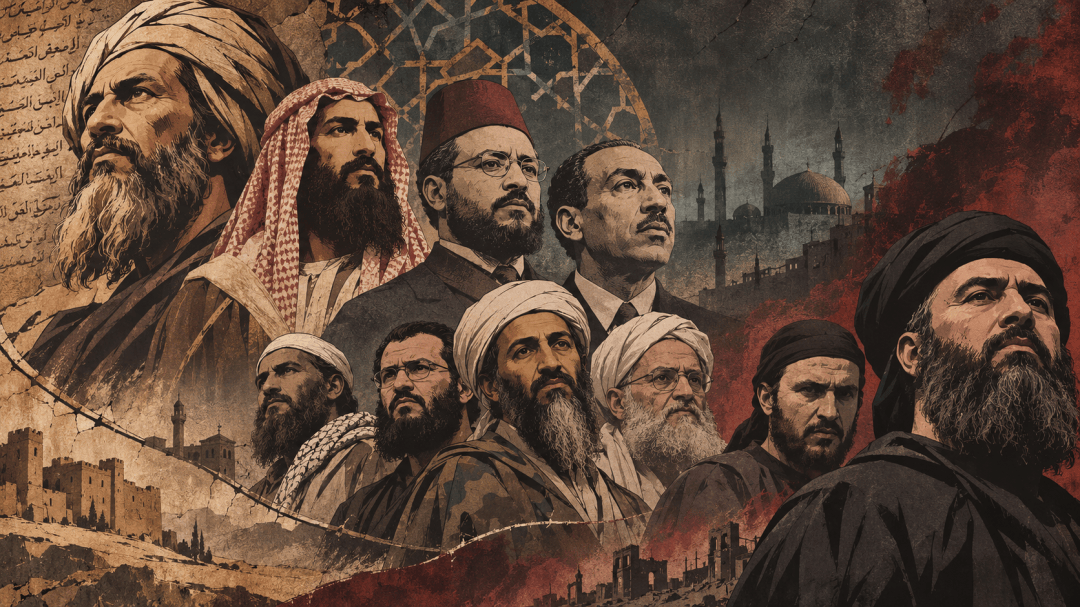
Salafism is a broad family of Muslim movements that seek to ground belief and practice in the example of the salaf, the first three generations of Islam: the Prophet Muhammad’s companions and the two generations after them. Most Salafis are not violent. Many are politically passive. However, Salafi-jihadism is a small, militant offshoot, but it produced al-Qaeda, the attacks of September 11, 2001, and the Islamic State (ISIS), which declared a caliphate in 2014 across parts of Iraq and Syria.
The standard defense of the Sunni tradition is that these movements are a deviation: a political pathology that hijacked a mercy-centered religion. The difficulty is that the jihadists cite the same medieval jurists, the same hadith collections, and the same legal categories that mainstream Sunni scholars teach. Classical Sunni law prescribes death for apostasy, and the jurists who built the tradition were generous in deciding who counts as an apostate. Whoever controls the definition of unbelief controls who may be killed, and nothing in the classical sources prevents a determined reader from drawing the widest possible circle.
This essay argues that the line from classical Sunni jurisprudence to Salafi-jihadism is not a break but a consistent application. It does not claim that the line was inevitable, since politics decided when, where, and by whom the logic was acted on. It follows five concepts across seven centuries: tawhid (the oneness of God), shirk (associating partners with God) and bid’ah (religious innovation), hakimiyya (God’s sovereignty in law and government), takfir (declaring a Muslim an unbeliever), and jihad. At each stage, the jihadists borrowed selectively, but what they borrowed was real.
The medieval foundations
Taqi al-Din Ahmad ibn Taymiyyah (1263–1328) was born in Harran, in what is now Turkey, only a few years after the Mongols sacked Baghdad in 1258 and ended the Abbasid caliphate there. His family fled the Mongol advance and settled in Damascus, where he lived under the Mamluks in a region repeatedly threatened by new invasions. The crisis deepened when Mongol rulers began professing Islam while keeping Mongol law. The enemy could now call himself a Muslim, and the question that runs through all of Ibn Taymiyyah’s work follows from that: what makes a person, a ruler, or a society Muslim, and when does deviation become unbelief?
His answer was severe. He attacked speculative theology, Sufi doctrines, the veneration of saints, and prayer at tombs, insisting in works like Iqtida’ al-Sirat al-Mustaqim that tawhid means worshipping God alone, not merely acknowledging Him as creator. He was imprisoned several times by the Mamluk authorities over questions about the divine attributes, divorce, and the visiting of graves, and he died in the Damascus citadel. His influence came later: Ibn Taymiyyah was a controversial and often censured figure in his own lifetime, and his writings became a major resource only centuries afterward.
Popular modern accounts produced by Salafis themselves try to rebrand him as a jurist of caution and restraint, which whitewashes his ideology. The hadith in Sunan an-Nasa’i (4059), reported from Ibn Abbas, has the Prophet saying, “Whoever changes his religion, kill him.” Once that rule is in force, a declaration of unbelief is a judgment about whether a person may live, and Ibn Taymiyyah’s definition of what puts a person outside the religion and thus up for the death penalty was very broad.
His fatwas show how broad. Across his Majmu’ al-Fatawa and his commentary Sharh ‘Umdat al-Fiqh, disagreements over ritual and belief repeatedly end in the same formula: the person is asked to repent, and otherwise he is killed. Abandoning prayer entirely earns execution (Sharh ‘Umdat al-Fiqh, vol. 2, p. 47). So does deliberately letting a single prayer lapse, in a passage that quotes Ahmad ibn Hanbal’s judgment that the offender’s neck is struck (vol. 2, p. 57). Delaying prayer because of business or hunting until the sun sets makes execution obligatory according to the majority of scholars (Majmu’ al-Fatawa, vol. 22, pp. 27–28). Insisting that praying toward a grave or shrine is superior to praying in an ordinary mosque places a man outside the religion and under the same sentence (vol. 27, p. 488), as does insisting that the intention for prayer must be spoken aloud (vol. 22, p. 236). One ruling holds that a hidden unbeliever, a zindiq, is killed even if he repents, and extends the principle to leaders of the Shia whose doctrines mislead others, “even if he is not judged to be a disbeliever” (vol. 28, p. 555).
Many of these principles existed in the jurisprudence he inherited, and he was not their sole inventor. His contribution was the energy and breadth with which he applied them, joined to an unusually expansive idea of what counted as deviation from the practice of the earliest Muslims. The Mongol rulings fit the same pattern. In the Mardin fatwa, collected in the same Majmu’, he held that rulers who professed Islam but governed by the Mongol legal code, the yasa, rather than the sharia, were not legitimate Muslim authorities, and that fighting them was obligatory. He also treated Mardin as a mixed case, and his political treatise al-Siyasa al-Shar’iyya values order highly. But the principle was now on the books: a ruler who professes Islam can be fought if his law departs from God’s.
His student Ibn Qayyim al-Jawziyya (1292–1350) was imprisoned alongside him and spent the rest of his life organizing, defending, and spreading his teacher’s ideas. His I’lam al-Muwaqqi’in and Zad al-Ma’ad gave Ibn Taymiyyah’s positions a systematic and devotional form, which made them portable across centuries. Most of what later movements call the school of Ibn Taymiyyah reached them through him.
Wahhabism and the first Saudi state
For about four centuries, Ibn Taymiyyah’s followers were a minority current in Hanbali circles. Muhammad ibn Abd al-Wahhab (1703–1792) revived them in central Arabia. Born in Uyayna, he preached against the veneration of tombs, sacred trees, and saints, practices he classed as shirk, and wrote Kitab al-Tawhid and the Kashf al-Shubuhat to argue that those who practiced them while calling themselves Muslims had left the faith. His Nawaqid al-Islam (“The Nullifiers of Islam”) lists ten acts that cancel a person’s Muslim status. The ten-item list works as a checklist for the same apostasy logic found in Ibn Taymiyyah’s fatwas, and it was contested at once, including by Ibn Abd al-Wahhab’s own brother, Sulayman, who wrote a refutation.
In 1744 he allied with Muhammad ibn Saud, ruler of the town of Diriyya. The pact joined a reform movement to a state, and the state’s armies carried the creed outward: the capture of Riyadh, the sack of the Shi’i shrine city of Karbala in 1802, and the conquest of Mecca and Medina after 1803. An Ottoman-Egyptian expeditionary force destroyed the first Saudi state in 1818. The movement revived, and a third Saudi state was founded in the twentieth century.
Historians disagree on how violent the founder himself was. Natana DeLong-Bas has argued that his own writings were more restrained than his reputation, while others, such as Michael Cook and David Commins, stress the militancy that followed from declaring opponents polytheists. Either way, Wahhabism was a state religion with a government to run, and it was not a global insurgency. Over time it developed doctrines of its own, especially al-wala’ wa-l-bara’, loyalty to believers and disavowal of unbelievers, which later jihadists would take over.
Reform and political Islamism
In the nineteenth and twentieth centuries, the question changed. The challenge was European empire, colonial law, and the end of the Ottoman caliphate in 1924, and the thinkers who answered it were often not clerics.
Muhammad Rashid Rida (1865–1935), a Syrian-born scholar who settled in Cairo, began as a disciple of the modernist reformer Muhammad Abduh and edited the journal al-Manar from 1898. After the First World War, he moved toward the Hanbali-Wahhabi tradition, published editions of Ibn Taymiyyah and Ibn Qayyim, and defended Ibn Saud’s rule in the Hijaz. His al-Khilafa (1922–23) argued for a restored caliphate led by a qualified scholar. He is a key bridge between modernist reform and a more textual Salafism.
Abul A’la Maududi (1903–1979) was an Indian, later Pakistani, journalist and the founder of Jamaat-e-Islami in 1941. His small book on four Quranic terms (ilah, rabb, din, ibada) argued that these words describe sovereignty and obedience, and not just private worship. To submit to God, on his reading, is to live under God’s law, and any other source of ultimate legislative authority is a rival divinity. This is the intellectual root of hakimiyya. Maududi, however, worked within elections and constitutions and opposed revolutionary violence against fellow Muslims.
Hasan al-Banna (1906–1949), an Egyptian schoolteacher, founded the Muslim Brotherhood in Ismailia in 1928. His genius was organizational: schools, clinics, scout troops, and a mass movement that treated Islam as a total way of life. He was a pragmatist who dealt with kings and parliaments, and he was not a Salafi in the strict sense, since his religious background was Sufi-influenced. A Brotherhood “secret apparatus” did use violence, and he was assassinated in 1949, probably by the state’s agents.
Sayyid Qutb (1906–1966) took the decisive step. A literary critic who came to the Brotherhood after a stay in the United States, he was imprisoned under Gamal Abdel Nasser from 1954. In his Quran commentary Fi Zilal al-Quran and in Ma’alim fi al-Tariq (“Milestones,” 1964), he took the term jahiliyya (the pagan “ignorance” of pre-Islamic Arabia) and applied it to the modern world, including nominally Muslim societies. Man-made law, in his view, was a rebellion against God, and a committed vanguard should break from that society and prepare to confront it. He was hanged on August 29, 1966.
Scholars still argue about what Qutb meant. His language of jahiliyya is sweeping, but whether he intended to excommunicate individual Muslims is unclear. The Brotherhood’s own supreme guide, Hasan al-Hudaybi, rejected the extension of this logic in a book titled Du’at la Qudat (“Preachers, Not Judges”). The core change, however, is plain. Before Qutb, a reformer could criticize a government as unjust. After him, a government that legislates for itself could be called an act of apostasy by its very structure, and the classical consequence for apostasy was already in the law books.
The making of Salafi-jihadism
By the late twentieth century, Salafism had at least three strands. Scholars such as Muhammad Nasir al-Din al-Albani (1914–1999) and the Saudi grand mufti Abd al-Aziz ibn Baz (1910–1999) represented the quietist or “purist” current, which focused on creed, worship, and obedience to the ruler. The “Sahwa” (Awakening) preachers of the 1980s and 1990s, such as Safar al-Hawali and Salman al-Awda, engaged politically and criticized the Saudi government. The third strand, jihadism, fused Salafi theology with the revolutionary politics of the Qutbist tradition. Quintan Wiktorowicz’s typology of “purists, politicos, and jihadis” remains the standard shorthand. Gilles Kepel and others have argued the fusion happened in Saudi Arabia and Afghanistan, in the years surrounding the Iranian Revolution, the Soviet invasion of Afghanistan in 1979, and the 1991 Gulf War, when American troops arrived on Saudi soil.
Abdullah Azzam (1941–1989), a Palestinian with a doctorate from al-Azhar, made the key doctrinal move in his 1984 fatwa Difa’ ‘an Aradi al-Muslimin (“Defense of the Muslim Lands”). Classical law treated jihad as a collective duty that the state could discharge for the community. Azzam argued that when non-Muslims invade Muslim territory, it becomes an individual obligation (fard ‘ayn) on every capable Muslim, with no need for parental or rulers’ permission. That is what turned Afghanistan into a magnet for Arab volunteers. Thomas Hegghammer’s biography stresses what Azzam did not do: he opposed fighting among Muslims and condemned civil strife, and he was assassinated in Peshawar in 1989 in unresolved circumstances.
Abu Muhammad al-Maqdisi (born 1959), a Palestinian-Jordanian, provided the theological spine. His Millat Ibrahim (1984) built a case that true tawhid demands open disavowal of unbelievers, and his al-Kawashif al-Jaliyya argued that the Saudi state was unbelieving because it legislated outside the sharia. Here the strands join: Wahhabi al-wala’ wa-l-bara’, Qutbist hakimiyya, and Ibn Taymiyyah’s Mongol precedent, applied to Arab governments. The Quranic proof-text for this reading is usually 5:44, wa-man lam yahkum bi-ma anzala Allahu fa-ula’ika humu al-kafirun, “those who do not rule by what God revealed, they are the unbelievers.” The problem with this interpretation is not the labeling of someone as a disbeliever. Communities can hold such views about one another and still coexist. The problem is the premise that a person who has claimed the faith and is then labeled a disbeliever is an apostate, and that an apostate has received a death sentence. Under that premise, any disagreement about the faith becomes a blood feud over interpretation.
Osama bin Laden (1957–2011) and Ayman al-Zawahiri (1951–2022) gave this ideology a global organization. Bin Laden, a Saudi from a wealthy construction family, helped found al-Qaeda in Peshawar in 1988, was expelled from Sudan in 1996, and issued a declaration of war on the United States that year and a second, joint statement in February 1998 that called killing Americans a duty of every Muslim. Zawahiri, an Egyptian physician and leader of Egyptian Islamic Jihad, brought the experience of the Egyptian underground. Its founding text, Muhammad Abd al-Salam Faraj’s al-Farida al-Gha’iba (“The Neglected Duty”), relied on Ibn Taymiyyah’s Mongol rulings to justify the 1981 assassination of Anwar Sadat on the grounds that the ruler was an apostate. Egyptian jihadists failed to topple their government, and Zawahiri’s Knights Under the Prophet’s Banner (2001) concluded the “near enemy” could not be beaten without striking its patron, the “far enemy.” The two groups merged in 2001.
The movement was never unanimous. After the Egyptian state crushed its militants, the Gama’a al-Islamiyya renounced violence between 1997 and 2002, and Sayyid Imam al-Sharif (“Dr. Fadl”), the author of a founding jihadist manual, published a sharp repudiation of al-Qaeda’s methods in 2007, to which Zawahiri wrote a rebuttal.
From al-Qaeda to ISIS
Abu Musab al-Zarqawi (1966–2006) was a Jordanian street tough turned militant who met Maqdisi in prison and fought in Afghanistan. After the American invasion of Iraq in 2003, he built an organization that pledged allegiance to bin Laden in 2004 and became al-Qaeda in Iraq. His strategy was to provoke sectarian war by targeting Iraq’s Shi’a, whom he treated as apostates. The bombing of the al-Askari shrine in Samarra in February 2006 was its great success, and a US airstrike killed him four months later.
The critiques came from inside the movement. Maqdisi, his own mentor, publicly criticized the killing of Muslim civilians in 2004 and 2005, and Zarqawi wrote back with contempt. In July 2005 Zawahiri sent Zarqawi a long letter, later intercepted by the United States, asking whether the Muslim masses would accept the slaughter of Shi’a, warning that the filmed beheadings were alienating supporters, and urging him to focus on expelling the Americans and building public support before declaring any state. Another senior al-Qaeda figure, Atiyyatullah al-Libi, repeated the warnings in December 2005. These were arguments about tactics and about takfir, and both sides shared the underlying worldview.
The successor organization became the Islamic State of Iraq in 2006. Abu Bakr al-Baghdadi (1971–2019), a religious-studies PhD from Samarra, took leadership in 2010. In April 2013 he announced that his group and the Syrian Nusra Front were one organization, ISIS. Zawahiri ruled against the merger, Baghdadi refused, and al-Qaeda formally disowned ISIS in February 2014. On June 29, 2014, ISIS proclaimed a caliphate with Baghdadi as caliph, after its capture of Mosul.
The disagreements went to the heart of the genealogy. Al-Qaeda held that a caliphate must be built on broad Muslim consent and territorial strength, and that a premature declaration would split the jihad and wreck the movement. ISIS held that the caliphate was an overdue duty, and it treated Muslims who would not swear allegiance as apostates, which meant it could kill other Muslims without limit. It enforced apostasy and blasphemy executions and policed prayer and dress through its religious police. Maqdisi and another prominent jihadist scholar, Abu Qatada al-Filistini, condemned it as deviant. The Yazidi massacre and enslavement in Sinjar in August 2014 and the mass executions of Sunni tribes made the contrast sharper. ISIS lost its last territory in Syria in 2019, and Baghdadi died in a US raid that October.
The logic of the law
Seen against the fatwas of the first section, ISIS is less an aberration than the movement that carried the logic to its end. If the law says that the person who abandons prayer, denies a known obligation, or holds a forbidden doctrine must repent or die, then a state that finds apostates everywhere and kills them is applying the rule as written. The argument is a rigorous one. A community that enforces the penalty consistently destroys itself, because virtually every believer has missed or delayed a prayer, and the judges and muftis are among them. The only way the rest of the tradition has avoided this is by professing the law while declining to apply it, and that evasion requires constant excuses: the benefit of the doubt, the presumption of ignorance, the claim that the ruling somehow does not apply here. Quietist Salafis, al-Qaeda’s strategists, and the Muslim mainstream all operate in that space. ISIS stepped out of it.
The strongest objection is historical. Most Sunni jurists in most centuries built procedural barriers, such as the demand for repentance, the doubt that suspends a penalty, and the high standard of proof, and the great majority of Sunni scholars today reject ISIS as a distortion. Those who make this case are not simply making excuses, and many of them were targeted by jihadists themselves. Politics also matters: Mongol invasion, colonial rule, Cold War proxy wars, authoritarian repression, and the invasion of Iraq determined where and when the logic was acted upon. The claim here is limited. The material for the jihadist reading was in the tradition from the start, and the debate between jihadists and their opponents is a debate about how to interpret the same inheritance.
The Quran offers a different starting point. It condemns disbelief, hypocrisy, and idolatry in the strongest terms yet never authorizes the state to execute someone for holding a belief. It says, “There shall be no compulsion in religion” (2:256). The jurists who built the apostasy penalty did so from the hadith corpus, and not from that verse.
The paradox
A tradition that begins by claiming it restores the earliest community produced, in succession, a theory of purifying worship, a state religion, a doctrine of divine sovereignty, a doctrine of revolution, and a doctrine of mass killing, with each stage disputing its predecessor. Everyone in this story, from the quietist who counsels obedience to the jihadist who plants a bomb, invokes the first Muslims, and the first Muslims cannot be summoned to settle the argument. They left texts, reports, and precedents that can be read narrowly or broadly, mercifully or severely, and whoever claims to speak for them is still deciding who has the authority to interpret them. That decision has always been made by living people with their own politics, fears, and ambitions, and the law that the tradition gave them was written wide enough to justify almost any answer.
Further reading on which this account draws: Jon Hoover, Ibn Taymiyya (2019); Yahya Michot’s studies of the Mardin fatwa; Yasir Qadhi, Understanding Salafism (Oneworld, 2025); David Commins, The Wahhabi Mission and Saudi Arabia; Natana DeLong-Bas, Wahhabi Islam; Michael Cook, Commanding Right and Forbidding Wrong in Islamic Thought; John Calvert, Sayyid Qutb and the Origins of Radical Islamism; Quintan Wiktorowicz, “Anatomy of the Salafi Movement” (2006); Gilles Kepel, Jihad: The Trail of Political Islam; Thomas Hegghammer, The Caravan: Abdallah Azzam and the Rise of Global Jihad; Fawaz Gerges, The Far Enemy; Cole Bunzel, From Paper State to Caliphate (2015); William McCants, The ISIS Apocalypse; and the West Point Combating Terrorism Center’s studies of the Maqdisi–Zarqawi dispute.


