
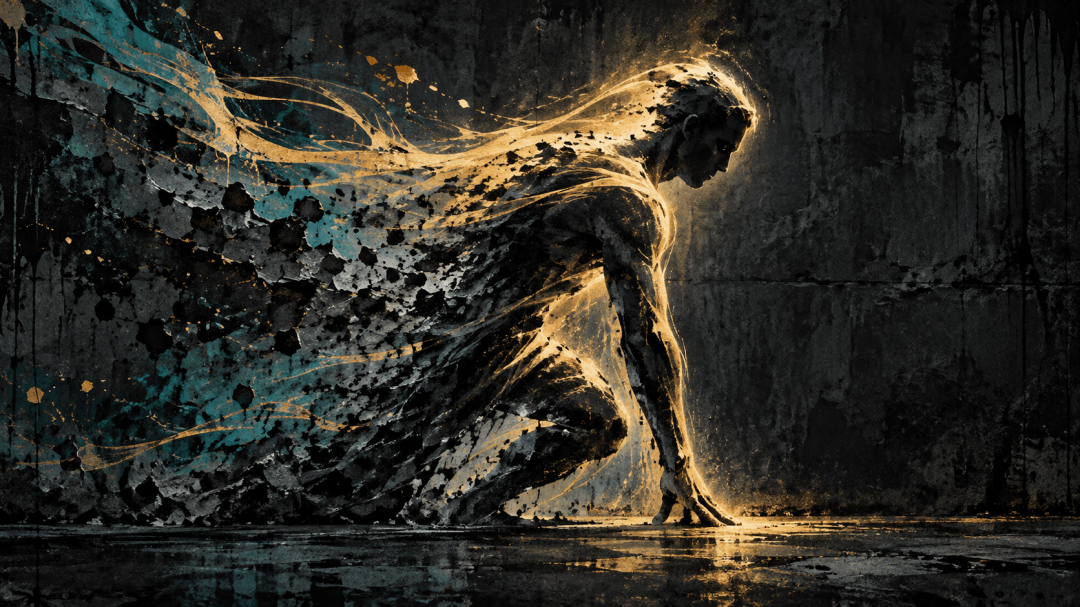
Righteousness is not a thing we accumulate but a process we become—and the process is what lasts.
Ask a believer what happens to their good deeds, and you will usually get an answer shaped like accounting. The deeds are entered into a record. They accrue. They are weighed. On a long enough horizon they add up to something: a balance, a stock, a treasure laid up against the day it will be counted. Behind the image sits a quiet assumption so natural we rarely notice we are making it—that righteousness is a thing. A possession. A quantity a person comes to have, the way one comes to have money or muscle or a house, accumulated act by act and stored against the reckoning.
The assumption draws strength from one of the Quran’s soberest teachings, that this life is a passing thing and only a certain kind of work survives it:
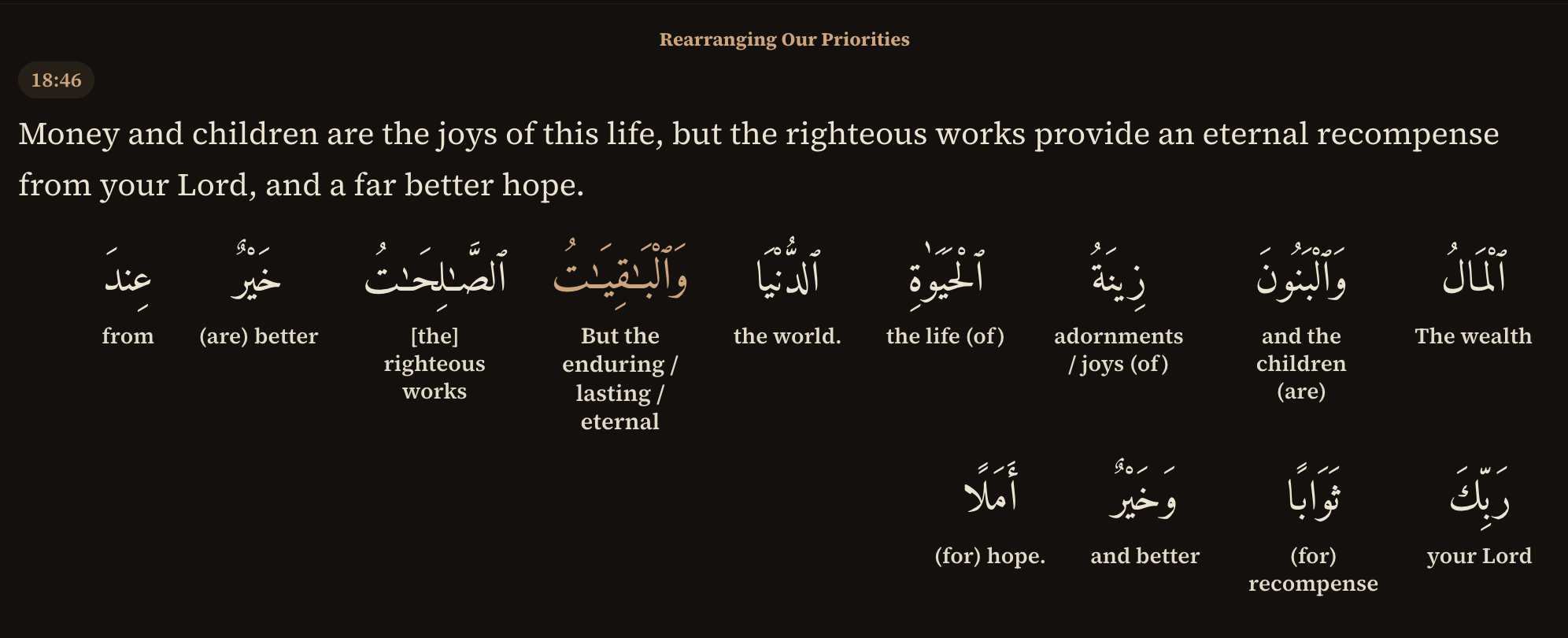
[18:45] Cite for them the example of this worldly life as water that we send down from the sky to produce plants of the earth, then they turn into hay that is blown away by the wind. GOD is able to do all things. [18:46] Money and children are the joys of this life, but the righteous works provide an eternal recompense from your Lord, and a far better hope.
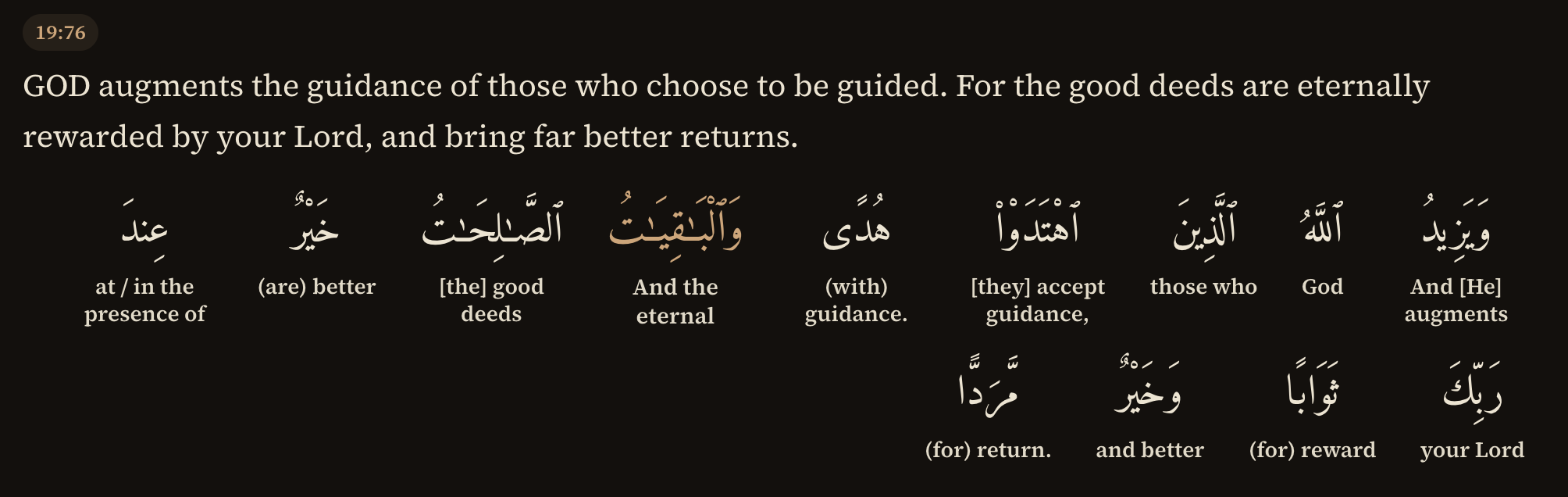
“The righteous works” here translates a precise Arabic phrase, al-bāqiyāt al-ṣāliḥāt, which the book uses again at 19:76.
[19:76] GOD augments the guidance of those who choose to be guided. For the good deeds are eternally rewarded by your Lord, and bring far better returns.
Rendered literally, it does not quite say “righteous works.” It says the enduring righteous things, the good that remains. The root is b-q-y, to stay, to persist, to be left over when everything else has gone; from it comes al-Bāqī, the Everlasting, a name of God. So the phrase names deeds by the one feature that separates them from money and children and hay: they last.
And immediately the accounting picture runs into a question it cannot answer. Last as what? What is the mode of being of a thing that endures when the world does not?
The Instant That Cannot Hold It
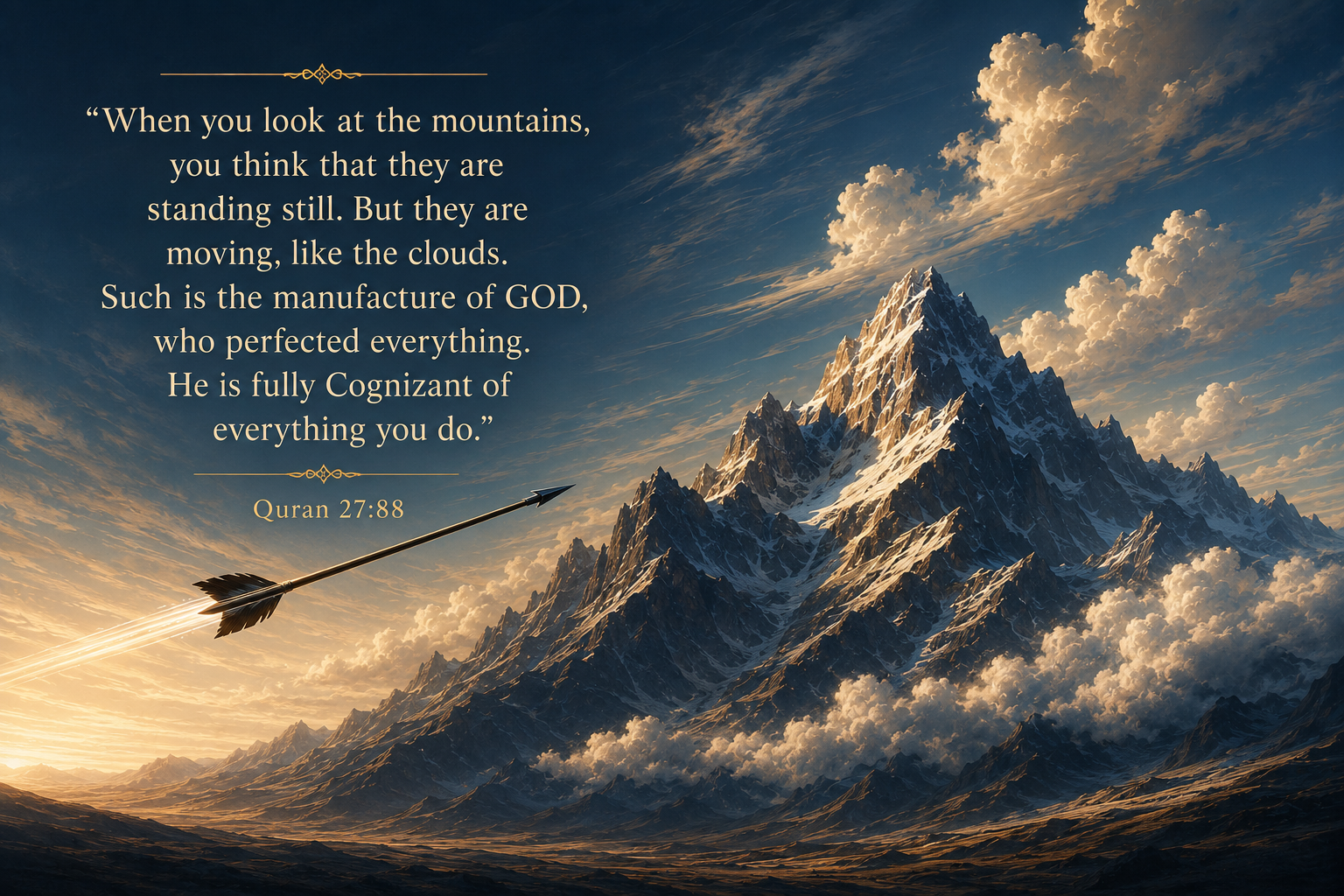
A companion inquiry on this site, The Arrow and the Mountain, tracing Zeno’s arrow and the moving mountain of Sura 27:88, arrived at a conclusion worth carrying into the moral realm: that there are, strictly, no things at all, only processes running at different speeds. What we call an object is a happening slow enough, relative to our clock, to be filed under a noun. The mountain you think is standing still is moving like the clouds; the solidity is in the looking, not in the stone.
Apply this understanding to righteousness, and the accounting picture takes on a new understanding.
Consider a single good act, isolated at the instant of its doing—one honest word, one coin given, one appetite refused. Freeze it, as Zeno froze his arrow, in a durationless slice of time. What is present in that frozen frame? A motion of a hand, a movement of the lips, a configuration of muscle and circumstance. But is righteousness present in it? Look as closely as you like at the single instant, and you will not find it there, any more than you will find motion in one still frame of the arrow. The arrow, at an instant, merely occupies a place; it does not move, because moving is not the sort of thing an instant can contain. And the deed, at its instant, merely happens; it is not yet righteous, because righteousness is not the sort of thing an instant can contain either.
Righteousness, like motion, is not a property of the frozen frame. It is a property of the trajectory. A hand can move identically in a bribe and in alms. What makes one of them righteous is not anything visible in the snapshot but everything the snapshot leaves out: where it came from, what it is oriented toward, what larger motion it is one instant of. There is no righteousness at an instant. It exists, if it exists at all, only across time—as a direction the frames are traveling when you stop freezing them and let them run.
The Verb Beneath the Noun
This is why the honest name for righteousness is a verb, not a noun.
Aristotle saw part of it. We become just, he wrote, by doing just acts, and temperate by doing temperate ones; virtue is not a gift that arrives whole but a hexis, a settled condition laid down by repetition, the way a person becomes a builder only by building. The moral life is not a state you are placed in but a competence you accrue, and you accrue it the only way competences are ever built—by doing the thing until the doing changes you.

But it is easy to hear Aristotle’s hexis as merely a subtler warehouse: a disposition acquired and then possessed, a thing set on a higher shelf. The deeper reading, the one the arrow and the mountain force, is that the disposition is not a possession at all. It is a standing wave. A flame keeps its shape not by being solid but by burning without pause, matter streaming through a stable pattern; a whirlpool is nothing but water held in a certain persistent motion. Virtuous character is like this. It looks like a fixed trait, a thing a person has, only because the process beneath it is running steadily enough to hold a recognizable form. Stop the process and the form does not sit there inertly like a stored coin. It goes, the way the whirlpool goes when the current stops. Righteousness is not what you have banked. It is what you are, at present, doing.
The Doer Remade by the Doing
Here the argument turns from the deed to the doer, which is where it was always heading.
If the deed is a frame in a motion and the character is a standing wave of that motion, then the deeds are not deposits made into a self that stands unchanged behind them, receiving them like a vault. The deeds are what the self is made of. Each act cuts a little of the channel the next act will run in. This is why the Quran locates the whole drama not in a ledger but in the soul, and describes the soul’s fate in the language of cultivation. Having created the human soul and made it conscious of its own wickedness and righteousness (91:7-8), the passage delivers its verdict in two lines:
[91:9] Successful is one who redeems it.
[91:10] Failing is one who neglects it.
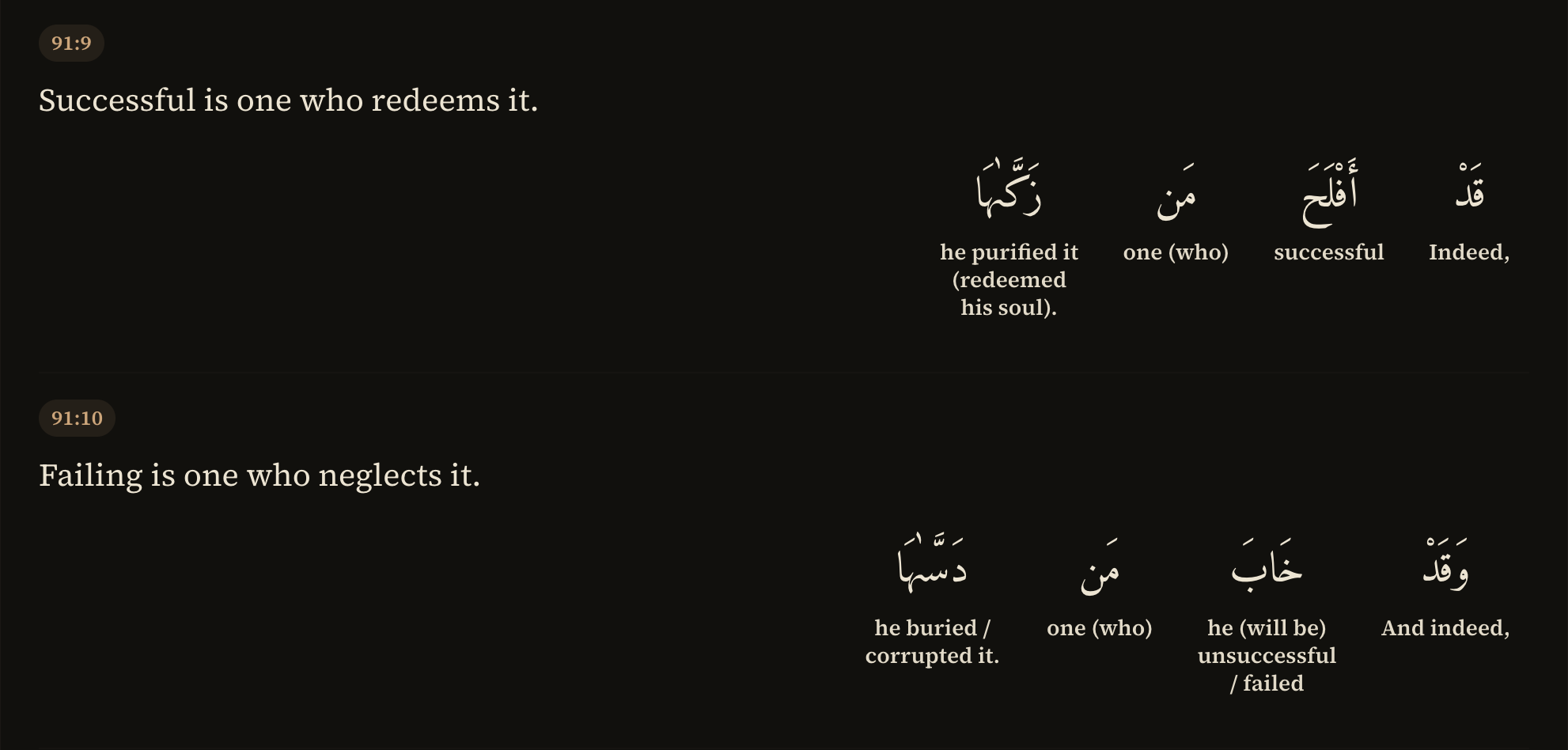
The verb behind “redeems” is zakkāhā, from a root that means at once to purify and to make grow—the same root as the purifying charity, zakāh. Its opposite in the next verse, dassāhā, means to stunt, to bury, to smother a thing in the soil. The imagery is horticultural, not financial. A soul is not a container you fill with righteous objects; it is something planted, cultivated into growth or choked into ruin by what you do to it, day after day, act after act. Tazkiyah, purification, is not a transaction completed once and filed. It is a process of becoming, and its product is not a stock of deeds but a kind of soul.
So the relation between righteous deeds and a righteous person is not the relation between coins and a purse. It is the relation between motion and a river, between burning and a flame. Righteous deeds come from a righteous process, and the righteous process, sustained, becomes the person’s constitution—part of their ontology, not their inventory. You do not perform good acts in order to accumulate a substance called righteousness. You perform them, and in the performing you are, slowly, imperceptibly, redrawn. The deed is real, but its deepest work is not out in the world where it lands. It is back on the one who did it.
What Actually Lasts
Now the ephemerality of the world can be read again, and it says something sharper than it first appeared to.
We are inclined to divide our lives into things and events, and to assume the things are the durable part. The estate is a thing; giving it away is a mere event. The body is a thing; a night spent in prayer is a mere event. The name carved over the door is a thing; the private honesty no one witnessed is a mere event, gone the instant it is done. Grammar tells us the possessions endure, and the deeds evaporate.
Grammar is deceiving us here in exactly the way it deceives us about the mountain. The possessions are the froth. In the parable of 13:17, both the flooding valley and the smelter’s fire throw up a surface foam that is swept away as worthless, while what genuinely benefits people is what stays behind.
[13:17] He sends down water from the sky, causing the valleys to overflow, then the rapids produce abundant foam. Similarly, when they use fire to refine metals for their jewelry or equipment, foam is produced. GOD thus cites analogies for the truth and falsehood. As for the foam, it goes to waste, while that which benefits the people stays close to the ground. GOD thus cites the analogies.
The wealth, the monuments, the mountain-solid holdings we spend our lives mistaking for permanence—these are the fast processes we have merely sampled too coarsely to watch dissolving. Speed up the film and the fortune scatters like the hay of 18:45, the empire ripples and is gone, the carved name weathers to a smooth blank. What looked like the enduring thing was the passing event all along. And the deed we dismissed as a vanishing act turns out to be the slow, abiding one—not because the act persists somewhere as an object, but because it has been woven into a self, and a self is a far slower process than any fortune, slow enough to be carried across the threshold where fortunes cannot follow.
[55:26] Everyone on earth perishes.
[55:27] Only the presence of your Lord lasts, Possessor of Majesty and Honor.
Only al-Bāqī remains, and so the only things of ours that remain are the ones bound to Him—which is precisely what al-bāqiyāt al-ṣāliḥāt, the enduring good deeds, means at the root. They endure not as trophies in a case but as the shape a life has taken by orienting itself, act after act, toward the One who does not pass. Their permanence is borrowed from His.
The Soul That Returns
Notice, finally, whom the Quran addresses at the end. When the reckoning is over and the perishable world has blown away like hay, the invitation home is not issued to a pile of deeds. It is issued to a someone:
[89:27] As for you, O content soul.
[89:28] Return to your Lord, pleased and pleasing.
[89:29] Welcome into My servants.
[89:30] Welcome into My Paradise.
An-nafs al-muṭma’innah, the soul at peace—not the record of the soul, not its balance sheet, but the soul itself, arrived at a settled condition. That condition is what the whole long process was for. The deeds were the frames. The righteousness was the motion the frames traced once they were allowed to run. And the doer is the standing wave the motion raised up: the self that was being made, quietly, under the appearance of standing still, every time a hand moved toward the good instead of away from it.
Which means the question that should govern a life is not the accountant’s question, how much righteousness have I stored. It is a question about direction and becoming: what is this doing making me into. You will not carry a hoard of good deeds across death, because righteousness was never a hoard. You will carry the one thing the whole process was ever producing. You will carry who you have become—and if the doing was right, you will be the kind of soul to whom the return is spoken.
Related Articles


