
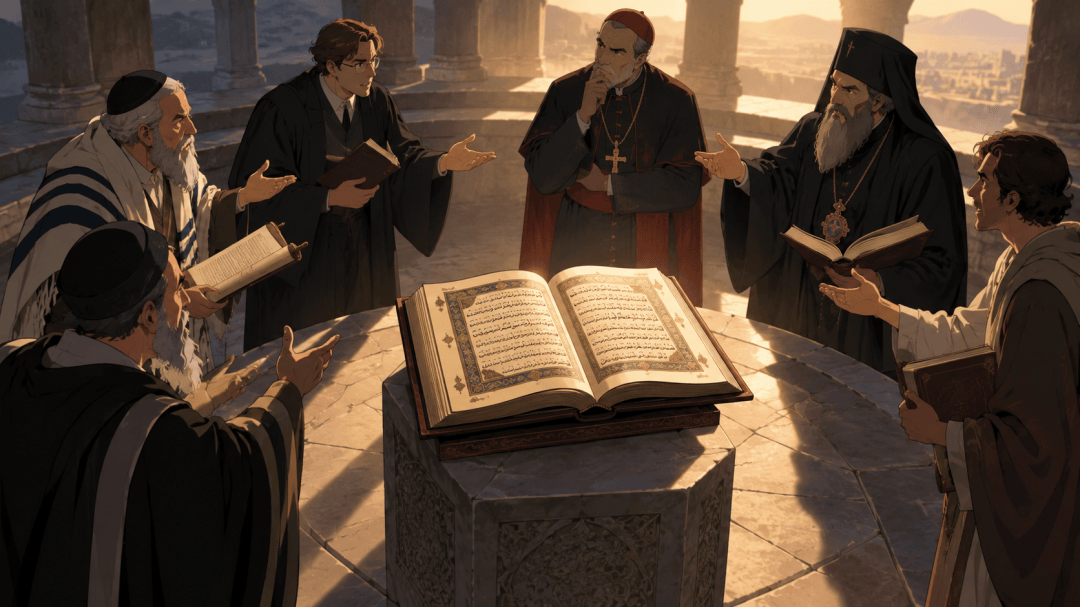
One of the most common arguments Christian apologists direct at Muslims is known as the Islamic Dilemma. It is built from two Quranic claims and one factual claim.
First, the Quran says it confirms the scriptures that came before it, the Torah and the Gospel. Second, Quran 10:94 says that if you are in doubt about what has been revealed to you, you should ask those who have been reading the scripture before you. Apologists read this as appointing the People of the Book, meaning Jews and Christians, as the referees who can verify or falsify the Quran. Third, Jews and Christians, reading their own scriptures, find teachings that differ from the Quran’s on the crucifixion, the divinity of Jesus, and much else.
Put together, the dilemma follows. Either the Quran is right to confirm the earlier scriptures, in which case it contradicts what those scriptures say according to the very people it sends us to consult. Or the Quran is wrong about the earlier scriptures, in which case it is not from God. Either way, the Quran fails.
This article is an internal critique. It does not ask the reader to believe anything about the Bible. It asks whether the dilemma follows from what the Quran actually says, and it argues that it does not, because the argument depends on a leap from consulting a source to submitting to that source. The Quran itself shows the leap is unjustified, and it shows it again and again.
The First Problem: Confirming Is Not Endorsing Everything
To confirm something is not to confirm everything attached to it. An archaeological discovery can confirm that a certain king existed without confirming every story told about his reign. Confirmation is a claim about a core, and nothing in the logic of the word extends it to every detail, interpretation, and doctrine that later communities built around that core.
The Quran also supplies a plain example of this in its own text, one that needs no inference. It states openly that its law differs from, and in places supersedes, the law given to earlier communities, and it uses the word confirming for its relationship to them in the same breath.
[3:50] I confirm the previous scripture, the Torah, and I am here to make lawful for you some of the things that were forbidden for you. I have come to you with a sign from your Lord. Therefore, you shall fear God and obey me.
وَمُصَدِّقًا لِّمَا بَيْنَ يَدَيَّ مِنَ التَّوْرَاةِ وَلِأُحِلَّ لَكُم بَعْضَ الَّذِي حُرِّمَ عَلَيْكُمْ ۚ وَجِئْتُكُم بِآيَةٍ مِّن رَّبِّكُمْ فَاتَّقُوا اللَّهَ وَأَطِيعُونِ
In one sentence, confirmation of the Torah and the lifting of some of its prohibitions sit side by side without strain. The Quran adds that certain earlier prohibitions were imposed as a consequence of wrongdoing, so they were never timeless features of the law.
[4:160] Because of the wickedness of those who are Jewish, we prohibited for them good things that used to be allowed for them, and for their hindering many from the way of God.
فَبِظُلْمٍ مِّنَ الَّذِينَ هَادُوا حَرَّمْنَا عَلَيْهِمْ طَيِّبَاتٍ أُحِلَّتْ لَهُمْ وَبِصَدِّهِمْ عَن سَبِيلِ اللَّهِ كَثِيرًا
So the apologist’s premise, that confirming earlier scripture means ratifying every provision as the earlier community held it, is contradicted by the Quran’s own statements. The Quran does not stumble into a disagreement with the People of the Book on points of law. It announces the difference openly, and it announces it while confirming.
In 5:48 it also calls itself muhaymin over the earlier scripture, a word variously rendered guardian, overseer, or one that supersedes. Whichever meaning one prefers, it places the Quran in a position of oversight, and a text that oversees another cannot at the same time be bound to accept that text’s interpreters as its judges.
[5:48] Then we revealed to you this scripture, truthfully, confirming previous scriptures, and superseding (muhaymin) over them. You shall rule among them in accordance with GOD’s revelations, and do not follow their wishes if they differ from the truth that came to you. For each of you, we have decreed laws and different rites. Had GOD willed, He could have made you one congregation. But He thus puts you to the test through the revelations He has given each of you. You shall compete in righteousness. To GOD is your final destiny—all of you—then He will inform you of everything you had disputed.
وَأَنزَلْنَآ إِلَيْكَ ٱلْكِتَٰبَ بِٱلْحَقِّ مُصَدِّقًا لِّمَا بَيْنَ يَدَيْهِ مِنَ ٱلْكِتَٰبِ وَمُهَيْمِنًا عَلَيْهِ فَٱحْكُم بَيْنَهُم بِمَآ أَنزَلَ ٱللَّهُ وَلَا تَتَّبِعْ أَهْوَآءَهُمْ عَمَّا جَآءَكَ مِنَ ٱلْحَقِّ لِكُلٍّ جَعَلْنَا مِنكُمْ شِرْعَةً وَمِنْهَاجًا وَلَوْ شَآءَ ٱللَّهُ لَجَعَلَكُمْ أُمَّةً وَٰحِدَةً وَلَٰكِن لِّيَبْلُوَكُمْ فِى مَآ ءَاتَىٰكُمْ فَٱسْتَبِقُوا۟ ٱلْخَيْرَٰتِ إِلَى ٱللَّهِ مَرْجِعُكُمْ جَمِيعًا فَيُنَبِّئُكُم بِمَا كُنتُمْ فِيهِ تَخْتَلِفُونَ
Quran 10:94 in Its Own Words
[10:94-95] If you are in doubt about what we revealed to you, ask those who read the scripture before you. The truth has come to you from your Lord, so do not be among the doubters. Nor shall you be among those who reject God’s revelations, lest you become a loser.
فَإِن كُنتَ فِي شَكٍّ مِّمَّا أَنزَلْنَا إِلَيْكَ فَاسْأَلِ الَّذِينَ يَقْرَءُونَ الْكِتَابَ مِن قَبْلِكَ ۚ لَقَدْ جَاءَكَ الْحَقُّ مِن رَّبِّكَ فَلَا تَكُونَنَّ مِنَ الْمُمْتَرِينَ وَلَا تَكُونَنَّ مِنَ الَّذِينَ كَذَّبُوا بِآيَاتِ اللَّهِ فَتَكُونَ مِنَ الْخَاسِرِينَ
Four features of the wording matter.
The condition is hypothetical. The verse opens with in (إِن), the Arabic particle for a condition that may or may not hold. It says “if you are in doubt,” and it does not assert that the addressee is in doubt. It describes a possibility, not a standing procedure.
The answer is stated before the consultation happens. In the same verse, the Quran says, “the truth has come to you from your Lord.” The conclusion arrives alongside the instruction to ask, so the consultation cannot be a trial whose outcome decides whether the revelation is true. It is closer to corroboration of something already asserted.
The address is singular. The verb kunta means “you” addressed to one person. This point carries less weight than the others, since the Quran sometimes uses singular address for instructions meant for everyone. But the apologist’s argument requires a standing rule for the whole community of believers, and the verse as worded speaks to one addressee about his own doubt.
Quran 10:94 instructs its addressee to consult people familiar with earlier scripture, but it does not establish that their interpretations constitute a final verdict on the Quran’s truth. The scope and purpose of the consultation must be established from the verse and its context, not assumed from the instruction to ask.
Additionally, nothing in the verse says what happens if the people asked disagree. The sentence “and if they contradict it, discard it” is not in the Quran. It has to be added, and the apologist’s whole case rests on that addition.
Suppose the addressee really is in doubt about something that was revealed, and does as the verse says: he asks those who have been reading the scripture before him. There are two possible outcomes. In the first, they confirm the point, and the doubt is settled, which is exactly the outcome the verse expects, since it declares in the next breath that the truth has come from the Lord. Nobody objects to this reading. The dilemma depends entirely on the second outcome, in which they say something different.
In that case, what does the verse tell the addressee to do? The apologist says he should conclude the revelation is false. But the verse says no such thing. The only instruction it gives for that moment is the one it has already stated: the truth has come to you from your Lord, so do not be among the doubters. The following verse adds that he must not be among those who reject God’s revelations. The verse’s own handling of disagreement therefore runs in the opposite direction from the apologist’s. The people asked can answer however they like, and the addressee has been told in advance not to treat a contrary answer as grounds for doubt. To reach the apologist’s conclusion, one has to delete the verse’s own ending and replace it with a rule that was never written.
The strongest version of the apologist’s reply runs like this. Why would the Quran send the addressee to the People of the Book unless it expected them to confirm the revelation? If it expected confirmation, then their disagreement is a failed prediction, and the Quran’s own confidence has been turned against it.
The verse places its confidence in the revelation, not in what any particular reader will say. The ground it gives for not doubting is “the truth has come to you from your Lord,” which is a statement about the source of the message and does not depend on the answer received. The Quran also says plainly that it does not expect every reader of the earlier scripture to be reliable.
[3:78] Some of them distort the scripture with their tongues, to make you think that it is from the scripture, while it is not from the scripture. They say, “This is from God,” while it is not from God. Thus, they utter lies and attribute them to God, knowingly.
وَإِنَّ مِنْهُمْ لَفَرِيقًا يَلْوُونَ أَلْسِنَتَهُم بِالْكِتَابِ لِتَحْسَبُوهُ مِنَ الْكِتَابِ وَمَا هُوَ مِنَ الْكِتَابِ وَيَقُولُونَ هُوَ مِنْ عِندِ اللَّهِ وَمَا هُوَ مِنْ عِندِ اللَّهِ وَيَقُولُونَ عَلَى اللَّهِ الْكَذِبَ وَهُمْ يَعْلَمُونَ
The same charge appears in 2:75 and 5:13. A text that says this about some of the people it directs the addressee to ask cannot be staking its truth on their answers. A prediction fails only if it was made, and the Quran never predicted that every reader would confirm it. It states in advance that some will not, and it tells the addressee not to treat their contrary answer as grounds for doubt. A disagreement the Quran has already anticipated cannot count as a refutation of it. And under 17:36, a contrary answer is a report to be verified like any other, not a verdict.
[17:36] You shall not accept any information, unless you verify it for yourself. I have given you the hearing, the eyes, and the brain, and you are responsible for using them.
وَلَا تَقْفُ مَا لَيْسَ لَكَ بِهِ عِلْمٌ ۚ إِنَّ السَّمْعَ وَالْبَصَرَ وَالْفُؤَادَ كُلُّ أُولَٰئِكَ كَانَ عَنْهُ مَسْئُولًا
There is also a second problem. The “people who read the scripture before you” are not a single monolith with a single reading, and the disagreement runs at every level. Jews and Christians disagree about what counts as scripture, since Christians add the New Testament and Jews reject it. They disagree about Jesus, about the Torah’s law, and about the meaning of the scriptures they share. Jewish readers reject the Trinity and the divinity of Jesus, as the Quran does, but they would side against the Quran on whether Jesus is the messiah or Muhammad a prophet. And Christians disagree among themselves. Catholic, Orthodox, and Protestant churches do not share the same Old Testament canon. The early church divided over the nature of Christ, and the bodies that descend from those disputes remain separate. Unitarian Christians reject the Trinity altogether. So the question “what do those who read the scripture say?” has no single answer, and the apologist’s own method returns a split verdict. If their answer decides whether the Quran is true, the verse has to say whose answer counts, and it gives no mechanism for choosing. Any choice the apologist makes is a theological commitment brought in from outside the Quran, and it is the very kind of commitment the argument claimed to be drawing from the verse. Nor does the verse say which matter is to be put to them. Read in its context, the surrounding verses concern Moses, Pharaoh, and the Children of Israel, and a question about that material does not become a license for outside readers to rule on the whole revelation.
Ironically, the Quran explicitly acknowledges that those who received earlier scripture disagreed among themselves, even after clear proofs had come to them.
[2:213] The people used to be one community when GOD sent the prophets as bearers of good news, as well as warners. He sent down with them the scripture, bearing the truth, to judge among the people in their disputes. Ironically, those who received the scripture were the ones who rejected any new scripture, despite clear proofs given to them. This is due to jealousy on their part. GOD guides those who believe to the truth that is disputed by all others, in accordance with His will. GOD guides whoever wills in a straight path.
كَانَ ٱلنَّاسُ أُمَّةً وَٰحِدَةً فَبَعَثَ ٱللَّهُ ٱلنَّبِيِّۦنَ مُبَشِّرِينَ وَمُنذِرِينَ وَأَنزَلَ مَعَهُمُ ٱلْكِتَٰبَ بِٱلْحَقِّ لِيَحْكُمَ بَيْنَ ٱلنَّاسِ فِيمَا ٱخْتَلَفُوا۟ فِيهِ وَمَا ٱخْتَلَفَ فِيهِ إِلَّا ٱلَّذِينَ أُوتُوهُ مِنۢ بَعْدِ مَا جَآءَتْهُمُ ٱلْبَيِّنَٰتُ بَغْيًۢا بَيْنَهُمْ فَهَدَى ٱللَّهُ ٱلَّذِينَ ءَامَنُوا۟ لِمَا ٱخْتَلَفُوا۟ فِيهِ مِنَ ٱلْحَقِّ بِإِذْنِهِۦ وَٱللَّهُ يَهْدِى مَن يَشَآءُ إِلَىٰ صِرَٰطٍ مُّسْتَقِيمٍ
It describes divine scripture as being sent with the truth to judge between people concerning their disagreements, rather than leaving those disagreements to be settled by the competing claims of the communities themselves. This creates a fundamental problem for the Islamic Dilemma. If the Quran recognizes that the recipients of earlier revelation disputed its meaning and required divine guidance to resolve their differences, how could their interpretations simultaneously serve as the final authority for judging the Quran? The Quran presents revelation as the means of adjudicating religious disputes, not the disputed interpretations of earlier communities as the authority over revelation.
[27:76] This Quran settles many issues for the Children of Israel; issues that they are still disputing.
إِنَّ هَٰذَا ٱلْقُرْءَانَ يَقُصُّ عَلَىٰ بَنِىٓ إِسْرَٰٓءِيلَ أَكْثَرَ ٱلَّذِى هُمْ فِيهِ يَخْتَلِفُونَ
If the recipients of earlier scripture cannot agree among themselves about what their scriptures teach, whose interpretation is supposed to serve as the final authority over the Quran? This is precisely the problem with the Islamic Dilemma: it assumes a unified and authoritative interpretation of earlier revelation where competing interpretations plainly exist.
The Second Problem: The Quran Sends Its Readers Elsewhere Constantly
This is the heart of the matter. The Quran says “ask those who read the scripture before you,” and the apologist concludes that those people therefore hold authority over the Quran’s truth. The step from ask to overrule is never supplied by the verse. It is supplied by the apologist, and it is supplied as a general rule: if the Quran tells you to consult X, then X is an arbiter over the Quran.
A general rule can be tested on its other instances, and the Quran provides plenty. It tells its audience to ask the people who know the history of earlier messengers. It tells them to ask the Children of Israel about the signs given to Moses. It tells them to roam the earth and look at the ruins of earlier nations, and to look at the camels, the mountains, and the sky. Apply the apologist’s rule to these, and it produces judges that no one would accept: the ruins of dead civilizations, the mountains, a camel. The rule fails as stated.
The apologist can retreat to a narrower rule, that 10:94 is special because it concerns doubt about revelation itself. But that is a different claim, and it has to be established from the verse’s own wording and context, which the previous section showed does not support it. Either way, 10:94 cannot be read through the general rule.
The survey below sorts these verses by what the outside source is actually doing. A source can be a witness who testifies to a fact, an evidentiary source that supplies material to be weighed, or a judge whose verdict binds. The people asked in 16:43 and 21:7, and the Children of Israel in 17:101 and 2:211, are witnesses to facts. The ruins, the camels, and the mountains are evidence. In 4:82 and 2:23, the Quran handles doubt about its own origin by pointing to tests of the text itself. In none of these is an outside source made judge over the Quran’s message, and the apologetic argument needs exactly that.
The Survey: Where the Quran Sends Its Readers
Ask the People of the Message
[16:43] We did not send before you any but men, to whom we sent revelations. So ask the people of the scripture (dhikr) if you do not know.
وَمَا أَرْسَلْنَا مِن قَبْلِكَ إِلَّا رِجَالًا نُّوحِي إِلَيْهِمْ ۚ فَاسْأَلُوا أَهْلَ الذِّكْرِ إِن كُنتُمْ لَا تَعْلَمُونَ
[21:7] We did not send before you except men whom we inspired. So ask the people of the scripture (dhikr), if you do not know.
وَمَآ أَرْسَلْنَا قَبْلَكَ إِلَّا رِجَالًا نُّوحِىٓ إِلَيْهِمْ فَسْـَٔلُوٓا۟ أَهْلَ ٱلذِّكْرِ إِن كُنتُمْ لَا تَعْلَمُونَ
These verses are the closest parallel to 10:94, since they use the same verb. Look at what is being asked: whether earlier messengers were mortal men. The addressees are the deniers who objected that Muhammad was merely human, and they are told to check with people who know the history of earlier messengers. The consultation is limited to one historical fact, and its answer is stated in advance. Nobody reads these verses as installing the “people of the message” as judges of the Quran, yet the grammar and logic are the same as 10:94.
[43:45] Ask those messengers whom we sent before you: “Did we ever appoint any gods beside the Most Gracious to be worshipped?”
وَاسْأَلْ مَنْ أَرْسَلْنَا مِن قَبْلِكَ مِن رُّسُلِنَا أَجَعَلْنَا مِن دُونِ الرَّحْمَٰنِ آلِهَةً يُعْبَدُونَ
The party consulted here is as authoritative as any could be: earlier messengers themselves. The question is rhetorical, since the earlier messengers can’t be literally questioned, so the instruction points to what they taught, and the question itself states the answer. If consulting earlier messengers does not make them arbiters over the Quran, it is hard to see why consulting readers of the earlier books would.
There is another implication worth considering. The Quran explicitly rejects the divinity of Jesus (5:72, 5:75) and the Trinity (4:171, 5:73), yet here it directs its audience to consult people familiar with earlier scripture, potentially including Christians who hold precisely those beliefs. While Trinitarians also affirm Jesus’ humanity, they attribute to him a divine status the Quran rejects.
Therefore, the instruction to consult them cannot reasonably be taken as a blanket endorsement of their theology. The Quran appeals to their knowledge of earlier messengers on a particular question without surrendering its own position on who those messengers were. If consulting the People of the Book required accepting their religious interpretations as authoritative, the Quran would be granting authority to beliefs it explicitly rejects.
Ask the Children of Israel
Another group that the Quran states to “ask” are the Children of Israel. These verses come closest to the apologist’s own position, because they name the very community the apologist says holds authority and tell the reader to go to them. If the Quran ever hands a verdict to the Children of Israel, this is where it would do it. So the useful questions to bring to these two verses are what exactly the reader is sent to ask, and who is supplying the answer.
[17:101] We have given Moses nine clear miracles. Ask the Children of Israel. When he went to them, Pharaoh said to him, “O Moses, I think you are bewitched.”
وَلَقَدْ آتَيْنَا مُوسَىٰ تِسْعَ آيَاتٍ بَيِّنَاتٍ ۖ فَاسْأَلْ بَنِي إِسْرَائِيلَ إِذْ جَاءَهُمْ فَقَالَ لَهُ فِرْعَوْنُ إِنِّي لَأَظُنُّكَ يَا مُوسَىٰ مَسْحُورًا
[2:211] Ask the Children of Israel how many clear miracles we have given them. Anyone who changes God’s blessing after receiving it, God is strict in enforcing retribution.
سَلْ بَنِي إِسْرَائِيلَ كَمْ آتَيْنَاهُم مِّنْ آيَةٍ بَيِّنَةٍ ۗ وَمَن يُبَدِّلْ نِعْمَةَ اللَّهِ مِن بَعْدِ مَا جَاءَتْهُ فَإِنَّ اللَّهَ شَدِيدُ الْعِقَابِ
Both verses send the reader to the Children of Israel for a specific matter of their own history: the signs given to Moses. In both, the Quran is the one telling the story and the Children of Israel are brought in as witnesses to events they lived through. In 2:211, the very next clause speaks of those who changed God’s blessing after receiving it. The Quran asks them as witnesses while openly saying that not all of them are reliable. If asking made someone an unquestionable judge, the verse could not say that in the same breath.
Look at the World
Throughout the Quran, the reader is told to look to certain realities or facts for proof. The command form recurs in 3:137, 16:36, 27:69, 29:20, and 30:42, and the question form in 12:109, 35:44, 40:21, 40:82, and 47:10. It is one of the most repeated formulas in the Quran.
[6:11] Say, “Roam the earth, then note the consequences for the rejectors.”
قُلْ سِيرُوا فِي الْأَرْضِ ثُمَّ انظُرُوا كَيْفَ كَانَ عَاقِبَةُ الْمُكَذِّبِينَ
[30:9] Have they not roamed the earth and observed the consequences for those before them?…
أَوَلَمْ يَسِيرُوا فِي الْأَرْضِ فَيَنظُرُوا كَيْفَ كَانَ عَاقِبَةُ الَّذِينَ مِن قَبْلِهِمْ
The Quran tells readers to go out and examine the historical record, confident that what they find will support the message. The ruins are evidence. They do not issue rulings, and treating “go and look at the ruins” as the appointment of the ruins as judge over scripture is the same mistake as treating “ask those who read scripture” that way.
[88:17-20] Do they not look at the camels—how they are created? And the sky—how it is raised? And the mountains—how they are installed? And the earth—how it is spread out?
أَفَلَا يَنظُرُونَ إِلَى الْإِبِلِ كَيْفَ خُلِقَتْ وَإِلَى السَّمَاءِ كَيْفَ رُفِعَتْ وَإِلَى الْجِبَالِ كَيْفَ نُصِبَتْ وَإِلَى الْأَرْضِ كَيْفَ سُطِحَتْ
Doubt Is Answered by a Test
10:94 is not the only place the Quran speaks of doubt about what it reveals. The other places are worth reading beside it, because they show what the Quran itself offers as the remedy.
[2:23] If you have any doubt about what we revealed to our servant, then produce one sura like these, and call upon your witnesses, other than God, if you are truthful.
وَإِن كُنتُمْ فِي رَيْبٍ مِّمَّا نَزَّلْنَا عَلَىٰ عَبْدِنَا فَأْتُوا بِسُورَةٍ مِّن مِّثْلِهِ وَادْعُوا شُهَدَاءَكُم مِّن دُونِ اللَّهِ إِن كُنتُمْ صَادِقِينَ
This verse opens with the same kind of conditional as 10:94: “if you have any doubt about what we revealed.” The remedy it names is a challenge the doubter can attempt, and it names no referee. Even the “witnesses” the doubter is invited to call are called on his side of the challenge, not as judges over it.
[4:82] Do they not study the Quran? If it were from other than God, they would have found in it numerous contradictions.
أَفَلَا يَتَدَبَّرُونَ الْقُرْآنَ ۚ وَلَوْ كَانَ مِنْ عِندِ غَيْرِ اللَّهِ لَوَجَدُوا فِيهِ اخْتِلَافًا كَثِيرًا
Here the remedy is an internal consistency test that any reader can run on the text.
Both verses are addressed to deniers, not to a believer in doubt, and a critic may say that makes them different from 10:94. But that is the point. Whoever the doubter is, the remedy the Quran names for doubt about its origin is evidence: a challenge to meet, a text to examine. If 10:94 were meant to hand the verdict to outside readers, it would be the one place in the Quran where doubt is answered by a referee instead of a test.
Conclusion
The Islamic Dilemma needs three things to be true:
- Confirming the earlier scriptures means endorsing every detail as their contemporary readers understood it.
- The Quran appoints those readers as judges over its own truth.
- That those readers’ understanding contradicts the Quran.
The first claim fails on the Quran’s own testimony. The dilemma needs “confirming” to mean ratifying every provision as the earlier communities held it, but the Quran uses the word in the same sentence as an announcement of difference. In 3:50 Jesus confirms the Torah and in the same breath declares that he is making lawful some of what had been forbidden. In 4:160 the Quran says certain earlier prohibitions were imposed as a consequence of wrongdoing, which means they were never fixed features of the law. In 5:48 it says that for each community God appointed a law and a method, and it calls itself muhaymin over the scripture it confirms, a word that places it in a position of oversight. The claim also has a second flaw, which is the phrase “as their contemporary readers understood it.” The Quran says in several places that some of those readers altered, concealed, or misrepresented what they were given (2:75, 3:78, 5:13). So the dilemma asks the Quran to endorse the very understanding it says was in part corrupted, and no reading of “confirming” requires that. What the Quran confirms is the divine origin and core message of the earlier revelation. It does not confirm every legal detail, every interpretation, or every doctrine later built on it.
The second claim fails on the wording of 10:94 and on the Quran’s consistent practice. The verse addresses one person, not the community. It uses a conditional that does not assert the doubt it describes. It states its conclusion, “the truth has come to you from your Lord,” in the same verse as the instruction to ask, so the consultation cannot be a trial whose outcome decides the matter. And it never says what follows if the people asked disagree. That sentence is not in the Quran, and the dilemma depends on it. The verses closest to 10:94 confirm the narrow reading. In 16:43 and 21:7 the same verb of asking sends skeptics to people who know the history of earlier messengers, on the single question of whether those messengers were men, with the answer given in advance. In 43:45 the party consulted is the earlier messengers themselves, and the question is rhetorical. When the Quran does bring in outside witnesses to its own message, as in 13:43 and 46:10, they stand beside God and testify in favor of the revelation. When it addresses doubt about revelation directly, as in 2:23 and 4:82, it offers a test of the text and names no referee. And where it says who rules between the Messenger and the People of the Book, in 5:48, the direction of judgment is the reverse of the apologist’s: the Messenger rules among them by what God has revealed and is told not to follow their opinions where those differ from the truth that came to him. Even on the most generous reading, then, consulting a source yields testimony on the matter asked. To make that testimony a verdict against the Quran as a whole, the verse would need to say so, and it does not.
The Quran sends its readers to many places: to the people who know the history of earlier messengers, to the earlier messengers themselves, to the Children of Israel, to the reports they must verify, to the ruins of vanished nations, to the camels and mountains and sky, and to its own pages. Nobody, including the apologist, reads those instructions as appointing each of those sources as judge. That is the test the second claim cannot pass, because it is a general principle, and a general principle has to hold across its instances. To consult someone is not to surrender one’s judgment to them. To confirm a source is not to endorse every claim associated with it. And to seek evidence outside a text is not to make that evidence’s source the supreme authority over the text.
The third claim, that the readers’ understanding of their scriptures contradicts the Quran, is a question about how Jews and Christians read the Bible, and this article does not take it up. It matters to the dilemma only if the first two claims hold. If confirming does not mean endorsing everything, and consulting does not mean submitting, then a disagreement between the Quran and the People of the Book is not a contradiction. It is the difference the Quran already announces. With the first two claims removed, the dilemma has nothing left to stand on.
A sound reading of 10:94 must establish the scope of the consultation from the wording and context of the verse itself. It cannot assume that consulting the People of the Book grants them unlimited authority over the Quran and then use that assumption to manufacture a contradiction. Once the assumption is removed, the verse supplies a witness and never a judge.


