The Quran does not describe God as one object set among other objects. It presents Him as the Absolute in relation to which every object is measured, named, and known. And yet the same book that insists there is nothing whatsoever like Him also speaks of Him ceaselessly—as One who wills, speaks, commands, sends, draws near, and shows Himself in what He makes. This is the central tension of any serious theology drawn from the text: how can the utterly incomparable be so intimately involved?
The answer proposed here is that God relates to creation through distinct modes of disclosure without ever suffering distinction in His essence. A mode is not a part. To divide God into parts would be the very error the Quran names as the gravest of all: assigning partners and portions to Him. The modes treated in this essay—the Absolute, the Command, and the Agent, resolving finally into the Signs—are the degrees at which a single indivisible God is received by His creation, where the Hidden becomes the Manifest.
The Quran authorizes exactly this language. In one verse God names Himself under four titles at once:
[57:3] He is the Alpha and the Omega. He is the Outermost and the Innermost. He is fully aware of all things.
First and Last, Outermost and Innermost, disclosed under aspects that would contradict each other for any created thing yet coincide effortlessly for God. A creature cannot be both the outermost surface and the innermost depth. God is both, and the same. This single verse is the license and the limit of everything that follows: we may speak of modes, because He does; we may not speak of parts, because the Quran forbids it.
[5:73] Pagans indeed are those who say that GOD is a third in a trinity. There is no god except the one god. Unless they refrain from saying this, those who disbelieve among them will incur a painful retribution.
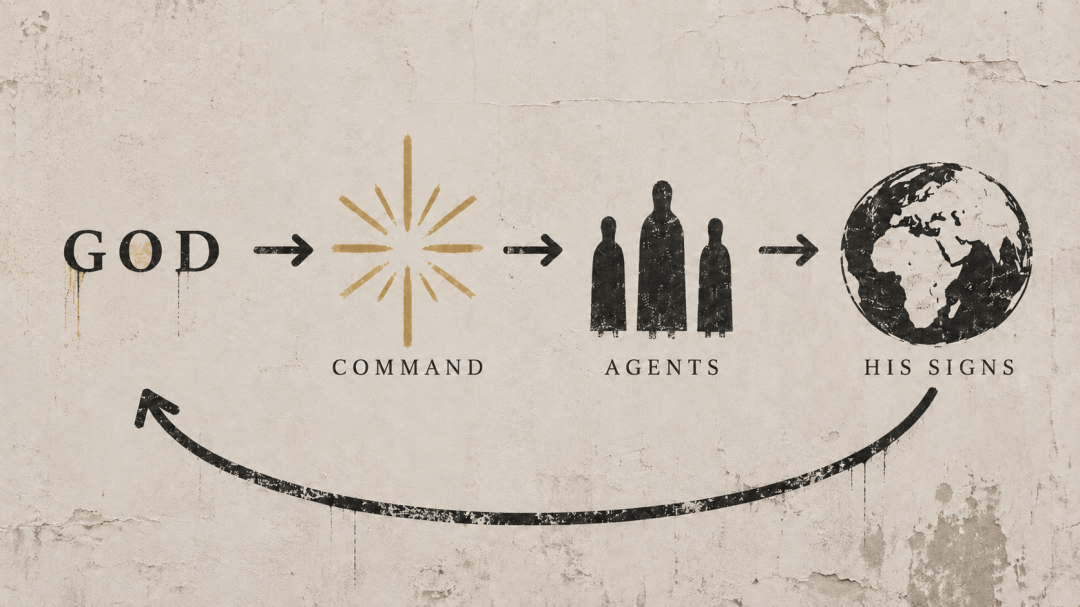
What follows traces an arc. It begins at the farthest reach, with God as He is in Himself, the Absolute that no perception contains. It descends to the Command, the living principle of will and Spirit by which the possible is called into the actual. It descends further to the Agent, the mode in which God acts into the world through manifestation, messengership, and speech. And it arrives at the Signs, the traces left across the horizons and within the self—by which the whole descent is directed back to the Absolute from which it began. The Arabic word for a Quranic verse and the word for a sign or miracle are one and the same: āya. The book and the cosmos are two registers of a single disclosure, and both exist to return the reader to their Author.
I. The Absolute, The Reality
Among the names the Quran gives to God, one carries the whole weight of His independence from everything else: al-Ḥaqq, the Real, the True.
[22:62] It is a fact that GOD is the Truth, while the setting up of any idols beside Him constitutes a falsehood, and that GOD is the Most High, the Supreme.
The word does not merely mean that God tells the truth or keeps His word, though He does both. It means that God is the truth in the ontological sense: the one reality that stands on its own, owing its existence to nothing, while everything else borrows its being moment by moment from Him. “Most Exalted is GOD, the only true (al-Ḥaqq) King” (20:114); “Then everyone is returned to GOD, their rightful (al-Ḥaqq) Lord and Master” (6:62). Everything other than al-Ḥaqq is, in the strict sense, on loan.
From this single attribute, the rest of the Absolute unfolds. Because God alone is real in Himself, He alone is necessary, and He alone is one without composition or rival. The shortest and densest statement of this in the entire Quran is the sura of sincere devotion:
[112:1-4] Proclaim, “He is the One and only GOD. The Absolute (al-Ṣamad) GOD. Never did He beget. Nor was He begotten. None equals Him.”
Four short lines dismantle every alternative theology. He is One, so there is no plurality within Him. He is al-Ṣamad, the Absolute toward whom all need turns while He needs nothing. He does not generate offspring and was not generated, so He stands outside the chain of cause and descent that binds all created things. And nothing is His equal, so comparison itself fails at the threshold.
That failure of comparison is stated as a first principle: “There is nothing that equals Him. He is the Hearer, the Seer” (42:11). The verse is precisely constructed. It denies all likeness in its first clause, and in its second it affirms that He hears and sees—lest the denial of likeness collapse into the denial of relation. He is incomparable and attentive. The transcendence of the Absolute is not the aloofness of an absent god; it is the transcendence of a Reality so encompassing that nearness and distance are equally His.
This is why perception cannot seize Him.
[6:103] No visions can encompass Him, but He encompasses all visions. He is the Compassionate, the Cognizant.
The created eye is built to receive objects smaller than itself, bounded, standing over against the seer. God is not an object of that kind. When Moses asked to see Him directly, the answer was not a rebuke but a demonstration:
[7:143] When Moses came at our appointed time, and his Lord spoke with him, he said, “My Lord, let me look and see You.” He said, “You cannot see Me. Look at that mountain; if it stays in its place, then you can see Me.” Then, his Lord manifested Himself to the mountain, and this caused it to crumble. Moses fell unconscious. When he came to, he said, “Be You glorified. I repent to You, and I am the most convinced believer.”
Even a fragment of unmediated disclosure unmakes the solid rock. The Absolute cannot be met as one thing meets another; it can only be met through mediation, which is the entire reason the later modes exist.
The self-subsistence of al-Ḥaqq reaches its clearest expression in the verse of the Throne:
[2:255] GOD: there is no other god besides Him, the Living, the Eternal. Never a moment of unawareness or slumber overtakes Him. To Him belongs everything in the heavens and everything on earth. Who could intercede with Him, except in accordance with His will? He knows their past, and their future. No one attains any knowledge, except as He wills. His dominion encompasses the heavens and the earth, and ruling them never burdens Him. He is the Most High, the Great.
Two names anchor the passage. Al-Ḥayy, the Living, names a life that depends on nothing and never lapses. Al-Qayyūm, the Eternal, or the Sustainer, names the One by whom all other things stand—remove Him and the cosmos does not merely lose its ruler; it loses its footing in being. The heavens and earth are not self-standing structures God happens to govern; they are held upright at every instant, and their upkeep costs Him nothing.
From this it follows that the Absolute alone endures.
[56:26] Everyone on earth perishes. [56:27] Only the presence of your Lord lasts. Possessor of Majesty and Honor.
[28:88] You shall not worship beside GOD any other god. There is no other god beside Him. Everything perishes except His presence. To Him belongs all sovereignty, and to Him you will be returned.
The literal word for “His presence” is “His Face” (wajhahu); here it is not a feature but the very presence and reality of God, that which is turned toward creation and which alone survives when creation lapses. And because His presence is the one abiding reality, it cannot be escaped in space:
[2:115] To GOD belongs the east and the west; wherever you go there will be the presence of GOD. GOD is Omnipresent, Omniscient.
The Absolute is not located somewhere; every direction is His direction. He is nearer to the human being “than the jugular vein” (50:16), not by traversing a distance but because distance itself is a created relation that never stood between Him and anything.
This, then, is the first mode: God as He is in Himself, the Real from which all else borrows reality, incomparable, self-subsisting, imperceptible, abiding when all else fails. Held alone, this mode would leave the creature with a God too high to know. The Quran does not leave it alone. The same verse that placed Him beyond comprehension named Him the Subtle and the Aware; the same book that hides Him behind majesty declares Him nearer than the heart. The Absolute discloses. The mode by which it begins to do so is the Spirit.
II. The Command
If the Absolute names God at rest in His own reality, the command names God as living principle—the divine will and command by which what is merely possible is summoned into actuality. This mode answers a question the first cannot: how does the self-sufficient Real, needing nothing and joined to nothing, bring a contingent world into being without being altered by the act?
The Quran’s answer is startling in its economy. Creation is not a labor, not an emanation, not a struggle with resistant matter. It is a word.
[2:117] The Initiator of the heavens and the earth: to have anything done, He simply says to it, “Be,” and it is.
The formula recurs across the book with the force of a refrain:
[36:82] All He needs to do to carry out any command is say to it, “Be,” and it is.
Between the divine intention and the existence of its object there is no gap to be crossed by effort; there is only the word kun, and the thing stands in being. This is why the same book that describes God resting on nothing can describe Him as author of everything. He does not build; He commands.
Note the structure of that verse from Sura 36 (Yā-Sīn): intention, then command, then existence. The intention is irāda, the will; the command is amr, the word; the result is fa-yakūn, the being of the thing. The Revelation, in this treatise’s sense, is the whole of that living movement from will through command to actuality. And the Quran explicitly binds the word “Rūḥ” to the word “command”:
[17:85] They ask you about the revelation (rūḥ). Say, “The revelation (rūḥ) is from the command of my Lord. The knowledge given to you is minute.”
وَيَسْـَٔلُونَكَ عَنِ ٱلرُّوحِ قُلِ ٱلرُّوحُ مِنْ أَمْرِ رَبِّى وَمَآ أُوتِيتُم مِّنَ ٱلْعِلْمِ إِلَّا قَلِيلًا
The rūḥ is min amr rabbī—from the command of my Lord. It is the animating side of the divine act, the breath of the “Be” rather than the mud that is shaped.
The command is God’s own possession, held apart from and above the creation it produces: “Absolutely, He controls all creation and all commands. Most Exalted is GOD, Lord of the universe” (7:54). Creation is the made; command is the making. And the making is instantaneous, not sequential:
[54:50] Our commands are done within the blink of an eye.
The whole apparatus of divine will operates outside the time it institutes. To the creature, worlds unfold across ages; to the command, it is a single glance.
Behind the command stands the will, and the will is unconditioned. “God does what He intends” (2:253); He is “the doer of what He wills” (11:107; 85:16). Nothing external constrains it, and even the creature’s own willing is enfolded within it:
[81:29] Whatever you will is in accordance with the will of GOD, Lord of the universe.
This is not the abolition of the human will but its grounding—the creature wills within a field of possibility that the divine will first opens. The Command is the mode in which God is not merely real but active, not merely self-sufficient but generative.
This mode also names the passage from potentiality to actuality, and the Quran marks that passage with a haunting precision. Before the word “Be,” the thing is not a diminished something but a genuine nothing—yet a nothing already present to God’s knowledge.
[76:1] Is it not a fact that there was a time when the human being was nothing to be mentioned?
And to the human directly:
[19:67] Did the human being forget that we created him already, and he was nothing?
[19:9] He said, “Thus said your Lord: ‘It is easy for Me to do. I created you before that, and you were nothing.'”
Here is potentiality in its exact Quranic form. The human was “nothing”—no independent existence—and yet was already “mentioned,” already an object of the divine knowing and willing before ever being an object in the world. The Spirit is the arc along which the merely known becomes the actually existing.
[20:50] He said, “Our Lord is the One who granted everything its existence, and its guidance.”
And it is the Spirit, that carries the command that takes life across the boundary from matter into soul. God shapes the human body from clay, “then He proportioned him and breathed into him of His Spirit” (32:9; 15:29; 38:72). The same breath quickens the son of Mary: “and we breathed into her of our Spirit” (21:91; 66:12). The “Spirit of God” breathed into the human is not a piece of God transferred into a body, as though the Absolute could be divided and distributed. It is the trace of the command, the animating word reaching its most intimate created effect. Life in the creature is the nearest echo of the “Be” that made it.
So the Spirit represents God’s will, command, and breath—the dynamism by which the Absolute, without ceasing to be absolute, brings the possible into the actual and quickens the actual into life. But a world summoned into being is not yet a world addressed. Command produces existence; it does not, by itself, produce guidance, communication, or covenant. For that, God does not merely will the world; He acts within it. This is the third mode.
III. The Agent: The Action
The Absolute is God in Himself; the breath of the spirit is God as will and command. The Agent is God as He acts into the created order and makes Himself present to it—not by becoming a creature, but by disclosing Himself through appointed loci: a manifestation, a messenger, a scripture, a sustaining Spirit. This is the mode in which the imperceptible Reality shows a face without being captured by it, and speaks a word without being confined to a mouth.
The Quran is exact about the terms on which the Absolute can be addressed.
[42:51] No human being can communicate with GOD except through inspiration, or from behind a barrier, or by sending a messenger through whom He reveals what He wills. He is the Most High, Most Wise.
Three modes of divine speech are named, and all three are mediated. There is no fourth mode of raw, unveiled encounter, for we have already seen what unveiling did to the mountain (7:143). Direct inspiration, a screening veil, an appointed messenger—each is a way the Real reaches the creature while preserving the distance that keeps the creature intact. Agency, in the Quran, is inseparable from mediation.
The chief instrument of this mediated speech is a Spirit given a specific title: the Rūḥ al-Qudus, the Holy Spirit, and elsewhere al-Rūḥ al-Amīn, the Honest Spirit. Here one must distinguish carefully from the second mode. The Spirit of the previous section was the animating breath of the command; the Holy Spirit of this section is the agent of communication, the bearer of revelation and the support of the messengers. “We gave Jesus, son of Mary, clear proofs, and we supported him with the Holy Spirit” (2:87; 2:253; 5:110). Of the Quran itself: “Say: the Holy Spirit has brought it down from your Lord in truth” (16:102). And in imagery of great tenderness: “The Honest Spirit has brought it down upon your heart, that you may be among the warners, in a clear Arabic tongue” (26:193–195). Revelation descends; it is carried; it is trustworthy; it lands upon a heart. The Agent is God communicating, and the Holy Spirit is the mode of that communication.
Revelation itself is called rūḥ, tying this mode back to the last while keeping it distinct:
[42:52] Thus, we inspired (wahi) to you a revelation (rūḥ) proclaiming our commandments. You had no idea about the scripture, or faith. Yet, we made this a beacon to guide whomever we choose from among our servants. Surely, you guide in a straight path.
The Quran is a rūḥ min amrinā, a spirit/revelation from the command: a living communication, not a dead text, descending from the same order as the “Be” but now bent toward address rather than mere existence. On the Night of Decree,
[97:4] The angels and the Spirit descend therein, by their Lord’s leave, to carry out every command.
The command that once said “Be” to the cosmos now descends as guidance to the heart.
The manifestation proper—God showing rather than only telling—is named tajallī. We have met it once, on the mountain that could not survive when God “manifested” Himself to it (7:143). But manifestation need not shatter; it can also illumine, and the Quran’s most sustained image of the Agent as disclosure is the verse of Light.
[24:35] GOD is the light of the heavens and the earth. The allegory of His light is that of a concave mirror behind a lamp that is placed inside a glass container. The glass container is like a bright, pearl-like star. The fuel thereof is supplied from a blessed oil-producing tree, that is neither eastern, nor western. Its oil is almost self-radiating; needs no fire to ignite it. Light upon light. GOD guides to His light whomever He wills. GOD thus cites the parables for the people. GOD is fully aware of all things.
The structure is the whole doctrine of mediated manifestation in a single figure. The light source is one, but it is received through a niche, a glass, a lamp—that amplifies, attracts, and guides. The Agent is the Absolute rendered visible through the media it appoints: “light upon light,” each layer a mercy to the weakness of the seer.
The Quran states divine agency in its boldest form. When an agent acts, it is God who acts through him.
[8:17] It was not you who killed them; GOD is the One who killed them. It was not you who threw when you threw; GOD is the One who threw. But He thus gives the believers a chance to earn a lot of credit. GOD is Hearer, Omniscient.
The human hand moved, and yet the act was ascribed to God, for the agency belonged to Him and the hand was its locus. When the believers pledged loyalty to the messenger, the Quran does not say their pledge merely resembled a pledge to God; it says:
[48:10] Surely, those who pledge allegiance to you, are pledging allegiance to GOD. GOD approves their pledge; He places His hand above their hands…
And the principle is generalized: “Whoever obeys the messenger is obeying GOD” (4:80). None of this makes the messenger divine; he remains wholly a servant, and the Quran is relentless on that point. It makes him transparent—a window through which the divine will is done, an authority whose authority is entirely borrowed.
[4:150] Those who disbelieve in GOD and His messengers, and seek to make distinction among GOD and His messengers, and say, “We believe in some and reject some,” and wish to follow a path in between;
This clarifies what may be meant by speaking of God’s “image.” The Absolute has no image; nothing is like Him, and no likeness can be drawn (42:11). But the Quran does give God a representative within creation—the khalīfa, to David: “We have made you a ruler on earth, so judge among the people with truth” (38:26). The deputy does not depict God, as an image depicts its subject; the deputy re-presents God’s will on the earth, standing in for an authority not his own. And the messenger is the perfected form of this deputyship, held up as the pattern the community is to trace:
[33:21] The messenger of GOD has set up a good example for those among you who seek GOD and the Last Day, and constantly think about GOD.
The nearest thing to an image of the imageless God is a life lived in perfect transparency to His command—not a picture of God, but a place where His will becomes visible in action.
The stable, transmissible form of this agency is Scripture. Revelation is called, without qualification, “the word of God” (9:6; 48:15)—not a report about God’s word but the word itself, entrusted to human language. Through the Book, the Agent’s speech outlasts the moment of its descent and reaches those who never stood in a messenger’s presence. Manifestation lights the sky in an instant; Scripture keeps the light burning after the flash. Together—the manifesting tajallī, the bearing Holy Spirit, the messenger, the enduring Book—they compose God’s agency, present and active within the world He commanded into being, addressing the creature through media that spare it the annihilation of a direct encounter.
Yet all of this agency is instrumental. Manifestation, messenger, and Book do not exist to be admired in themselves. They exist to point—to turn the creature’s attention back through the descent to the Absolute. That pointing is the last mode, and it is where the whole arc reverses.
IV. The Signs That Point Back to God
The three modes so far describe a descent: from the Absolute in itself, to the will and command, to the Agent acting within the world. The fourth mode is not a further step down but the beginning of the ascent. It is the āyāt—the signs—the traces that the descent leaves everywhere across creation and scripture, and by which the creature is led back up to the God who left them.
Everything now turns on a single feature of the Arabic. The word for a verse of the Quran and the word for a phenomenon of nature are the same: āya, a sign, a pointer, a token that indicates something beyond itself. This is not a coincidence to be noted and set aside; it is a theological claim built into the vocabulary. The cosmos and the Book are two systems of signs issued by one Author, and both are structured to be read. The lines of scripture and the lines of the horizon are, in the Quran’s own idiom, sentences of a single divine speech.
The key verse fuses the whole treatise into one sentence, and it does so by returning to the name with which we began.
[41:53] We will show them our proofs in the horizons, and within themselves, until they realize that this is the truth. Is your Lord not sufficient, as a witness of all things?
Al-Ḥaqq—the very name of the first mode—is the destination of the last. The signs in the outer world (al-āfāq) and the signs in the inner self (anfusihim) do not terminate in themselves; they terminate in the recognition of the Absolute. The arc closes. What descended as command, manifestation, and speech now ascends as evidence, and the evidence resolves back into al-Ḥaqq.
The two provinces of the sign named there—the horizons and the self—organize the Quran’s entire invitation to reflect. Outwardly:
[3:190] In the creation of the heavens and the earth, and the alternation of night and day, there are signs (ayat) for those who possess intelligence.
[2:164] In the creation of the heavens and the earth, the alternation of night and day, the ships that roam the ocean for the benefit of the people, the water that GOD sends down from the sky to revive dead land and to spread in it all kinds of creatures, the manipulation of the winds, and the clouds that are placed between the sky and the earth, there are sufficient proofs (ayat) for people who understand.
The book presses the eye toward the ordinary until the ordinary yields its strangeness:
[88:17] Why do they not reflect on the camels and how they are created? [88:18] And the sky and how it is raised. [88:19] And the mountains and how they are constructed. [88:20] And the earth and how it is built.
Nothing exotic is required. The commonest facts of the world are already signs; only attention is lacking.
Inwardly, the signs are nearer still:
[51:19] The earth is full of signs (ayat) for those who are certain. [51:21] And within yourselves; can you see?
The self is the closest text a person will ever read, and the least often opened. The Quran gathers both provinces into a single litany introduced by the recurring phrase wa min āyātihi, “and among His signs”: the creation of the heavens and earth; sleep by night and the seeking of provision by day; the lightning that carries fear and hope; and, most tenderly, the bonds of human intimacy—
[30:21] Among His proofs is that He created for you spouses from among yourselves, in order to have tranquility and contentment with each other, and He placed in your hearts love and care towards your spouses. In this, there are sufficient proofs (ayat) for people who think.
The diversity of human languages and colors is likewise named a sign for those who know (30:22). Love, rest, sleep, speech, difference—the whole texture of a human life is a field of pointers, if only it is read as such.
This is why the Quran calls its own verses āyāt bayyināt, “clear signs” (2:99), and why it can move without any change of register from a verse about scripture to a verse about the sun and the moon. Both are its verses. The disbeliever, in the Quran’s diagnosis, is not primarily someone who lacks information but someone who “turns away from the signs” (as the recurring reproach has it)—who walks through a world dense with pointers and reads none of them. Faith, correspondingly, is not a leap made in the dark; it is literacy in a world that is everywhere written. To see the sign as a sign is already to have begun the ascent.
And the ascent it begins is the exact reverse of the descent this treatise has traced. The creature meets first the signs—the created and revealed traces, the fourth mode. Reading them rightly, it is carried to the Agent whose action they record. Through the Agent it apprehends the Spirit, the will and command whose word the signs spell out. And through the Spirit it is returned at last to the Absolute, al-Ḥaqq, the Reality “until it becomes clear that it is the Real” (41:53). The signs are the rungs; the descent laid them down, and the reader climbs.
Epilogue: The Circle of Disclosure
Set the four modes in a line, and they look like a hierarchy descending from an unreachable summit to a scatter of clues in the dust. Set them in a circle and their real shape appears. The Absolute discloses itself as Spirit; the Spirit acts as Agent; the Agent leaves Signs; and the Signs return the reader to the Absolute. It is one movement, outward and then home, and it is authored at every point by one God.
This is the safeguard the whole essay has tried to keep. The modes must never be counted as separate powers, for that is the counting the Quran most severely forbids—the apportioning of the One into partners and shares. The Absolute is not a remote high god served by lesser divine functionaries called Spirit and Agent. It is the same He, disclosed at different degrees of nearness to a creature that could not survive Him all at once. The verse that permitted this language guards it as well:
[57:3] He is the Alpha and the Omega. He is the Outermost and the Innermost. He is fully aware of all things.
The Inward is the Absolute in His hiddenness; the Outward is the same God in His signs; and between the two there is no seam, because there is only one He.
What, then, is the human task before such a God? Not to see the Absolute directly, which levels mountains and undoes the seer. Not to seize the command, which is His alone. The task is to read—to move through the signs with attention, to let the outward return one to the inward, to trace the disclosure back along the path by which it came. The Quran names the reward of that reading in the same breath as the signs themselves: that “it becomes clear that it is the Real.” The modes of God are, in the end, the mercy of a Reality too great to be met, arranging itself into a book the creature can actually read—so that the one who begins with the faintest sign in the horizon or the self may be carried, rung by rung, back to al-Ḥaqq, the Truth, the Reality.


