
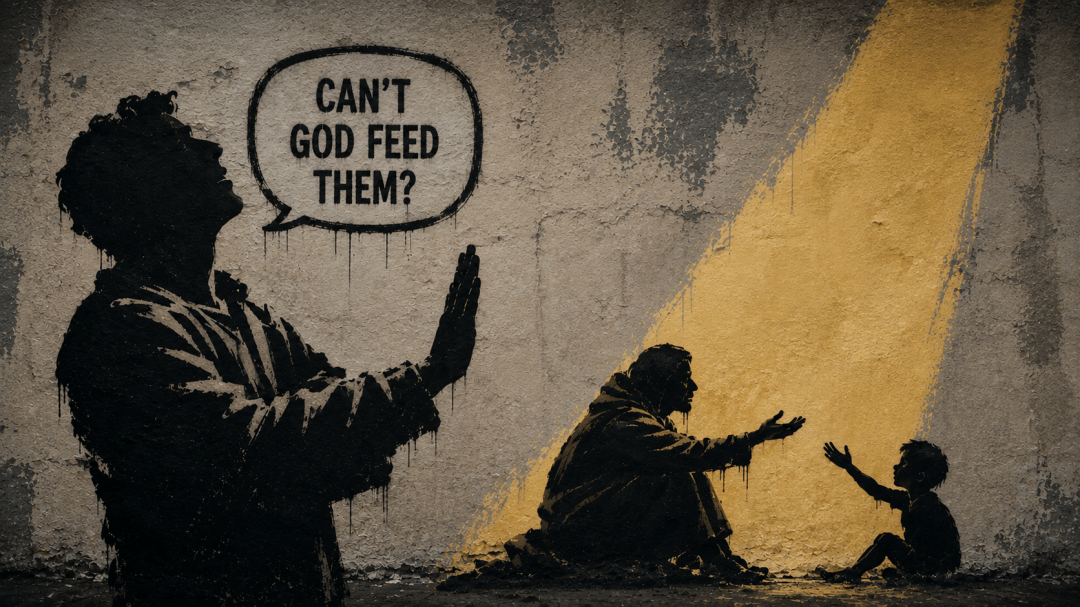
The verse stages a small drama. The believers are told to give from what God has provided. The disbelievers answer with something that sounds almost devout:
[36:47] When they are told, “Give from GOD’s provisions to you,” those who disbelieve say to those who believe, “Why should we give to those whom GOD could feed, if He so willed? You are really far astray.”
It has the shape of piety. It appeals to God’s power. And it is completely backward.
The argument works by taking something true and bending it toward something false. It is true that God could feed anyone He wills. From this the disbelievers conclude that they themselves have no business feeding anyone. If the poor are poor, that must be God’s arrangement—so who are they to interfere?
This is fatalism disguised as reverence. It treats God’s power as a reason for human passivity. But God’s power was never an argument against responsibility. It is the ground of it.
Notice what they have missed. They speak of the poor as those God “could” feed, as if He is not already at work. But the provision in their own hands is God’s provision—”Give from GOD’s provisions to you.” The wealth they are clutching is the very means by which God feeds the hungry. God’s answer to poverty was placed in their pockets.
So when they refuse, they are not deferring to God’s will. They are refusing to be the instrument God chose. They imagine themselves stepping aside to let God act, when in fact God was acting through them, and they walked away.
The irony is complete: they use God’s generosity toward them as their excuse to withhold it from others.
There is a final detail. They do not merely decline—they call the believers “really far astray.” The selfish party casts itself as the clear-eyed one and the charitable as the confused. This is how bad theology usually ends: not only excusing the wrong thing, but inverting the moral order so that generosity looks foolish and neglect looks wise.
The lesson here is to question any theology that happens to relieve you of a duty to strive and do righteous works or allows you to justify what you would rather not perform. When a religious argument lines up perfectly with your own convenience, that alignment is worth examining.
God’s sovereignty does not cancel human responsibility—it assigns it. To be given is to be entrusted. The provision in your hand is not proof that the poor are God’s problem; it is evidence that they have been made yours. What you hold was given so that it could move through you.
The disbelievers asked, “Why should we feed those whom God could feed?” The verse’s quiet answer is that God is feeding them—or would be, if the ones holding His provision would open their hands.

 Quran Talk Blog