
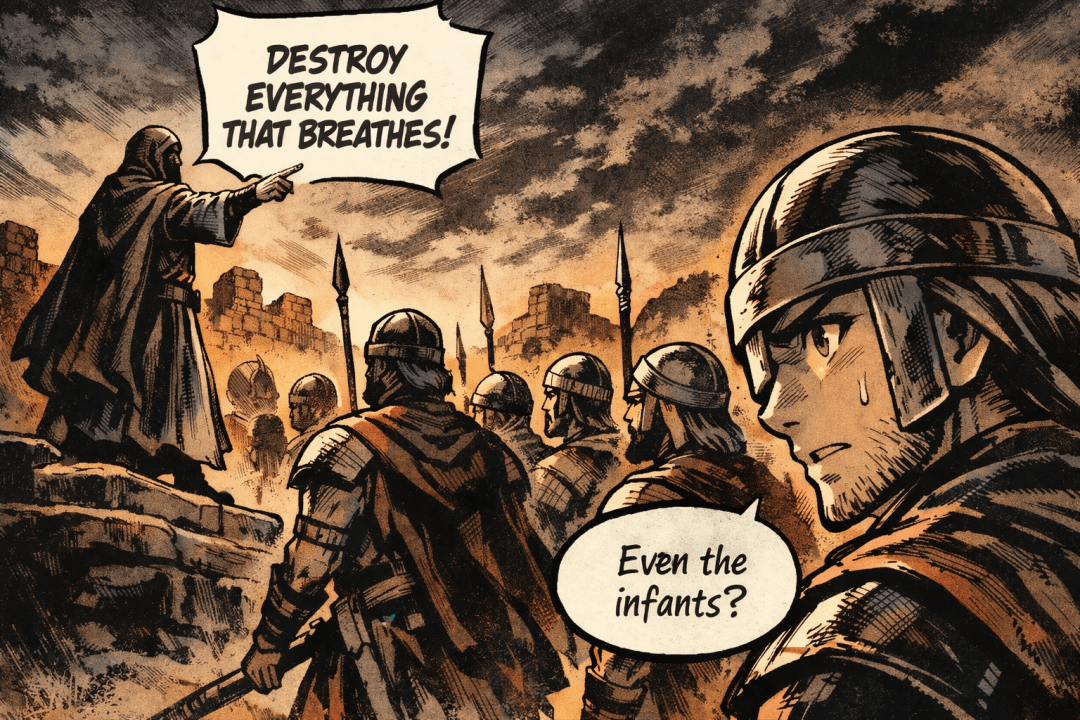
There are passages in the Hebrew Bible where God commands the killing of infants. Not as collateral damage. Not as tragic necessity. As policy, by name, with approval for thoroughness. This article does not soften that fact, spiritualize it, or frame it as ancient mystery beyond moral evaluation. It documents what the text says and asks whether the attempt to call such commands righteous does more damage to the concept of God than any atheist critique ever could.
These are not obscure verses hidden in genealogies or poetic metaphors lost in translation. They are direct commands and narratives that describe the intentional killing of entire populations, explicitly including women, children, and infants. To attribute such commands to God is not merely difficult; it is a theological scandal.
This article does not attempt to excuse these passages, nor does it accept the common apologetic retreat that dismisses them as “ancient commands” beyond moral scrutiny. Such explanations do not resolve the problem—they evade it. To suggest that acts which would be universally condemned as atrocities today become righteous simply because they are placed in the distant past is to abandon moral reasoning altogether.
What follows is documentation of these texts and a confrontation with the question apologetics consistently avoid: can the deliberate extermination of innocents ever be reconciled with a just and moral God, or does the attempt to do so collapse into the very moral incoherence it seeks to defend?
How to Read What Follows
This article reads the biblical text on its own terms—not as what it might symbolize, not as what later interpreters wished it said, but as what the words actually claim to describe: commands issued, obedience measured, and consequences enforced. If the language is clear enough to command armies, it is clear enough to judge morally.
The passages examined here employ specific terminology, follow deliberate patterns, and make explicit claims about divine authorization. They are presented chronologically to show how violence moves from legal mandate through systematic execution to ultimate measure of faithfulness.
The Legal Framework of Annihilation
Deuteronomy 20:16–18 — The Foundational Command
Deuteronomy presents itself as Moses’ final address to Israel on the plains of Moab, just east of the Jordan River, on the eve of the conquest of Canaan. The generation that left Egypt has died in the wilderness, and a new generation stands poised to enter the land promised to their ancestors. Deuteronomy functions as a legal restatement and expansion of earlier laws, framing obedience as the condition for national survival.
Chapter 20 forms part of Deuteronomy’s laws of warfare. It begins by distinguishing between two categories of enemies. Cities “far away” may be offered terms of peace and subjected to forced labor if they surrender. But a stark exception is then introduced—the cities within the land designated as Israel’s inheritance.
It is here that Deuteronomy 20:16–17 draws an unambiguous line:
“But in the cities of these peoples that the LORD your God is giving you for an inheritance, you shall save alive nothing that breathes, but you shall devote them to complete destruction, the Hittites and the Amorites, the Canaanites and the Perizzites, the Hivites and the Jebusites, as the LORD your God has commanded.” — Deuteronomy 20:16–17
This language is not poetic or metaphorical. It employs the technical term herem (ḥērem), meaning total devotion to destruction. In biblical law, ḥērem denotes irrevocable removal—persons or objects placed beyond human use, permanently eliminated in the name of God. The phrase “nothing that breathes” (כָּל־נְשָׁמָה) is exhaustive by design. It includes infants, children, the elderly, and noncombatants without exception.
The stated justification follows immediately in verse 18:
“…that they may not teach you to do according to all their abominations which they have done for their gods, and so you sin against the LORD your God.” — Deuteronomy 20:18
Entire populations are condemned not for crimes committed, but for the perceived risk they pose to Israel’s religious purity. Cultural influence itself is treated as a capital offense. Moral agency is rendered irrelevant; identity alone determines fate.
This command functions as foundational law, not situational instruction. Later narratives in Joshua explicitly cite obedience to this command as the measure of righteousness. Cities are evaluated not by how fiercely they resisted, but by whether anyone was left alive. Failure to carry out total destruction is portrayed as disobedience, even rebellion.
What makes this passage especially consequential is that it precedes and authorizes everything that follows. The massacres of Jericho, Ai, and the wider Canaanite campaigns are not battlefield excesses; they are the execution of statute. Violence is not incidental—it is legislated.
The moral difficulty cannot be sidestepped by appealing to ancient warfare norms. The text itself does not justify the command by military necessity or reciprocal cruelty, but by divine mandate. The extermination of innocents is not presented as tragic inevitability, but as righteous compliance.
If this law is accepted as divinely issued, then moral reasoning collapses into obedience alone. If it is questioned, then the text must be acknowledged as reflecting human conquest ideology sacralized through religious language. Deuteronomy 20:16–18 allows no neutral middle ground.
Transjordan Slaughters: Before Entering Canaan
Deuteronomy 2:34 — The Destruction of Sihon’s Cities
As Israel moves northward along the eastern side of the Jordan River, the text presents the journey as a series of divinely managed encounters. Certain peoples are explicitly off-limits, while others are placed in Israel’s path. When Israel approaches the territory of Sihon, king of Heshbon, a request is made for peaceful passage—travel through the land without turning aside into fields or vineyards. The request is refused, and Sihon mobilizes his forces. Conflict follows.
The battle itself is described briefly. What receives emphasis is not the clash of armies, but what happens afterward. Following victory, the narrative turns from military engagement to systematic elimination:
“And we captured all his cities at that time and devoted to destruction every city, men, women, and children. We left no survivors.” — Deuteronomy 2:34
Deuteronomy 3:6 — The Same Policy Applied to Og
The account then continues north into Bashan, where Og, king of Bashan, confronts Israel. The outcome is portrayed as inevitable. Og’s forces are defeated, his cities taken, and the same policy is enacted again, without modification or exception:
“So we devoted them to destruction, as we did to Sihon the king of Heshbon, devoting to destruction every city, men, women, and children.” — Deuteronomy 3:6
The language is precise and repetitive. This is not the rhetoric of chaotic warfare, but the terminology of policy. The verb used—ḥērem—denotes total and irreversible destruction. Nothing is spared. Civilians are not casualties of circumstance; they are explicitly included by definition.
What makes these accounts especially revealing is their context. These events take place outside the land of Canaan, before Israel has crossed the Jordan or encountered the peoples later described as uniquely corrupt. The justification is not religious contamination, as in later conquest laws, but simple opposition. Refusal of passage and military resistance are enough to warrant annihilation of entire urban populations.
The narrative offers no pause for moral reflection, no acknowledgment of civilian suffering, and no distinction between combatants and noncombatants. Victory is defined by completeness. The destruction of “men, women, and children” is presented as a matter-of-fact outcome of obedience and divine favor.
These episodes quietly undermine a common apologetic claim—that total destruction in the biblical text is a limited, exceptional response to extreme moral depravity. Here, the same formula is applied to peoples whose only recorded offense is resistance. The implication is unavoidable: once warfare is framed as divinely sanctioned, the threshold for extermination collapses entirely.
By embedding these actions in Moses’ retrospective address, the text normalizes them as part of Israel’s foundational story. The slaughter is not portrayed as tragic necessity or moral failure, but as faithful execution of divine will. The narrative does not struggle with the deaths of innocents; it records them as evidence that nothing was left undone.
Midian: Killing Children by Command
Numbers 31:15–18 — Moses Orders the Execution of Male Children
Near the end of Israel’s wilderness journey, after decades of wandering and on the verge of entering the land beyond the Jordan, the book of Numbers records a final divinely sanctioned campaign. The target is Midian—a people portrayed not primarily as a military threat, but as a moral one. Earlier in the narrative, Midianite women are accused of leading Israelites into idolatry and sexual transgression at Peor. The war that follows is framed not as territorial conquest, but as retribution.
The initial assault is described briefly. Israel attacks Midian, killing every adult male, including named leaders. The women and children, however, are taken alive, along with livestock and spoil. At this point, the narrative pauses—not to lament the violence, but to register Moses’ reaction.
When Moses sees the captives, he is enraged.
“Have you let all the women live? Behold, these, on Balaam’s advice, caused the people of Israel to act treacherously against the LORD in the incident of Peor, and so the plague came among the congregation of the LORD.” — Numbers 31:15–16
What follows is not a correction from God, nor a moment of moral hesitation, but an explicit command that escalates the violence beyond the battlefield:
“Now therefore, kill every male among the little ones, and kill every woman who has known man by lying with him.” — Numbers 31:17
The command is precise. Male children are singled out for death. Women are divided by sexual history. The only survivors permitted are girls who are virgins:
“But all the young girls who have not known man by lying with him, keep alive for yourselves.” — Numbers 31:18
The text offers no ambiguity about intent. Children are not collateral damage; they are explicitly targeted. Infants are condemned by category, not action. The violence is no longer a byproduct of war—it is an ordered procedure carried out after combat has ended.
What makes this episode especially disturbing is the source of the command. It does not come from a panicked army or a bloodthirsty enemy. It comes from Moses—the central prophetic figure of the Torah—presented as enforcing divine will. The narrative offers no dissenting voice, no divine rebuke, and no ethical tension. Compliance is assumed.
The rationale given is preventive and punitive at once. These women are blamed collectively for past transgression, and their children—incapable of agency—are treated as extensions of guilt. Moral responsibility is inherited, not chosen.
This passage removes any remaining uncertainty about how far the biblical war ethic can extend. Here, the deliberate killing of children is not merely permitted—it is commanded. The sparing of virgins, framed without explanation, raises further ethical questions the text itself never addresses.
Numbers 31 does not portray this moment as tragic, regrettable, or morally complex. It records it as correction—violence intensified in the name of obedience. If earlier passages leave room for denial or reinterpretation, this one does not. The killing of children is not an unfortunate consequence of war; it is the point.
Jericho: The Template for Total Destruction
Joshua 6:21 — Young and Old Destroyed Without Distinction
After the death of Moses, leadership passes to Joshua, and the long-anticipated entry into the land begins. The crossing of the Jordan is portrayed as a ritual reenactment of the Red Sea, signaling that what follows is not merely a military campaign but a divinely orchestrated act of fulfillment. Jericho stands as the first city in the land—a fortified urban center and a symbolic gateway to Canaan.
From the outset, Jericho is marked out for ḥērem—total devotion to destruction. The strategy itself is framed as liturgical rather than tactical: priests carry the ark, trumpets are blown, and the army circles the city in silence for six days. On the seventh day, the walls collapse without conventional combat. The victory is attributed entirely to divine intervention.
Only after this ritualized display does the narrative turn to what follows inside the city:
“Then they devoted all in the city to destruction, both men and women, young and old, oxen, sheep, and donkeys, with the edge of the sword.” — Joshua 6:21
The verse is constructed to remove ambiguity. “Men and women” establishes gender inclusivity; “young and old” explicitly spans age; animals are listed last, reinforcing the totality of what is destroyed. This is not a description of battlefield casualties. It is an inventory of extermination.
Jericho is presented as the paradigmatic victory of faith. The city falls not because of military ingenuity, but because Israel obeys precisely. The slaughter that follows is therefore inseparable from that obedience. The narrative does not distinguish combatants from civilians, nor does it acknowledge resistance within the city once the walls fall. The destruction is immediate and comprehensive.
The phrase “young and old” collapses any attempt to reinterpret the event as a conventional act of war. Infants and the elderly cannot be cast as enemy fighters. Their inclusion signals that this is ritualized extermination, not military necessity. The killing functions as a sacred act, completing what divine intervention began.
The story reinforces this framing by its aftermath. The city is burned, its valuables are declared sacred to the treasury of the LORD, and a curse is pronounced on anyone who attempts to rebuild it:
“Cursed before the LORD be the man who rises up and rebuilds this city, Jericho. At the cost of his firstborn shall he lay its foundation, and at the cost of his youngest son shall he set up its gates.” — Joshua 6:26
Jericho is not merely conquered; it is erased. Its destruction becomes a theological template rather than a historical anomaly.
The narrative offers no expression of grief, no ethical hesitation, and no justification beyond obedience itself. The annihilation of an entire population—humans and animals alike—is presented as the proper response to divine command. Faithfulness is measured not by restraint, but by total compliance.
If Jericho is meant to inaugurate life in the land, it does so through an act that leaves no room for moral reinterpretation. The first fruits of the conquest are not justice or mercy, but eradication—performed, celebrated, and memorialized as sacred obedience.
Ai and the Southern Campaign: Repetition as Policy
Joshua 8:24–25 — Complete Destruction of Ai’s Population
Following the destruction of Jericho, the conquest narrative in Joshua settles into a rhythm. The initial miracle gives way to repetition. Jericho is no longer an exception; it becomes the template by which subsequent victories are measured.
The city of Ai is the first to follow. After an initial failure attributed to disobedience within Israel’s camp, the campaign is renewed. Ai is captured, its king executed, and the text turns again to the fate of the population:
“And when Israel had finished killing all the inhabitants of Ai in the open wilderness where they pursued them, and all of them to the very last had fallen by the edge of the sword, all Israel returned to Ai and struck it down with the edge of the sword. And all who fell that day, both men and women, were 12,000, all the people of Ai.” — Joshua 8:24–25
The emphasis is not on the battle itself, but on its conclusion. The narrative pauses to confirm that nothing remains undone. Completion, not conflict, is the point. Even the number—twelve thousand—functions less as historical record than as demonstration of thoroughness.
Joshua 10:28–40 — Systematic Extermination Across Southern Canaan
What follows in chapter 10 is an extended campaign through southern Canaan. One city after another is taken—Makkedah, Libnah, Lachish, Eglon, Hebron, Debir—and with each conquest the same formula is repeated, almost mechanically:
“And Joshua captured Makkedah on that day and struck it and its king with the edge of the sword. He devoted to destruction every person in it; he left none remaining.” — Joshua 10:28
“And the LORD gave Lachish into the hand of Israel, and he captured it on the second day and struck it with the edge of the sword, and every person in it, as he had done to Libnah.” — Joshua 10:32
“And they captured it on that day, and struck it with the edge of the sword. And he devoted every person in it to destruction that day, as he had done to Lachish.” — Joshua 10:35
The repetition is deliberate. Each city receives its own brief notice, not to explore circumstances or resistance, but to affirm that the outcome matches the standard set earlier. The language allows no variation. To leave survivors would be failure; to destroy everyone is obedience.
The phrase “every person” is comprehensive by definition. It does not permit distinctions between soldiers and civilians, adults and children, guilty and innocent. Breath itself becomes the criterion for death.
What emerges is not a series of tragic excesses, but a systematized practice. The violence is routinized, standardized, and narrated with bureaucratic efficiency. No city is singled out as uniquely corrupt or deserving. Each is processed according to the same formula.
The southern campaign concludes with a summary statement that elevates efficiency to virtue:
“So Joshua struck the whole land, the hill country and the Negeb and the lowland and the slopes, and all their kings. He left none remaining, but devoted to destruction all that breathed, just as the LORD God of Israel commanded.” — Joshua 10:40
These passages reveal something essential about the conquest narrative: extermination is not framed as an emotional response to resistance, nor as a desperate act of survival. It is policy. It is the execution of a standing command. The moral weight of the act is absorbed entirely into obedience.
By this point in the narrative, the reader is no longer meant to react. The repetition dulls outrage by design. What was shocking at Jericho becomes expected at Hebron and Debir. The text trains its audience to equate righteousness with thoroughness.
The result is a portrayal of conquest in which mercy is not a virtue but a liability, and restraint is indistinguishable from rebellion. The cities fall, the formula is repeated, and the land is secured—not through justice, but through erasure.
Northern Canaan: The Command Fulfilled
Joshua 11:11–15 — “He Left Nothing Undone”
As the southern campaigns conclude, the conquest narrative shifts north. A coalition of kings forms around Hazor, the largest and most powerful city in the region, described as “the head of all those kingdoms.” Unlike Jericho, there is no ritual spectacle here—no marching, no trumpets, no collapsing walls. What follows is conventional warfare, fought on open ground and in fortified cities.
The outcome is decisive. The coalition is defeated, the cities are taken, and Hazor is singled out for special treatment. It alone is burned to the ground. The narrative then turns, once again, to the fate of the population:
“And they struck with the sword all who were in it, devoting them to destruction; there was none left that breathed. And he burned Hazor with fire.” — Joshua 11:11
“And all the spoil of these cities and the livestock, the people of Israel took for their plunder. But every person they struck with the edge of the sword until they had destroyed them, and they did not leave any who breathed.” — Joshua 11:14
This statement functions as a theological summation. The violence is no longer narrated city by city; it is consolidated into a single evaluative judgment. What matters most is not who was killed, but whether the killing aligned with prior instruction.
For the first time, the text explicitly closes the loop between law and execution:
“Just as the LORD had commanded Moses his servant, so Moses commanded Joshua, and so Joshua did. He left nothing undone of all that the LORD had commanded Moses.” — Joshua 11:15
The extermination carried out in Joshua is presented as the faithful fulfillment of commands issued earlier through Moses—commands such as those found in Deuteronomy’s laws of warfare. Joshua’s success is measured not by tactical brilliance or moral discernment, but by adherence to the mandate of total destruction.
The phrase “left nothing undone” carries immense weight. It means no survivors were spared, no cities exempted, no mercy extended. Completion is righteousness.
The passage concludes with a final evaluative statement:
“So Joshua took the whole land, according to all that the LORD had spoken to Moses. And Joshua gave it for an inheritance to Israel according to their tribal allotments. And the land had rest from war.” — Joshua 11:23
The conquest is declared complete not when resistance ends, but when extermination has been sufficiently carried out. The destruction of populations becomes evidence that divine instruction has been properly followed. The land rests—but only after it has been emptied.
By this point in the narrative, the logic of annihilation is fully normalized. Earlier acts of mass killing no longer require explanation or justification. They are assumed. The text does not linger on the dead, nor does it acknowledge civilian suffering. The moral gravity of extermination has been entirely absorbed into the concept of obedience.
This is not the language of reluctant violence or tragic necessity. It is the language of compliance. Faithfulness is defined by thoroughness, and righteousness is measured by the absence of survivors.
If Jericho introduced extermination as sacred act, and the southern campaigns turned it into routine practice, Joshua 11 presents it as successful completion of divine mandate. The story does not end with peace or reconciliation, but with confirmation that nothing—and no one—was left unfinished.
Amalek: When Mercy Becomes Sin
1 Samuel 15:3 — Infants Named Explicitly
By the time the narrative reaches 1 Samuel 15, Israel is no longer a wandering people or a loose tribal confederation. It is a monarchy. Saul has been anointed as Israel’s first king, and his legitimacy depends entirely on obedience to prophetic command. Warfare at this stage is not framed as defense or expansion, but as execution of divine judgment.
The target is Amalek, a people remembered for attacking Israel during its earliest and most vulnerable moment after the exodus. The grievance is ancestral rather than immediate—an offense carried forward across generations. Through the prophet Samuel, Saul receives an unqualified command:
“Now go and strike Amalek and devote to destruction all that they have. Do not spare them, but kill both man and woman, child and infant, ox and sheep, camel and donkey.” — 1 Samuel 15:3
The language is unparalleled in its clarity. For the only time in the biblical text, infants are named explicitly and individually. Not “the young,” not “children,” but “infant” (ʿôlēl)—those incapable of walking, speaking, or possessing moral agency. Innocence is not a category the command recognizes. Total destruction—human and animal alike—is the measure of obedience.
1 Samuel 15:14–23 — Saul Condemned for Incomplete Destruction
Saul carries out the campaign but stops short of complete annihilation. He spares Agag, king of Amalek, and preserves the best of the livestock. When Samuel confronts him, Saul initially claims success, insisting that he has obeyed the command. Samuel immediately exposes the contradiction:
“What then is this bleating of the sheep in my ears, and the lowing of the oxen that I hear?” — 1 Samuel 15:14
At this point, Saul offers his justification—not denial, but explanation:
“They have brought them from the Amalekites, for the people spared the best of the sheep and of the oxen to sacrifice to the LORD your God, and the rest we have devoted to destruction.” — 1 Samuel 15:15
Saul repeats this defense again in verse 21, framing the decision as religious devotion rather than rebellion. The livestock were spared, he claims, not out of greed or compassion, but to honor God through sacrifice. In other words, Saul attempts to improve upon the command—to substitute ritual piety for total compliance.
The narrative does not accept this reasoning. Samuel’s response is immediate and definitive:
“Has the LORD as great delight in burnt offerings and sacrifices, as in obeying the voice of the LORD? Behold, to obey is better than sacrifice, and to listen than the fat of rams. For rebellion is as the sin of divination, and presumption is as iniquity and idolatry. Because you have rejected the word of the LORD, he has also rejected you from being king.” — 1 Samuel 15:22–23
Crucially, Saul is not condemned for killing civilians or waging a war of extermination. He is condemned for not killing everyone. His mercy toward Agag and his preservation of animals—even for sacrificial purposes—are treated as acts of disobedience equivalent to rebellion and idolatry. Mercy becomes sin. Religious intent becomes defiance.
Samuel then executes Agag himself:
“And Samuel said, ‘As your sword has made women childless, so shall your mother be childless among women.’ And Samuel hacked Agag to pieces before the LORD in Gilgal.” — 1 Samuel 15:33
The prophet personally completes the extermination, eliminating any suggestion that the king was spared for further instruction or deliberation. The command had been clear from the beginning. Saul’s failure was not moral hesitation, but incomplete destruction.
This episode crystallizes the theological logic of the conquest tradition. Obedience is not measured by intention, compassion, or reverence, but by thoroughness. The sparing of life—even for sacrifice to God—is unacceptable when total annihilation has been commanded.
Here, extermination is not a tragic necessity or unfortunate excess. It is the standard by which faithfulness is judged. Saul does not lose his kingship for killing innocents, including infants explicitly named. He loses it for failing to finish the task.
The War Against Benjamin: When the Logic Turns Inward
Judges 20:48 — Total War Against Fellow Israelites
The book of Judges concludes with a narrative that demonstrates what happens when the logic of ḥērem and collective punishment is turned inward against Israel itself. The story begins with a horrific crime—a Levite’s concubine is gang-raped to death by men of Gibeah, a city in the territory of Benjamin. The Levite responds by cutting her body into twelve pieces and sending them throughout Israel as a summons to war.
The tribes gather and demand that Benjamin hand over the guilty men. Benjamin refuses to surrender its own people. What follows is civil war—Israelite against Israelite—and the same extermination logic that defined the Canaanite conquest is deployed without modification.
After three days of battle, Benjamin is nearly destroyed:
“And the men of Israel turned back against the people of Benjamin and struck them with the edge of the sword, the city, men and beasts and all that they found. And all the towns that they found they set on fire.” — Judges 20:48
The language is deliberate. “The city, men and beasts and all that they found” echoes the conquest formula exactly. The phrase “all that was found” (כָּל־הַנִּמְצָא) mirrors the comprehensive destruction commanded in Deuteronomy and executed in Joshua. No distinction is made between the guilty men of Gibeah and the rest of Benjamin’s population. Entire cities are burned. Women and children are killed alongside combatants.
The result is near-extinction. Only six hundred Benjaminite men survive by fleeing to the rock of Rimmon.
Judges 21:10–11 — Massacre at Jabesh-gilead to Provide Wives
But then the narrative takes a darker turn. Israel suddenly realizes they have nearly eliminated one of their own tribes. They had sworn an oath that none of their daughters would marry a Benjaminite—an oath that now threatens to make Benjamin’s extinction permanent. The solution they devise does not involve repentance or acknowledgment of excess. Instead, they identify another target for violence.
The town of Jabesh-gilead had not sent fighters to the assembly. This absence is treated as betrayal, and the response is immediate:
“And the congregation sent 12,000 of their bravest men there and commanded them, ‘Go and strike the inhabitants of Jabesh-gilead with the edge of the sword; also the women and the little ones. This is what you shall do: every male and every woman that has lain with a male you shall devote to destruction.'” — Judges 21:10–11
An entire town is massacred to solve a marriage shortage. The same language of ḥērem—”devote to destruction”—is applied. The killing is systematic and categorical. Four hundred young virgins are found among the dead and given to the surviving Benjaminites.
Judges 21:20–21 — Kidnapping Women from Shiloh
But four hundred women are not enough for six hundred men. So Israel devises another solution:
“And they commanded the people of Benjamin, saying, ‘Go and lie in ambush in the vineyards and watch. If the daughters of Shiloh come out to dance in the dances, then come out of the vineyards and snatch each man his wife from the daughters of Shiloh, and go to the land of Benjamin.'” — Judges 21:20–21
The remaining Benjaminites are instructed to kidnap women during a religious festival at Shiloh. Israel facilitates this by creating a legal loophole: the fathers of Shiloh didn’t “give” their daughters in marriage, so the oath is technically preserved. The women are simply taken by force.
The narrative ends with a summary that borders on the absurd:
“In those days there was no king in Israel. Everyone did what was right in his own eyes.” — Judges 21:25
This conclusion is meant to critique the period of the judges, but it inadvertently exposes something more troubling. The actions taken against Benjamin, Jabesh-gilead, and Shiloh were not the product of lawless chaos. They were executed by the assembled tribes of Israel, acting collectively and invoking the same formulaic violence that had been mandated and celebrated in the conquest narratives.
What this story reveals is that the logic of extermination, once established as righteous when directed outward, can be deployed against anyone. The framework does not contain its own limits. If total destruction is acceptable for Canaanites, it becomes available for Amalekites. If it is righteous for Amalekites, it becomes permissible for Benjaminites. If faithfulness is measured by thoroughness, then any group identified as transgressive can be subjected to the same treatment.
The war against Benjamin demonstrates that the problem is not merely historical distance or cultural difference. The problem is the framework itself—a system that equates obedience with completeness of killing, that treats collective identity as sufficient grounds for extermination, and that offers no internal mechanism for moral restraint once violence has been sanctioned as divine will.
The kidnapping of the women from Shiloh adds a final, bitter note. It shows that even after the mass killing, the violence continues in a different form. Women are treated as transferable resources, distributed to solve a demographic problem created by the very extermination logic that nearly destroyed Benjamin in the first place.
A Liturgy of Violence: When Extermination Enters Worship
Psalm 137:8–9 — Blessing Pronounced on Those Who Kill Infants
The violence documented in the historical books is not confined to narrative alone. It finds its way into Israel’s worship. Psalm 137 is a lament composed during or after the Babylonian exile, reflecting on the destruction of Jerusalem and captivity of its people. It begins with profound sorrow—”By the waters of Babylon, there we sat down and wept, when we remembered Zion.”
But the psalm does not end in grief. It ends in anticipated violence that makes the conquest narratives look restrained by comparison:
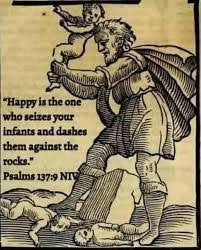
“Remember, O LORD, against the Edomites the day of Jerusalem, how they said, ‘Lay it bare, lay it bare, down to its foundations!’ O daughter of Babylon, doomed to be destroyed, blessed shall he be who repays you with what you have done to us! Blessed shall he be who takes your little ones and dashes them against the rock!” — Psalm 137:7–9
This is not law or battle report. This is liturgical poetry, preserved in Israel’s songbook, sung in worship. The psalmist pronounces blessing—divine favor—on whoever seizes Babylonian infants and smashes them against stone. Not metaphorically. Not as hyperbole. The image is visceral, specific, and celebratory.
What makes this passage especially revealing is its context within the canon. The Psalms are not historical chronicles; they are prayers and songs meant for repeated use in worship. This particular psalm was preserved, copied, transmitted, and eventually canonized as scripture. Generations of worshipers have encountered these words as part of the sacred text.
The violence here is not commanded by God, nor is it enacted in obedience to divine instruction. It is wished for, fantasized about, and framed as deserving of blessing. It represents the internalization of extermination logic into the emotional and liturgical life of the community. The psalmist imagines doing to Babylon’s children what Israel was commanded to do to Canaanite children—and expects divine approval for it.
The inclusion of this psalm in scripture exposes something uncomfortable: the violence in conquest narratives is not an isolated problem that can be quarantined to “ancient warfare” or “specific historical moments.” It has seeped into prayer. It has shaped how vengeance is imagined, how enemies are dehumanized, and how violence against the most vulnerable is sanctified through religious language.
Defenders sometimes argue that this psalm expresses understandable human rage in response to trauma, and that the psalmist is being “honest with God” rather than acting on these desires. But that explanation, while perhaps true on a psychological level, does not resolve the theological problem. The text does not frame these desires as sinful or inappropriate. It presents them as righteous. The one who kills infants is called “blessed.”
If the conquest narratives show violence commanded and executed, Psalm 137 shows violence desired and celebrated. Together, they form a pattern in which the killing of innocents is not merely tolerated as tragic necessity, but integrated into the moral and spiritual imagination of the community as something worthy of blessing.
This is not a peripheral text easily dismissed. It is part of the Psalter—the hymnbook of ancient Israel and the prayer book of early Christianity. Its presence in the canon forces the question: what kind of God is imagined as delighting in the destruction of infants? And what kind of faith tradition preserves such imagination as sacred?
The Moral Crisis These Texts Create
Taken together, these passages do not present isolated moments of excess or misunderstanding. They form a coherent pattern—laws issued in advance, campaigns executed in sequence, failures judged not by cruelty but by incompleteness, and violence so normalized that it enters liturgy. Infants are named. Children are categorized. Survivors are treated as evidence of disobedience. Again and again, the text insists that extermination is not a tragic byproduct of war, but its divinely mandated goal.
This leaves the reader with a stark and unavoidable dilemma.
Either God commands the deliberate slaughter of innocents, including infants incapable of moral agency; or these texts preserve human warfare ideology—total war, collective guilt, annihilation of enemies—later sanctified by attributing it to God.
There is no third option that survives close reading.
Why Standard Apologetic Responses Fail
Before proceeding further, it is worth addressing the most common attempts to evade this dilemma, as each collapses under examination:
“It’s hyperbole or literary exaggeration.” This fails where language is most explicit. When 1 Samuel 15:3 names “infant” (ʿôlēl) as a specific category for execution, hyperbole becomes impossible to claim. When Numbers 31:17 distinguishes male children for death and virgin girls for distribution, we are not reading ancient exaggeration—we are reading precise categorization. The text does not use vague language where it could; it uses surgical specificity. Even if one is to claim that the text is hyperbolic, the problem is that the text is considered God’s inspired word by billions of adherents, and is attributing such gross violence to the Creator for the justification of atrocities.
“You must understand the cultural context.” Cultural relativism does not resolve moral problems; it relocates them. The issue is not whether ancient Near Eastern warfare was brutal—it was. The issue is whether such brutality, when attributed to God and commanded as righteous, can be defended as anything other than the projection of human violence onto the divine. The text does not present these actions as tragic products of their time, but as righteous obedience worthy of emulation and remembrance. To say “that’s just how things were done” is not a defense of God’s justice—it is an admission that these commands reflect human barbarism, not divine character.
“God’s ways are higher than our ways; it’s simply mystery.” This is not humility before God—it is intellectual surrender. If “mystery” means we cannot understand why exterminating infants might be just, then the word “justice” has lost all meaning. Mystery cannot be deployed selectively to excuse what conscience recognizes as evil while maintaining that God is good in ways we can understand. Either moral language refers to something real and intelligible, or it refers to nothing at all. To claim that murdering infants can be righteous in ways beyond human comprehension is not to defend God’s goodness—it is to make “goodness” an empty word that can mean anything, including its opposite.
“These were acts of divine judgment on uniquely wicked peoples.” This fails on multiple levels. First, the Transjordan conquests apply the same extermination formula to peoples whose only offense was military resistance—no unique wickedness is mentioned. Second, even if the adults were guilty, children and infants cannot be held morally responsible for their parents’ actions. Third, and most damning: if the logic is that God can justly kill anyone at any time because all deserve judgment, then the specific commands become meaningless. The text doesn’t present these as general expressions of divine sovereignty over life and death—it presents them as specific instructions for Israel to carry out systematic killing based on ethnic identity.
“This prepared the land for the Messiah; it served a redemptive purpose.” This is perhaps the most morally corrosive defense of all. It suggests that the deliberate killing of children can be justified by future benefits—that infants can be sacrificed as means to an end, no matter how exalted that end might be. This reasoning, if accepted, could justify any atrocity. It also fails to explain why an omnipotent God would require the extermination of entire populations to accomplish divine purposes. The argument doesn’t defend God’s justice—it abandons it entirely in favor of utilitarian calculation.
“The Canaanites weren’t fully human” or “They were demonically corrupted beyond redemption.” These defenses, occasionally voiced, are simply racism dressed in theological language. They attempt to make genocide acceptable by dehumanizing the victims. This reasoning has been used throughout history to justify atrocities, and its appearance in biblical apologetics should be recognized for what it is: an attempt to defend the indefensible by declaring certain peoples less than human. The text itself makes no such claim—it portrays the Canaanites as peoples with cities, kings, families, and cultures. They are presented as human beings marked for destruction because of their identity and perceived religious threat.
None of these responses engage honestly with what the text actually says. They are attempts to avoid confrontation, not to resolve it.
What Is Actually at Stake
What is most revealing is not only what the text commands, but what it condemns. Saul is rejected not for killing civilians, but for sparing them. His error is not violence, but restraint. His attempt to redirect destruction toward sacrifice—an act framed as devotion—is denounced as rebellion. The lesson is unmistakable: when annihilation is commanded, mercy itself becomes sin.
This is the point at which theological defense turns inward and corrodes what it seeks to protect. To insist that such commands originate with God is not an act of reverence. It is an act of attribution—placing upon God the very forms of violence that human conscience, across cultures and centuries, has recognized as evil. It sanctifies atrocity by calling it obedience.
A faith that refuses to name this problem does not preserve holiness; it sacrifices it. If God is truly just, then justice must be intelligible as justice. If God is truly merciful, then mercy cannot be redefined as extermination. To collapse these distinctions is not humility before God—it is surrender of moral coherence.
The real scandal is not that ancient texts contain violence—many do. The scandal is the insistence that this violence must be defended as righteous because it is attributed to God. This reverses the proper relationship between moral truth and religious claim. Instead of evaluating religious claims by moral truth, it demands that moral truth be bent, twisted, or abandoned to accommodate religious claims.
But if moral terms like “justice,” “mercy,” and “goodness” can be redefined to include the systematic killing of infants, then these words no longer mean anything stable. They become empty containers that can be filled with whatever content power assigns them. This does not protect faith—it undermines the very foundation on which faith’s moral claims rest.
Conclusion: Let the Text Speak—and Judge It Honestly
These narratives demand honesty, not evasiveness. They do not ask to be admired; they ask to be confronted. Their authors present extermination as righteous, mercy as failure, and obedience as measured by how completely life is erased. Any theology that insists this reflects the will of a just God must reckon with the cost of that insistence.
The greater danger is not reading these passages. It is refusing to judge them—pretending that moral clarity must be suspended whenever violence is clothed in sacred language. History shows where that road leads. When religion provides cover for atrocity, when obedience supersedes conscience, when divine command exempts action from moral evaluation—the result is not holiness but horror.
The challenge to those who insist these commands reflect divine will is straightforward: explain how the deliberate killing of infants becomes righteous when attributed to God—not by appealing to mystery, power, or context, but by showing how it aligns with any coherent definition of justice. If that explanation cannot be given, then perhaps what scripture preserves here is not God’s character, but a human record of violence dressed in divine language—a record that honors God not by defending it, but by seeing it clearly and refusing to call it holy.
If God is worthy of worship, then God is worthy of truth. And truth requires the courage to say that human violence, even when placed within scripture, remains human violence. To confuse the two is not faithfulness. It is the final triumph of power over conscience.
The texts stand as written. They cannot be unwritten, and they should not be ignored. But they can be read honestly—not as models of divine justice, but as evidence of how thoroughly human concepts of tribal warfare, ethnic cleansing, and total war were projected onto the divine and preserved as sacred command.
To recognize these texts for what they are is not to abandon faith, but to insist that faith must be grounded in something more than the uncritical defense of ancient atrocity. It is to say that conscience matters, that moral reasoning matters, and that no claim to divine authority—however ancient, however canonical—can make the killing of children righteous.
That is not an attack on God. It is a refusal to blaspheme God by attributing to the divine what human conscience knows to be evil.


