
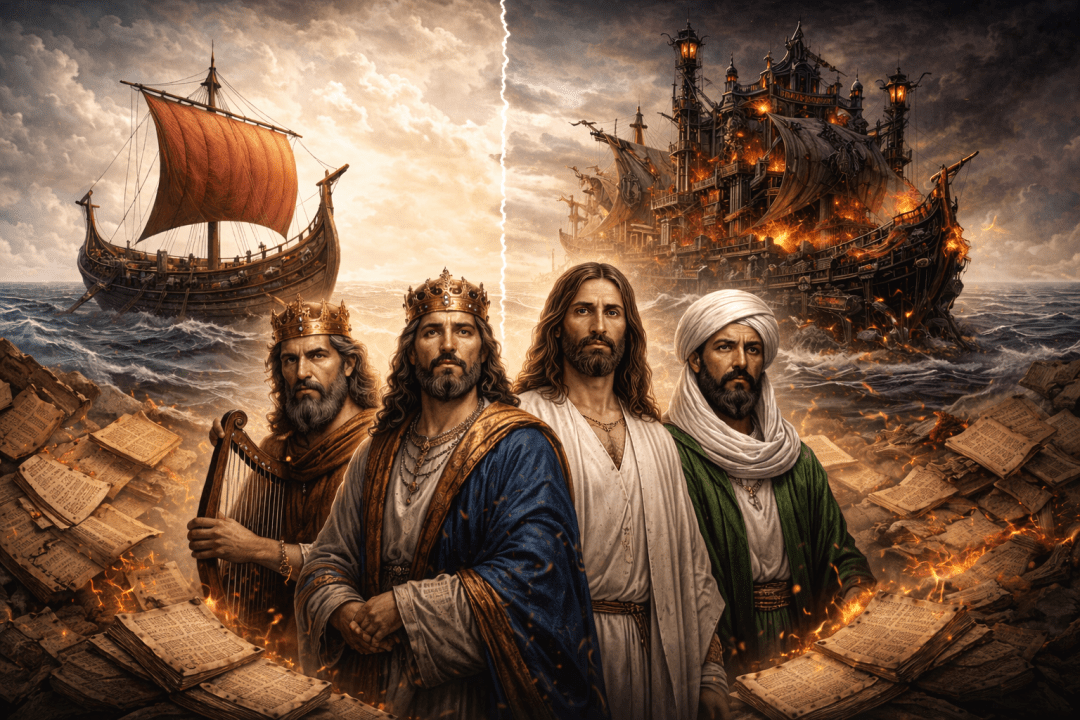
The ancient Greeks asked: if you replace every plank of Theseus’s ship over time, does it remain the same vessel? The question is elegant, almost gentle. It assumes each replacement is faithful—oak for oak, nail for nail. The ship is renewed, but it remains recognizably itself.
But what if we abandon this gentleness? What if the planks are replaced not with oak but with iron, the sails with stone slabs, the rudder with a propeller? What if, piece by piece, the vessel is reconstructed until nothing of the original remains—not in material, not in design, not in purpose? At some point the question of identity stops being philosophical and becomes absurd. Identity is not infinitely elastic. There is a threshold beyond which continuity collapses, and what remains is not preservation but replacement wearing the original’s name.
This is not merely a puzzle about ships. It is precisely what has happened to the prophets of God—and, ultimately, to the portrait of God Himself—in the hands of human tradition. The names endure. The identities were rebuilt plank by plank. And the remarkable thing is that the Quran anticipated this, diagnosed it, and preserved the originals.
From Ships to Prophets
Imagine a righteous man who lived in antiquity. In his own time he was known for moral clarity and devotion. But he dies, and over generations his story is edited, supplemented, embellished. Episodes are added that contradict his character. Failures are invented; virtues distorted. The composite figure enshrined in later tradition bears little resemblance to the man who lived.
Are we still speaking about the same person—or merely invoking the same name? Are we preserving memory, or constructing mythology?
The Quran tells us this is exactly what happened to earlier revelation and the figures within it:
Do you expect them to believe as you do, when some of them used to hear the word of God, then distort it, with full understanding thereof, and deliberately? (2:75)
Woe to those who write the scripture with their own hands, then say, “This is from God,” to seek a cheap material gain. (2:79)
Distortion is not a modern scholarly hypothesis in the Quran’s framework. It is a documented crime. And nowhere is the evidence clearer than in what tradition did to David, Solomon, Jesus, and Muhammad.
David: The Reconstruction
Open the biblical books of Samuel and you find a David who is ethically incoherent. He is the “man after God’s own heart”—and also an adulterer who takes Bathsheba and arranges her husband’s death. More chilling still, the text describes David raiding villages while living among the Philistines and leaving “neither man nor woman alive” so that no witness could expose his deception. The narrative presents these exterminations not as sin but as cunning. The same tradition then hands him the Psalms and makes him the prototype of the messiah. Righteous and abhorrent, chosen and condemned—the portrait cannot hold together.
Now the original:
Be patient in the face of their utterances, and remember Our servant David, the resourceful; he was obedient. We committed the mountains in his service, glorifying with him night and day. (38:17–18)
The Quran’s David is a servant given kingship, wisdom, and the Psalms (4:163). He is tested—two litigants enter his sanctuary, he judges hastily, and he immediately falls prostrate seeking forgiveness (38:21–24). That is the whole of his failure: a lapse in judgment, followed by instant repentance, followed by God’s pardon. No Bathsheba. No massacred villages. No calculated atrocity dressed up as strategy.
The difference is not that the Quran sanitizes David. It is that the Quran presents a coherent moral character—a fallible man whose response to error is repentance—where the accumulated tradition presents a contradiction wearing a crown.
Solomon: The Slander Refuted
Tradition’s Solomon is even more jarring. The wisest man alive—who accumulates a thousand wives and concubines, builds temples to foreign gods, and turns from his Lord. The books of Kings add that his architectural glory was built on forced labor, with entire populations drafted into permanent slavery, recorded as unremarkable administrative detail. Later tradition goes further and makes him a master of the occult, a commander of demons through magical arts.
Here the Quran does something extraordinary. It does not merely offer an alternative portrait; it directly names and refutes the slander:
They pursued what the devils taught concerning Solomon’s kingdom. Solomon, however, was not a disbeliever, but the devils were disbelievers. (2:102)
This is the Ship of Theseus problem addressed by name. The Quran identifies the counterfeit planks—the apostasy charge, the sorcery legends—and declares them fabrications. Its own Solomon is a devoted servant whose power never corrupts his worship, who upon witnessing the wonders of his kingdom responds:
This is by the grace of my Lord, to test me, whether I am appreciative or unappreciative. (27:40)
Even the famous episode with the horses, which tradition reads as distraction from prayer, ends in the Quran with Solomon turning back to his Lord (38:30–35). The wise king and the devoted worshiper are the same man. There is no second Solomon lurking in the text.
Jesus: The Multiplied Messiah
With Jesus, tradition did not merely reconstruct one ship—it built a fleet. Mark’s Jesus is fully human, crying out in abandonment on the cross. John’s Jesus is a cosmic being who existed before Abraham. Paul’s Christ is a pre-existent agent of creation with little interest in the teacher’s actual life. Revelation gives us a warrior-king with a sword emerging from his mouth. These are not four perspectives on one person; they are different characters sharing a name, and the tradition asks us to worship the composite as God incarnate.
The Quran cuts through the fleet to the original vessel:
The Messiah, Jesus, the son of Mary, was a messenger of God, and His word that He had sent to Mary, and a revelation from Him. Therefore, you shall believe in God and His messengers. You shall not say, “Trinity.” (4:171)
The Quranic Jesus is singular and coherent: a human messenger, born miraculously, strengthened with the Holy Spirit, performing signs by God’s leave, preaching exactly what every prophet preached—worship God alone. He himself disclaims the reconstruction that would be built upon him:
I told them only what You commanded me to say: “You shall worship God, my Lord and your Lord.” (5:117)
The deification of Jesus is the most consequential plank-replacement in religious history: a monotheist preacher rebuilt into the second person of a triune godhead. The Quran’s verdict is that the name was kept and the identity replaced—and it restores the man tradition lost.
Muhammad: The Reconstruction in Progress
Here the pattern becomes uncomfortable for Muslims, because the same process that rebuilt David, Solomon, and Jesus did not spare the final prophet.
The Quran, revealed during Muhammad’s lifetime, presents a consistent figure: a warner, a mercy to the world (21:107), a man of great moral character (68:4), who is commanded to say “I am no more than a human being like you” (18:110) and who possesses no power to benefit or harm even himself (7:188). He is explicitly told he will not be asked about the sects who divide the religion (6:159), and he judges by the revelation alone.
But the Muhammad known to most Muslims today is not primarily this figure. He is the Muhammad of the hadith—vast collections compiled two to three centuries after his death, attributing to him child marriage, mass executions, and thousands of rulings the Quran never mentions. Whether one defends these reports or doubts them, the structural fact remains: an entire second prophet was constructed generations after the first one died, and tradition demands we revere the reconstruction.
The Quran saw it coming:
We have permitted the enemies of every prophet—human and jinn devils—to inspire in each other fancy words, in order to deceive. (6:112)
And it records the prophet’s own complaint on the Day of Judgment:
The messenger will say, “My Lord, my people have deserted this Quran.” (25:30)
Not attacked it. Deserted it—for something else bearing his name. The hadith corpus is the Ship of Theseus under construction in real time: the Quranic Muhammad steadily replaced, plank by narrated plank, with a figure the Quran does not know.
The Ultimate Reconstruction: God Himself
Follow the logic to its end. If tradition rebuilt the prophets, what did it do to their Lord?
The God of the accumulated biblical text is volcanic and unstable. He commands the extermination of the Amalekites down to the infants and livestock. He must be talked down by Moses from destroying His own people—and “the Lord relented.” He regrets making Saul king. He sends serpents to kill the Israelites for complaining, then commands the crafting of a brass serpent—a graven image by His own law—to undo His own plague. This is a portrait of power without coherence, justice interrupted by rage and regret.
Is this the God of Abraham? Or is it what the Quran says it is—a portrait corrupted by the same hands that corrupted everything else?
The Quran’s answer is a God whose defining attribute opens 114 chapters: the Most Gracious, the Most Merciful. A God who declares:
God does not love the aggressors. (2:190)
Whoever kills a soul—unless for a soul or for corruption in the land—it is as if he killed all of humanity. (5:32)
You will find no change in God’s way. (33:62)
No regret. No revision. No prophet talking Him down from catastrophe. The Quranic God does not change His mind because He never errs; His mercy is not a mood that interrupts His wrath but His essential nature—”My mercy encompasses all things” (7:156). The incoherence in the older portraits is not evidence that God evolved. It is evidence that the texts did—that human editors layered their tribal furies and political needs onto the divine name, plank by plank, until the God of the text no longer resembled the God of Abraham.
The Quran calls itself muhaymin—the guardian and arbiter over prior scripture (5:48). It is the original blueprint against which every reconstruction can be measured.
The Dry-Docked Original
Return to the ship one last time. The paradox torments philosophers because, for ordinary ships, the original is gone. Once the planks are scattered, there is no way to check the reconstruction against what Theseus actually sailed. All we have is the name and the institution’s insistence.
This is the condition of every religious tradition built on centuries of accumulation—except one. The Quran’s singular claim is that the original was never lost:
Absolutely, We have revealed the reminder, and absolutely, We will preserve it. (15:9)
The true David still stands in Sura 38, repenting in prostration. The true Solomon still speaks in Sura 27, crediting every blessing to his Lord. The true Jesus still testifies in Sura 5, disclaiming his own deification. The true Muhammad still lives in the only text contemporary with his mission. And the true God—consistent, merciful, unchanging—still speaks in every chapter.
The Ship of Theseus paradox has no solution for those who possess only reconstructions. But it dissolves entirely for those who possess the original. The question was never whether identity can survive change. The question is whether we will keep venerating the replacements—the hadith Muhammad, the triune Jesus, the sorcerer Solomon, the warlord David, the raging deity of the edited texts—or walk back down to the harbor where the original vessel still floats, preserved by its Owner, waiting to be boarded.
This Quran cannot possibly be authored by other than God. It confirms all previous messages, and provides a fully detailed scripture. It is infallible, for it comes from the Lord of the universe. (10:37)
The name is not the identity. But here, uniquely, we do not have to choose between them. We have the ship itself.


