There is a moment in the twelfth sura of the Quran when Joseph, imprisoned on a false charge, is asked by two fellow inmates to interpret their dreams. Before he answers, he delivers a short speech about God—and in it he makes one of the strangest and most penetrating claims in the entire book. Speaking of the gods his companions serve, he does not say that they worship false gods, or weak gods, or too many gods. He says something more unsettling:
“You do not worship beside Him except innovations that you have made up, you and your parents. GOD has never authorized such idols. All ruling belongs to GOD, and He has ruled that you shall not worship except Him. This is the perfect religion, but most people do not know. (12:40)
Names. Not demons, not statues, not rival powers. The objects of human devotion, Joseph says, are asma’—words, designations, labels—minted by the worshipers themselves and their ancestors, and then invested with an authority God never conferred. The idol is not primarily the thing on the pedestal. The idol is the name, and the thing on the pedestal is merely where the name is parked.
This is not a one-off rhetorical flourish. The Quran repeats the formula, nearly verbatim, in two other mouths and two other centuries. The prophet Hud says it to the people of ‘Ad:
He said, “You have incurred condemnation and wrath from your Lord. Do you argue with me in defense of names you have designated— you and your parents—which were never authorized by GOD? Therefore, wait and I will wait along with you.” (7:71).
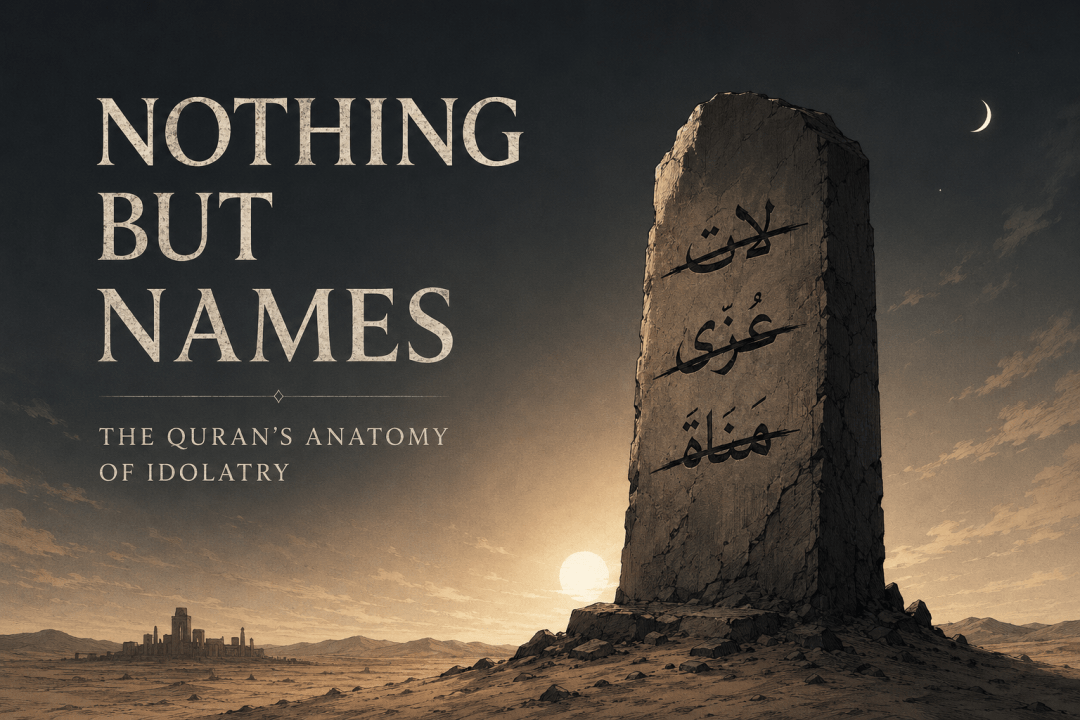
And the Quran itself says it about the three goddesses of Mecca, in the passage that names them—Allaat, ‘Uzza, and Manat—only to dissolve them in the same breath:
These are but names that you made up, you and your forefathers. GOD never authorized such a blasphemy. They follow conjecture, and personal desire, when the true guidance has come to them herein from their Lord. (53:23)
Three eras, three civilizations, one diagnosis. Whatever else changes about idolatry—its statues, its rites, its mythologies—the Quran insists that its underlying substance is constant: human beings manufacture a name, inherit it, defer to it, and worship it. Idolatry is, at bottom, a disorder of language. And once that diagnosis is taken seriously, it turns out to reach much further than the shrines of ancient Arabia.
The Name with Nothing Behind It
To feel the force of the diagnosis, start with what a name is. A name is not a thing; it is a designator—a compact token of speech that stands in place of something so that the thing can be summoned, referred to, and handled in its absence. That is the whole utility of naming: the word is a proxy, and its entire value is borrowed from what stands behind it. Say “Moses” and a man is meant; say “the sun” and a star is meant; the sound itself is nothing, a puff of breath, and no one cares about the sound because everyone is looking through it at the referent.
A name, in other words, is a kind of promissory note: it circulates on the credit of a reality it points to. Which means there is a precise and devastating question that can be asked of any name: what backs it? If something real stands behind the designator, the name is an instrument of knowledge. If nothing stands behind it, the name does not become a lesser instrument—it becomes a counterfeit. A designator with no referent is not a weak pointer; it is a fabrication wearing the grammar of a pointer, a note drawn on an empty account, substance-free by construction yet passing from hand to hand as if it were backed. And because it looks and behaves exactly like a genuine name—it can be spoken, invoked, inherited, and defended—nothing about its surface betrays the vacancy behind it.
This is precisely the audit the Quran performs on the idols, and the result it reports is: nothing. Not a lesser power, not a demon in disguise—nothing. “They follow nothing but conjecture.” The idols “create nothing, and are themselves created” (16:20); they “possess not even the membrane of a date seed” (35:13). And at the Judgment, when the idolaters are asked to produce the partners they served, the Quran stages a scene of pure semantic collapse:
“Then it will be said to them: where are those you used to associate besides God? They will say: they have strayed from us. Rather, we were not calling upon anything before.” (40:73–74)
We were not calling upon anything before. This is the confession the whole analysis has been driving toward. The worshiper discovers, when the veil lifts, that his god had no referent—that the name he invoked, sacrificed to, and killed for was a word pointing at vacancy. Allaat and ‘Uzza were never entities that failed to save; they were nouns that never denoted. The devotion was real; the object was grammatical.
But a name that points at nothing does not come from nothing. It comes from the namers. “Names which you have named”—the verb is thrown back on the worshipers themselves. The god is a human artifact, and not even a material one: an artifact of speech. Which means the worship, traced to its source, is circular. The community coins a word, projects its fears and desires onto it—”they follow conjecture and what their souls desire”—and then bows to its own projection. The idolater kneeling before Allat is, without knowing it, kneeling before the accumulated speech of his own tribe. Idolatry is the community worshiping itself with extra steps, and the name is the device that hides the circularity. This is why the Quran can describe sectarians, people whose idol is their own faction, in the same register as polytheists: “each party rejoicing in what it has” (30:32). Rejoicing in what it has—in its own possession, its own name for itself. The mirror has simply been renamed an altar.
Sultan: The Missing Authorization
The hinge of the formula, repeated in all three verses, is the phrase ma anzala Allahu biha min sultan—”for which God has sent down no authority.” The word sultan in the Quran means warrant, authorization, evidentiary power. It is what Moses carries to Pharaoh (11:96), what the disbelievers are challenged to produce for their claims (10:68, 37:156), what Satan concedes he never had over anyone (14:22). The Quran’s parallel demand is for burhan, proof: “Say: produce your proof, if you are truthful” (2:111, 21:24, 27:64).
So the crime specified in 12:40 is precise: not that the name exists, but that it circulates without authorization. Human beings name things constantly and innocently. The offense begins at the moment a humanly minted name starts to command—when it demands deference, loyalty, sacrifice, obedience—without any warrant from the only source entitled to issue one. An idol, in the Quran’s strict definition, is an unauthorized authority. It is a word that has jumped the fence between description and command.
This definition explains an otherwise curious feature of the Quran’s polemic: its consistent framing of idolatry as an epistemic failure before a moral one. The idolaters’ root sin is conjecture—zann—asserted as knowledge: “They follow nothing but conjecture, and conjecture avails nothing against the truth” (53:28, immediately after the goddesses passage). “You have no knowledge of this—do you say about God what you do not know?” (10:68). The idol-name is the crystallized form of the unverified claim: an assertion that has stopped being examined because it has started being revered. Idolatry, on this account, is what happens when a proposition acquires immunity.
You and Your Fathers: How Time Launders Speech
Every occurrence of the formula includes the same genealogical clause: names you have named, you and your fathers. The Quran is identifying the mechanism by which an unauthorized name acquires its counterfeit authority: inheritance. A word coined in one generation is merely a word; transmitted through five generations, it becomes a sanctity. Nothing has been added to it except time—but time is precisely what launders speech into holiness. The name arrives in each new generation pre-installed, already surrounded by the deference of the dead, and the sheer seniority of the sound is mistaken for a warrant.
The Quran returns to this mechanism obsessively, in a refrain that recurs across a dozen suras: “When they are told, ‘Follow what God has revealed,’ they say, ‘We follow what we found our fathers doing.’ What—even if their fathers understood nothing, and were not guided?” (2:170; cf. 5:104, 7:28, 10:78, 21:53, 26:74, 31:21, 43:22–23). Notice that the ancestral argument is never answered with a counter-tradition. It is answered with a question about understanding—as if to say: a chain of transmission adds no truth to its first link. If the fathers understood nothing, then a thousand years of faithful transmission have preserved, with perfect fidelity, nothing.
There is a sting here that the Quran’s first audience could not have felt but its later readers should. The clause “you and your fathers” describes a process, and processes do not check what they carry. Any name—including names born inside the community of revelation itself—can enter the ancestral conveyor and emerge, generations later, wearing the same unearned halo: the name of a school, a founder, an imam, a rite, a sect. The Quran describes exactly this happening to prior communities after revelation, not before it: “They did not become divided until after the knowledge had come to them” (42:14). Corruption is the fate of heirs, and its instrument is the inherited name. The formula of 12:40 contains no expiration date and no exemption clause.
Adam Names; Adam Is Not Named After
If naming were intrinsically corrupt, the Quran would be incoherent, for it presents the capacity to name as the founding distinction of the human being. In the creation account of Sura 2, what elevates Adam above the angels is precisely this: “He taught Adam the names, all of them” (2:31), and the angels, unable to reproduce the feat, concede: “Glory to You—we have no knowledge except what You have taught us” (2:32). Language is the human credential. Naming is knowledge.
The Quran, then, distinguishes two fates for the name. In Adam’s mouth, names are instruments: they point at things, organize knowledge, and remain transparent to their referents. The name serves the reality. In the idolater’s mouth, the direction of service is reversed: the name no longer points at anything—”we were not calling upon anything”—and instead absorbs devotion into itself. The name has become opaque. It has stopped being a window and become a wall, and the wall is worshiped.
The test case is God’s own names. The Quran affirms them lavishly—”To God belong the most beautiful names, so call on Him by them” (7:180)—but watch how it handles them:
“Say: call upon God (Allah), or call upon the Most Gracious (al-Rahman); whichever you call upon, to Him belong the most beautiful names.” (17:110)
The verse was revealed, the context suggests, amid confusion over whether “Allah” and “al-Rahman” named one deity or two. The answer is a shrug of majestic indifference: use either. The divine names are many, interchangeable in address, and all of them descriptive—the Merciful, the Just, the Truth—terms that dissolve into the attributes they assert rather than congealing into brands. God, in other words, is the one being in the Quran who is entirely indifferent to His own label. The same verse of 7:180 adds a warning against those who ilhad concerning His names—who deviate, who twist them—which the idolaters of Mecca did in the most instructive way possible: ‘Uzza is simply the feminine of al-‘Aziz, the Mighty; Allaat is plausibly a feminization of Allah; Manat trades on the divine attribute of apportioning fate. The idol-names were not invented from nothing. They were divine attributes broken off, capitalized, and set up in business for themselves. That is the whole mechanics of idolatry in a single etymology: a description of God, detached from God, becomes a god.
The Tongue as Legislator
The name that commands without warrant has a natural next move: it begins to legislate. The Quran tracks the progression explicitly:
You shall not utter lies with your own tongues stating: “This is lawful, and this is unlawful,” to fabricate lies and attribute them to GOD. Surely, those who fabricate lies and attribute them to GOD will never succeed. (16:116)
Here is the idolatry of names in its mature, institutional form. No statue is anywhere in sight. The tongue describes; the description hardens into a category—lawful, unlawful, sacred, forbidden—and the category, humanly minted, is stamped with God’s signature and put into circulation as law. The sura’s surrounding passage is about exactly this: pagan dietary taboos, cattle declared sacrosanct by custom (5:103 names them—bahirah, sa’ibah, wasilah, ham, a whole taxonomy of consecrated animals), an entire jurisprudence generated by naming. The Quran’s response to that taxonomy is definitional: “God did not institute any of it—but the disbelievers fabricate lies about God” (5:103). The categories were names for which no authority was sent down. The law was an idol with a legal vocabulary.
And because the tongue is the factory, the Quran audits words against realities wherever the two threaten to come apart. When the desert Arabs announce their credential—
The Arabs said, “We are Mu’mens (believers).” Say, “You have not believed; what you should say is, ‘We are Muslims (submitters),’ until belief is established in your hearts.” (49:14).
A self-description is repriced, on the spot, to match its actual backing. The book that defines idols as unauthorized names could hardly do otherwise: every label, including the labels of piety, is a check written against the account of reality, and the Quran’s habit is to call the bank.
The Significance: An Iconoclasm of Language
Take the diagnosis seriously, and its reach becomes clear. If the idol is essentially a name—a humanly coined designation exercising unauthorized command—then idolatry did not end when the shrines of Arabia were emptied. It merely lost its statues, which were always incidental. The load-bearing component, the name, is more portable than ever.
The religious application is the nearest one, and the Quran makes it itself: the sect “rejoicing in what it has” is filed, in 30:31–32, under shirk. A school, a founder’s name, a communal label—each is a name named by fathers, each accumulates seniority, each eventually demands the deference that only truth may demand. The believer who would sooner abandon a verse than his madhhab has answered the question of what he worships. But the mechanism is not confined to religion, because nothing in 12:40 restricts it to religion. The ideological -ism that functions as a terminal justification; the national name for which lives are demanded without argument; the identity label that ends conversations it should begin; the brand, the movement, the acronym invoked as though invoking it settled something—all of these are candidates for the same audit. The question the Quran teaches is uniform across all of them, and it is devastating in its simplicity: this name that is commanding you—where is its authorization? Not its age; age is what fathers supply. Not its popularity; “if you obey the majority of those on earth, they will lead you away from God’s path—they follow only conjecture” (6:116). Its warrant.
This is why the Quran’s monotheism is best understood not as one more name entering the competition of names, but as the refusal of the competition. The shahada itself has the logical form of a clearing operation: la ilaha—no god, no name with intrinsic authority, none—illa Allah, except the One who is not a projection of any tribe’s speech, who taught Adam the names and is served by none of them, who answers to “God” or “the Most Gracious” with equal readiness because He, alone, is not a label but the reality every truthful label points toward. The first half of the sentence demolishes the pantheon of names; the second half is the only survivor of the demolition. Judgment belongs to God—Joseph’s phrase, in al-hukmu illa lillah—precisely because judgment is what every manufactured name attempts to seize and none is entitled to.
The upright religion, Joseph concludes, is just this: worship what is real, and refuse authority to what is merely named. Most people, he adds, do not know—and the observation has not aged. Human beings remain what the Quran found them: prolific manufacturers of names, industrious inheritors of them, and instinctive worshipers of what they and their fathers have coined. The statues were never the problem. The statues were only ever the visible tips of vocabularies—and the vocabularies survived the statues. The Quran’s iconoclasm was always aimed at the language underneath, and that is why, alone among iconoclasms, it is never finished: the tongue rebuilds overnight what the hammer breaks by day. Every generation mints its names, hands them to its children, and forgets that it made them. And to every generation the same short question is put, quietly, from a prison cell in Egypt: has God sent down any authority for this—or is it, once again, nothing but names?


