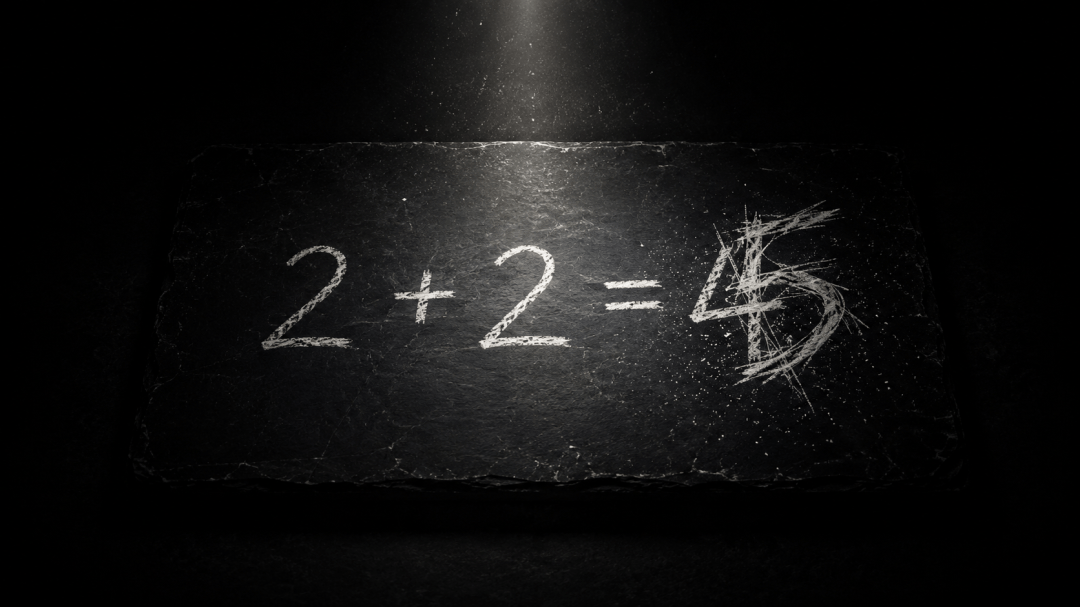
Near the end of George Orwell’s Nineteen Eighty-Four, Winston Smith is strapped to a table in the Ministry of Love, and his torturer, O’Brien, holds up four fingers.
“How many fingers am I holding up, Winston?”
“Four.”
“And if the Party says that it is not four but five—then how many?”
The dial goes up. The pain comes. And here is the detail that makes the scene immortal: O’Brien does not want Winston to say five. Saying five is easy—any regime can rent a tongue. O’Brien turns the dial until Winston sees five, until he believes five, until the last private courtroom inside his skull—the place where the Party’s word can still be checked against reality—is burned out of him. Because O’Brien understands something most people never think about: any truth that exists independently of power is a rival to power. A man who can say “the answer is four, no matter what the Party announces” possesses a capacity, and it does not stay in mathematics. It is the same capacity that says “the trial was rigged, no matter what the verdict announces” and “that man is innocent, no matter what the statute says.” That is why the Party cannot leave arithmetic alone. Orwell gave his hero one sentence to stake everything on: Freedom is the freedom to say that two plus two make four. If that is granted, all else follows.
Hold onto that scene. This entire article is an application of it.
Here is the argument, stated up front in plain terms, so you know exactly where we are going. God’s moral laws are like the laws of mathematics and physics: they hold everywhere, for everyone, in every century, and they cannot change—because they were built into creation by the same Author who set the orbits of the planets. Any law, therefore, that distorts morality is not God’s law. It is the law of men.
And when we apply this test to a specific body of law—the rulings of traditional Islamic jurisprudence that come from the hadith rather than the Quran: execution for apostasy, stoning for adultery, child marriage, slavery, and the rest—those laws fail the test, one after another, in exactly the same way. They fail it, moreover, by the Quran’s own standard, because the Quran states this test about itself, repeatedly, as a warranty. We will not be judging these laws by modern Western values. We will be judging them by the specification printed on the box.
That is the whole argument. Now let us build it carefully, piece by piece.
What no power on earth can legislate
Start with the simplest possible case, because it actually happened. In 1897, the Indiana House of Representatives voted 67 to 0 for a bill that quietly enacted a false value of pi—the pet theory of a country doctor who believed he had solved a problem mathematicians had already proven unsolvable. The bill was sailing toward passage in the Senate when a visiting mathematics professor, in the building on unrelated business, spent an evening explaining to senators what they were about to do. The bill died the next morning.
Everyone tells this story as a joke, but ask the serious question hiding inside it. Suppose the professor had stayed home. Suppose the bill had passed—and not just in Indiana, but in every legislature on earth, enforced by every court, printed in every textbook, with every dissenting mathematician jailed. What would have happened to the actual ratio of a circle’s circumference to its diameter?
Nothing. Circles would have stayed circles. Engineers who used the legal value would have watched their bridges fall into rivers. The combined power of every government in history can criminalize a truth. It cannot amend one. No power on earth can make two plus two equal five.
This tells us something important about law itself: it comes in two fundamentally different kinds, and everything in this article depends on keeping them separate.
The first kind is convention—rules where the saying makes it so. Which side of the road do we drive on? Britain says left, France says right, and reality has no opinion; both work fine. What day are taxes due? Whatever day the legislature picks. Here governments genuinely create law out of nothing, and legitimately so.
The second kind is description of reality—rules that can only be stated accurately or falsely, because the underlying truth exists whether anyone legislates it or not. Pi is what it is. Two plus two is four. A statute setting pi at 3.2 is not a strict law or a lenient law. It is an empty law—a command with nothing to grip, words in the shape of a statute with a hole where the law should be.
The oldest tradition in legal philosophy—called natural law, running from the Greek playwrights through Cicero to Aquinas—makes one central claim: the moral core of law belongs to the second kind. When law addresses murder, slavery, fraud, or the condemnation of the innocent, it has entered territory that was mapped before any parliament ever sat. It can read the map well or badly. It cannot redraw the map. A statute declaring some class of people subhuman is not a “policy difference.” It is a false statement in mandatory form—an Indiana Pi Bill written in blood.
The skeptic’s standard objection is that math is provable and morality is not, so the comparison is a trick. But look at how moral history actually behaves. If morality were mere custom—mere fashion riding the currents of power—then moral change should wander the way fashions do: drifting, cycling, coming back around. It does not. Slavery was practiced on every inhabited continent, defended by Aristotle, blessed by churches, protected by navies—the single most universal institution in human history. Today not one government on earth will defend it out loud, and no movement anywhere campaigns for its return. Fashions come back. Corrected errors do not. Nobody is lobbying to restore Indiana’s value of pi, either, and for the same reason: what happened in both cases was not a change of taste but a discovery—the slow recognition of something that was true all along. And notice what fashions never produce: martyrs. Nobody dies for a hemline. People have died, over and over throughout history, for the difference between four and five.
One balance: the moon and the marketplace
The philosopher who turned this intuition into a working instrument was Immanuel Kant, and his famous test—the categorical imperative—sounds intimidating but is actually simple. Before acting on a rule, ask: could this rule be a universal law—binding on everyone, everywhere, always—without destroying itself?
The power of the test is in how bad rules fail it. Take the rule “I may make a promise I intend to break whenever it benefits me.” Now make that rule universal—everyone follows it, always. What happens? Promising itself dies, because no one believes promises anymore. The rule does not become universally harsh; it becomes universally impossible, because it devours the very institution it depends on. In plain terms: a rule fails the test when it destroys the very thing it claims to use or protect. Such a rule is not forbidden because it is unpleasant. It is forbidden the way five is forbidden as the sum of two and two—it cannot even be thought consistently. Kant added a second version of the test to catch what the first might miss: never treat a human being merely as a tool—as raw material for someone else’s purposes—but always also as a person in their own right. Keep both versions in your pocket; we will need them.
Kant closed his great work on ethics with the most famous sentence he ever wrote:
Two things fill the mind with ever-increasing awe—the starry heavens above me and the moral law within me.
Two orders of law, one physical and one moral, equally binding, equally beyond anyone’s power to amend, contemplated with a single reverence.
Now open the Quran to Surah 55 and watch it make the identical pairing—not as a philosopher’s flourish, but in a single word. The sun and the moon run by precise calculation, the chapter begins; the stars and the trees bow down; God raised the sky and established the balance—al-mizan. And then, with no pause at all, the very same word pivots from the orbits of the heavens to the scales of the marketplace: do not transgress the balance; weigh with justice, and do not cheat the balance (55:5-9). Read that again slowly, because it is the theological heart of this entire article.
[55:1] The Most Gracious.
[55:2] Teacher of the Quran.
[55:3] Creator of the human beings.
[55:4] He taught them how to distinguish.
[55:5] The sun and the moon are perfectly calculated.
[55:6] The stars and the trees prostrate.
[55:7] He constructed the sky and established the law (al-mizan, The Balance).
[55:8] You shall not transgress the law (al-mizan, The Balance).
[55:9] You shall establish justice; do not violate the law (al-mizan, The Balance).
The motion of the moon and the honesty of a shopkeeper’s scale are placed under one word, one order, one Author. What Kant labored a lifetime to prove, the Quran simply asserts as the architecture of creation: physics and morality are the same kind of law. Legislated by the same authority. Holding everywhere. Exempting no one. Admitting no amendment. And the “moral law within” that Kant could describe but not name, the Quran names: the fitra, the natural design upon which God created mankind—there is no altering God’s creation, which includes His laws.
[30:30] Therefore, you shall devote yourself to the religion of strict monotheism. Such is the natural instinct (fitra) placed into the people by GOD. Such creation of GOD will never change. This is the perfect religion, but most people do not know.
[10:61] You do not get into any situation, nor do you recite any Quran, nor do you do anything, without us being witnesses thereof as you do it. Not even an atom’s weight is out of your Lord’s control, be it in the heavens or the earth. Nor is there anything smaller than an atom, or larger, that is not recorded in a profound record. [10:62] Absolutely, GOD’s allies have nothing to fear, nor will they grieve.[10:63] They are those who believe and lead a righteous life. [10:64] For them, joy and happiness in this world, as well as in the Hereafter. This is GOD’s unchangeable law. Such is the greatest triumph.
Why morality cannot flip
Now we come to the argument’s foundation stone, and it is worth building slowly because everything else stands on it.
Ask the simplest possible question about any moral ruling: can it flip? Can an act be genuinely moral on Monday and genuinely immoral on Tuesday—not merely judged differently by confused people, but actually be different in the eyes of God?
Think about what a yes would mean. It would mean that when you ask “is it right to stone a human being to death?”—the question has no stable answer. Right this century, wrong the next. Commanded here, forbidden there. And a morality that can flip is not a strict morality or a mysterious morality. It is no morality at all, for the same reason that a mathematics in which two plus two sometimes makes four and sometimes makes five is not a difficult mathematics but the absence of mathematics. If the answer can be anything, the question means nothing.
The Quran has already told us why, in the scale (mizan) of Surah 55: the moral law and the physical law hang on one balance, woven into a single interconnected order. So run the comparison honestly. Imagine the laws of physics flipping the way a changeable morality would flip—gravity pulling down on Monday and up on Tuesday, water boiling at one temperature this year and freezing at it the next. Nothing could be built. Nothing could be planned. No seed could be planted, no bridge crossed, no promise of tomorrow made, because tomorrow would be governed by different laws than today. The universe would not be a harsh place. It would be chaos—and chaos is precisely what the Quran says God did not create:
[67:3] He created seven universes in layers. You do not see any imperfection in the creation by the Most Gracious. Keep looking; do you see any flaw?
A morality that flips would be exactly as chaotic, and for exactly the same reason: it is part of the same balance. Trust, covenant, justice, and conscience all depend on right and wrong meaning tomorrow what they mean today, just as engineering depends on gravity meaning tomorrow what it means today. Because the order is interconnected—one mizan, one Author—a flip anywhere is a collapse everywhere.
This is why the Quran’s famous “no change” verses are not arbitrary divine promises but descriptions of what moral law has to be in order to exist at all: The word of your Lord is complete, in truth and justice; nothing can change His words (6:115). You will find no change in the practice of God (33:62; repeated at 35:43 and 48:23). These verses are the Quran’s warranty on its own contents—its printed specification. And notice what the warranty commits it to. God’s law cannot flip on morality for the same reason He does not flip on gravity: it is all one balance, in perfect equilibrium, and He is not a God of chaos.
And the Quran does something more remarkable still: it converts this warranty into a test, and dares the reader to run it.
[4:82] Why do they not study the Quran carefully? If it were from other than GOD, they would have found in it numerous contradictions.
Set this verse beside 67:3, and you are looking at twins. One says: examine the creation, you will find no flaw. The other says: examine the book, you will find no contradiction. Same Author, same signature—consistency is how God signs His work, whether the medium is galaxies or verses, and contradiction is the fingerprint of everything that is “from other than God.” Now notice how far the verse’s word reaches. The “contradictions” it speaks of—ikhtilaf, divergence—are not restricted to one verse clashing with another. Since the book and the world have one Author, the warranty cannot stop at the text’s edge: a collision between God’s word and God’s world would be exactly as disqualifying as a collision between two verses, because either way, God would be diverging from Himself.
Internal consistency is merely the special case where the two colliding truths both happen to sit inside the covers. The full claim is larger: the Quran is warranted against contradicting anything true—and that puts not only the text under the test, but every reading of the text, because interpretation is precisely where the book meets the world. God’s revelation—both the text and its interpretations—cannot contradict reality (al-Hagg, the Truth). This is why 4:82 opens with a command rather than a boast: study carefully. When a careful reader finds a contradiction—verse against verse, or verse against reality—the verse tells him exactly what he has found: something from other than God. What it does not tell him is where the human element entered. It may be in the text—which the Quran rules out for itself—or it may be in the reading. A false interpretation manufactures a divergence the text never contained; the command to study carefully is a command to keep testing readings until the contradiction dissolves. Hold onto this, because we will watch it work.
Keep this in hand as the sharpest blade in the article, because when we reach the stoning ruling, it will cut the question down to a binary that has no escape: either stoning people to death is moral, or it is not. If it is moral, God would not have replaced it. If it is immoral, God never commanded it. The one thing that is impossible—by the Quran’s own theology—is that it was moral once and immoral now. God’s law does not flip.
The line the Quran draws for itself
At this point a careful reader—especially a Muslim reader—should be objecting, and the objection is a good one. Divine law visibly has varied. The Torah’s rulings differ from the Quran’s. The Sabbath bound Israel and does not bind Muslims. The Quran itself changed the direction of prayer partway through the revelation. Doesn’t that break the “no change” warranty we just established?
It would—except that the Quran draws the necessary distinction itself, in the very verse that describes the variation.
[5:48] Then we revealed to you this scripture, truthfully, confirming previous scriptures, and superseding them. You shall rule among them in accordance with GOD’s revelations, and do not follow their wishes if they differ from the truth that came to you. For each of you, we have decreed laws and different rites (shir’atan wa minhajan). Had GOD willed, He could have made you one congregation. But He thus puts you to the test through the revelations He has given each of you. You shall compete in righteousness. To GOD is your final destiny—all of you—then He will inform you of everything you had disputed.
Each community receives its own shir’a: its own rites, forms, and practices. That variety is not a flaw; the verse says it is deliberate—a test, an invitation to compete in goodness rather than fight over forms. But 42:13 supplies the other half of the picture: God ordained for you the same din—the same essential religion—that He enjoined on Noah, Abraham, Moses, and Jesus. The moral substance is one and has always been one. The ritual shell is intentionally plural.
[42:13] He decreed for you the same religion (al-din) decreed for Noah, and what we inspired to you, and what we decreed for Abraham, Moses, and Jesus: “You shall uphold this one religion, and do not divide it.“The idol worshipers will greatly resent what you invite them to do. GOD redeems to Himself whomever He wills; He guides to Himself only those who totally submit.
In other words: God Himself partitions His law into two categories—and they are the same two categories we found at the beginning of this article. Rites and practices are convention: like which side of the road to drive on, they can legitimately differ from community to community and era to era, because their purpose is served either way. Morality—the law of right and wrong, of good and evil—is description of reality: like mathematics, it cannot vary without becoming meaningless.
And you can watch the partition operating inside the Quran itself. The qibla—the direction of prayer—was changed by revelation, publicly, mid-course, and when people objected, God dismissed the controversy with a shrug: to God belong the east and the west (2:142-144).
[2:142] The fools among the people would say, “Why did they change the direction of their Qiblah?” Say, “To GOD belongs the east and the west; He guides whoever wills in a straight path.” [2:143] We thus made you an impartial community, that you may serve as witnesses among the people, and the messenger serves as a witness among you. We changed the direction of your original Qiblah only to distinguish those among you who readily follow the messenger from those who would turn back on their heels. It was a difficult test, but not for those who are guided by GOD. GOD never puts your worship to waste. GOD is Compassionate towards the people, Most Merciful. [2:144] We have seen you turning your face about the sky (searching for the right direction). We now assign a Qiblah that is pleasing to you. Henceforth, you shall turn your face towards the Sacred Masjid. Wherever you may be, all of you shall turn your faces towards it. Those who received the previous scripture know that this is the truth from their Lord. GOD is never unaware of anything they do. [2:145] Even if you show the followers of the scripture every kind of miracle, they will not follow your Qiblah. Nor shall you follow their Qiblah. They do not even follow each others’ Qiblah. If you acquiesce to their wishes, after the knowledge that has come to you, you will belong with the transgressors. [2:146] Those who received the scripture recognize the truth herein, as they recognize their own children. Yet, some of them conceal the truth, knowingly. [2:147] This is the truth from your Lord; do not harbor any doubt.
Ritual law, openly amended, without the slightest embarrassment. Now search the entire Quran for one instance of the moral law reversing—murder made lawful, perjury praised, the orphan’s property opened to plunder, the cheating of the scale permitted. There is none. Not one. That total asymmetry is the whole argument in miniature. The qibla is a speed limit. The prohibition of murder is π. One may change by decree; the other was never in any decree’s power.
This distinction also disarms, in advance, the tradition’s cleverest defense. Classical jurisprudence files the harsh corporal punishments under a category called huquq Allah—”the rights of God”—treating them as quasi-ritual duties owed to Heaven, and therefore beyond ordinary moral scrutiny. In plain terms, the move is: this killing is not really a matter of morality; it is a form of worship. But relabeling a killing as worship does not carry it across the line God drew. A rite is what lands on the worshipper—his own prostration, his own fast, his own pilgrimage. Anything that lands on another human being’s body, freedom, or life is a claim about good and evil by its very nature, no matter what shelf the jurists store it on. The filing system of men cannot amend the partition of God.
Laws with their conditions built in
Before assembling the final test, one more feature of the Quran’s legal architecture must be put on the table—because without it, the sharpest available rebuttal to this entire article goes unanswered.
The rebuttal runs like this: “You claim God’s law never needs an off-switch. But the Quran suspends its own laws constantly. Carrion becomes lawful for the one compelled by starvation (6:145). A believer forced at the point of violence may profess disbelief while his heart remains secure (16:106). Prayer itself—the most fixed of rites—may be performed walking or riding when there is fear (2:239). So when the jurists softened or set aside a penalty in hard circumstances, weren’t they simply exercising the same divine mercy?”
Look closely at those verses, because the answer is sitting inside them. In every case, the exception is written into the law itself. The carrion clause is in the verse. The duress clause is in the verse. The condition and the command were revealed together, published together, and stand together in the preserved text—for all people, in all centuries. This is not a law being suspended. This is what an unchanging law looks like when it is written for a changing world. The physics analogy is exact: water boils at a lower temperature on a mountaintop, but the law of physics has not changed—the law includes the pressure variable. An eternal law is not a law without conditions. It is a law whose conditions are themselves eternal, and stated.
A clear demonstration in the Quran is polygamy—a subject usually treated as an embarrassment and actually a masterclass in this architecture. Read the permission in full: it is granted in one specific context, the care of orphans.
[4:3] If you deem it best for the orphans, you may marry their mothers—you may marry two, three, or four. If you fear lest you become unfair, then you shall be content with only one, or with what you already have. Additionally, you are thus more likely to avoid financial hardship.
The ideal—one—is stated inside the very verse that grants the concession. And then the Quran quietly closes the loop:
[4:129] You can never be equitable in dealing with more than one wife, no matter how hard you try. Therefore, do not be so biased as to leave one of them hanging (neither enjoying marriage, nor left to marry someone else). If you correct this situation and maintain righteousness, GOD is Forgiver, Most Merciful.
Put the two verses together, and the structure snaps into focus. The equity condition is declared humanly unachievable—which means the Quran itself defines polygamy not as an ideal but as a concession: a narrow allowance for preventing a greater evil, fatherless children left without protection or support, in societies where war had made widows and orphans a permanent fact. The ideal, the concession, the triggering circumstance, and the limiting condition are all published together in the eternal text. Nothing needs to be suspended, invented, or discovered later. The law carries its own boundaries the way an orbit carries its own equation.
And notice that none of this makes morality flip—this is the point a careless reading gets wrong, and it must be stated precisely. When the starving man eats carrion, the food does not become good; when the coerced believer professes disbelief, the lie does not become noble. The moral status of the act never moves. What the stated conditions lift is accountability—the Quran’s own formula is no sin upon him (2:173)—while the prohibition stands exactly where it always stood. This is not a change in the law; it is a fixed hierarchy within the law: life outranks dietary rules, the faith preserved in the heart outranks the words extracted from the mouth, the sheltered orphan outranks the ideal of monogamy. When two goods collide, the collision is resolved by a ranking that is itself eternal—the same ranking, in every land, in every century. Morality does not change. Accountability scales with circumstance, according to a published, permanent formula. Even God’s mercy operates by law.
Now the contrast that closes the trap. When the jurists’ rulings met reality, where were their exceptions? Nowhere in the text. They had to be manufactured afterward, from outside: an entire juristic maxim—”avert the hudud by ambiguities”—engineered to keep their own penalties from being applied; the hiyal, whole libraries of legal fictions for routing around the rules; parallel imperial codes legislated alongside the shariah because no state could actually run on it. However wise any given workaround was, the pattern is the signature that separates the two kinds of law. God’s laws come with their conditions inside them. Men’s laws need rescuing from outside. A law that requires an off-switch its own text never contained has confessed who built it.
The test, in plain terms
So here is the complete instrument, assembled and ready. Take any ruling attributed to God and ask three questions.
First: which side of the partition is it on? If it governs only the worshipper’s own practice—when to pray, which direction, what to eat, how to fast—it is a rite, variation is expected, and no alarm should sound. But if it reaches another person’s life, body, freedom, or property, it is a moral law, and it carries God’s no-change warranty.
Second: does it pass the universal test? Apply it to everyone, everywhere, in every century, forever, with no quiet exceptions—because that is how God’s law would have to run. Does it still function? Or does it destroy the very thing it claims to protect, treat human beings as mere tools, or collapse into contradiction?
Third: has it needed exceptions supplied from outside the text? This is the empirical check, and the previous section gave it precision. God’s laws carry their conditions inside them—the carrion clause, the duress clause, the equity condition—published with the command, eternal alongside it. Man-made law leaves the opposite fingerprint: suspensions improvised in hard years, legal loopholes, parallel codes, quiet non-enforcement—rescue arriving from outside, after the fact. God’s law never needs a workaround, for the same reason the moon’s orbit never needs one: its equation already contains every variable.
Any ruling that fails is not “strict.” It is false—a five filed under the name of God. Now let us run the test on the actual rulings.
Running the test
Execution for apostasy. What is being tested: the classical ruling that a Muslim who leaves Islam must be killed. First fact: this ruling appears nowhere in the Quran. The Quran discusses people abandoning faith more than a dozen times and never once prescribes an earthly penalty. What it prescribes is the opposite, in categorical language: there is no compulsion in religion (2:256); let whoever wills believe, and whoever wills disbelieve (18:29); Had your Lord willed, all the people on earth would have believed. Do you want to force the people to become believers? (10:99). And one verse quietly demolishes the entire apostasy jurisprudence in passing: it describes people who believe, then disbelieve, then believe, then disbelieve again (4:137)—a person who leaves the faith twice and is still alive to do it. That sequence is impossible in a legal system that executes the first departure.
The execution ruling comes entirely from hadith. Now run the universal test, and watch it fail in the precise way Kant’s lying promise fails. Faith has value only when freely chosen—that is the entire logic of “no compulsion.” Make death the universal, eternal penalty for leaving Islam, and every profession of faith on earth becomes a hostage’s statement, unverifiable even to the believer himself, since the alternative to professing is dying. The rule does not protect belief. It abolishes the very possibility of meaningful belief—it destroys the thing it claims to guard. Verdict: this is not a rite; it is a claim about right and wrong; it fails the test; it is not God’s law.
Stoning for adultery. What is being tested: the classical ruling that married adulterers are stoned to death. First fact: the Quran legislates on this exact question and prescribes a hundred lashes (24:2)—more symbolic than severe—wrapped in an evidentiary requirement of four eyewitnesses to the act itself (24:4), a standard so deliberately impossible to meet that the law’s real-world function is to punish public indecency and slander, not to fill pits with bodies. Stoning contradicts the explicit verse. So where did it come from? Here the tradition tells its own story, and it must be heard in full. According to reports in the canonical collections, Aisha explained that a verse of stoning had been revealed, and was kept written on a page beneath her bedding—and in the confusion surrounding the Prophet’s death, an animal got into the room and ate it. A goat, the tradition specifies. The verse is gone from the Quran, the jurists say, but the ruling survives—carried on the memory of men, overruling the verse God actually preserved. Simply state the claim, and you have refuted it: the unchangeable word of God endures because men remembered it after a goat destroyed the evidence. But now bring the sharpest blade, because the goat is only the comedy; the binary is the execution. Either stoning human beings to death is moral, or it is not. If it is moral—eternally, universally moral, as God’s law must be—then God would not have replaced it with lashes in the preserved text, because God’s law does not flip. If it is immoral, God never commanded it, because God does not command evil. The only position that is impossible, on the Quran’s own theology of the unchanging balance, is the tradition’s actual position: that stoning was God’s moral law for a time, attested by a devoured verse, standing forever alongside a Quranic verse that says otherwise. That is not a mystery to be endured. That is a flip—and God’s law does not flip, for the same reason gravity does not. Verdict: this is not a rite; it is a claim about right and wrong; it fails the test; it is not God’s law.
Child marriage. What is being tested: the classical ruling permitting the marriage of prepubescent girls. Its basis is almost entirely the late-surfacing reports of Aisha’s age at marriage—reports contradicted by other traditions and by the recorded chronology of her own sister Asma. The Quran, meanwhile, ties legal capacity to a threshold it names explicitly: test the orphans until they reach marriageable age, and release their property to them only when you perceive in them sound judgment—rushd (4:6). And it calls marriage a solemn covenant (4:21)—a contract requiring understanding and consent. Put these two verses side by side with the ruling and feel the contradiction: the same book that will not hand a girl control of her own money until she can reason maturely is alleged—on the strength of oral reports written down two centuries later—to hand over her entire person before she can reason at all. Run the universal test and the ruling fails both of Kant’s formulations simultaneously. A covenant that one party is categorically incapable of understanding is not a covenant; it is the appearance of consent wrapped around its absence—a contradiction in mandatory form. And the child inside that contract is being used purely as a tool for another’s purposes, with no possible standing as a person in her own right. The empirical fingerprint confirms it: nearly every Muslim-majority country on earth has now legislated minimum marriage ages against the classical ruling—meaning the ruling could not survive universal application even within its own civilization, and everyone quietly knows it. Verdict: this is not a rite; it is a claim about right and wrong; it fails the test; it is not God’s law.
Slavery. What is being tested: the elaborate jurisprudence of slave ownership, concubinage, capture, and sale that classical law presents as divinely sanctioned forever. Now look at what the Quran actually does with the institution it found saturating the entire ancient world. Every single legislative gesture points in one direction: out. Freeing a slave is the prescribed penance for a broken oath and for accidental killing (5:89, 4:92). Freeing the slave is the very requirement for righteousness (90:12-13). Slaves who ask for freedom contracts in order to get married must be granted them—and given money from God’s own wealth to fund their liberation (24:33). Emancipation is a permanent budget line of the zakat itself (9:60). This is a machine engineered to wind slavery down. The hadith-built jurisprudence took that machine and ran it in reverse—reading the Quran’s transitional accommodations of an existing institution as eternal divine endorsement, and elaborating permanent rules for owning, using, and selling human beings. Run the universal test on the jurists’ version and the consequence is unavoidable: if slave ownership is God’s law, valid for all times, then slavery is legitimate forever—in which case its worldwide abolition was a successful rebellion against God. Nobody believes that. Not even the traditionalists believe it; they simply decline to finish the sentence. And recall how abolition actually behaved: universal, permanent, never repealed anywhere—the exact signature of a corrected error, of discovery rather than fashion. What was corrected was not the Quran’s trajectory. It was the jurists’ inversion of it. As for Kant’s second test, slavery is its textbook case—by definition, a person held as property is a human being reduced entirely to a tool. Verdict: this is not a rite; it is a claim about right and wrong; it fails the test; it is not God’s law.
Amputation for theft. What is being tested: the classical reading of 5:38 as commanding the severing of a thief’s hand. Here—unlike apostasy and stoning—an anchor verse actually exists, and honesty requires saying so plainly. But the verse admits more than one reading, and watch what the hadith-maximalist tradition did with that fact. The very next verse—whoever repents after his wrongdoing and reforms, God will accept his repentance (5:39)—was read out of the penalty entirely. And the verb qata’a was locked to its most irreversible meaning, even though the Quran itself uses the same verb for cutting upon the hand rather than severing it—in 12:31, the women of the city “cut their hands” at the sight of Joseph and live to gossip about it. So the question is not whether the verse exists. The question is which reading is God’s—and the test answers it. Universalize the severing reading: every thief, every land, every century, forever. What accumulates? A permanent and ever-growing class of the maimed—men who can no longer farm, build, carry, or craft in societies where nearly all honest work is done with the hands. The punishment does not restore the thief to honest labor; it forecloses honest labor permanently, converting a man who stole once into a beggar or a dependent for life—or a thief again, now with nothing left to lose. Run that forward across a whole civilization, and the reading collapses under its own arithmetic: the law of theft exists to protect property and productive society, and this interpretation of it manufactures, by design, a standing population that cannot produce and must be provided for. It destroys the very things it claims to protect—and it destroys, above all, the outcome its own next verse commands, because reform (5:39) is precisely what a man barred from honest work can no longer perform.
Wherever movements have held power long enough to enforce the maximalist reading at scale—from the Wahhabi emirates of Arabia onward—the result has been maiming as public spectacle, not the restoration the text pairs with the penalty; and it is telling that across most of Islamic history, the jurists themselves built machinery to avoid applying their own reading: the famous maxim “avert the hudud by ambiguities,” an off-switch of their own invention, bolted on from outside the text. And from this case comes a principle that upgrades the entire test: when a verse admits more than one reading, and one reading fails universal application while another does not, the failing reading is self-disqualifying—because God’s word cannot mean what God’s law cannot be. This is not our invention; it is 4:82 doing exactly what it commands. The severing reading manufactures three divergences at once—against the reform of 5:39, against the usage of 12:31, against reality itself under universal application—and all three dissolve the moment the reading is corrected. Study carefully, the verse said, and the contradictions you find will mark what is from other than God: here, they mark not the verse but the reading. The test is not merely a filter for detecting men’s laws. It is a rule of interpretation for reading God’s. Verdict: the verse is God’s; the severing interpretation carries the fingerprints of men.
Sexual access to slaves. What is being tested: the classical reading of ma malakat aymanuhum—”what their right hands possess”—in the chastity verses (23:5-6, repeated at 70:29-30) as a divine license for men to have sexual relations with female slaves, including women captured in war. We watched the institution of slavery fail the test wholesale a few paragraphs ago; now watch the same maneuver executed at the level of a single phrase—because this case is the second demonstration of the interpretive principle the amputation case established, and it may be the cleaner one. The verses read: and they guard their chastity, except with their spouses or ma malakat aymanuhum—then they are not to be blamed. The phrase admits more than one reading. The tradition chose the one that licenses concubinage. Run the test on that choice.
Start with universalization against the Quran’s own moral floor, because the collisions come immediately: a license to take conquered women contradicts the command that even warfare must not transgress limits (2:190), the declaration that oppression is worse than killing (2:191-192), the rule that relations between people be by mutual consent (4:29), and the command of kindness to those in one’s care (4:36). But set all of that aside, grant the traditionalist everything—suppose the relationship is even mutually desired—and the reading still destroys itself, this time inside the verse’s own grammar. The chastity command of 23:5 binds every believer, master and slave alike. The exception of 23:6 runs in one direction only: the master’s right hand possesses the slave, but the slave’s right hand does not possess the master. So under the slave reading, the slave has no exception—and every act the verse supposedly licenses for the master is, in the same breath, a sin for the slave. The permission manufactures the very unchastity the passage exists to prevent. Notice that this failure needs no appeal to morality, modernity, or mercy; the reading is convicted by the sentence it sits in. Compare the verse’s other category: azwaj, spouses—a word the Quran applies to husband and wife alike (2:232, 2:234), a two-way bond. The exception clause pairs a mutual term with—on the traditionalists’ reading—a one-way term, and the asymmetry breaks the verse.
Now apply the universalization test inside the text itself, and the reading fails a third time. The identical construction appears in 24:31 for women—ma malakat aymanuhunna, what their (feminine) right hands possess. If the phrase grants sexual license, it grants it to female masters over male slaves by the same grammar. No classical jurist ever accepted that consequence or ever would; the tradition special-pleads against the very construction it claims to be reading literally. A reading that cannot survive universal application across the Quran’s own usage—that must be switched off the moment the genders reverse—has confessed, one more time, who built it.
So study carefully, as 4:82 commands, until the contradiction dissolves—and it dissolves the moment the phrase is read whole. Malakat means to possess, but across Arabic usage it extends to supporting and taking in marriage; ayman is the plural of both “right hand” and oath—the Quran itself uses it for oaths in the very command do not violate your ayman after pledging them (16:92). Those bound by their oaths: a marriage bond contracted by pledge—what we would call a common-law union—mutual by definition. Under that reading every divergence vanishes at once: the grammar runs both ways, the parity with azwaj holds, 4:29’s mutual consent is satisfied, the feminine usage of 24:31 reads naturally, and the verse guards chastity instead of licensing its violation. Three contradictions under one reading; zero under the other. The Quran told us in advance what that pattern means—and it told us, too, who would choose the failing reading anyway: those with perversity in their hearts pursue the multi-meaning verses, seeking discord and seeking to extricate a certain meaning (3:7). The verse is a prophecy of its own abuse, and 4:82 is the remedy the same book supplies. Verdict: the verse is God’s; the concubinage reading carries the fingerprints of men—and of Kant’s second test it is scarcely necessary to speak, for a human being reduced to a licensed instrument of another’s desire is the textbook case of a person consumed as a means.
And step back to see the same fingerprint across the rest of the classical edifice—the machinery of external rescue we identified earlier, operating everywhere: penalties suspended, revived, and suspended again as politics required; and the dhimmi system of graded citizenship and ritualized humiliation, built by jurists from a single wartime verse (9:29) into a permanent caste architecture that contradicts the Quran’s own charter of pluralism (5:48, 60:8)—another ruling that no century could universalize without walling it off behind exemptions. Perpetual exception is the empirical signature of man-made law. The moon’s orbit has never needed a workaround.
How five got into the books
None of this required a conspiracy. It required only a mechanism, and the mechanism is a matter of historical record, so let us state it plainly.
The hadith collections were compiled beginning roughly two centuries after the Prophet’s death—Bukhari, the most revered collector, died 238 years after him. Two centuries is not a footnote. It is the distance between us and Napoleon, bridged by memory alone, across civil wars, dynastic revolutions, and sectarian schisms in which every faction had a burning motive to arm itself with the Prophet’s voice. The collectors themselves admitted that the overwhelming majority of reports in circulation were fabricated; they kept the fraction they judged sound. And then the surviving reports were projected backward onto the Quran—the verses re-read through the reports until the reports controlled the verses. In plain terms: law made after the fact, and stamped with an earlier date.
Now bring back the test verse—if it were from other than God, they would have found in it numerous contradictions (4:82)—and apply it where the tradition never dares to. The hadith corpus does not merely contain contradictions; it is structured by them. Aisha’s reported age contradicts her sister’s chronology. The stoning ruling contradicts the preserved verse of lashes—and required a devoured page to explain the gap. The apostasy rulings contradict 4:137’s believer who leaves the faith twice, alive. Report contradicts report so routinely that an entire science—mukhtalif al-hadith, “the contradictions of hadith”—had to be invented just to referee them. Run 4:82 on this corpus, using only its most minimal, internal reading, and the verdict falls out in the verse’s own words: numerous contradictions found; from other than God. The verse was given as the signature test for divine speech, and the hadith literature fails it on the first pass.
Where the contradictions with the preserved text became impossible to hide, the jurists reached for a doctrine that—once you have read this article—you will recognize as a signed confession. It is called naskh: abrogation. The claim that some verses of the eternal book cancel other verses, and that hadith reports can cancel verses too. Pause on what abrogation is. A law that requires abrogation has changed. The doctrine exists for exactly one purpose: to manage change—to explain why the ruling enforced in the courtroom does not match the verse recited in the mosque. But we have already established, from the Quran’s own mouth, that nothing can change His words—and we have established why: because a morality that flips is chaos, and God is not a God of chaos. And see what abrogation does to the test verse: reading the Quran through the hadith generates exactly the contradictions 4:82 says the reader will never find—so the jurists rescued the system by teaching that God contradicts Himself on schedule. Naskh is the tribute men’s law pays to 4:82: a standing admission that contradictions were found, and had to be managed rather than confessed. So the doctrine of abrogation, applied to moral rulings, is not a tool of interpretation. It is a claim that God flipped on good and evil—the one thing the balance makes impossible. Every time it is invoked, it issues a fresh certificate of human manufacture. God does not need to overrule Himself. Men who have signed His name to their own rulings need Him to.
Which brings us back, finally, to the Ministry of Love—because the motive behind all of this is the one O’Brien explained on the table. Remember what he actually wanted: not Winston’s words but his inner tribunal—the private place where the Party’s claims could still be checked against reality. Power cannot tolerate an external standard, because an external standard is a leash. Now consider what the doctrine of the Quran’s insufficiency accomplishes. The Quran calls itself complete, detailed, and fully explained (6:114-115, 12:111, 16:89)—a public standard, preserved, that anyone can read and check any ruling against. A scholar facing that book is a servant of a text that can be read against him. But declare the book insufficient—unintelligible without two centuries of curated oral tradition and the trained guild that navigates it—and the scholar becomes a gatekeeper of God. The standard is relocated from the preserved page into the custody of men. And once the standard is in custody, five can be legislated at will, because there is no longer any public place where four is written down. The doctrine that the Quran needs the hadith is O’Brien’s move, performed in theology: the seizure of the multiplication table.
The balance holds
In 1946, standing in the moral rubble of a legal system that had processed atrocity with flawless procedural correctness, the German legal philosopher Gustav Radbruch—who had spent his career teaching that “law is law”—recanted, and coined a term for enactments that keep the form of law while forfeiting its substance: falsches Recht. False law. German courts used the concept to strip Nazi statutes of legal effect; the category names something real—a statute-shaped hole where a law was supposed to be. That is precisely the category into which the rulings examined here fall. Not divine mysteries to be endured. Not embarrassments to be quietly liberalized while averting the eyes. False law: rulings with the form of divine command and none of its substance, exposed not by the Enlightenment, not by modern Western values, but by the Quran’s own printed warranty—the test the book issues about itself, which Kant merely rediscovered, and which a child can apply.
And here the standard objection arrives exactly backward. You are judging God’s law by human standards. No. The standard applied on every page of this article is God’s stated standard: the balance of Surah 55 that puts the moon and the marketplace under one law; the fitra of 30:30 that no one can alter; the warranty of 6:115 that nothing changes His words; the partition of 5:48 that lets rites vary and holds morality fixed. The act of judging God by human standards was performed long ago—in the hadith workshops of the second and third Islamic centuries, when the rulings of men, some wise and some brutal and all mortal, were filed under a signature that was not theirs. The Quran saw the maneuver coming and named it in advance: woe to those who write the book with their own hands and then say, “This is from God” (2:79).
So the criterion stands, simple enough to carry in your pocket. God may give every people its own rites—its own qibla, its own fasts, its own forms—and the Quran says that variety is His deliberate intention: a race in good deeds, not a war over shells. But morality is not a rite. It is the mizan, established with the sky itself: one word governing the orbit of the moon and the honesty of a scale, identical in every land and every century, incapable of flipping—because a morality that flips is chaos, and He is not a God of chaos. And where His law meets human weakness, the mercy is already written into the verse—the starving man’s clause, the coerced believer’s clause, the orphan’s concession—published once, valid forever, needing no ruler to invent it. The criterion even reads the book for you—and the book invites it: study carefully, it says, and contradiction will expose whatever is from other than God. So where God’s verse admits more than one meaning, the reading that cannot hold universally was never His—for God’s word cannot mean what God’s law cannot be. Whatever must be switched off by maxims the text never contained, walled off behind legal fictions, rescued by devoured verses, or confined to the seventh century was never on that side of the balance. It was men’s law all along.
Winston Smith, strapped to the table, had it exactly right, and his sentence needs only one extension to become theology. Freedom is the freedom to say that two plus two make four. If that is granted, all else follows—including this: that no torturer, no empire, no guild of scholars, and no goat has ever had the power to make five the law of God.
Related Articles


2 thoughts on “Two Plus Two and the Law of God: A Simple Test for Telling Divine Law from Human Law”