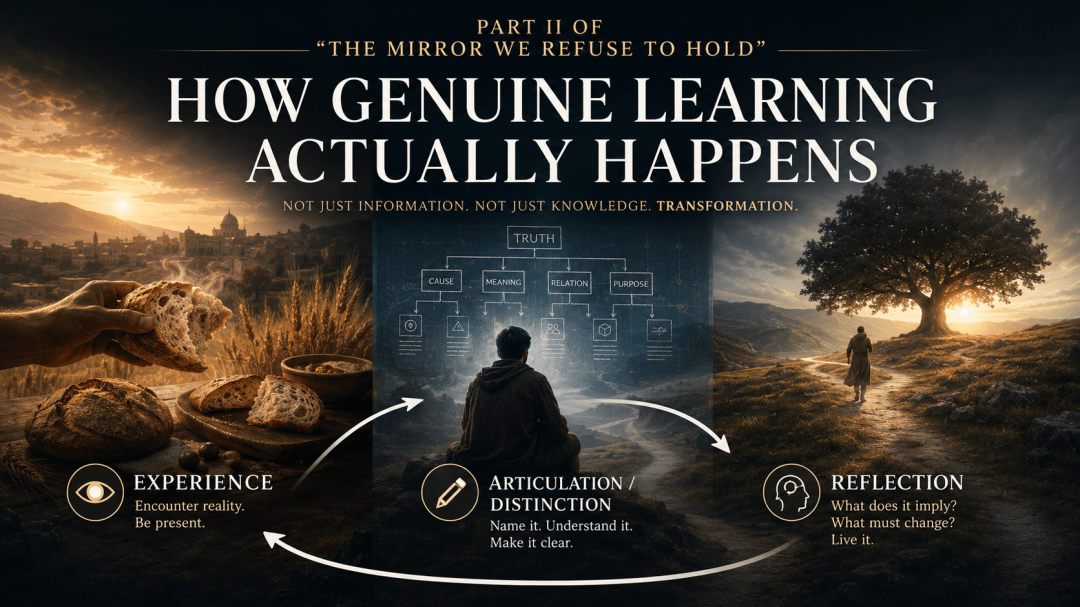
Part II of “The Mirror We Refuse to Hold”
In the previous article, we established that darkness is not the absence of light but the absence of reflection. The cosmos is flooded with photons that pass through empty space unseen, not because the light fails but because there is nothing there to catch it and give it back. Ignorance works the same way. The limiting factor is not truth’s availability but the mind’s capacity to receive it. We said the failure was structural. What we did not ask is why the structure fails, and whether anything can restore it.
That question requires us to start somewhere surprising: with the strange fact that genuine learning should not be possible at all.
The Paradox at the Door
Here is the problem. When you learn something genuinely new, not a new fact that slots into an existing category but something that changes the framework itself, how does it get in? Your mind can only process incoming information through the structures it already has. If something new fits those structures, it is absorbed. If it doesn’t, it is rejected, reclassified, or ignored. By this logic, truly new knowledge, the kind that requires the framework to change, can never arrive, because the framework is the only instrument available to evaluate what arrives. The gatekeeper and the gate are the same thing.
This is not a hypothetical puzzle. It is the lived experience of everyone who has ever tried to explain something to someone who was not ready to hear it. The words land, the person nods, and nothing changes. The information was delivered. The framework was not touched, not because the words were unclear but because the listener was structurally incapable of receiving them. The Quran describes this with unsettling precision:
Some of them listen to you, then as soon as they leave they ask those who were enlightened, “What did he just say?” God thus seals their hearts and, consequently, they follow only their opinions. (47:16)
The Quran describes such people as standing logs, despite their eloquence. All speech with no foundation.
When you see them, you may be impressed by their looks. And when they speak, you may listen to their eloquence. They are like standing logs. They think that every call is intended against them. These are the real enemies; beware of them. God condemns them; they have deviated. (63:4)
Or the one that, whether they are scolded or rewarded, they do not change.
Had we willed, we could have elevated him therewith, but he insisted on sticking to the ground, and pursued his own opinions. Thus, he is like the dog; whether you pet him or scold him, he pants. Such is the example of people who reject our proofs. Narrate these narrations, that they may reflect. (7:176)
The question of how genuine learning happens turns out to be a question about the structure of the mind itself.
The Quran gives us a perfect case study in what happens when someone introduces information the existing framework cannot accommodate.
Abraham is living among people who worship idols. Rather than argue, he smashes the idols while the people are away at their festival, leaving only the largest one standing with the tools of destruction placed at its feet.
When the people return and confront him, Abraham points to the large idol:
He said, “It is that big one who did it. Go ask them, if they can speak.” (21:63)
The people stop. The Quran captures the moment of cognitive rupture with unusual economy:
They were taken aback, and said to themselves, “Indeed, you are the ones who have been transgressing.” (21:64)
For one moment, they see it. They know the idols cannot speak. They know their own logic has been exposed. Abraham has not given them new information; they always knew the idols couldn’t speak. He has structured the existing information differently, forced it into a configuration where the conclusion can no longer be avoided.
And then, almost immediately, the framework snaps back.
Yet, they reverted to their old ideas: “You know full well that these cannot speak.” (21:65)
The admission evaporates. The dissonance is resolved not by following the logic where it leads but by returning to the prior position as if the moment of clarity had not happened. The people genuinely saw, for a moment, what Abraham was showing them. But seeing it would have required restructuring everything: their religious practice, their social world, the identity organized around what they worshipped. The cost of seeing clearly was too high, and the framework reinstated itself.
The Divided Brain
The human brain has two hemispheres connected by a thick bundle of nerve fibers called the corpus callosum. The neuroscientist Iain McGilchrist spent thirty years establishing what, precisely, each hemisphere is for, and what happens when their relationship goes wrong.
The two hemispheres do not divide labor by subject matter. They divide it by mode of attention, by how they engage with the world, not what they engage with.
The right hemisphere attends to the world as it actually is: whole, living, ambiguous, always in context. It perceives the forest. It recognizes faces. It understands metaphor, not as decoration but as a form of knowing, a way of grasping something that cannot be unpacked into propositions without being destroyed. The right hemisphere deals in imagery, in analogy, in the felt sense of a situation before any of it can be said. It holds questions open rather than closing them prematurely. It is comfortable with uncertainty, not because it is vague but because it knows that reality is always larger than any description of it. It registers threat in the periphery, the thing at the edge of awareness. It is the seat of genuine doubt, because it is in doubt that we go in search of certainty,
The left hemisphere attends to what has already been captured: parts, tools, abstractions, what is already known, and can be safely categorized. It operates in words. It reasons step by step. It draws distinctions, names them, files them. It is precise, confident, and efficient. It is also constitutionally unable to recognize its own errors. When it is wrong, it confabulates a reason it was right. When it is missing information, it generates a plausible substitute and experiences the substitute as fact. It does not register its own blind spots as blind spots. It experiences them as clarity.
McGilchrist’s central argument is that these two modes are meant to work in a specific hierarchy: the right hemisphere as master, providing the broader, embodied, contextual awareness that grounds everything; the left hemisphere as emissary, sent out to handle specific tasks with precision. The problem, and it is a civilizational problem, not merely a personal one, is that the emissary has forgotten it was sent. It has begun to govern on its own authority.
The Gorilla in the Room
In 1999, psychologists Christopher Chabris and Daniel Simons showed participants a video of two teams passing basketballs and asked them to count how many times the white team passed the ball. In the middle of the video, a person in a full gorilla suit walked slowly through the frame, stopped, thumped its chest, and walked off. The gorilla was on screen for nine full seconds.
Approximately half the participants did not see it.
They were not unintelligent. They were not distracted. They were doing exactly what they were asked to do, with complete attention, and that was precisely the problem. The left hemisphere had been given a task: count passes. It locked onto that task with focused, categorical attention and filtered everything else out. The gorilla did not belong to the category “things relevant to counting passes,” so it was never processed. It was not seen because the mode of attention being deployed was not capable of seeing it.
The right hemisphere, by contrast, is precisely the hemisphere that would have caught the gorilla. It maintains broad, ambient awareness, the kind that keeps the periphery in view, that notices what doesn’t fit, that tracks the whole scene rather than a selected feature of it. It is the hemisphere of unexpected relevance. The gorilla was unexpected, and so it was invisible to the focused, left-hemisphere attention the task had recruited.
The lesson is not that focused attention is bad. It is that focused attention comes at a cost the focused mind cannot see from the inside. When you are certain you know what to look for, you will find it. And you will miss the gorilla.
The more certain someone is, the less they actually see, because certainty is the left hemisphere telling the right to stand down. Attention narrows. The peripheral vision, literal and cognitive, contracts. And into that contracted space, things that do not fit the existing framework simply vanish. Not because they are not there. Because the mode of attending has been organized to exclude them.
As Thoreau stated, “the question is not what you look at, but what you see.”
What Happens When You Cut the Bridge
The most dramatic evidence for what the two hemispheres are actually doing comes from what happens when the corpus callosum is surgically severed, a procedure performed on severe epilepsy patients beginning in the 1960s. The results were among the most philosophically startling findings in the history of neuroscience.
Split-brain patients function normally in everyday life. Hold a conversation with one, and you would notice nothing unusual. But in controlled experiments, you find that you are effectively speaking to two separate consciousnesses sharing one body.
In a typical experiment, the patient fixes their gaze on a central point. An image of a snow scene is flashed briefly to the left visual field, meaning it is processed by the right hemisphere. The right hemisphere sees it. But with the corpus callosum severed, this information cannot cross to the left hemisphere, which controls language. So when the researcher asks “What did you see?”, a question routed through the left hemisphere, the patient says: “Nothing. A flash of light, maybe.”
Then the researcher asks the patient to point, with their left hand (controlled by the right hemisphere), to a card that matches what they saw. Without hesitation, the hand points to a shovel. The right hemisphere saw the snow scene and knew the shovel was the right answer, even though the verbal, conscious self had no idea why.
But here is where it becomes genuinely strange. When the researcher points to the shovel and asks why their hand chose it, the left hemisphere, which did not see the snow scene and has no account of why the hand moved, does not say “I don’t know.” It immediately generates a confident explanation: “Oh, I thought we might need to shovel something.” The explanation is false. The patient believes it completely.
This is not a quirk of surgery. This is the left hemisphere doing exactly what it always does, only now visible because the corpus callosum can no longer hide the seam. In ordinary life, the same process runs constantly beneath awareness. The left hemisphere narrates a coherent story of why we did what we did, why we believe what we believe, and the story is often not the real reason. The real reason lives in the hemisphere that cannot talk.
This is what it means to say that humans do not reason. They rationalize. They arrive at conclusions through processes they cannot fully access, and then generate post-hoc explanations that feel like reasoning but are, in technical terms, confabulation.
Moses, Aaron, and the Children of Israel
The Quran offers a map of this dynamic that is remarkably precise. It has three figures, and each represents one of the forces at work in the divided mind.
Moses is the prophet who stammers, the one called from “the right side” of the valley to encounter something total, simultaneous, and overwhelming: a fire that burns without consuming, a voice unlike anything language was built to carry. He has experienced something beyond words that, after the encounter, transformed him into a changed man. He represents the right hemisphere: the seat of direct experience, holistic perception, and the knowing that precedes words.
When he reached it, he was called from the edge of the right side of the valley, in the blessed spot where the burning bush was located: “O Moses, this is Me. God; Lord of the universe. (28:30)
Aaron is Moses’s brother, introduced specifically as the solution to Moses’s problem. He was the eloquent mouthpiece for Moses. Aaron is a gifted articulator, fluent, organized, and capable of rendering what Moses carries into the sequential medium that communities can process. He represents the left hemisphere: precise, communicative, and derivative. His fluency depends entirely on Moses behind him.
The Children of Israel represent the flesh and body, not biology alone, but appetite, gravity, the chronic preference for what is immediate and visible over what is demanding and true. They act on worldly desires without the control mechanisms that Moses and Aaron provide.
Now watch what happens when Moses goes up the mountain for forty days. The people grow restless and converge on Aaron. The body turns on the articulate mind with the full weight of its appetites, and Aaron, with no mountain experience of his own to draw authority from, cannot hold the line. He stands down as the Children of Israel, the body, collects the jewelry and fashions the calf. When Moses returns and sees what had happened, he takes hold of Aaron’s head.
When Moses returned to his people, angry and disappointed, he said, “What a terrible thing you have done in my absence! Could you not wait for the commandments of your Lord?” He threw down the tablets, and took hold of his brother’s head, pulling him towards himself. (Aaron) said, “Son of my mother, the people took advantage of my weakness, and almost killed me. Let not my enemies rejoice, and do not count me with the transgressing people.” (7:150)
The golden calf is what the left hemisphere capitulates when it governs without the right: fluent, organized, and lacking authority. A representation of the divine rather than a connection to it. A category where there should be an encounter.
Two Kinds of Knowing
The Quran makes a distinction that maps with uncomfortable precision onto the two hemispheres. It does so not through explicit philosophical argument but through two narratives that describe fundamentally different relationships between the mind and reality.
The first is in chapter 2, verses 31 to 33. God teaches Adam the names of all things, presenting him with creation and giving him the capacity to name it. This is the act of distinction: one thing is identified as separate from another, given a label, classified. This is the left hemisphere’s native activity. To name something is to say this is different from that, this belongs here and not there. Adam’s naming is the birth of explicit knowledge: facts, propositions, things that can be stated and transmitted.
He taught Adam all the names then presented them to the angels, saying, “Give me the names of these, if you are right.” (2:31)
They said, “Be You glorified, we have no knowledge, except that which You have taught us. You are the Omniscient, Most Wise.” (2:32)
He said, “O Adam, tell them their names.” When he told them their names, He said, “Did I not tell you that I know the secrets of the heavens and the earth? I know what you declare, and what you conceal.” (2:33)
But there is a second kind of knowing, described in 7:172. Before the creation, God gathered all the souls that would ever exist and addressed them directly:
Recall that your Lord summoned all the descendants of Adam, and had them bear witness for themselves: “Am I not your Lord?” They all said, “Yes. We bear witness.” Thus, you cannot say on the Day of Resurrection, “We were not aware of this.” (7:172)
This covenant happened before time, before language in the worldly sense, before the categories with which we navigate the world were available. It is a knowing that precedes names. It is not a set of propositions. It is an experience, direct, immediate, pre-linguistic.
This is the right hemisphere’s native domain: not names but presences, not distinctions but encounters. The right hemisphere knows things the way you know someone you love, before you could articulate what you know about them, before any list of qualities, in the direct experience of their being there. That kind of knowing is real, often the most important knowing we have, and it cannot be transmitted the way a fact can because it lives in a dimension that language only approximates.
The philosopher Frank Jackson posed a thought experiment called Mary’s Room that illuminates this form of learning. Mary is a scientist who has lived her entire life in a black-and-white room. She knows everything there is to know about the physics and neuroscience of color: wavelengths, cone cells, neural processing. Her knowledge of color vision is encyclopedic.
Then the door opens, and she sees a red apple for the first time.
Does she learn anything new?
Obviously, yes. She learns what red looks like. And this is knowledge that no amount of propositional information, no description, no measurement, no fact, could have given her. The experience is irreducible. It is its own category of knowing, prior to and not replaceable by any set of distinctions about it.
The pre-cosmic covenant of 7:172 is something like Mary’s Room but in reverse. We had the experience, the direct encounter, the divine presence, the recognition, before we entered the room of this world with all its distinctions and names. We are now in the room, surrounded by facts and categories. And somewhere, in the hemisphere that cannot speak clearly, what we knew before we arrived is still there, directing us toward the right answer even when we cannot say why.
Return now to the split-brain patient. Their right hemisphere saw the snow scene. Their left hemisphere did not. When asked, “What did you see?” the honest verbal answer was “nothing.” But the right hemisphere had already reached its conclusion. The hand pointed to the shovel without permission, without any verbal account of why. The knowledge was real, operative, and completely invisible to the part of the mind that does the talking.
This is the condition of every human being in relation to the covenant of 7:172. Something in us already knows. It cannot fully explain itself in the sequential medium of language, because the knowing happened outside that medium. The Quran calls this prior knowing to attention with its most insistent name for itself: al-Dhikr, the Reminder. Not the Instructor. Not even the Revealer, though it is that too. The Reminder. The name carries a precise assumption: the capacity to understand what is being offered is already present, because the encounter it describes already happened. The task is not installation but awakening, not learning from scratch but recognizing what the right hemisphere has been holding all along, in the register that language only partly reaches. The body knows, but the mind just needs to remember.
To God prostrates everything in the heavens and everything on earth – every creature – and so do the angels; without the least arrogance. (16:49)
*footnote: The human body, whether it belongs to a believer or a disbeliever, submits to God; the heartbeats, the lungs’ movement, and peristalsis illustrate this submission.
The Man Who Grew Wheat
There is a story that makes the argument more immediate than any philosophy can.
A man lived all his life as a wheat farmer. He knew wheat the way you know something you have worked with every day: its weight, its texture, the way it looks in the field before harvest. Every day, he would grind some wheat and eat the raw kernels. It was what wheat was. It was food.
One day, he traveled to the city. At a meal, his host placed before him a piece of bread, golden, fragrant, with a crust that crackled when he pressed it. He had never seen bread. “What is this?” he asked. “Bread,” his host said. “Eat it.” He took a bite and was astonished. It was wheat transformed, soft inside, complex in a way the raw kernel had never been.
“What is it made of?” he asked.
“Wheat,” the host said.
He was quiet.
After dinner, his host brought out a cake. The man took a bite and shook his head slowly in disbelief.
“What is this?” he asked.
“Cake.”
“And what is it made of?”
“Wheat.”
Then his host brought out one final thing: a small layered pastry soaked in honey and studded with pistachios. The man took one bite and his eyes went wide.
“What is this?”
“Baklava.”
“And this too is made of wheat?”
“Yes.”
The man finished the meal in a kind of stunned silence, then said his goodbyes and walked the long road back to his farm. That evening, he looked out at his fields, golden in the late light. Then he reached into his sack, took out a handful of kernels, and ate them raw.
He continued to do so for the rest of his life.
The man had the experience. Three times over. The living demonstration of what his wheat could become reached him and astonished him. But he never crossed from the experience to the question the experience was demanding: what would I have to do differently? He never sat with what he had tasted long enough to let it become a challenge to what he had been doing. He never reflected.
And so the experience remained sealed inside him, wonderful, memorable, completely inert.
This is the structure of every encounter with genuine knowledge that fails to transform. The information arrived. The impression was real. The failure happened in the third step, the one that converts experience and distinction into actual growth. Without reflection, the encounter with bread does not change the farmer’s practice. He files it under “remarkable things I have seen in the city” and returns to his kernels.
He is the people of Abraham’s city: genuinely struck, momentarily seeing, and then returned to exactly where they were. He is Aaron without Moses: receiving something real and being unable to hold it. He is the children of Israel in the wilderness, surrounded by manna, unable to let the experience of liberation actually liberate them.
The wheat is in the field. The bread has been waiting in it the whole time. The gap between them is not intelligence. It is not even information. It is reflection.
The Three Steps
This gives us the answer, or the beginning of one, to the paradox with which we opened. How do we learn anything genuinely new?
Not by receiving new information. The farmer received new information and returned to his kernels. Not by exposure to better arguments. The people of Abraham’s city were cornered by logic they could not refute and walked back to their idols anyway. Not by sheer intelligence.
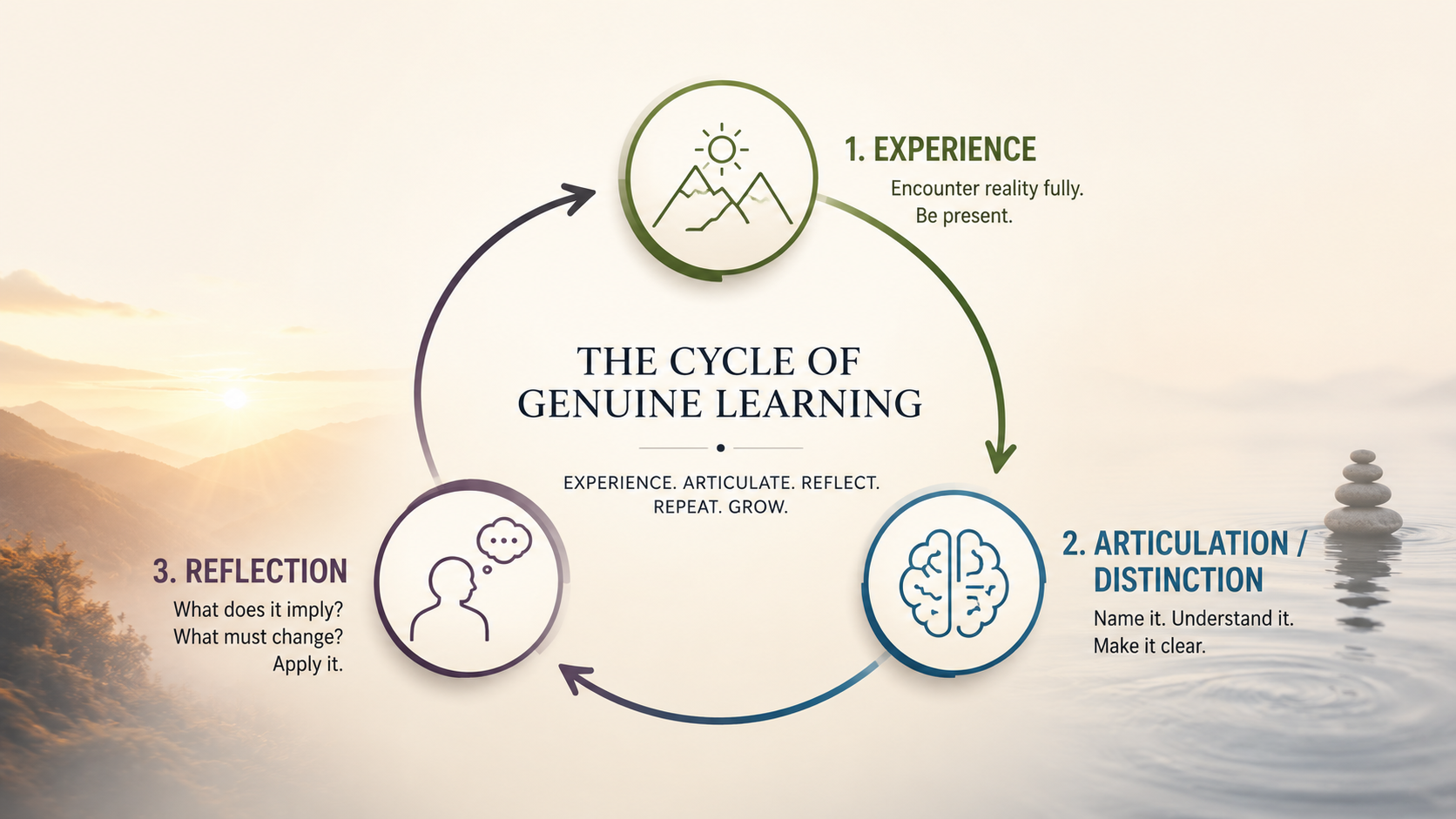
Genuine learning requires three distinct movements, in sequence.
First, experience. Not information but experience. The right hemisphere must be genuinely present to something it does not yet understand, without immediately forcing it into existing categories. This is what the farmer received in the city: not a description of bread but the taste of it. It is what Abraham’s neighbors experienced for one flashing moment before the framework reinstated itself. It is what Mary experiences when the door opens and she sees the red apple. Experience is the right hemisphere’s domain, holistic, immediate, prior to words, and it cannot be shortcut. You cannot substitute a description of the experience for the experience itself, any more than telling Mary about wavelengths could show her red. Moses had to go up the mountain. There is no version of the burning bush that can be transmitted from a safe distance.
Second, distinction. The left hemisphere’s work. Once the experience has genuinely arrived, the mind must process it into articulable form: draw the lines between this and that, name what it encountered, locate it in relation to what it already knows. This is what God gave Adam, the names of things, the capacity to hold the world in categories that can be shared and built upon. This step is not optional. Without it, experience remains private, incommunicable, unable to accumulate. The farmer could have asked: what exactly did they add to the wheat? What is the process? What heat, how long? He had the material for distinction-making. He simply never made the distinctions. Aaron’s role, rendering Moses’s encounter into language the community could receive, is not secondary. It is necessary. The vision must become words. The experience must become teachable.
Third, reflection. This is the step the farmer skipped, the step the children of Israel could never hold, the step Abraham’s neighbors took for one vertiginous moment and then rejected. Reflection is the act of turning the distinctions you have made back against your existing practice, asking what they imply, what they demand, what would have to change if they were true. It is the step that converts knowledge from spectacle into instruction. And it is the most uncomfortable step, because it is the one that costs something. To genuinely reflect on the bread is to see the raw kernels differently: as a choice you have been making, a limitation you have been inhabiting, a potential you have not touched. Reflection does not feel like learning. It feels like exposure. Which is exactly why the left hemisphere, operating on its own authority, works so hard to avoid it.
The Quran’s repeated challenge, a-fa-lā ta’qilūn (“do you not reason?”) and a-fa-lā tatafakkarūn (“do you not reflect?”), is not a demand for more information processing. It is a demand for this specific sequence: genuine presence to the world, honest distinction-making from what is encountered, and then the willingness to let the distinctions do what they imply. To sit with what you tasted long enough to ask what it means for your fields.
What Was Always Already There
These three steps: experience, distinction, and reflection, in this order, are necessary for genuine learning that will impact change. So how do these three steps apply to our own submission?
The experience was the covenant of 7:172, the direct encounter with the divine that every soul underwent before entering this world. This was our meeting with God before language, before categories, before we had any instrument for processing what we encountered, much as Moses stood before the burning bush and found that what happened there exceeded anything speech was built to carry. This became the Fitra “instinctive knowledge” that every person has that gravitates them to monotheism.
Therefore, you shall devote yourself to the religion of strict monotheism. Such is the natural instinct (fitra) placed into the people by God. Such creation of God will never change. This is the perfect religion, but most people do not know. (30:30)
The articulation is the Quran itself, Aaron’s function raised to its highest register: the vision rendered into language, the pre-linguistic knowing translated into words that the mind can approach, hold, and share. It is the form the encounter takes so that the part of us that cannot remember can still receive something of what happened there. The Quran does not introduce us to a stranger. It returns us to something we already knew, in a register we had no words for until now.
For this reason the Quran calls itself: al-Dhikr, the Reminder. Not the Instructor. Not even the Revealer, though it is that too. The Reminder. The name carries a precise assumption: the capacity to understand what is being offered is already present, because the encounter it describes already happened. The task is not installation but awakening, not learning from scratch but recognizing what the right hemisphere has been holding all along, in the register that language only partly reaches.
Which means the third step, reflection, falls entirely to us. The experience has already occurred. The articulation has already been given. What remains is the one movement no revelation can make on anyone’s behalf: the turn inward, the willingness to let what has been said press against what we actually do, to let the distinction land in the body where the appetites live and begin, slowly, to reorganize them from within.
Most of the time, it doesn’t happen. The children of Israel witnessed miracle after miracle and still lost patience and turned to another god the moment Moses left their sight. The farmer tastes the bread and goes back to his kernels. The people of Abraham’s city stand, for one honest moment, in the truth, and then retreat.
But the light did not stop. The wheat is still in the field. And the bread that has been waiting in it all along is still waiting.
The question the Quran poses at the end of every reminder is the same question: perhaps. Perhaps the reminder will benefit. Perhaps the experience will be followed by the distinction, and the distinction by the reflection, and the reflection by the change that makes a person into something capable of receiving the next thing that arrives.
Perhaps. The word is never accidental. It is the one variable the cosmos leaves entirely to us.
Therefore, you shall remind; perhaps the reminder will benefit. (87:9)
This is the second essay in a series beginning with “The Mirror We Refuse to Hold: On Darkness, Ignorance, and the Nature of Reflection.”


One thought on “How Do We Learn Anything New?”