
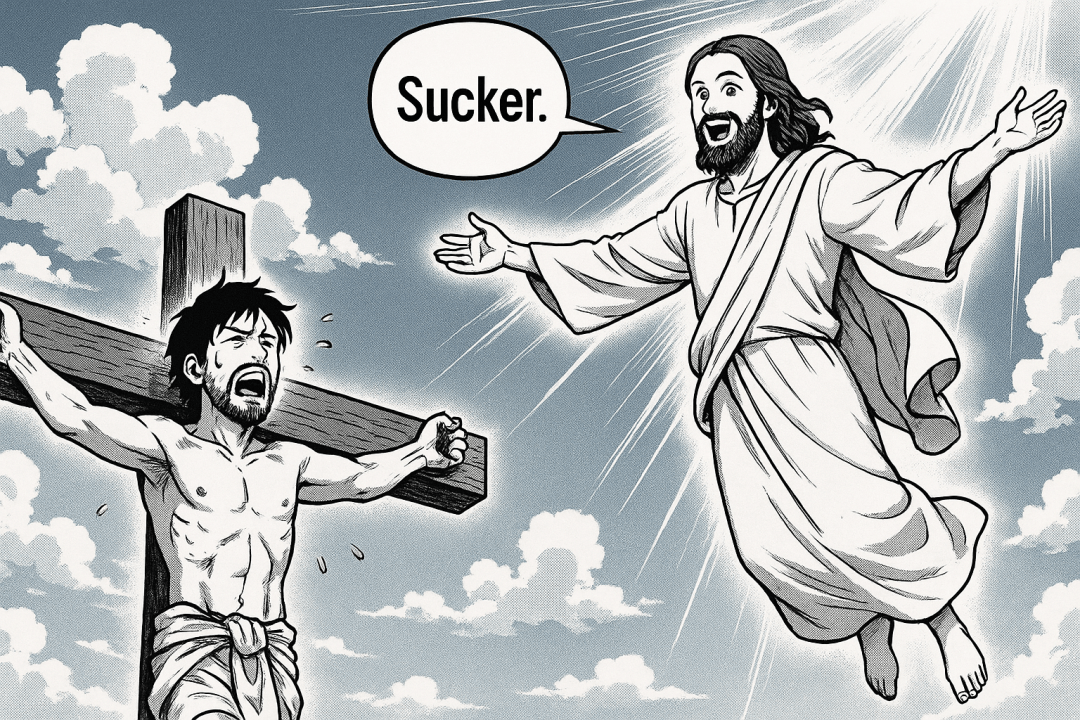
In mainstream Sunni theology, Jesus (ʿĪsā) was neither killed nor crucified but was raised alive to God, where he continues to live in a state unique among all prophets. Sunnis generally hold that God made someone else resemble Jesus externally, and that this substitute was crucified in his place. They derive this “substitution theory” from their interpretation of specific Quranic verses, particularly 4:157-158. This belief ties directly to their eschatological expectations: according to Sunni tradition, Jesus will descend physically before the Day of Judgment as a just ruler, break the cross, kill the swine, abolish the jizya, defeat the false messiah (al-Dajjāl), and restore true monotheism before dying a natural death and being buried next to the Prophet Muhammad.
These eschatological details, however, are not found in the Quran. They are derived entirely from Hadith literature, particularly reports in Bukhārī and Muslim, which locate Jesus’ second coming within a dramatic end-times narrative involving the Mahdī, cosmic tribulations, and the final triumph of Islam. As a result, Sunni belief fuses a Quranic affirmation of Jesus’ rescue with post-Quranic traditions that elaborate his eschatological mission, creating a composite doctrine where a living, heavenly Jesus awaits a future return to complete a storyline absent from the Quran itself. However, a careful examination of the verses of the Quran reveals that this entire understanding creates numerous contradictions with the Quranic text.
The Substitution Theory and What the Quran Actually Says
The verses most often cited to support the substitution theory are the following:
[4:157] And for claiming that they killed the Messiah, Jesus, son of Mary, the messenger of GOD. In fact, they never killed him, they never crucified him—they were made to think that they did. All factions who are disputing in this matter are full of doubt concerning this issue. They possess no knowledge; they only conjecture. For certain, they never killed him. [4:158] Instead, GOD raised him to Him; GOD is Almighty, Most Wise.
At first glance, many assume this means Jesus’ physical body was saved from crucifixion entirely. Yet this interpretation overlooks a major Quranic theme that runs throughout the text: the righteous who are killed in the cause of God do not truly die. Their bodies may be destroyed, but their souls are immediately taken by God and granted life in His presence. The Quran states this principle repeatedly and unambiguously:
[2:154] Do not say of those who are killed in the cause of God, “They are dead.” They are alive at their Lord, but you do not perceive.
[3:169] Do not think that those who are killed in the cause of God are dead; they are alive at their Lord, enjoying His provisions.
These verses establish a critical theological distinction. To say that Jesus was killed or crucified by human power is to grant control of life and death to humans, even though the Quran repeatedly states that God alone controls life and death (cf. 3:156; 7:158; 10:56; 23:80; 40:68; 53:44; 57:2). Humans can only appear to kill, but only God causes death and can terminate a life—take a soul. Thus, what 4:157 negates is not the physical event of crucifixion, but rather the claim that the Jews had power over Jesus’ actual death. They “did not kill him” in the sense that his true death—the taking of his soul (wafā) —was in God’s hands alone, not theirs.
[9:116] To God belongs the sovereignty of the heavens and the earth. He controls life and death. You have none beside God as a Lord and Master.
This understanding becomes even clearer when we examine another key verse about Jesus’ departure from this world:
[3:54] They plotted and schemed, but so did GOD, and GOD is the best schemer. [3:55] Thus, God said, “O Jesus, I am terminating (mutawaffīka) your life, raising you to Me, and ridding you of the disbelievers. I will exalt those who follow you above those who disbelieve, till the Day of Resurrection. Then to Me is the ultimate destiny of all of you, then I will judge among you regarding your disputes.”
The word mutawaffīka (متوفيك) is crucial here. In this context, it specifically means the “taking one’s soul from their body” at death. This same verb is used unambiguously for death throughout the Quran (see 10:46, 13:40, 40:77). The sequence in 3:55 is clear: God terminated Jesus’ earthly life (mutawaffīka), then raised him spiritually (rāfiʿuka), and cleansed him from the disbelievers.
What the Quran affirms, therefore, is the spiritual truth behind the historical event: Jesus’ soul was taken by God and raised to Him before the disbelievers could desecrate his body or claim victory over him. His enemies achieved nothing over his true self—his soul—even though his body was subjected to crucifixion. This was all part of God’s scheme: to save His devoted worshiper, while confirming the evilness of his enemies who were persecuting him by allowing them to carry on with the heinous act of torturing and crucifying an empty body.
The Quranic Framework of Death and the Righteous
The Quran distinguishes between mawt (biological death, the cessation of bodily function) and wafā (the taking of the soul, the completion of earthly life). It also teaches that believers experience only the first death that occurred before our arrival here on Earth, while disbelievers will experience a “second death.”
[40:11] They (the disbelievers) will say, “Our Lord, you have put us to death twice, and You gave us two lives; now we have confessed our sins. Is there any way out?”
[2:28] How can you disbelieve in GOD when (1) you were dead and He gave you life, then (2) He puts you to death, then He brings you back to life, then to Him you ultimately return?
This pattern applies to all humans, including the prophets. In the case of Jesus, his soul was directly taken (wafā) by God at the moment of crucifixion, without any spiritual defilement, humiliation, or abandonment. He did not experience a “second death,” nor did he undergo a break in consciousness between worldly death and resurrection, as the disbelievers will. Like all martyrs, his soul was raised immediately to God.
Understanding these Quranic categories clarifies the picture entirely: Jesus’ mawt (bodily termination) occurred, but was not granted as a victory to his enemies. His wafā (the actual taking of his soul) was performed directly by God, not by human hands. His soul was raised immediately to God, consistent with the status of all martyrs. And after his departure from this world, he remained unaware of earthly events until the Day of Judgment—a point the Quran makes explicit, as we will see.
Again, this is the same for all righteous believers. For example, consider the individual who urged his people to follow the messengers in Sura 36. It states that upon his death, he was admitted into Paradise. These verses suggest that the righteous do not actually die; they simply pass on to Paradise. They join the prophets, saints, and martyrs in an active and utopian life.
[36:20] A man came from the other end of the city, saying, “O my people, follow the messengers. [36:21] “Follow those who do not ask you for any wage, and are guided. [36:22] “Why should I not worship the One who initiated me, and to Him is your ultimate return? [36:23] “Shall I set up beside Him gods? If the Most Gracious willed any harm for me, their intercession cannot help me one bit, nor can they rescue me. [36:24] “In that case, I would be totally astray. [36:25] “I have believed in your Lord; please listen to me.”[36:26] (At the time of his death) he was told, “Enter Paradise.” He said, “Oh, I wish my people knew. [36:27] “That my Lord has forgiven me, and made me honorable.”
The Earliest Christian Record and the Quranic Account
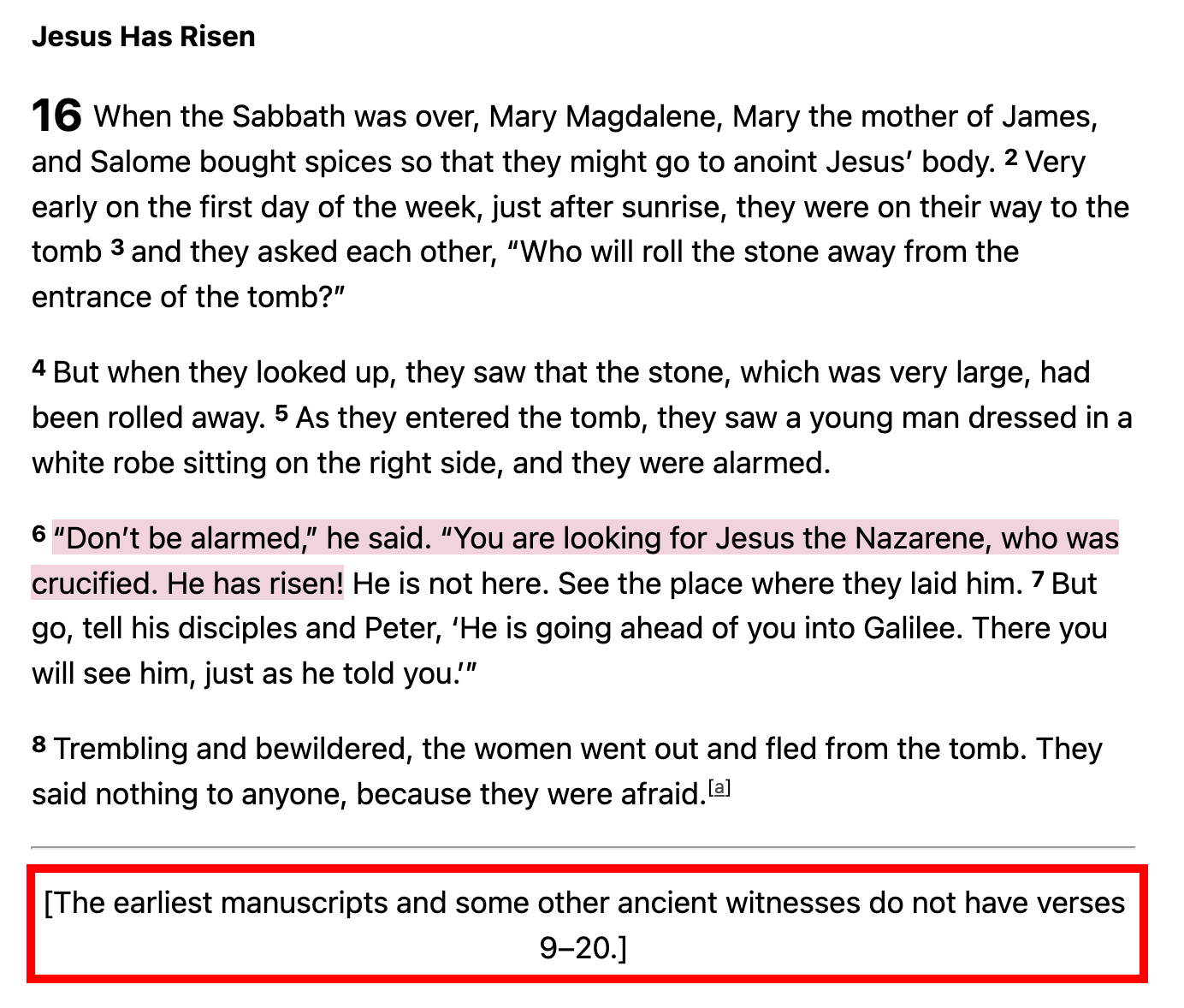
Remarkably, the earliest Christian textual evidence aligns closely with this Quranic understanding. In the earliest manuscripts of the Gospel of Mark—widely considered the oldest written gospel—the narrative ends abruptly at what we now call Mark 16:8. When the women go to Jesus’ tomb, they are told simply, “He has risen—He is not here. See the place where they laid him.” There is no resurrection appearance, no post-crucifixion encounters with Jesus, and no mythology of a God-man physically returning from the dead. The women flee in fear and “said nothing to anyone, because they were afraid.” This is where the original text ends.
Mark 16: When the Sabbath was over, Mary Magdalene, Mary the mother of James, and Salome bought spices so that they might go to anoint Jesus’ body. 2 Very early on the first day of the week, just after sunrise, they were on their way to the tomb 3 and they asked each other, “Who will roll the stone away from the entrance of the tomb?” 4 But when they looked up, they saw that the stone, which was very large, had been rolled away. 5 As they entered the tomb, they saw a young man dressed in a white robe sitting on the right side, and they were alarmed. 6 “Don’t be alarmed,” he said. “You are looking for Jesus the Nazarene, who was crucified. He has risen! He is not here. See the place where they laid him. 7 But go, tell his disciples and Peter, ‘He is going ahead of you into Galilee. There you will see him, just as he told you.’” 8 Trembling and bewildered, the women went out and fled from the tomb. They said nothing to anyone, because they were afraid.
The longer ending now found in most Bibles (Mark 16:9-20), which includes post-resurrection appearances and the ascension, was added by later scribes centuries afterward. Scholars universally recognize these verses as inauthentic additions not present in the earliest and most reliable manuscripts. What we have in the original ending of Mark, therefore, is a pre-theological, pre-doctrinal account: the body is gone, Jesus “has risen” (in the spiritual sense), and there is no narrative of physical return. This mirrors precisely what the Quran teaches—that Jesus was taken by God, his soul raised to Him, and his enemies deprived of any true victory over him.
Jesus’ Unawareness After His Departure
The Quran provides explicit testimony that Jesus, like all messengers, remained unaware of what transpired on earth after his departure. In Surah 5, God describes the Day of Judgment when He will summon all the messengers:
[5:109] The day will come when GOD will summon the messengers and ask them, “How was the response to you?” They will say, “We have no knowledge. You are the Knower of all secrets.”
This verse establishes that all messengers—including Jesus—will have no knowledge of what happened after their earthly missions ended. If Jesus had returned to earth for a second mission, this verse would be false. He could not claim ignorance of events that occurred after his initial departure if he had, in fact, lived through them during a return visit.
A few verses later, this principle is applied directly and specifically to Jesus:
[5:116] GOD will say, “O Jesus, son of Mary, did you say to the people, ‘Make me and my mother idols beside GOD’?” He will say, “Be You glorified. I could not utter what was not right. Had I said it, You already would have known it. You know my thoughts, and I do not know Your thoughts. You know all the secrets. [5:117] “I told them only what You commanded me to say, that: ‘You shall worship GOD, my Lord and your Lord.’ I was a witness among them for as long as I lived with them. When You terminated my life on earth, You became the Watcher over them. You witness all things.”
Notice Jesus’ explicit statement: “I was a witness among them for as long as I lived with them.” Then he says, “When You terminated my life on earth, You became the Watcher over them.” Jesus clearly indicates that his earthly life ended, that his role as witness ended at that moment, and that afterward God alone watched over his followers. He expresses complete ignorance of what they did after his departure—including the deification of himself and his mother. This passage makes the Sunni narrative of a physical second coming impossible. If Jesus returned to earth after Muhammad, he would possess knowledge of post-departure events, directly contradicting his own testimony in 5:117.
The Problem of Muhammad as the Final Prophet
Another fundamental and insurmountable contradiction arises when we consider the Quranic doctrine that Muhammad was the final prophet. The Quran states this unequivocally:
[33:40] Muhammad was not the father of any man among you. He was a messenger of GOD and the final prophet. GOD is fully aware of all things.
The term khātam al-nabiyyīn (خَاتَمَ ٱلنَّبِيِّـۧنَ) means “the seal of the prophets”—the one who closes and completes the line of prophetic authority. Yet Sunni theology insists that Jesus will physically return to earth before the Day of Judgment. The Quran explicitly identifies Jesus as a prophet of God (19:30). Here lies the irreconcilable problem: prophethood is not a temporary job assignment that expires when a prophet’s initial mission ends. It is an ontological status, a permanent identity bestowed by God. A messenger does not cease being a messenger simply because his worldly ministry has concluded, any more than Moses or Abraham stopped being prophets after their deaths. Prophethood is not something one can resign from or that God revokes.
Therefore, if Jesus were to return to earth after Muhammad—regardless of the mission he performs or the role he plays—he would return as Jesus the prophet of God. By definition, he would be the last living prophet on earth, which directly contradicts 33:40. Sunni scholars attempt to escape this logical impasse by claiming that Jesus will return “not as a prophet” but merely as a “follower of Muhammad” or as a ruler implementing Sharia. But this argument collapses under the slightest scrutiny. One cannot strip a prophet of his prophethood without denying the very divine revelation that granted him that status in the first place. Jesus was made a prophet by God; no human theological construct can unmake that reality. A prophet returning to earth remains a prophet—regardless of what tasks he performs, whose law he implements, or what title scholars prefer to assign him.
The Sunni position, therefore, requires either nullifying Muhammad’s status as the final prophet or denying Jesus’ prophetic identity. The Quran permits neither. This makes the physical return of Jesus not only textually unsupported but theologically impossible within the coherent framework of Quranic doctrine.
Final Thoughts
The Quran affirms Jesus as an obedient prophet and messenger, describes his enemies’ failure to truly kill him, and confirms his immediate elevation to God. But it speaks nothing of an elaborate eschatological drama involving Jesus’ return—breaking crosses, killing swine, defeating Dajjāl. None of this exists in the Quran. Such narratives are a post-Quranic construction built entirely from Hadith literature and imposed backward onto Quranic verses that, when read carefully, say something entirely different.
When the Quran is read coherently and holistically—allowing its verses to interpret one another and respecting its consistent theological principles—the traditional Sunni narrative of Jesus’ substitution and second coming unravels entirely. The Quran teaches that while the physical body of Jesus was crucified, his soul was taken directly by God without any defilement or defeat. And like all righteous martyrs, he was raised spiritually and immediately to God’s presence and is not dead but alive at his Lord. After his departure, he will remain unaware of earthly events, as verse 5:117 explicitly states. He will not return before the Day of Judgment, as this would contradict both his own testimony and the finality of Muhammad’s prophethood, as stated in the Quran. And it will not be until the Day of Judgment that he will be shocked to hear all that transpired after he was raised by God and his life on earth was terminated.
Related Content:

 Quran Talk Blog