
Islam proclaims itself as a religion of justice, mercy, and a defense for the weak in society. Yet buried within the hadith canon—especially in collections labeled sahih, or “authentic”—are narrations that do the very opposite: they victimize the innocent, normalize cruelty, and assign blame to those whom the Quran explicitly protects.
These aren’t isolated fabrications or obscure reports. They are embedded in the core hadith collections upheld by Sunni orthodoxy, often above the authority of the Quran. And disturbingly, they target the most vulnerable members of society—newborns, orphans, and children born out of wedlock—with cruelty, condemnation, and sweeping moral judgment.
One so-called authentic narration sends a murdered infant to Hell. Another has a revered figure boasting about beating orphans into submission. Yet another declares a child born outside of marriage to be inherently more evil than the sinners who conceived them—and forever unworthy of freedom.
But these are just a few examples. The deeper we go, the more we find a pattern—not of mercy, but of moral collapse.
These Hadith violate the Quran’s most basic principles: that no soul bears the burden of another, that justice must be upheld even against oneself, and that oppression is never sanctioned except in resistance to injustice.
The Hadith That Sends a Murdered Baby to Hell
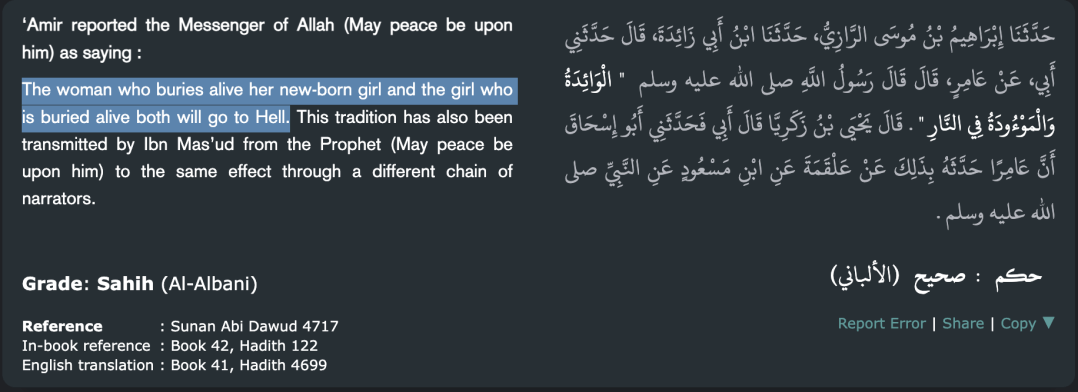
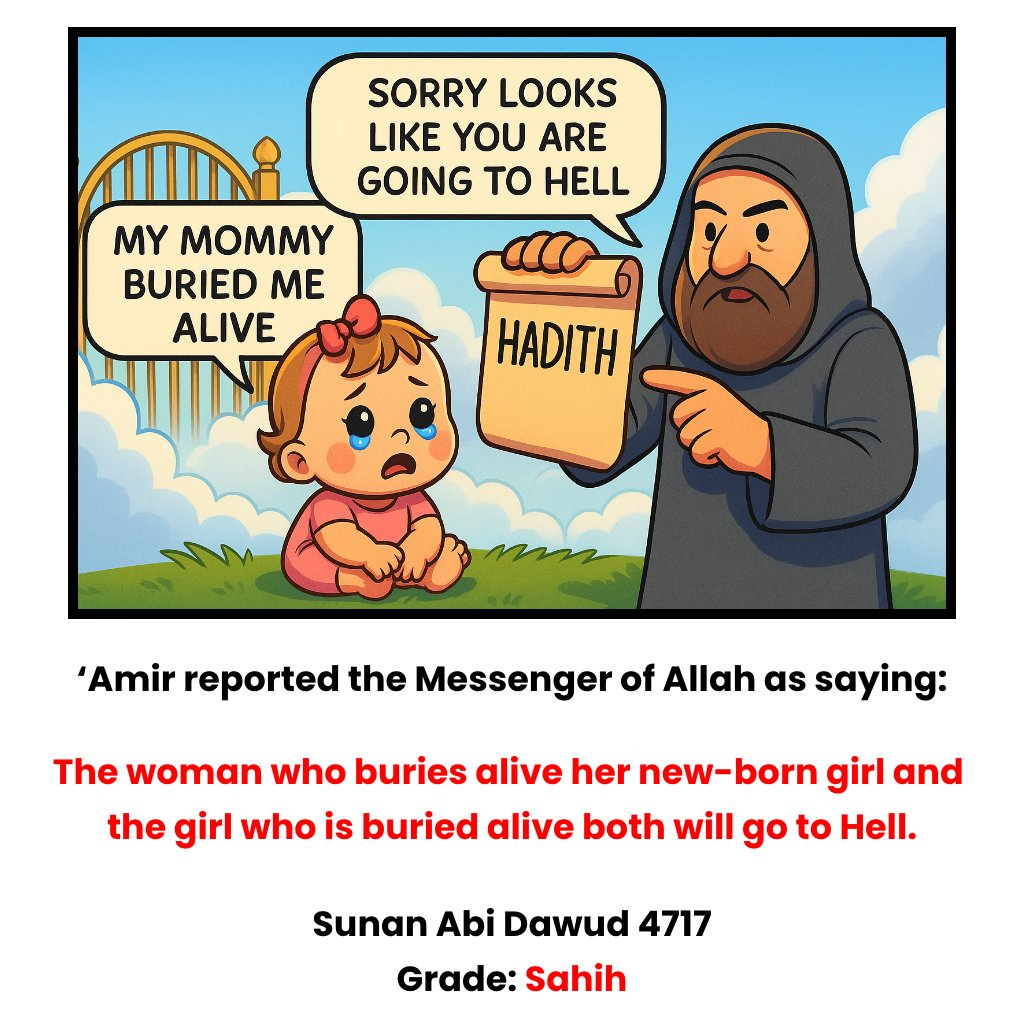
‘Amir reported the Messenger of Allah (May peace be upon him) as saying: The woman who buries alive her new-born girl and the girl who is buried alive both will go to Hell. This tradition has also been transmitted by Ibn Mas’ud from the Prophet (May peace be upon him) to the same effect through a different chain of narrators.
حَدَّثَنَا إِبْرَاهِيمُ بْنُ مُوسَى الرَّازِيُّ، حَدَّثَنَا ابْنُ أَبِي زَائِدَةَ، قَالَ حَدَّثَنِي أَبِي، عَنْ عَامِرٍ، قَالَ قَالَ رَسُولُ اللَّهِ صلى الله عليه وسلم “ الْوَائِدَةُ وَالْمَوْءُودَةُ فِي النَّارِ ” . قَالَ يَحْيَى بْنُ زَكَرِيَّا قَالَ أَبِي فَحَدَّثَنِي أَبُو إِسْحَاقَ أَنَّ عَامِرًا حَدَّثَهُ بِذَلِكَ عَنْ عَلْقَمَةَ عَنِ ابْنِ مَسْعُودٍ عَنِ النَّبِيِّ صلى الله عليه وسلم .
Sunan Abi Dawud 4717
https://sunnah.com/abudawud:4717

This narration is not just disturbing—it is obscene. It asserts that the baby girl who was buried alive, the victim of one of the most horrific pre-Islamic practices, is herself damned to Hell alongside her murderer. No qualifications, no stipulations, no moral nuance—just blanket condemnation of both oppressor and oppressed.
The Quran, however, tells a completely different story.
Surah 81 contains one of the most vivid depictions of the Day of Judgment, describing the events that are to unfold. And after the events, the first person that God calls to account for justice is the baby girl who was buried alive.
[81:1] When the sun is rolled.
[81:2] The stars are crashed into each other.
[81:3] The mountains are wiped out.
[81:4] The reproduction is halted.
[81:5] The beasts are summoned.
[81:6] The oceans are set aflame.
[81:7] The souls are restored to their bodies.
[81:8] The girl who was buried alive is asked:
[81:9] For what crime was she killed?
This verse is not ambiguous. God Himself centers the victim. The girl is not punished—she is given a voice. She is not judged—she is vindicated. The purpose of the questioning is not to condemn her, but to expose the guilt of her killer.
The Quran doesn’t just absolve the child—it makes her the symbol of divine justice.
Contrast that with the hadith in question. What the Quran treats as the pinnacle of injustice, this hadith turns into a shared sentence. By assigning Hell to the murdered child, the hadith erases accountability and desecrates the moral clarity of the Quran. It reduces divine justice to indiscriminate damnation.
It also violates another fundamental Quranic principle: “No soul bears the burden of another” (6:164). A child who was murdered before she could speak, choose, or sin cannot possibly be accountable for her fate. This hadith would have us believe otherwise, making God into the punisher of infants—a grotesque slander against the One who is Most Merciful and Most Just.
Let us not forget: this narration is not buried in some obscure volume. It is graded sahih in one of their most revered books of Hadith. It is part of the corpus held up as the second source of Islamic law and theology. And it portrays a God who punishes the powerless and excuses the crime by sharing the blame.
Beating Orphans
Shumaysa al-‘Atakiyya said, “The disciplining of orphans was mentioned in the presence of ‘A’isha and she said, ‘I would beat an orphan until he submits.'”
حَدَّثَنَا مُسْلِمٌ، قَالَ: حَدَّثَنَا شُعْبَةُ، عَنْ شُمَيْسَةَ الْعَتَكِيَّةِ قَالَتْ: ذُكِرَ أَدَبُ الْيَتِيمِ عِنْدَ عَائِشَةَ رَضِيَ اللَّهُ عَنْهَا، فَقَالَتْ: إِنِّي لأَضْرِبُ الْيَتِيمَ حَتَّى يَنْبَسِطَ.
Al-Adab Al-Mufrad 142
https://sunnah.com/adab:142

What kind of religion permits, let alone praises, violence against an orphan? What kind of moral system takes pride in the physical domination of a child who has already lost everything?
According to this sahih hadith, Aisha—the “Mother of the Believers”—declared unapologetically that she would beat orphans into submission. Not correct, not teach, not guide—beat.
The Quran, again, speaks with clarity and conscience:
[107:1] Do you know who really rejects the faith?
[107:2] That is the one who mistreats the orphans.
[93:9] Therefore, you shall not forsake the orphan.
(٩) فَأَمَّا ٱلْيَتِيمَ فَلَا تَقْهَرْ
| 1 | fa-ammā | فَأَمَّا | So as for |
| 2 | l-yatīma | ٱلْيَتِيمَ | the orphan, |
| 3 | falā | فَلَا | then (do) not |
| 4 | taqhar | تَقْهَرْ | you treat harshly / allow to be oppressed. |
There is no room for interpretation here. God explicitly forbids being harsh or mistreating orphans. And what is beating a defenseless child if not the most direct form of oppression? The Quran’s standard is moral care, not coercive violence. It commands protection—not punishment—of the orphan. There is no clause that allows for “disciplining” through force, no justification for beating a child into compliance.
And when it comes to physical aggression, the Quran’s moral framework is unyielding:
[2:190] You may fight in the cause of GOD against those who attack you, but do not aggress. GOD does not love the aggressors.
Even in war, the Quran demands restraint. Yet here, in a domestic context, a revered figure boasts of using physical force against an orphan. This isn’t merely harsh—it’s a flagrant inversion of everything the Quran teaches about mercy, justice, and power.
Some may argue that this is not attributed to the prophet, so this may just be Aisha’s shortcoming. Yet, we see the false claim that the Prophet also advocated beating children in the Hadith.
Narrated Abdullah ibn Amr ibn al-‘As: The Messenger of Allah (ﷺ) said: Command your children to pray when they become seven years old, and beat them for it (prayer) when they become ten years old; and arrange their beds (to sleep) separately.
حَدَّثَنَا مُؤَمَّلُ بْنُ هِشَامٍ، – يَعْنِي الْيَشْكُرِيَّ – حَدَّثَنَا إِسْمَاعِيلُ، عَنْ سَوَّارٍ أَبِي حَمْزَةَ، – قَالَ أَبُو دَاوُدَ وَهُوَ سَوَّارُ بْنُ دَاوُدَ أَبُو حَمْزَةَ الْمُزَنِيُّ الصَّيْرَفِيُّ – عَنْ عَمْرِو بْنِ شُعَيْبٍ، عَنْ أَبِيهِ، عَنْ جَدِّهِ، قَالَ قَالَ رَسُولُ اللَّهِ صلى الله عليه وسلم “ مُرُوا أَوْلاَدَكُمْ بِالصَّلاَةِ وَهُمْ أَبْنَاءُ سَبْعِ سِنِينَ وَاضْرِبُوهُمْ عَلَيْهَا وَهُمْ أَبْنَاءُ عَشْرِ سِنِينَ وَفَرِّقُوا بَيْنَهُمْ فِي الْمَضَاجِعِ ” .
Sunan Abi Dawud 495
https://sunnah.com/abudawud:495
These narrations are not just a bad look—it’s a moral failure. And the fact that it was recorded, preserved, and declared sahih tells us something deeply troubling: the hadith system does not merely deviate from the Quran. It preserves injustice in the name of piety.

Illegitimate Children Are Worse Than Their Parents
Narrated Abu Hurayrah: The Prophet (ﷺ) said: The child of adultery is worst of the three. Abu Hurairah said: That I give a flog in the path of Allah (as a charity) is dearer to me than emancipating a child of adultery.
حَدَّثَنَا إِبْرَاهِيمُ بْنُ مُوسَى، أَخْبَرَنَا جَرِيرٌ، عَنْ سُهَيْلِ بْنِ أَبِي صَالِحٍ، عَنْ أَبِيهِ، عَنْ أَبِي هُرَيْرَةَ، قَالَ قَالَ رَسُولُ اللَّهِ صلى الله عليه وسلم “ وَلَدُ الزِّنَا شَرُّ الثَّلاَثَةِ ” . وَقَالَ أَبُو هُرَيْرَةَ لأَنْ أُمَتِّعَ بِسَوْطٍ فِي سَبِيلِ اللَّهِ عَزَّ وَجَلَّ أَحَبُّ إِلَىَّ مِنْ أَنْ أَعْتِقَ وَلَدَ زِنْيَةٍ .
Sunan Abi Dawud 3963
https://sunnah.com/abudawud:3963

Here we see the full weight of hadith cruelty drop onto the shoulders of a child—not for anything the child did, but for the circumstances of their birth. This narration declares that a child born out of wedlock is worse than the adulterers who conceived them. And Abu Hurairah says he would rather give a whip than grant that child their freedom.
What kind of moral compass is this?
The Quran, again, obliterates this kind of logic with a simple, divine axiom:
“No soul bears the burden of another.”
(Quran 6:164, 17:15, 35:18, 39:7, 53:38)
This is not a marginal teaching—it is one of the most frequently repeated principles in the Quran. God does not hold you responsible for someone else’s sin. Not your parents’. Not your community’s. And certainly not the manner of your conception.
To label a child as inherently “evil” (sharru) simply because they were born through zina (adultery) is a direct assault on this foundational truth. It is a rejection of God’s justice. It turns divine mercy into inherited damnation. And it places hadith in the camp of those who slander God’s law.
In fact, the Quran places the burden of sin precisely where it belongs: on the one who commits it. The adulterer is condemned, not the child. The Quran never even hints at the idea that a child born in sin is somehow stained by it. Even worse, the hadith goes beyond judgment—it withholds liberation. Abu Hurairah openly states he would rather give a whip than free a child slave born through zina. That is, he’d prefer to perpetuate slavery than show compassion to someone whose only “crime” was being born.
A system that canonizes this kind of thinking is not just flawed. It’s broken at the root, and attributes lies to the prophet and God’s religion. This defies the Quran, defiles justice, and turns God’s religion, Submission, into a religion of inherited shame and cruelty.
[6:21] Who is more evil than one who lies about God, or rejects His revelations? The transgressors never succeed.
Advocating for Child Marriage
Few hadith have done more damage to Islam’s moral image than the infamous claim that the Prophet married Aisha at six and consummated the marriage at nine.
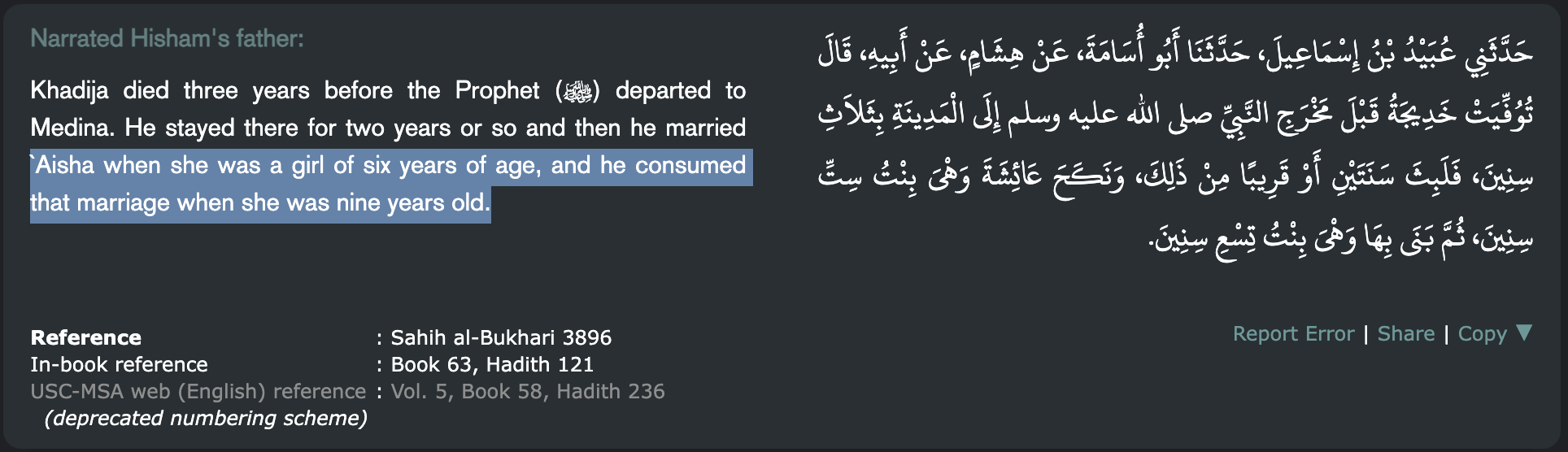
“The Prophet married me when I was six years old, and consummated the marriage when I was nine.”
(Sahih al-Bukhari 3896)
This narration forms the basis upon which many classical jurists permitted child marriage. But the hadith corpus does not merely document this event—it portrays child marriage as prophetically recommended. In another sahih narration the prophet’s asks a companion:
“Why did you not marry a virgin so that you could play with her and she with you?”
(Sahih al-Bukhari 2097)
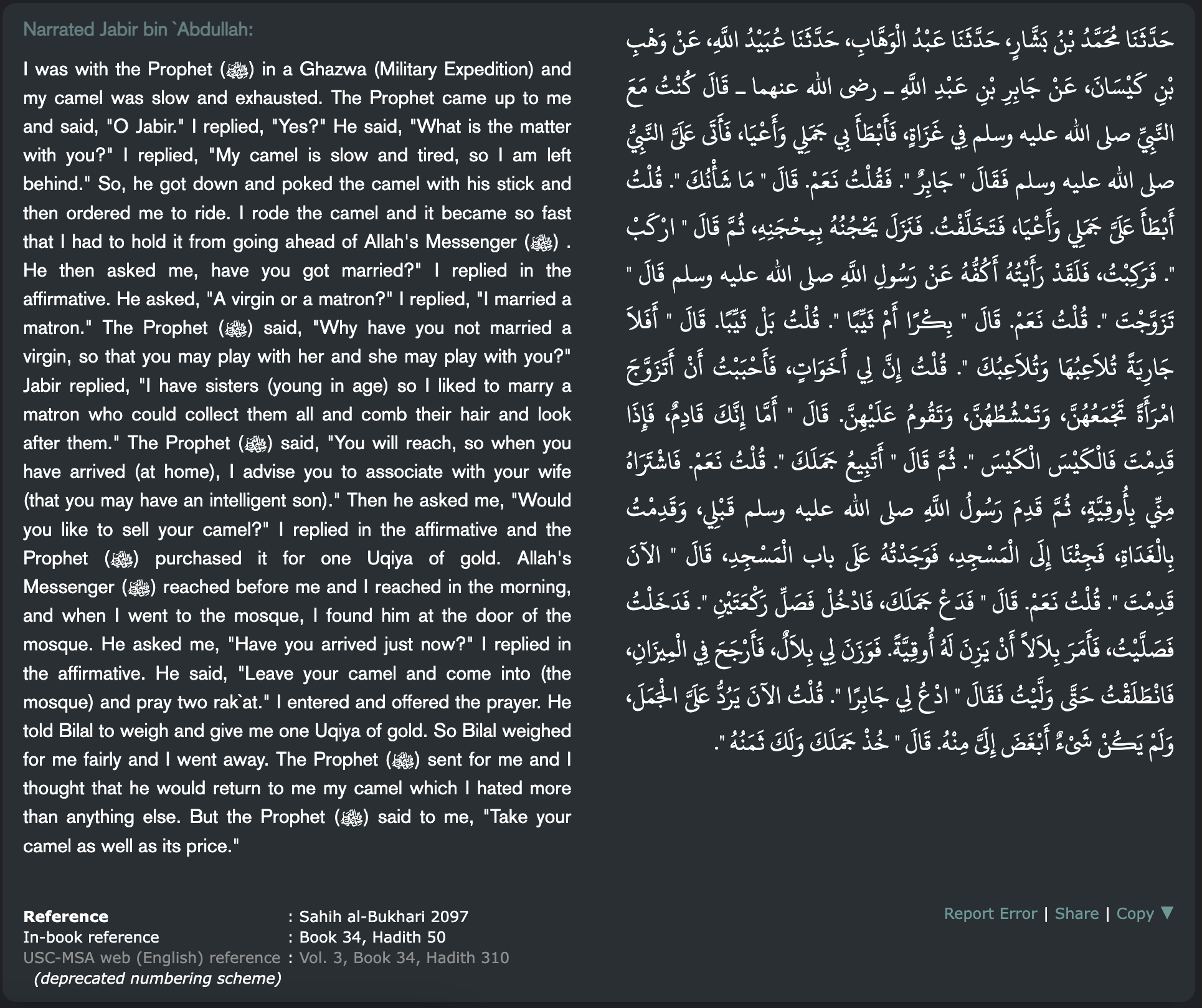
The Arabic term لَاعِبْتَهَا (lāʿibatahā), translated here as “play,” is used in classical Arabic as a euphemism for sexual activity—a fact noted explicitly in Sahih al-Bukhari 5105 and recognized by traditional commentators. Additionally, the word جَارِيَة (jāriya) used to describe the bride is significant: it refers to a prepubescent girl, often a female slave who has not reached sexual maturity. The term can be applied to individuals as young as infancy (see Bulugh al-Maram, Book 12, 42, and Bulugh al-Maram, Book of Purification, 29 (3)), but is typically used for a child before puberty is reached. The Quran, in contrast, uses the term nisa’ (نساء) for adult women, and fatāt (فتاة) for young women who have reached puberty. The use of jāriya here indicates the hadith envisions a girl who is still a child.
Historically, this advice was given to Jabir ibn Abdullah, who, based on historical records, was born in 16 BH (607 CE). His father died in the Battle of Uhud in 3 AH (625 CE), meaning Jabir would have been at least 21 years old when this conversation took place. Thus, we are presented with a hadith in which a grown man is advised to marry a prepubescent girl—explicitly for her sexual “playfulness.”
This portrayal, however, is incompatible with the Quran, which ties the institution of marriage to puberty and maturity, not age alone. Consider the following verse:
[4:6] You shall test the orphans when they reach puberty (al-nikha). As soon as you find them mature enough, give them their property. Do not consume it extravagantly in a hurry, before they grow up. The rich guardian shall not charge any wage, but the poor guardian may charge equitably. When you give them their properties, you shall have witnesses. GOD suffices as Reckoner.
وَابْتَلُوا الْيَتَامَىٰ حَتَّىٰ إِذَا بَلَغُوا النِّكَاحَ فَإِنْ آنَسْتُمْ مِنْهُمْ رُشْدًا فَادْفَعُوا إِلَيْهِمْ أَمْوَالَهُمْ وَلَا تَأْكُلُوهَا إِسْرَافًا وَبِدَارًا أَنْ يَكْبَرُوا وَمَنْ كَانَ غَنِيًّا فَلْيَسْتَعْفِفْ وَمَنْ كَانَ فَقِيرًا فَلْيَأْكُلْ بِالْمَعْرُوفِ فَإِذَا دَفَعْتُمْ إِلَيْهِمْ أَمْوَالَهُمْ فَأَشْهِدُوا عَلَيْهِمْ وَكَفَىٰ بِاللَّهِ حَسِيبًا
The expression “balaghū al-nikāḥ” ( بَلَغُوا النِّكَاحَ ) means reaching the age of marriage, and it is used here as synonymous with puberty. But the verse goes further: reaching physical maturity is not enough. The Quran adds a second condition: “rūshd” ( رُشْدًا )—mental maturity. Only after both are confirmed is a person entrusted with their wealth, which implies full legal adulthood. The Quran ties marriageability directly to this stage of development. Therefore, someone who cannot be the custodian of their own affairs and needs a guardian to execute a contract is not permissible to be married.
In this framework, a child cannot be married. The Quran does not recognize marriage to someone who has not yet reached sexual and intellectual maturity. There is no example in the Quran of a prepubescent girl being married. No verse permits or implies such a thing. On the contrary, the Quran emphasizes protection, patience, and responsibility when dealing with minors—especially orphans.
The hadith corpus, by contrast, contains multiple narrations that advocate marrying children for sexual purposes, all while labeling these reports as sahih. This raises a serious theological problem for upholders of Hadith. The presence of these narrations in so-called authentic books is not evidence of prophetic practice—it is evidence that the hadith corpus is not from God and contradicts the Quran.
Conclusion: A System That Sanctions Injustice Cannot Represent God
What we’ve seen is not a few questionable narrations hidden in obscure collections. These are sahih hadith—stamped with scholarly approval, taught as religious truth, and used to shape moral and legal codes in the name of “Islam.” And yet, they stand in open defiance of the Quran—the very Book they claim to supplement.
They condemn murdered infants to Hell. They endorse the beating of orphans. They curse children for the sins of their parents. These are not teachings of mercy. They are not teachings of justice. They are fabrications, slanders against the Prophet, and blasphemies against God.
The Quran speaks for the voiceless. It defends the orphan, uplifts the oppressed, and holds each soul accountable only for its own deeds. It is a Book of balance, compassion, and perfect justice. This perfect book is at odds with the Hadith corpus which stands in direct contradiction to it.
To cling to both is to live in contradiction. You cannot serve a God who is Most Merciful and simultaneously accept narrations that victimize the innocent. You cannot claim to follow the Quran and excuse a system that punishes children, glorifies cruelty, and smears the name of the Prophet.
This is not a call for reinterpretation. It is a call for clarity. The Quran is complete, perfect, and fully detailed. It needs no partner. And certainly not one that brings with it injustice dressed in the robes of faith.

 Quran Talk Blog
Amazingly clear and extremely emancipating . Al hamdullilah WA jzk.
LikeLike