
In the Quran, after the Children of Israel broke God’s covenant during Moses’ absence by worshiping the calf, Moses confronts them for their transgression (7:148-154). He then selects seventy men from his people to accompany him to Mount Sinai to seek God’s forgiveness.
[7:155] Moses then selected seventy men from among his people, to come to our appointed audience. When the quake shook them, he said, “My Lord, You could have annihilated them in the past, together with me, if You so willed. Would You annihilate us for the deeds of those among us who are foolish? This must be the test that You have instituted for us. With it, You condemn whomever You will, and guide whomever You will. You are our Lord and Master, so forgive us, shower us with Your mercy; You are the best Forgiver.
وَٱخْتَارَ مُوسَىٰ قَوْمَهُۥ سَبْعِينَ رَجُلًا لِّمِيقَـٰتِنَا فَلَمَّآ أَخَذَتْهُمُ ٱلرَّجْفَةُ قَالَ رَبِّ لَوْ شِئْتَ أَهْلَكْتَهُم مِّن قَبْلُ وَإِيَّـٰىَ أَتُهْلِكُنَا بِمَا فَعَلَ ٱلسُّفَهَآءُ مِنَّآ إِنْ هِىَ إِلَّا فِتْنَتُكَ تُضِلُّ بِهَا مَن تَشَآءُ وَتَهْدِى مَن تَشَآءُ أَنتَ وَلِيُّنَا فَٱغْفِرْ لَنَا وَٱرْحَمْنَا وَأَنتَ خَيْرُ ٱلْغَـٰفِرِينَ
The next set of verses describes God’s covenant with the Children of Israel, which they must fulfill to continue receiving God’s mercy.
[7:156] “And decree for us righteousness in this world, and in the Hereafter. We have repented to You. He said, “My retribution befalls whomever I will. But My mercy encompasses all things. However, I will specify it for those who (1) lead a righteous life, (2) give the obligatory charity (Zakat), (3) believe in our revelations, and
وَٱكْتُبْ لَنَا فِى هَـٰذِهِ ٱلدُّنْيَا حَسَنَةً وَفِى ٱلْـَٔاخِرَةِ إِنَّا هُدْنَآ إِلَيْكَ قَالَ عَذَابِىٓ أُصِيبُ بِهِۦ مَنْ أَشَآءُ وَرَحْمَتِى وَسِعَتْ كُلَّ شَىْءٍ فَسَأَكْتُبُهَا لِلَّذِينَ يَتَّقُونَ وَيُؤْتُونَ ٱلزَّكَوٰةَ وَٱلَّذِينَ هُم بِـَٔايَـٰتِنَا يُؤْمِنُونَ
The fourth requirement is that the Children of Israel must follow the Gentile Prophet ( لنَّبِيَّ الْأُمِّيَّ ).
[7:157] (4) follow the messenger, the gentile prophet (Muhammad), whom they find written in their Torah and Gospel. He exhorts them to be righteous, enjoins them from evil, allows for them all good food, and prohibits that which is bad, and unloads the burdens and the shackles imposed upon them. Those who believe in him, respect him, support him, and follow the light that came with him are the successful ones.
الَّذِينَ يَتَّبِعُونَ الرَّسُولَ النَّبِيَّ الْأُمِّيَّ الَّذِي يَجِدُونَهُ مَكْتُوبًا عِنْدَهُمْ فِي التَّوْرَاةِ وَالْإِنْجِيلِ يَأْمُرُهُمْ بِالْمَعْرُوفِ وَيَنْهَاهُمْ عَنِ الْمُنْكَرِ وَيُحِلُّ لَهُمُ الطَّيِّبَاتِ وَيُحَرِّمُ عَلَيْهِمُ الْخَبَائِثَ وَيَضَعُ عَنْهُمْ إِصْرَهُمْ وَالْأَغْلَالَ الَّتِي كَانَتْ عَلَيْهِمْ فَالَّذِينَ آمَنُوا بِهِ وَعَزَّرُوهُ وَنَصَرُوهُ وَاتَّبَعُوا النُّورَ الَّذِي أُنْزِلَ مَعَهُ أُولَٰئِكَ هُمُ الْمُفْلِحُونَ
[7:158] Say, “O people, I am GOD’s messenger to all of you. To Him belongs the sovereignty of the heavens and the earth. There is no god except He. He controls life and death.” Therefore, you shall believe in GOD and His messenger, the gentile prophet, who believes in GOD and His words. Follow him, that you may be guided.
قُلْ يَاأَيُّهَا النَّاسُ إِنِّي رَسُولُ اللَّهِ إِلَيْكُمْ جَمِيعًا الَّذِي لَهُ مُلْكُ السَّمَاوَاتِ وَالْأَرْضِ لَا إِلَٰهَ إِلَّا هُوَ يُحْيِي وَيُمِيتُ فَآمِنُوا بِاللَّهِ وَرَسُولِهِ
النَّبِيِّ الْأُمِّيِّ الَّذِي يُؤْمِنُ بِاللَّهِ وَكَلِمَاتِهِ وَاتَّبِعُوهُ لَعَلَّكُمْ تَهْتَدُونَ
Interestingly, the Bible foretells a prophet for the Gentiles, who will come to fulfill God’s covenant with the Children of Israel.
Isaiah 42
For example, we read the following passage in Isaiah 42:
42 “Here is my servant, whom I uphold,
my chosen one in whom I delight;
I will put my Spirit on him,
and he will bring justice to the Gentiles.

2 He will not shout or cry out,
or raise his voice in the streets.
Note the Quran confirms that the prophet was not verbose in his speech.
[9:61] Some of them hurt the prophet by saying, “He is all ears!” Say, “It is better for you that he listens to you. He believes in GOD, and trusts the believers. He is a mercy for those among you who believe.” Those who hurt GOD’s messenger have incurred a painful retribution.
وَمِنْهُمُ ٱلَّذِينَ يُؤْذُونَ ٱلنَّبِىَّ وَيَقُولُونَ هُوَ أُذُنٌ قُلْ أُذُنُ خَيْرٍ لَّكُمْ يُؤْمِنُ بِٱللَّهِ وَيُؤْمِنُ لِلْمُؤْمِنِينَ وَرَحْمَةٌ لِّلَّذِينَ ءَامَنُوا۟ مِنكُمْ وَٱلَّذِينَ يُؤْذُونَ رَسُولَ ٱللَّهِ لَهُمْ عَذَابٌ أَلِيمٌ
3 A bruised reed he will not break,
and a smoldering wick he will not snuff out.
In faithfulness he will bring forth justice;
4 he will not falter or be discouraged
till he establishes justice on earth.
In his teaching the islands will put their hope.”
Notice the connection in the above passage from Isaiah and the verse from th Quran, and how the one sent to the gentile nation will be a covenant for the people of the scripture and will remove the shackles imposed upon them and bring them out of darkness into the light.
5 This is what God the Lord says—
the Creator of the heavens, who stretches them out,
who spreads out the earth with all that springs from it,
who gives breath to its people,
and life to those who walk on it:
6 “I, the Lord, have called you in righteousness;
I will take hold of your hand.
I will keep you and will make you
to be a covenant for the people
and a light for the Gentiles,
7 to open eyes that are blind,
to free captives from prison
and to release from the dungeon those who sit in darkness.
[7:157] (4) follow the messenger, the gentile (ummy) prophet (Muhammad), whom they find written in their Torah and Gospel. He exhorts them to be righteous, enjoins them from evil, allows for them all good food, and prohibits that which is bad, and unloads the burdens and the shackles imposed upon them. Those who believe in him, respect him, support him, and follow the light that came with him are the successful ones.
الَّذِينَ يَتَّبِعُونَ الرَّسُولَ النَّبِيَّ الْأُمِّيَّ الَّذِي يَجِدُونَهُ مَكْتُوبًا عِنْدَهُمْ فِي التَّوْرَاةِ وَالْإِنْجِيلِ يَأْمُرُهُمْ بِالْمَعْرُوفِ وَيَنْهَاهُمْ عَنِ الْمُنْكَرِ وَيُحِلُّ لَهُمُ الطَّيِّبَاتِ وَيُحَرِّمُ عَلَيْهِمُ الْخَبَائِثَ وَيَضَعُ عَنْهُمْ إِصْرَهُمْ وَالْأَغْلَالَ الَّتِي كَانَتْ عَلَيْهِمْ فَالَّذِينَ آمَنُوا بِهِ وَعَزَّرُوهُ وَنَصَرُوهُ وَاتَّبَعُوا النُّورَ الَّذِي أُنْزِلَ مَعَهُ أُولَٰئِكَ هُمُ الْمُفْلِحُونَ
It is worth mentioning that Isaiah 42 also references the settlements of Kedar and the people of Sela, which are both Arab tribes of the descent of Ishmael and the Nabatians, respectively.
10 Sing to the Lord a new song,
his praise from the ends of the earth,
you who go down to the sea, and all that is in it,
you islands, and all who live in them.
11 Let the wilderness and its towns raise their voices;
let the settlements where Kedar lives rejoice.
Let the people of Sela sing for joy;
let them shout from the mountaintops.
Kedar refers to a nomadic tribe in the Arabian Peninsula, which is mentioned several times in the Bible. They were descendants of Ishmael, as indicated in Genesis 25:13, where Kedar is listed as the second son of Ishmael, Abraham’s son by Hagar, Sarah’s Egyptian servant. It states “the settlements where Kedar lives,” corresponding with the Hijaz where the prophet resided. Additionally, Muhammad is a descendant of Kedar.

Sela is a term in the Bible that refers to a geographical location, specifically a rock or mountainous area. The name “Sela” translates to “rock” in Hebrew, referring to the city of Petra, in modern-day Jordan. Petra is renowned for its rock-cut architecture and water conduit system, and it served as the capital of the Nabatean Kingdom from around the 6th century BCE until Roman annexation in 106 CE.
It is worth mentioning that Isaiah 42 is also quoted in chapter 12 of the Gospel of Matthew, which confirms that the Gentile Prophet is mentioned in both the Torah and Gospel, just like the Quran claims.
Isaiah 49
We see another passage from Isaiah 49 that echoes this same message of one who is sent to the people (um) as a fulfillment of God’s covenant to the Children of Israel who will be a light for the Gentiles.
5 And now the Lord says—
he who formed me in the womb to be his servant
to bring Jacob back to him
and gather Israel to himself,
for I am honored in the eyes of the Lord
and my God has been my strength—
6 he says:
“It is too small a thing for you to be my servant
to restore the tribes of Jacob
and bring back those of Israel I have kept.
I will also make you a light for the Gentiles,
that my salvation may reach to the ends of the earth.”
7 This is what the Lord says—
the Redeemer and Holy One of Israel—
to him who was despised and abhorred by the nation,
to the servant of rulers:
“Kings will see you and stand up,
princes will see and bow down,
because of the Lord, who is faithful,
the Holy One of Israel, who has chosen you.”
8 This is what the Lord says:
“In the time of my favor I will answer you,
and in the day of salvation I will help you;
I will keep you and will make you
to be a covenant for the people,
to restore the land
and to reassign its desolate inheritances,
9 to say to the captives, ‘Come out,’
and to those in darkness, ‘Be free!’
The reason this was a test for the Children of Israel is because they have a predisposition against Gentiles, so the fact that God sent his final prophet and scripture to Gentiles would serve as a significant test for the Children of Israel.
Quran: A Message to the Children of Israel
One misconception many people have is that the Quran was exclusively meant for the Arabs. While the Quran is for the Gentiles, including the Arabs, the specific group of believers most widely addressed in the Quran is the Children of Israel. For example, the Children of Israel are mentioned 42 times in the Quran, and Moses is the most frequently mentioned prophet in the entire scripture, being mentioned 136 times. The prophet Muhammad is only mentioned four times in the entire Quran by name.
For example, the second Sura of the Quran contains an extensive passage addressing the Children of Israel and inviting them to accept the Quran as God’s New Covenant with mankind (2:40-123).
[2:40] O Children of Israel, remember My favor, which I bestowed upon you, and fulfill your part of the covenant, that I fulfill My part of the covenant, and reverence Me.
[2:41] You shall believe in what I have revealed herein, confirming what you have; do not be the first to reject it. Do not trade away My revelations for a cheap price, and observe Me.
[2:42] Do not confound the truth with falsehood, nor shall you conceal the truth, knowingly.
[2:43] You shall observe the Contact Prayers (Salat) and give the obligatory charity (Zakat), and bow down with those who bow down.
[2:44] Do you exhort the people to be righteous, while forgetting yourselves, though you read the scripture? Do you not understand?
[2:45] You shall seek help through steadfastness and the Contact Prayers (Salat). This is difficult indeed, but not so for the reverent,
[2:46] who believe that they will meet their Lord; that to Him they ultimately return. [2:47] O Children of Israel, remember My favor which I bestowed upon you, and that I blessed you more than any other people.
[2:48] Beware of the day when no soul can avail another soul, no intercession will be accepted, no ransom can be paid, nor can anyone be helped.
[2:49] Recall that we saved you from Pharaoh’s people who inflicted upon you the worst persecution, slaying your sons and sparing your daughters. That was an exacting test from your Lord.
[2:50] Recall that we parted the sea for you; we saved you and drowned Pharaoh’s people before your eyes.
[2:51] Yet, when we summoned Moses for forty nights, you worshiped the calf in his absence, and turned wicked.
[2:52] Still, we pardoned you thereafter that you may be appreciative.
[2:53] Recall that we gave Moses scripture and the statute book, that you may be guided.
[2:54] Recall that Moses said to his people, “O my people, you have wronged your souls by worshiping the calf. You must repent to your Creator. You shall kill your egos. This is better for you in the sight of your Creator.” He did redeem you. He is the Redeemer, Most Merciful.
[2:55] Recall that you said, “O Moses, we will not believe unless we see GOD, physically.” Consequently, the lightning struck you, as you looked.
[2:56] We then revived you, after you had died, that you may be appreciative.
[2:57] We shaded you with clouds (in Sinai), and sent down to you manna and quails: “Eat from the good things we provided for you.” They did not hurt us (by rebelling); they only hurt their own souls.
[2:58] Recall that we said, “Enter this town, where you will find as many provisions as you like. Just enter the gate humbly, and treat the people nicely. We will then forgive your sins, and increase the reward for the pious.”
[2:59] But the wicked among them carried out commands other than the commands given to them. Consequently, we sent down upon the transgressors condemnation from the sky, due to their wickedness.
[2:60] Recall that Moses sought water for his people. We said, “Strike the rock with your staff.” Whereupon, twelve springs gushed out therefrom. The members of each tribe knew their own water. Eat and drink from GOD’s provisions, and do not roam the earth corruptingly.
[2:61] Recall that you said, “O Moses, we can no longer tolerate one kind of food. Call upon your Lord to produce for us such earthly crops as beans, cucumbers, garlic, lentils, and onions.” He said, “Do you wish to substitute that which is inferior for that which is good? Go down to Egypt, where you can find what you asked for.” They have incurred condemnation, humiliation, and disgrace, and brought upon themselves wrath from GOD. This is because they rejected GOD’s revelations, and killed the prophets unjustly. This is because they disobeyed and transgressed.
[2:62] Surely, those who believe, those who are Jewish, the Christians, and the converts; anyone who (1) believes in GOD, and (2) believes in the Last Day, and (3) leads a righteous life, will receive their recompense from their Lord. They have nothing to fear, nor will they grieve.
Why Isaiah 49 & Isaiah 42 Cannot Be Jesus
Some Christians attempt to claim that Isaiah 49 and Isaiah 42 are referring to Jesus. This cannot be the case simply because Jesus was sent only to the Children of Israel. Therefore, he was never sent as a beacon for the Gentiles.
The New Testament explicitly indicates that Jesus’ primary mission—and that of His disciples—was to proclaim His message to the Children of Israel.
5 These twelve Jesus sent out, charging them, “Go nowhere among the Gentiles, and enter no town of the Samaritans, 6 but go rather to the lost sheep of the house of Israel.Matthew 10
24 He answered, “I was sent only to the lost sheep of the house of Israel.” Matthew 15
This also corresponds with what is written in the Quran regarding Jesus.
[3:47] She said, “My Lord, how can I have a son, when no man has touched me?” He said, “GOD thus creates whatever He wills. To have anything done, He simply says to it, ‘Be,’ and it is.
[3:48] He will teach him the scripture, wisdom, the Torah, and the Gospel.
[3:49] As a messenger to the Children of Israel: “I come to you with a sign from your Lord—I create for you from clay the shape of a bird, then I blow into it, and it becomes a live bird by GOD’s leave. I restore vision to the blind, heal the leprous, and I revive the dead by GOD’s leave. I can tell you what you eat, and what you store in your homes. This should be a proof for you, if you are believers.
قَالَتْ رَبِّ أَنَّىٰ يَكُونُ لِى وَلَدٌ وَلَمْ يَمْسَسْنِى بَشَرٌ قَالَ كَذَٰلِكِ ٱللَّهُ يَخْلُقُ مَا يَشَآءُ إِذَا قَضَىٰٓ أَمْرًا فَإِنَّمَا يَقُولُ لَهُۥ كُن فَيَكُونُ
وَيُعَلِّمُهُ ٱلْكِتَـٰبَ وَٱلْحِكْمَةَ وَٱلتَّوْرَىٰةَ وَٱلْإِنجِيلَ
وَرَسُولًا إِلَىٰ بَنِىٓ إِسْرَٰٓءِيلَ أَنِّى قَدْ جِئْتُكُم بِـَٔايَةٍ مِّن رَّبِّكُمْ أَنِّىٓ أَخْلُقُ لَكُم مِّنَ ٱلطِّينِ كَهَيْـَٔةِ ٱلطَّيْرِ فَأَنفُخُ فِيهِ فَيَكُونُ طَيْرًۢا بِإِذْنِ ٱللَّهِ وَأُبْرِئُ ٱلْأَكْمَهَ وَٱلْأَبْرَصَ وَأُحْىِ ٱلْمَوْتَىٰ بِإِذْنِ ٱللَّهِ وَأُنَبِّئُكُم بِمَا تَأْكُلُونَ وَمَا تَدَّخِرُونَ فِى بُيُوتِكُمْ إِنَّ فِى ذَٰلِكَ لَـَٔايَةً لَّكُمْ إِن كُنتُم مُّؤْمِنِينَ
Jesus Equates Gentiles to Dogs
In the Gospel of Matthew (15:26-28) and Mark (7:24-30), Jesus equates the Gentiles to dogs. In this account, a Canaanite woman asks Jesus to heal her daughter, and Jesus responds, “It is not right to take the children’s bread and throw it to the dogs.” The “children” in this case refers to the people of Israel, and “dogs” refers to Gentiles. The woman replies, “Yes, Lord, yet even the dogs eat the crumbs that fall from their masters’ table.” Moved by her faith, Jesus grants her request and heals her daughter: “O woman, great is your faith! Be it done for you as you desire.” This passage uses the metaphor of “dogs” to represent Gentiles, reflecting that Jesus was not commissioned for the Gentiles but exclusively for the Children of Israel. If a Gentile benefits from his message, so be it, but that was not his purpose.
The Fabrication of the Great Commission
Some claim that after Jesus’ supposed resurrection, he commissioned his disciples to go to the Gentiles. This is what is known as “the Great Commission” and is found in the following passages:
“Go into all the world and proclaim the gospel to the whole creation.” (Mark 16:15)
“Go therefore and make disciples of all nations, baptizing them in the name of the Father and of the Son and of the Holy Spirit, teaching them to observe all that I have commanded you.” (Matthew 28:19-20)
The problem with this narrative is that the story of Jesus’ resurrection is a fabrication. Proof of this can be found in the history of the Gospel of Mark, the oldest of the four Gospels. It is known that the Gospels of Matthew and Luke utilized the Gospel of Mark to create their Gospels. Interestingly, the original Gospel of Mark did not contain Chapter 16, verses 9-20, which details Jesus’s supposed reappearing to the disciples and giving them the Great Commission. Instead, consistently, the oldest manuscripts of the Gospel of Mark end with the following:
6 “Don’t be alarmed,” he said. “You are looking for Jesus the Nazarene, who was crucified. He has risen! He is not here. See the place where they laid him. 7 But go, tell his disciples and Peter, ‘He is going ahead of you into Galilee. There you will see him, just as he told you.’” 8 Trembling and bewildered, the women went out and fled from the tomb. They said nothing to anyone, because they were afraid.
Below is a screenshot from Biblegateway.com, and the note that verses 9-20 were not part of the original text of chapter 16 of the Gospel of Mark.

Also, if we read the following excerpt from Misquoting Jesus, page p. 75
The evidence that these verses were not original to Mark is similar in kind to that for the passage about the woman taken in adultery, and again I don’t need to go into all the details here. The verses are absent from our two oldest and best manuscripts of Mark’s Gospel, along with other important witnesses; the writing style varies from what we find elsewhere in Mark; the transition between this passage and the one preceding it is hard to understand (e.g., Mary Magdalene is introduced in verse 9 as if she hadn’t been mentioned yet, even though she is discussed in the preceding verses; there is another problem with the Greek that makes the transition even more awkward); and there are a large number of words and phrases in the passage that are not found elsewhere in Mark. In short, the evidence is sufficient to convince nearly all textual scholars that these verses are an addition to Mark.
Since the Great Commission is a later addition to the Gospel of Mark, it’s unlikely that Mark knew about it and chose to omit it. This suggests that the story was retroactively inserted into Mark’s Gospel. Even if one accepts the account, there’s a deeper issue: if Jesus truly gave this command to His disciples after the resurrection, why did it take Paul to convince James, Peter, and the Jerusalem Council—Jesus’ closest followers—to start ministering to the Gentiles? If Jesus had clearly made these statements, we would expect His disciples to act on them immediately, but that doesn’t appear to be the case.
Deuteronomy 18: A Prophet Like Moses
In Deuteronomy 18, we are given a prophet to come who will be like Moses.
15 The Lord your God will raise up for you a prophet like me from among you, from your fellow Israelites. You must listen to him. 16 For this is what you asked of the Lord your God at Horeb on the day of the assembly when you said, “Let us not hear the voice of the Lord our God nor see this great fire anymore, or we will die.”
17 The Lord said to me: “What they say is good. 18 I will raise up for them a prophet like you from among their brothers like you, and I will put my words in his mouth. He will tell them everything I command him. 19 I myself will call to account anyone who does not listen to my words that the prophet speaks in my name.
Christians often claim that the prophet who is being prophecized is Jesus, but there is little merit to this claim. Firstly, Christians, today claim that Jesus was the Son of God and part of a triune God, so if they claim that Deuteronomy 18 is referring to Jesus, then this causes them to have to renounce their doctrine of the Trinity as it describes this person as a prophet like Moses.
That aside, let’s look at some basic facts to see who is a better match between Jesus and Muhammad about this prophecy.
Right off the bat, we see that Jesus is nothing like Moses. Jesus was born of a virgin, while both Moses and Muhammad were born naturally. Both Moses and Muhammad had large families and lived long lives, unlike Jesus, who did not. Both Moses and Muhammad became political and military leaders, whereas Jesus was more of a spiritual figure. Both Moses and Jesus died of old age and were not martyred like the case of Jesus. Both Moses and Muhammad provided a complete book of law, but Jesus did not bring any new laws, only the teachings on how to properly apply the existing Mosaic law.
“Do not think that I have come to abolish the Law or the Prophets; I have not come to abolish them but to fulfill them. For truly, I say to you, until heaven and earth pass away, not an iota, not a dot, will pass from the Law until all is accomplished.” (Matthew 5:17-18)
When asked about the greatest commandment, Jesus summarizes the law rather than introducing new commandments.
“‘You shall love the Lord your God with all your heart and with all your soul and with all your mind.’ This is the great and first commandment. And a second is like it: ‘You shall love your neighbor as yourself.’ On these two commandments depend all the Law and the Prophets.” (Matthew 22:37-40)
| Criteria | Moses | Muhammad | Jesus (Trinitarian) |
| Human Prophethood | A human prophet chosen by God | A human prophet chosen by God | Fully god and fully man |
| Natural Birth | Born naturally to two parents | Born naturally to two parents | Born miraculously without a father |
| Life Span | Lived a full life | Lived a full life | Crucified ~33 years old |
| Political Leadership | Led a nation (Israel) | Led a nation (Arabia) | Did not lead a political nation |
| Law-Giver | Brought the Torah (Law) | Brought the Quran (Law) | Did not bring a new law; fulfilled existing law |
| Military Leadership | Led battles and commanded armies | Led battles and commanded armies | Did not fight or lead armies |
| Marriage & Family | Married, had children | Married, had children | Never married, no children |
| Death | Died a natural death | Died a natural death | Resurrected |
| Acceptance by Own People | Initially rejected but later accepted by his people | Initially rejected but later accepted by his people | Largely rejected by his own people (Jews) |
| Success in Mission | Established a religious and political order and nation | Established a religious and political order and nation | Did not establish a political order, followers spread his message later |
Many translations of Deuteronomy 18:18 will intentionally mistranslate the text to make it appear that the prophet that it is speaking of will be from the Children of Israel. For example, below is the NIV translation:
18 I will raise up for them a prophet like you from among their fellow Israelites,
18 I will raise up for them a prophet like you from among their brothers like you,
Here is the word-by-word translation as well to show the manipulation
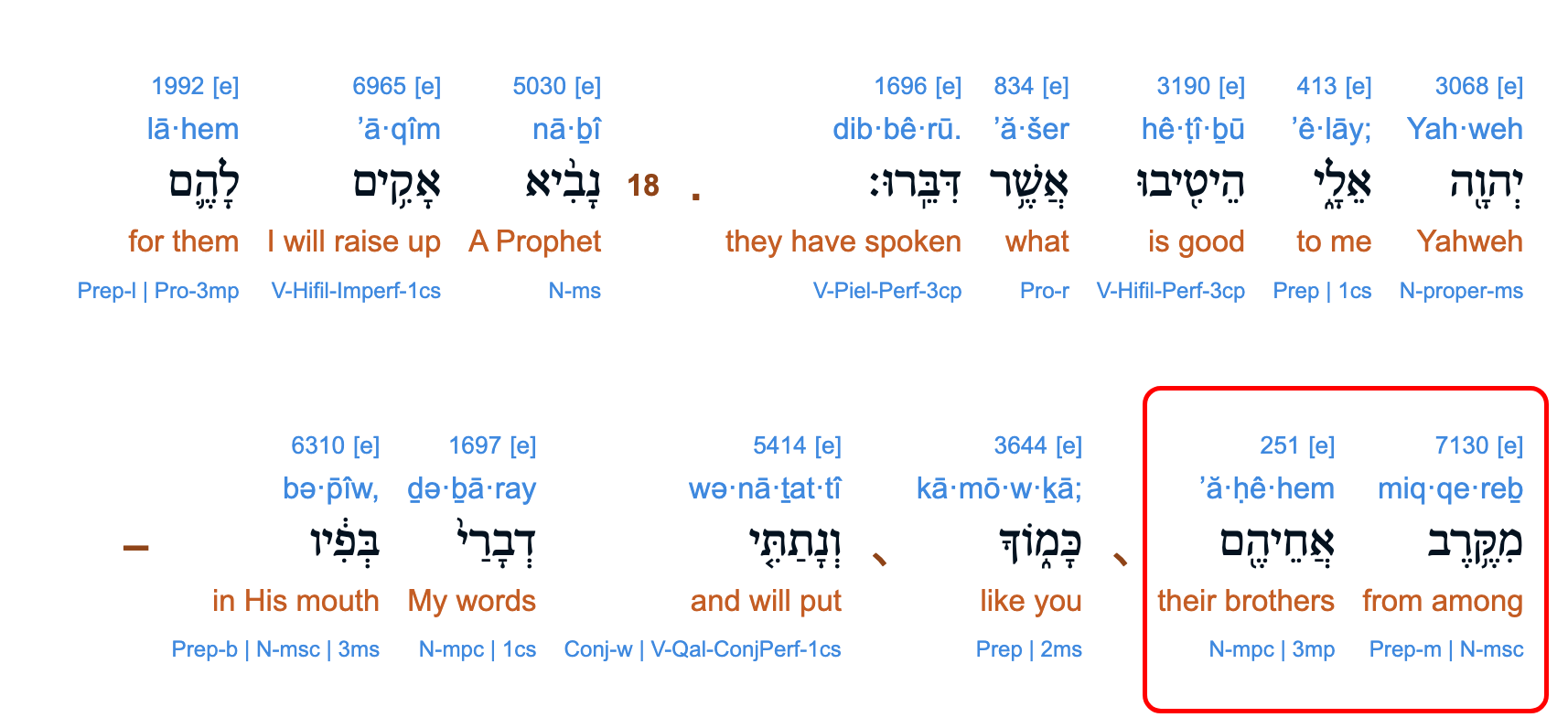
This phrase “from among their brothers like you” refers to the Ishmaelites (descendants of Ishmael), not just the Israelites (descendants of Isaac), like the distorted translations make it appear. Since the Ishmaelites are traditionally understood as the forefathers of the Arabs, Muhammad, as an Arab, would be considered one of their “brothers.”
Also, The description of God putting His words in the prophet’s mouth aligns with how the Quran was revealed to Muhammad. The Quran was revealed verbally to Muhammad through the Angel Gabriel, and Muhammad would recite exactly what he was commanded, without changing or altering the words. This is contrasted with Jesus, who spoke from His own authority at times, often prefacing His teachings with phrases like “I say to you.”
This proves that Muhammad fits the criteria described in Deuteronomy 18 better than Jesus. The similarities between Moses and Muhammad, the interpretation of “from among their brothers” as referring to the Ishmaelites, and the way the Quran was revealed to Muhammad all contribute to this interpretation.
Additional Readings:

 Quran Talk Blog
One thought on “Muhammad Prophecized in Bible”