On October 8, 2024, the YouTube channel Capturing Christianity hosted a live stream titled “Refuting the BEST Muslim Objections to the Trinity.” In response, on October 15, 2024, Dr. Khalil Andani and Dr. Steven Nemes released a video titled “Debunking the Monarchial Trinity? | A Response to @CapturingChristianity and Dr. Joshua Sijuwade.”
While both videos are worth watching in full, I want to focus on some key arguments presented by Dr. Andani and Dr. Nemes that are frequently raised in Christian-Muslim debates. My goal is to expand on these points and provide some of my own commentary. Please note that I am drawing from my memory and some light notes I jotted down while watching the videos, so I may not capture every detail perfectly. That said, I hope to share a few takeaways that I found particularly compelling, along with my reflections on these important theological discussions.
Quran Doesn’t Understand the Trinity
Capturing Christianity argued that the Quran presents a bad argument against the Trinity based on the following verse.
[5:73] Pagans indeed are those who say that GOD is a third in a trinity. There is no god except the one god. Unless they refrain from saying this, those who disbelieve among them will incur a painful retribution.
لَّقَدْ كَفَرَ ٱلَّذِينَ قَالُوٓا۟ إِنَّ ٱللَّهَ ثَالِثُ ثَلَـٰثَةٍ وَمَا مِنْ إِلَـٰهٍ إِلَّآ إِلَـٰهٌ وَٰحِدٌ وَإِن لَّمْ يَنتَهُوا۟ عَمَّا يَقُولُونَ لَيَمَسَّنَّ ٱلَّذِينَ كَفَرُوا۟ مِنْهُمْ عَذَابٌ أَلِيمٌ
| 1 | laqad | لَّقَدْ | Certainly |
| 2 | kafara | كَفَرَ | [he] disbelieved |
| 3 | alladhīna | ٱلَّذِينَ | those who |
| 4 | qālū | قَالُوٓا۟ | [they] said, |
| 5 | inna | إِنَّ | “Indeed |
| 6 | l-laha | ٱللَّهَ | God (is) |
| 7 | thālithu | ثَالِثُ | a third (of) |
| 8 | thalāthatin | ثَلَـٰثَةٍ | three / trinity.” |
The argument presented by Capturing Christianity suggested that the Quran’s critique of the Trinity may have only applied to a small, insignificant group of Christians and not to the majority Christian belief. They further claimed that the Quran fails to engage with the intricate details of the doctrine of the Trinity as established by the Ecumenical Councils.
In response, the rebuttal video explained that the Quran takes a very broad brush in addressing various forms of Trinitarian beliefs through its instruction not to say, “God is a third of three,” as stated in 5:73. This general condemnation allows the Quran to reject all variations of Trinitarian doctrines without needing to delve into the specific theological nuances crafted by councils or the multitude of sects. From its perspective, the Quran does not recognize these councils’ authority and does not need to address their specific conclusions. Instead, it focuses on confronting the beliefs held by the average Christian, which is where the theological disconnect often lies.
Although many Christian theologians deny ever professing that “God is a third of three,” their denial is often rooted in complex theological redefinitions and intricate reasoning. The Quran bypasses these elaborate rationalizations by addressing the core issue: the association of God with any kind of Trinity. Regardless of how theologians attempt to redefine or explain the doctrine, the Quran’s condemnation is aimed at the concept itself, which it views as fundamentally incompatible with monotheism.
The claim that the Quran should only engage with the specific theological understanding of the Trinity, as defined by the Ecumenical Councils, is fundamentally flawed. The Quran does not acknowledge the authority of these councils or the scholars who participated in them, and their conclusions hold no weight within its framework. The Quran’s message is intended for the masses, not just for a small group of theologians. Expecting the Quran to engage with the refined nuances of a select group of Christian scholars would be to ascribe undue legitimacy to these councils—something the Quran explicitly rejects.
Furthermore, it’s important to recognize that the vast majority of Christians, both historically and today, often struggle to grasp the complex theological definitions of the Trinity established by the councils. If most lay Christians were to attempt to explain the Trinity, their interpretations would often deviate into what the councils themselves would consider heretical. This was especially true when the Quran was first revealed, and theological understanding among the Christian populace was limited, as well as today, where the complex definitions of the Trinity are far from universally understood by ordinary Christians. This underscores the Quran’s approach: addressing the broader misconceptions and general beliefs, rather than catering to the intricate details established by a small theological elite.
The Average Christian’s Understanding of Theology in 16th Century
To illustrate this point, consider the level of theological understanding among the average Christian in the 16th century—over 800 years after the revelation of the Quran. This can be achieved by looking at the historical context surrounding Martin Luther (1483–1546) and William Tyndale (1494–1536), both famous for making the Bible and, thus, Christian theology accessible to ordinary people. Luther translated the Bible into German in 1534, while Tyndale translated the New Testament into English, first printed in 1526. Tyndale’s translation efforts were considered heretical, and he was executed in 1536, largely because translating the Bible into the vernacular was illegal in many parts of the Church at that time.
This highlights a significant reality: during this period, access to scripture was severely restricted. The Bible was available primarily in Latin, a language understood by clergy and scholars, but not by the general population. The majority of laypeople were illiterate and had no direct access to the Bible, relying entirely on the clergy to explain complex doctrines, such as the Trinity. However, this information was often communicated in a language or format that the masses could not fully grasp.
Even within the clergy itself, biblical literacy was far from uniform. Lower-ranking priests often had only rudimentary education and limited access to scripture, leading to a surface-level understanding of Church teachings, rituals, and theological doctrines. Many of them had little or no grasp of the intricate theological debates, including the finer points of Trinitarian doctrine. Higher-ranking clergy were generally better educated, but they too often relied on the Latin Vulgate and adhered strictly to Church interpretations without deep engagement with the text.
This historical context underscores how inaccessible biblical teachings were to the average Christian, even centuries after the Quran’s revelation. The understanding of key doctrines, like the Trinity, was often reduced to simple formulas or recitations that the masses memorized without a full comprehension of their theological significance. In light of this, the Quran’s broad critique of the Trinity can be understood as addressing the beliefs held by ordinary Christians, rather than engaging in the intricate theological arguments developed by a small group of scholars.
The following video, “Tyndale’s Brutal Death is NOT What You’ve Been Told,” provides great data points to show the level of theological understanding of Christians of that time.
Here are some of the slides from the video regarding this topic:
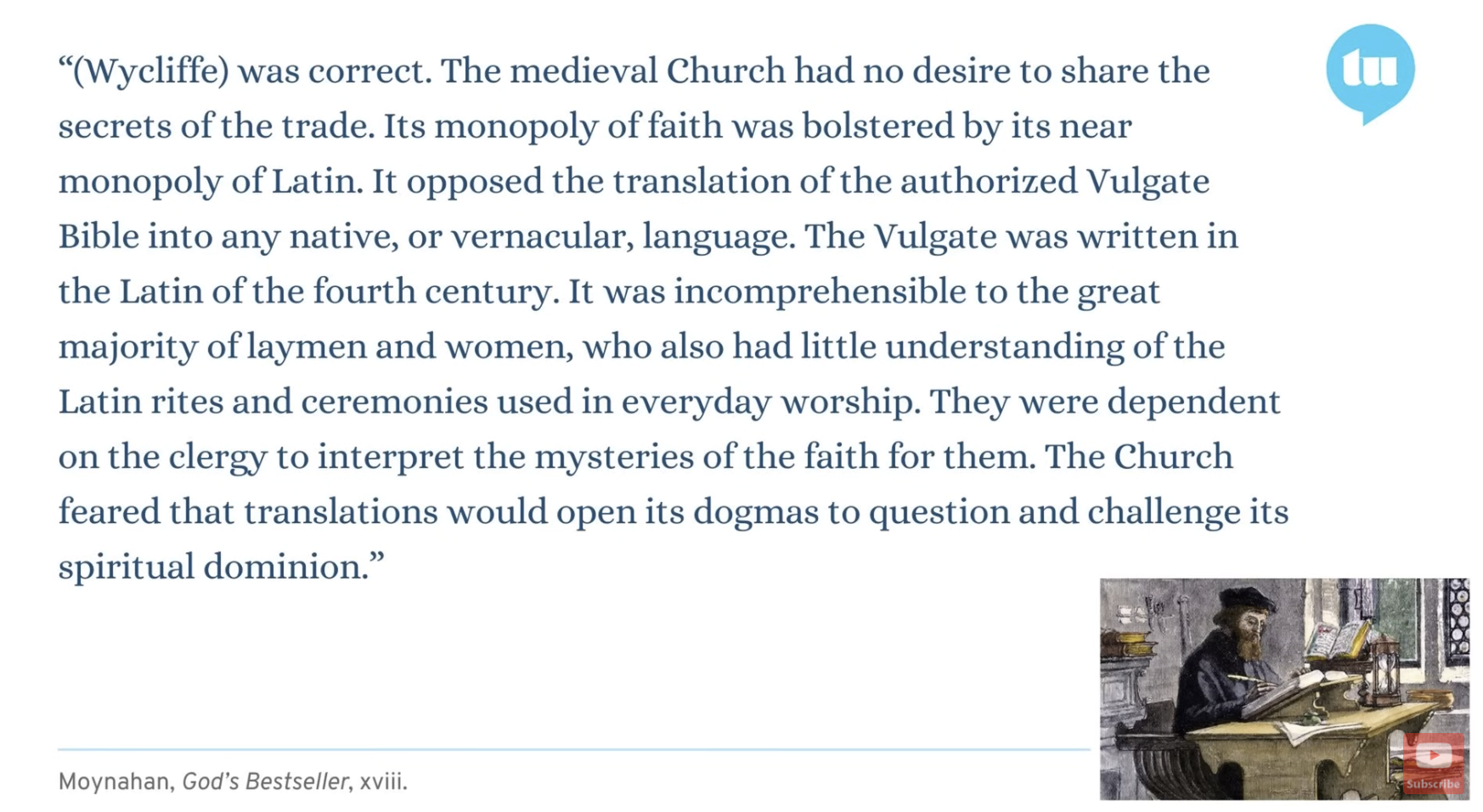
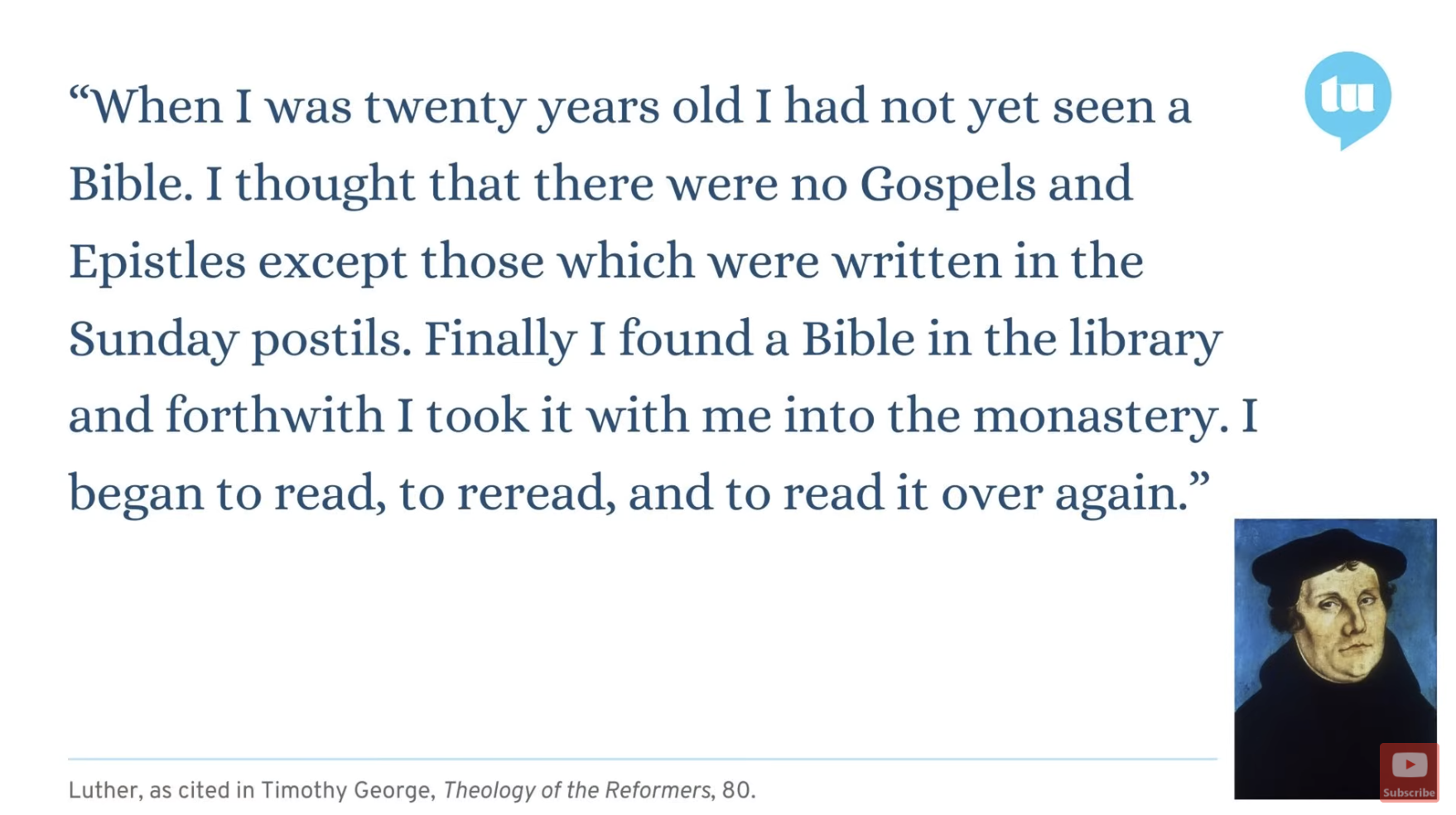
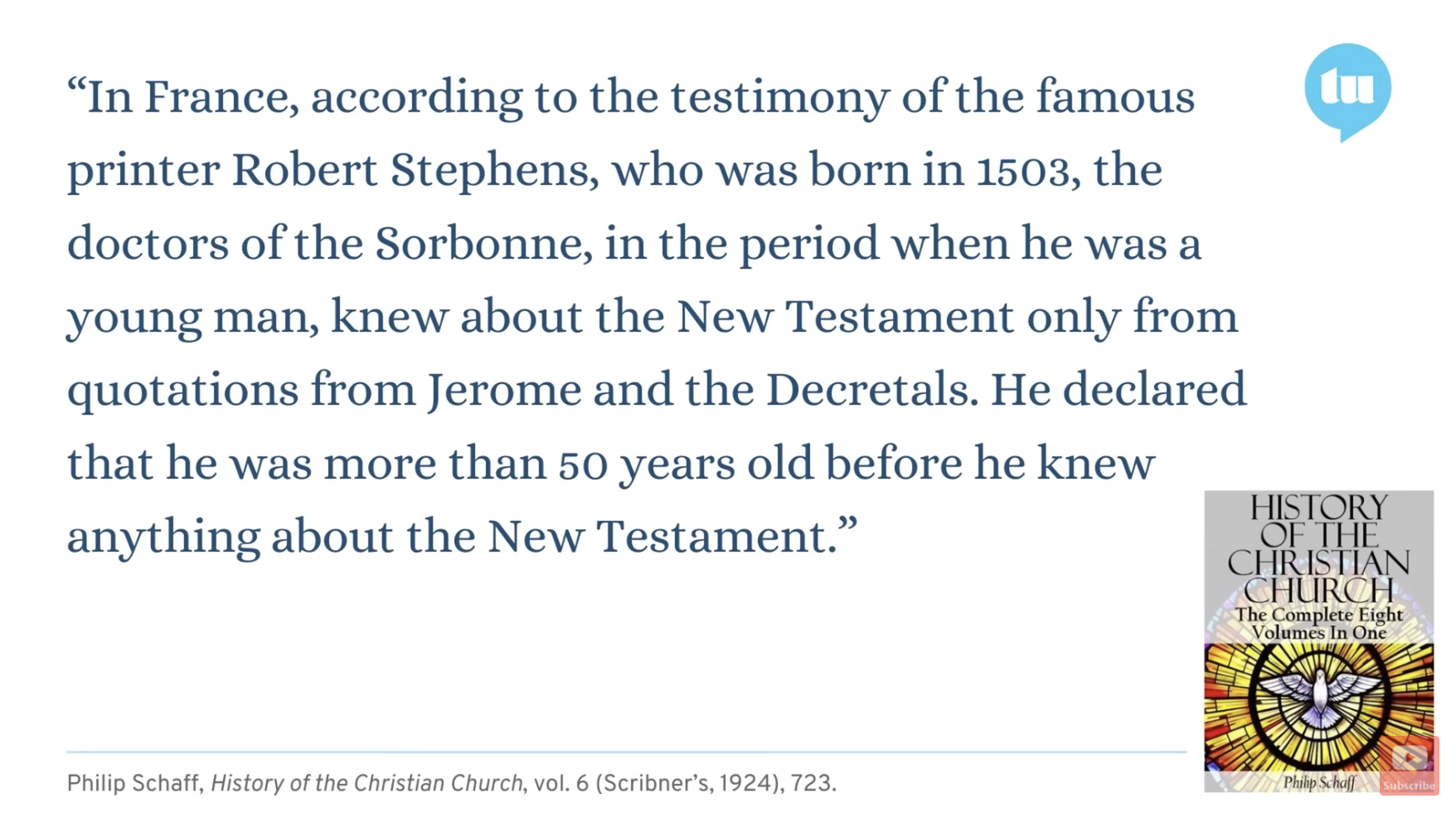
The above slides were from around the 14-minute mark of the video. At around the 15-minute mark of the video, the speaker states that during Tyndale’s life in the 1520s, a survey was conducted within his county of the 311 priests. The survey found that 9 priests didn’t know there were 10 commandments, more than half couldn’t name the 10 commandments, and 30 didn’t know that the Lord’s Prayer was decreed by Jesus. This shows that there is no question that the vast majority of ignorance of the scripture and its doctrine as late as the 16th century, even among their clergy, hundreds of years after the revelation of the Quran.
The efforts of figures like Luther and Tyndale were revolutionary because they sought to break this barrier, translating the Bible into languages the common people could understand. This democratized religious knowledge, allowing laypeople—and not just the clergy—to engage directly with scripture. Their work was central to the Reformation, which challenged the Catholic Church’s authority and sought a return to the foundational texts of Christianity.
The Quran’s critique, then, is not directed at the nuanced theological definitions crafted by ecumenical councils, but rather at the general understanding of Christians who had little access to the Bible or theological education. The majority of Christians in the 16th century—and even earlier—would have struggled to articulate or fully comprehend the doctrine of the Trinity, especially given that many had no direct interaction with scripture in a language they understood. The Quran’s rejection of Trinitarian beliefs is aimed at this widespread misunderstanding and oversimplification of Christian doctrines.
This disconnect between theological elites and the average believer is crucial for understanding why the Quran does not need to engage with the specific definitions of the Trinity developed by the councils. Instead, it addresses the general Christian populace, whose understanding of the Trinity often deviated from the sophisticated theological formulations debated by scholars. This reality was evident in the centuries following the Quran’s revelation and persisted into the Reformation period, as demonstrated by figures like Luther and Tyndale. The masses were taught basic religious formulas without delving into the intricate theology behind them, which aligns with the Quran’s broad rejection of associating partners with God.
Modern Christians Don’t Understand Trinity
The 2020 State of Theology study by Lifeway Research, sponsored by Ligonier Ministries, reveals that many Americans hold complex and sometimes contradictory religious beliefs. More than half (54%) view theology as a matter of personal opinion rather than objective truth. While a majority of Americans (72%) affirm belief in the Trinity, many misunderstand key aspects of it—such as believing that Jesus was merely a human teacher or that the Holy Spirit is a force rather than a person.

“Many Americans treat theology like a choose-your-own adventure book,” said Scott McConnell, executive director of Lifeway Research. This sentiment reflects a growing trend where many Americans see truth as something they are free to define individually, leading to seemingly contradictory beliefs. For example, despite 72% claiming to adhere to the Trinity doctrine, only 52% agree that Jesus was a great teacher but not God, and slightly more than half (55%) believe Jesus was the first and greatest being created by God—an idea that contradicts the historical Christian belief in Jesus’ eternal divinity as God the Son.
Despite this rejection of Jesus’ deity, most still affirm the biblical account of His resurrection, with two-thirds (66%) believing that Jesus physically rose from the dead, which is still less than the 72% who affirmed the Trinity. In terms of the Holy Spirit, three in five (59%) view the Spirit as a force rather than a personal being, and 19% even believe that the Holy Spirit can instruct someone to act against what is written in the Bible.
Additionally, the study reveals that very few (15%) think that learning about theology is only the responsibility of pastors and scholars, indicating that many feel personally empowered to explore and define their own beliefs, even when those beliefs are at odds with traditional Christian teachings.
Why didn’t Jesus just say that God is three or that He is God?
During the Capturing Christianity stream, they took questions from viewers, and one viewer asked, “Why didn’t Jesus just say that God is three or that he is God?” The response to this question was revealing. They argued that such a direct revelation would have been too overwhelming for Jesus’ contemporaries, so he spoke in coded terms, leaving later generations to piece together the doctrine of the Trinity.
However, the rebuttal video pointed out a contradiction in their argument. In the same talk, Dr. Joshua Sijuwade explained that the term “God” can either refer to the Father or the Triune God and that understanding this simplifies the concept of the Trinity. First, they identified how such a statement sounds a lot like stating that God is three like it is stated in Quran 5:73. Secondly, they argued that if it’s so simple, then why didn’t Jesus explain it that way in the New Testament? Why didn’t he explicitly say there are three powers in Heaven, or that God is triune, or that God, Jesus, and the Holy Spirit are of the same substance, co-eternal, and co-equal? These straightforward one-liners would have made it clear that Jesus was teaching a triune God, yet none of these explicit statements are found in the New Testament.
This contradiction raises a crucial question: if the concept of the Trinity is as central and essential to understanding God, why was it not explicitly stated by Jesus during his ministry? If, as Dr. Sijuwade suggests, the notion that “God” can refer to either the Father or the Triune God simplifies things, then Jesus could have easily clarified this foundational doctrine with a few clear statements. Yet, instead of making such direct claims, Jesus’ teachings in the New Testament leave the concept of the Trinity to be inferred through later theological interpretations. This absence of explicit Trinitarian language in Jesus’ words suggests either that the doctrine was not part of his core message or that the audience was never intended to understand God as triune during his time. This lack of clarity contrasts with the simplicity claimed by proponents of the doctrine today, and it leaves a gap between what Jesus directly taught and what later generations concluded.
The Johannine Comma
Dr. Nemes called out something that is often overlooked. These are passages that Christians frequently attempt to utilize in the Bible, which are ascribed to Jesus, to justify a Trinity where God, Jesus, and the Holy Spirit are mentioned together. The first is from 1 John 5:7-8, known as the Johannine Comma (1 John 5:7-8), found in the King James Version but removed in more accurate translations. However, it is not present in any Greek manuscript before the 14th century and is believed to have been a later addition.
For there are three that bear record in heaven, the Father, the Word, and the Holy Ghost: and these three are one. – King James Translation
For there are three that testify: the Spirit and the water and the blood, and the three are in agreement. – Most other translations
In the book Misquoting Jesus, by Bart Ehrman, page 81, he writes the following about the Johannine Comma and shows that in the earliest manuscripts, which are in Greek, do not contain what is found in the King James Translation.
There was one key passage of scripture that Erasmus’s source manuscripts did not contain, however. This is the account of i John 5:7-8, which scholars have called the Johannine Comma, found in the manuscripts of the Latin Vulgate but not in the vast majority of Greek manuscripts, a passage that had long been a favorite among Christian theologians, since it is the only passage in the entire Bible that explicitly delineates the doctrine of the Trinity, that there are three persons in the godhead, but that the three all constitute just one God. In the Vulgate, the passage reads:
There are three that bear witness in heaven: the Father, the Word, and the Spirit, and these three are one; and there are three that bear witness on earth, the Spirit, the water, and the blood, and these three are one.
It is a mysterious passage, but unequivocal in its support of the traditional teachings of the church on the “triune God who is one.” Without this verse, the doctrine of the Trinity must be inferred from a range of passages combined to show that Christ is God, as is the Spirit and the Father, and that there is, nonetheless, only one God. This passage, in contrast, states the doctrine directly and succinctly.
Father, Son, Holy Spirit
In the New Testament, aside from 1 John 5:7-8, there are several instances where the Father, Son, and Holy Spirit are mentioned together. Many Christians use these references to support the doctrine of the Trinity. However, as Dr. Nemes points out, there is a vast chasm between acknowledging the existence of these three entities and asserting that they form a triune Godhead—one that is co-equal, co-eternal, and co-substantial.
For instance, in Matthew 28:19, Jesus instructs his disciples to baptize in the name of the Father, the Son, and the Holy Spirit. The verse reads:
“Go therefore and make disciples of all nations, baptizing them in the name of the Father and of the Son and of the Holy Spirit.”
This passage, often referred to as the Great Commission, is frequently cited as evidence for the Trinity. However, it only mentions these three entities and does not elaborate on their relationship. It simply instructs that baptism be performed in their names, without explaining whether these three entities are of the same substance, share equality, or coexist eternally—key components needed to establish the doctrine of the Trinity.
Similarly, other passages such as 2 Corinthians 13:14 (the “Apostolic Benediction”), 1 Peter 1:2, Ephesians 4:4-6, and John 14:16-17 mention the Father, Son, and Holy Spirit together. Yet, none of these verses explicitly define their relationship as one of co-equality or shared divinity. They acknowledge the existence of the three entities but fall short of constructing the theological framework required for the Trinity.
The absence of explicit Trinitarian language is significant. If the concept of the Trinity—that God is three persons in one essence—was central to Jesus’ message or early Christian understanding, we might expect clearer, direct statements affirming this doctrine in the New Testament. Instead, the relationship between the Father, Son, and Holy Spirit is left open to interpretation. For example, in John 14:28, Jesus says, “The Father is greater than I,” which raises further questions about the idea of co-equality among the three entities.
Moreover, the development of Trinitarian doctrine took several centuries, emerging as formalized theology at the Council of Nicaea in 325 CE and the Council of Constantinople in 381 CE. These councils were convened specifically to address disputes about the nature of Christ and the Godhead. The very need for these councils suggests that the doctrine was not universally understood or accepted in the early Christian community.
Furthermore, the biblical passages often cited in support of the Trinity do not contain the language of “co-eternality” or “co-substantiality”—terms essential to the orthodox understanding of the Trinity. These concepts were developed through philosophical and theological reflection after the New Testament was written, indicating that the Bible alone does not provide a full Trinitarian doctrine.
So, while the New Testament mentions the Father, Son, and Holy Spirit together in several instances, these references do not amount to a definitive argument for the Trinity. The theological claims of co-equality, co-eternality, and co-substantiality are later developments in Christian thought, not explicitly stated in the New Testament itself. This gap between the biblical text and later doctrinal formulations shows that the Trinity was not part of the original Christian message and only a later theological construction.
Mary Worship
Another passage that the Capturing Christianity team brought up from the Quran was the following from Sura 5, The Feast (Al-Mã’edah), where Jesus is questioned on the Day of Judgment regarding his time here on earth.
[5:116] GOD will say, “O Jesus, son of Mary, did you say to the people, ‘Make me and my mother idols beside GOD’?” He will say, “Be You glorified. I could not utter what was not right. Had I said it, You already would have known it. You know my thoughts, and I do not know Your thoughts. You know all the secrets.
وَإِذْ قَالَ ٱللَّهُ يَـٰعِيسَى ٱبْنَ مَرْيَمَ ءَأَنتَ قُلْتَ لِلنَّاسِ ٱتَّخِذُونِى وَأُمِّىَ إِلَـٰهَيْنِ مِن دُونِ ٱللَّهِ قَالَ سُبْحَـٰنَكَ مَا يَكُونُ لِىٓ أَنْ أَقُولَ مَا لَيْسَ لِى بِحَقٍّ إِن كُنتُ قُلْتُهُۥ فَقَدْ عَلِمْتَهُۥ تَعْلَمُ مَا فِى نَفْسِى وَلَآ أَعْلَمُ مَا فِى نَفْسِكَ إِنَّكَ أَنتَ عَلَّـٰمُ ٱلْغُيُوبِ
Capturing Christianity criticized the Quran, claiming it misunderstands the Trinity by suggesting that Mary was part of the Godhead. They argue that since Mary is not considered part of the Trinity in Christian theology, the Quran misrepresents the doctrine and fails to grasp the true Christian understanding of the Trinity.
However, what the Capturing Christianity team fails to recognize is that the Quran’s concept of idolatry is much more nuanced than simply labeling someone or something as “God.” The Quran often addresses forms of idolatry that are subtle, where people elevate others to positions that rival God, even if they do not explicitly call them gods.
Below is a list of different idols that people make according to the Quran. What makes them idols is not limited to directly ritualistically worshiping another deity but also extends to the ways in which people treat, prioritize, and revere entities in relation to God. This broader understanding of idolatry encompasses behaviors where people give undue authority, devotion, or obedience to others besides God, effectively making them idols.
- Statues (2:51, 21:51-53)
- Jesus (5:72)
- Mary (5:116)
- Jinns (6:100)
- Children (7:190)
- Humans/creatures (7:194)
- Intercessors (10:18)
- Satan (14:22, 16:100, 36:60)
- Property (18:32-36, 18:42)
- Provisions (68:17-32)
- Prophets/messengers/saints (16:20-21, 3:79)
- Ego (25:43, 45:23)
- Upholding religious sources besides God’s revelation (6:19)
- Religious leaders and scholars (9:31)
- Secetarianism (30:31-32)
- Dividing believers and giving comfort to enemies of God (9:107)
This nuanced view is particularly important when considering the Quran’s treatment of figures like Mary. The Quran does not necessarily accuse Christians of declaring Mary to be part of the divine Trinity in an explicit sense, but it critiques the excessive reverence and veneration that elevates her status in a way that competes with God’s unique position. In some Christian traditions, Mary is honored with titles such as “Mother of God” and “Queen of Heaven,” and although she is not officially considered a part of the Godhead, such reverence elevates her status to a level that compromises strict monotheism. The Quran warns against this kind of excessive devotion, even when it does not involve a direct claim of divinity.
The Quran’s critique can be seen as a cautionary message against the dangers of over-exalting any figure, whether prophets, saints, or other revered individuals, to a point where they are treated as intermediaries or objects of worship, thus detracting from the sole worship of God. This broad understanding of idolatry also applies to other forms of human behavior, where individuals or concepts—such as wealth, power, or tradition—can become idols when people prioritize them over their relationship with God.
Furthermore, the Quran emphasizes that anything or anyone given the status of absolute loyalty or devotion in a way that competes with God can become a form of shirk (associating partners with God). Therefore, the Quran’s critique is not a misunderstanding of the Trinity but a broader theological concern about the elevation of any figure, including Mary, to a level that compromises pure monotheism. Yet, many Christians have taken the reverence for Mary even further, venerating statues and images of her as holy.
Additionally, Catholics attribute divine-like qualities to Mary, most notably the belief that she can simultaneously hear and respond to millions of individuals calling upon her in various languages, both publicly and privately, across the world at any given moment. By ascribing such godlike powers to Mary, Catholics, who make up the majority of the Christian population today, have elevated her to a status that signifies a god beside God. While they may not explicitly declare her as a deity, their actions and theology suggest otherwise.
Capturing Christianity’s claim that the Quran misunderstands the Trinity overlooks the Quran’s more comprehensive view of idolatry. The Quran’s warnings are about any form of idolatry, where excessive devotion to figures like Mary can blur the lines between honoring someone and elevating them to a near-divine status. It is not necessarily a critique of Christian theology as it is formally understood but a caution against the kinds of reverence that might challenge God’s unique authority.
The Nestorian Controversy
In the context of Mary worship, it is worth taking a quick look at what is known as the Nestorian controversy. This controversy, which arose in the 5th century, revolves around the debate over the nature of Christ and, by extension, the role of Mary in Christian theology. This theological dispute offers a crucial historical context for understanding why the Quran critiques certain Christian practices and beliefs surrounding Mary, even if she was never officially considered part of the Trinity.
The controversy began when Nestorius, the Patriarch of Constantinople, challenged the popular title for Mary, Theotokos, meaning “God-bearer” or “Mother of God.” Nestorius argued that calling Mary Theotokos was inappropriate because it implied that she gave birth to the divine nature of Jesus, thus potentially confusing Jesus’ humanity and divinity. Nestorius instead proposed the title Christotokos, or “Mother of Christ,” emphasizing that Mary gave birth to Jesus in his human form, not as the eternal divine Logos (the Word of God).
This debate wasn’t just about semantics but touched on fundamental questions of how Christ’s divine and human natures coexisted. Nestorius and his supporters believed that emphasizing Mary as the “Mother of God” blurred the distinction between Christ’s divinity and humanity, risking a form of idolatry by ascribing divine qualities to Mary through her role as mother. On the other hand, the prevailing theological view, supported by the Alexandrian Church and later formalized by the Council of Ephesus in 431 CE, declared that Mary could rightfully be called the blasphemous title of Theotokos, “God-bearer,” or “Mother of God.” They argued that since Jesus was fully God and fully human from the moment of conception, it was fitting to call Mary the “Mother of God.”
The declaration of Mary as Theotokos solidified her role as an exalted figure within Christian devotion. While this title emphasized Christ’s divinity, it also elevated Mary to an unparalleled level of reverence within certain Christian traditions. Although officially, she was not considered divine or part of the Trinity, her veneration grew to the point where, for many, her intercessory role and exalted status in heaven became central to Christian piety. Over time, some Christians began to offer prayers to Mary, viewing her as a powerful intercessor with God.
This elevation of Mary, even without the formal declaration of divinity, effectively places her in a position that rivals or competes with God’s unique role, especially within the framework of strict monotheism like that found in Islam. The Quran critiques this kind of excessive devotion, seeing it as a form of idolatry, even if Mary was not explicitly worshipped in the same way that Jesus was worshiped. By elevating her to the level of “Mother of God,” they were conflating her role with that of the divine and insinuating that Jesus was God and that God had a mother.
[112:1] Proclaim, “He is the One and only GOD.
[112:2] “The Absolute GOD.
[112:3] “Never did He beget. Nor was He begotten.
[112:4] “None equals Him.”
(١) قُلْ هُوَ ٱللَّهُ أَحَدٌ
(٢) ٱللَّهُ ٱلصَّمَدُ
(٣) لَمْ يَلِدْ وَلَمْ يُولَدْ
(٤) وَلَمْ يَكُن لَّهُۥ كُفُوًا أَحَدٌۢ
Final Thoughts Regarding the Deifying of Mary
The Nestorian controversy helps shed light on the Quran’s broader theological critique of the veneration of Mary. While Nestorius himself argued against the elevation of Mary to a status that blurred the line between human and divine, the victorious side in the controversy not only upheld her title as Theotokos but further contributed to her veneration in popular Christian piety.
So, while some have criticized verse 5:116 as a misunderstanding of Christian theology, understanding the historical context clarifies that the Quran is addressing the de facto elevation of Mary through titles like Theotokos and the devotion shown to her, which, from the Quran’s perspective, borders on or constitutes idolatry. The Quran’s concern is not limited to whether Christians formally included Mary in the Trinity but extends to the practical effects of elevating her status to divine levels.
The Nestorian controversy illustrates the tensions within early Christianity over how to understand Christ’s nature and the role of Mary. Even within Christian circles, there were concerns, like those raised by Nestorius, that elevating Mary too highly would lead to theological confusion or even idolatry. The resolution of the controversy in favor of Theotokos only deepened her role in Christian devotion, making it understandable why the Quran would critique this practice, even if it does not directly accuse Christians of officially including her in the Godhead.
The Quran’s broader understanding of idolatry, as mentioned earlier, sees any figure or entity that is given undue reverence or authority in competition with God as a potential form of shirk (associating partners with God). The title Theotokos, while theologically justifiable in certain Christian doctrines, could be seen from the Quran’s perspective as contributing to such a distortion of true monotheism, especially given the devotional practices that followed in later centuries.
The Nestorian controversy and the prevailing view that Mary was the Theotokos explain why the Quran offers a critique of Christian views on Mary. The Quran’s concern is not merely theological but also practical, addressing how religious figures like Mary have become objects of excessive devotion and reverence, thereby compromising the worship of God alone. This broader view of idolatry explains why the Quran’s critique remains relevant, even if Mary was never officially considered divine within mainstream Christian doctrine.
Quran’s Address to Those Who Claim Jesus Is God
The Quran acknowledges that some claim that Jesus is God, and the Quran labels such people as pagans (kafr).
[5:72] Pagans indeed are those who say that GOD is the Messiah, son of Mary. The Messiah himself said, “O Children of Israel, you shall worship GOD; my Lord and your Lord.” Anyone who sets up any idol beside GOD, GOD has forbidden Paradise for him, and his destiny is Hell. The wicked have no helpers.
لَقَدْ كَفَرَ ٱلَّذِينَ قَالُوٓا۟ إِنَّ ٱللَّهَ هُوَ ٱلْمَسِيحُ ٱبْنُ مَرْيَمَ وَقَالَ ٱلْمَسِيحُ يَـٰبَنِىٓ إِسْرَٰٓءِيلَ ٱعْبُدُوا۟ ٱللَّهَ رَبِّى وَرَبَّكُمْ إِنَّهُۥ مَن يُشْرِكْ بِٱللَّهِ فَقَدْ حَرَّمَ ٱللَّهُ عَلَيْهِ ٱلْجَنَّةَ وَمَأْوَىٰهُ ٱلنَّارُ وَمَا لِلظَّـٰلِمِينَ مِنْ أَنصَارٍ
[5:73] Pagans indeed are those who say that GOD is a third in a trinity. There is no god except the one god. Unless they refrain from saying this, those who disbelieve among them will incur a painful retribution.
لَّقَدْ كَفَرَ ٱلَّذِينَ قَالُوٓا۟ إِنَّ ٱللَّهَ ثَالِثُ ثَلَـٰثَةٍ وَمَا مِنْ إِلَـٰهٍ إِلَّآ إِلَـٰهٌ وَٰحِدٌ وَإِن لَّمْ يَنتَهُوا۟ عَمَّا يَقُولُونَ لَيَمَسَّنَّ ٱلَّذِينَ كَفَرُوا۟ مِنْهُمْ عَذَابٌ أَلِيمٌ
[5:74] Would they not repent to GOD, and ask His forgiveness? GOD is Forgiver, Most Merciful.
أَفَلَا يَتُوبُونَ إِلَى ٱللَّهِ وَيَسْتَغْفِرُونَهُۥ وَٱللَّهُ غَفُورٌ رَّحِيمٌ
[5:75] The Messiah, son of Mary, is no more than a messenger like the messengers before him, and his mother was a saint. Both of them used to eat the food. Note how we explain the revelations for them, and note how they still deviate!
مَّا ٱلْمَسِيحُ ٱبْنُ مَرْيَمَ إِلَّا رَسُولٌ قَدْ خَلَتْ مِن قَبْلِهِ ٱلرُّسُلُ وَأُمُّهُۥ صِدِّيقَةٌ كَانَا يَأْكُلَانِ ٱلطَّعَامَ ٱنظُرْ كَيْفَ نُبَيِّنُ لَهُمُ ٱلْـَٔايَـٰتِ ثُمَّ ٱنظُرْ أَنَّىٰ يُؤْفَكُونَ
[5:76] Say, “Would you worship beside GOD powerless idols who can neither harm you, nor benefit you? GOD is Hearer, Omniscient.”
قُلْ أَتَعْبُدُونَ مِن دُونِ ٱللَّهِ مَا لَا يَمْلِكُ لَكُمْ ضَرًّا وَلَا نَفْعًا وَٱللَّهُ هُوَ ٱلسَّمِيعُ ٱلْعَلِيمُ
[5:77] Say, “O people of the scripture, do not transgress the limits of your religion beyond the truth, and do not follow the opinions of people who have gone astray, and have misled multitudes of people; they are far astray from the right path.”
قُلْ يَـٰٓأَهْلَ ٱلْكِتَـٰبِ لَا تَغْلُوا۟ فِى دِينِكُمْ غَيْرَ ٱلْحَقِّ وَلَا تَتَّبِعُوٓا۟ أَهْوَآءَ قَوْمٍ قَدْ ضَلُّوا۟ مِن قَبْلُ وَأَضَلُّوا۟ كَثِيرًا وَضَلُّوا۟ عَن سَوَآءِ ٱلسَّبِيلِ
The Quran then provides the argument that Jesus is powerless and cannot harm or benefit anyone, even himself (7:188). Jesus also confirms this in the Gospels, indicating that he had no authority of his own. Jesus makes several statements in the New Testament that indicate he cannot act out of his own will but instead follows the will of God, the Father. These statements emphasize his role as a servant and messenger, aligning his actions entirely with God’s will.
“I can of Myself do nothing. As I hear, I judge; and My judgment is righteous, because I do not seek My own will but the will of the Father who sent Me.” (John 5:30)
In this verse, Jesus explicitly states that he does nothing on his own and that his actions are guided by the will of the Father. This statement underscores his complete submission to God’s authority, emphasizing that his judgments and actions are not independent but are in accordance with God’s guidance.
“For I have come down from heaven, not to do My own will, but the will of Him who sent Me.” (John 6:38)
Here, Jesus makes it clear that his purpose is not to fulfill his own desires or act independently but to carry out the will of God, the one who sent him. This highlights his role as a messenger of God and reinforces his obedience to God’s will.
“Then Jesus said to them, ‘When you lift up the Son of Man, then you will know that I am He, and that I do nothing of Myself; but as My Father taught Me, I speak these things.'” (John 8:28)
In this verse, Jesus emphasizes that he does nothing on his own authority but speaks and acts according to what God has taught him. This further illustrates his dependency on God’s direction in everything he does.
“For I have not spoken on My own authority; but the Father who sent Me gave Me a command, what I should say and what I should speak. And I know that His command is everlasting life. Therefore, whatever I speak, just as the Father has told Me, so I speak.” (John 12:49-50)
Jesus here confirms that he does not speak on his own authority but communicates the commands of God, the Father. His teachings are thus portrayed as a direct transmission of God’s will, not originating from himself.
In these verses, Jesus consistently indicates that he is not acting out of his own independent will but rather is following the will of God. These statements underscore Jesus’ role as a messenger and servant of God, highlighting his submission and obedience to the divine authority of the Father. This portrayal aligns with the broader theological concept that Jesus’ mission on Earth was to fulfill God’s plan and not to act autonomously.

 Quran Talk Blog
The only being that the Quran recognizes as “God” in the Bible is “the father”. So the Quran is quite right when it says that the Christians say God (= “the father”) is one of three.
I don’t see it as the Quran getting the trinity wrong, I see it as the Quran doubling down on the fact that the being called “the father” in the New Testament is the only one that can be referred to as “God”. Thus, when Christians say “the father” is part of three, they are saying God is part of three. Again, because “the father” is the only entity the Quran considers as being God.
LikeLike
Wonderful blog. As a former catholic and current Submitter, it is my opinion that you can try to convince a christian to convert using great arguments as included in this article, but christians do whatever they want no matter what you tell them. As the author pointed out in his Moral Event Horizon YouTube video, christians place all their emphasis on beliefs and nothing on actions. They are not going to stop eating pork, drinking alcohol, or fast during Ramadan to avoid hell because they think Jesus will intercede on their behalf.
LikeLike