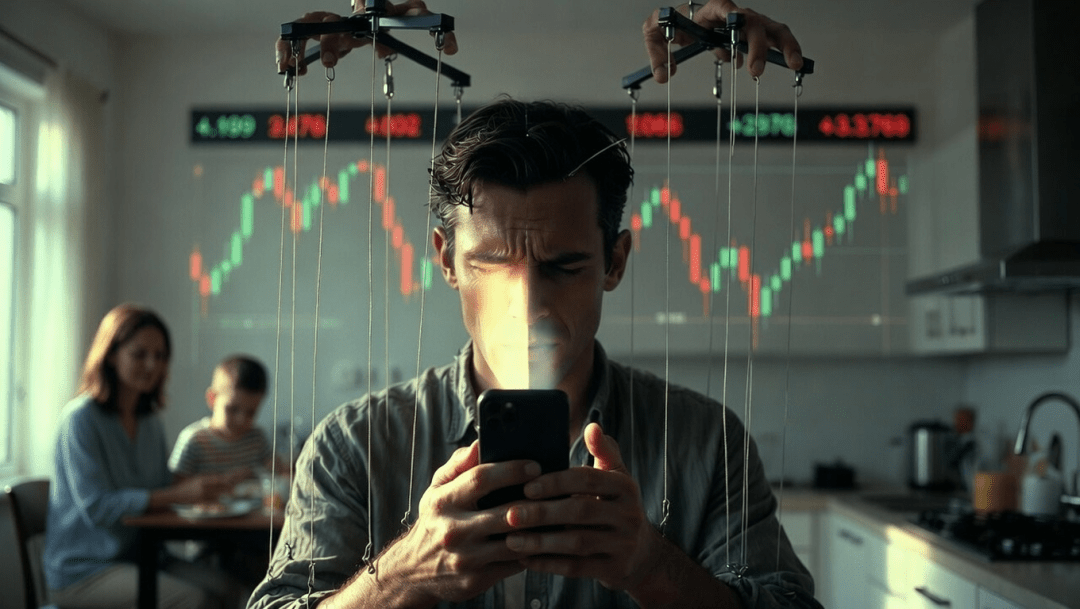
Here is a man you probably know. Every morning, before he has spoken to his family, before he has eaten, before he has done a single thing that is actually within his control, he reaches for his phone and checks the market. If the numbers are green, he will be in a good mood today. If they are red, he will be irritable at breakfast, distracted in meetings, and quietly miserable until the closing bell rescues him or doesn’t. He did not decide to be this way. It simply happened, gradually, through the accumulation of days in which he confused watching prices move with having a stake in something real. He has, without quite realizing it, delegated the management of his inner life to a ticker.
He is not unusual. Consider the sports fan who, by Sunday evening, is either jubilant or genuinely bereaved based on twenty-two men he has never met executing a game plan on his behalf. The team wins: the week begins well. The team loses: the week is ruined, and Monday morning meetings happen in the shadow of it. He would be the first to tell you that this is slightly absurd. He knows it, somewhere. He keeps watching anyway, because the absurdity is invisible when you are inside it.
Both of these men are, technically speaking, free. Nobody is forcing them to check the ticker. Nobody is compelling their emotional response to the final score. They live in open societies with formal liberties, disposable income, and the full range of options modern life provides. And yet something has them. Not a law, not a tyrant, not a visible chain—but something. Their emotional states are not their own. They have been leased out, involuntarily, to external mechanisms that have no knowledge of them and no care for them whatsoever.
The previous essay in this series called that kind of captivity the subtlest form available. Qãroon was not imprisoned by anyone. He was imprisoned by his own treasury—by the project of accumulation he could no longer separate from himself. The market-watcher and the sports fan have done something structurally identical: they have tied their inner weather to external conditions, and called the arrangement living. It is not freedom. It is just a more comfortable cage, upholstered in leisure and delivered without drama.
Parts One and Two of this series mapped two axes of freedom. The first was discipline freedom: the capacity to override appetite, to look at what your biology is demanding and say not today—what Ramadan encodes into community practice and what the hunger striker enacts at its most dramatic extreme. The second was independence freedom: the Diogenes clearing, the Moses posture at the well, the genuine discovery that most of what the world calls indispensable is not, and that holding your possessions with open hands rather than clenched fists is actually the more stable arrangement.
This essay is about the third axis. Call it expectation freedom: the cultivated ability to aim high, act fully, and then release the outcome to the One who actually knows what the outcome means.
Fighting may be imposed on you, even though you dislike it. But you may dislike something which is good for you, and you may like something which is bad for you. GOD knows while you do not know. — Quran 2:216
Seven words at the end of that verse do more work than any self-help library assembled in the last century: GOD knows while you do not know. This is not merely a theological claim. It is an epistemological one. And it raises an uncomfortable question for the market-watcher and the sports fan alike: if you genuinely cannot know whether a given outcome is good or bad for you, what exactly are you celebrating? What, precisely, are you mourning?
The Philosopher Who Refused to Be Disturbed
Around the fourth century BCE, a Greek philosopher named Pyrrho of Elis sailed to India with Alexander’s army and came back a changed man. What changed him, the ancient sources suggest, was his encounter with certain Indian ascetics—men who had apparently achieved an enviable serenity through the radical practice of not committing to definitive judgments about the things that happened to them. Pyrrho took this home and built a philosophical school around the insight.
His central claim was unsettling in its simplicity: we cannot, with confidence, determine the true nature of things. Not because the world is unknowable in principle, but because our perceptions and judgments are systematically unreliable in ways we rarely acknowledge. The same honey is sweet to the healthy tongue and bitter to the sick one. The same sun is pleasant to the pedestrian and blinding to the sailor. The same outcome that looks like a catastrophe today may look, with time and distance, like the necessary precondition for something good. We judge from inside our own limited vantage point, with incomplete information, using instruments—our desires, our fears, our expectations—that are not exactly precision-calibrated.
Pyrrho’s response to this predicament was epoché: a suspension of judgment. Not cynical relativism, not the lazy shrug of someone who has given up thinking. A disciplined refusal to affix permanent evaluations—this is good, this is bad, this is a disaster, this is a windfall—to events whose full meaning we cannot yet, and perhaps never will, see clearly.
The result, his followers claimed, was ataraxia: that untranslatable Greek word for a settled, undisturbed tranquility. Not the forced calm of someone white-knuckling their emotions, but the natural peace of someone who has genuinely stopped handing their emotional sovereignty over to events outside their control. This is precisely what the market-watcher has lost without knowing it. Not his money—that fluctuates—but his sovereignty. The ticker is running him. Pyrrho would have recognized this immediately as the defining condition of the unfree person: not someone in chains, but someone who has installed an external arbiter where their own judgment should be.
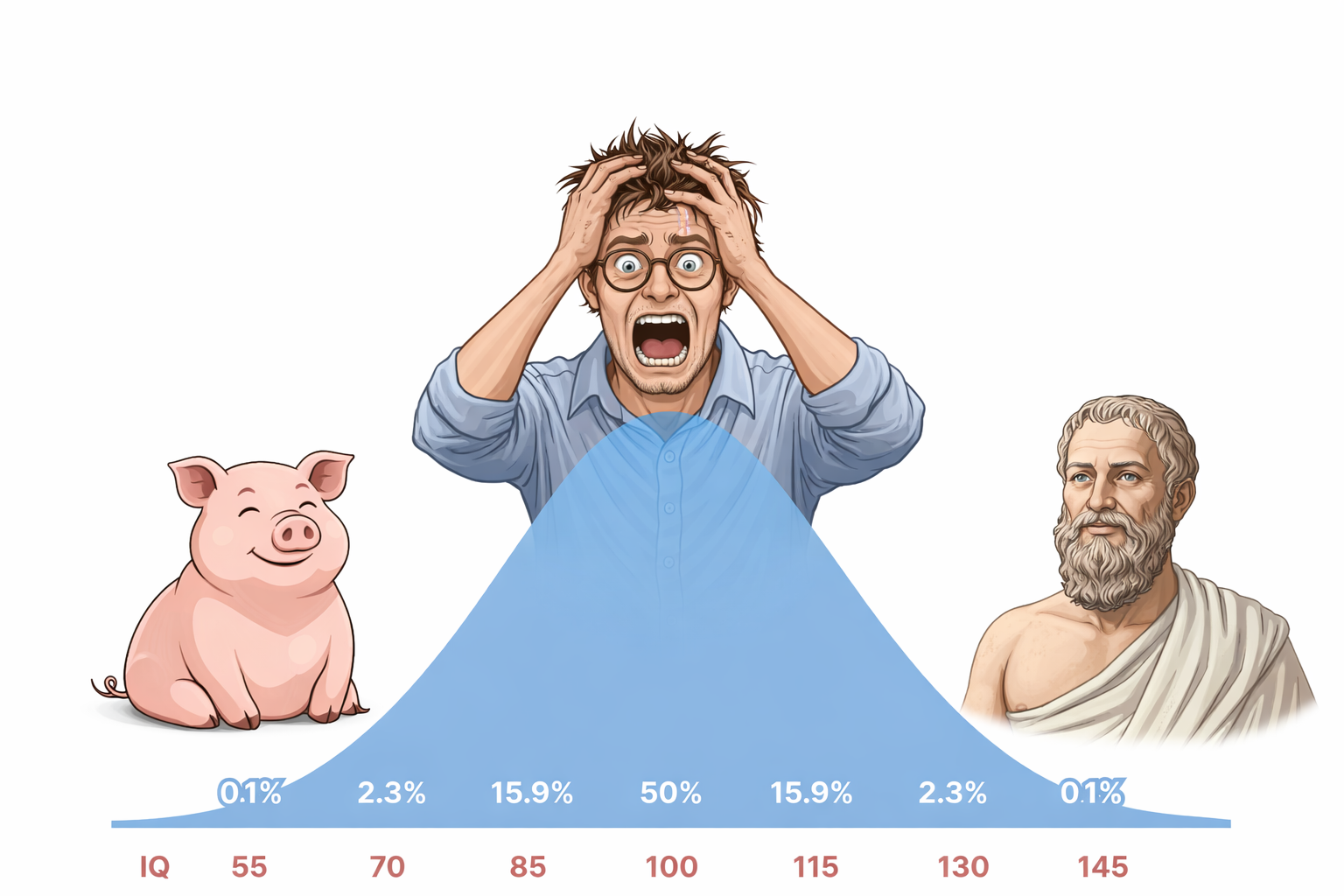
Pyrrho himself reportedly demonstrated this composure with a theatricality that his companions found less than comforting. Caught in a storm at sea while his fellow passengers panicked around him, he pointed at a small pig on the deck that was eating contentedly, entirely unbothered by the heaving water, and said that this was the disposition the wise man should maintain. The pig’s equanimity was not indifference to outcomes. It simply had not committed, in advance, to a story about what the storm’s arrival meant. The philosopher and the animal, in this moment, look identical from the outside—both unmoved. But the animal is unmoved because it lacks the cognitive apparatus to be troubled. Pyrrho is unmoved because he has done the work to reclaim the apparatus that the rest of the panicking passengers had handed to the weather.
The Half-Knowledge Problem
Pyrrho’s epistemological caution connects to something deeper than mere uncertainty about facts. It is a recognition that human beings are constitutively bad at evaluating their own circumstances—not because we are stupid, but because we evaluate with incomplete information in real time, then act as though we have issued something final.
There is an old story, told in various forms across cultures, that makes this visible. A farmer’s horse runs away. The neighbors come to commiserate: what terrible luck. The farmer says: Maybe. The next day, the horse returns, bringing three wild horses with it. The neighbors congratulate him: what wonderful luck. The farmer says: Maybe. His son, trying to break one of the new horses, falls and breaks his leg. The neighbors commiserate again. The farmer says: Maybe. Then the army comes through conscripting young men, and passes over the son because of his broken leg. The neighbors—by now perhaps aware they are operating with insufficient data—say: what wonderful luck. The farmer says: maybe.
This is not a story about passivity. The farmer still tends his fields, feeds his animals, and plans for winter. He acts within the domain of what he can actually do. He has simply stopped issuing verdicts about the moral quality of events he cannot fully see yet.
The Quran is making the same point with characteristic directness—and extending it into the domains where the epistemological failure is most personally costly. It is one thing to acknowledge uncertainty about markets and scores. It is considerably more challenging to apply the same suspension of judgment to the relationships you live inside:
Treat them nicely. If you dislike them, you may dislike something wherein GOD has placed a lot of good. — Quran 4:19
The verse is addressed to spouses, and it is arresting for its specificity. Not a general counsel of niceness, but a targeted intervention in one of the places where human beings are most certain they know what is good for them—and most reliably wrong about it. The person you married is not what you expected. The relationship did not arrive with the features advertised. You have formed a judgment: this is bad. And the Quran says, with its characteristic economy: maybe. You may dislike something wherein God has placed a lot of good.
This is not a verse telling people to tolerate abuse. It is a verse pointing at the gap between your evaluation of a situation and the reality of it, which is exactly the Pyrrhonist insight, now aimed at the most intimate possible domain. The same person you have decided to dislike may be the instrument through which your character is refined, your patience developed, your understanding deepened—in ways you cannot see from inside your current frustration. The judgment was issued prematurely, from the inside of an experience you have not yet finished living through.
The Quran also names the other side of this error with equal precision. It is not only that we rush to negative verdicts on things that turn out to be good:
The human being often prays for something that may hurt him, thinking that he is praying for something good. The human being is impatient. — Quran 17:11
This is the version of the problem that is less comfortable to sit with, because it implicates not just our judgments but our prayers. The things we implore God for, with sincerity and urgency, are not exempt from the half-knowledge problem. We want the job, and we do not actually know what that job would do to us. We want the relationship, and we do not know. We want the outcome, with great conviction, and we are working from incomplete information just as reliably as when we were dreading what we feared. Impatience—the human tendency to demand resolution now rather than waiting for a picture to fully develop—is the mechanism that converts incomplete information into premature certainty. We cannot wait to know what the thing means. So we decide.
God’s Timing
Immediately following the verse about human beings praying for what may harm them is a reflection on the structure of time itself that is easy to read past:
We rendered the night and the day two signs. We made the night dark, and the day lighted, that you may seek provisions from your Lord therein. This also establishes for you a timing system, and the means of calculation. We thus explain everything in detail. — Quran 17:12
The sequence is not accidental. The human being is impatient, and then the Quran points to the sky. Night and day: God’s timing, built into the architecture of creation itself, cycling with a regularity that has nothing to do with human urgency. The light comes when it comes. The dark comes when it comes. Neither consults your preference about the hour.
This is a gentle but firm reorientation. You are living inside a timing system you did not design and cannot accelerate. The provision you are seeking has its own schedule, which is not yours to dictate. The fruit does not ripen faster because you are hungry. The dawn does not come earlier because you find the night difficult. The Quran is not being cruel about this. It is being factual. And the factual point is that human impatience—the demand for resolution on your own timeline—is a demand being made of a universe that runs on a different clock.
GOD’s command has already been issued, and everything has already been written, so do not rush it. Be He glorified; the Most High, far above any idols they set up. — Quran 16:1
The instruction is not passive: it is an active discipline. Do not rush it is something you have to practice, because the impulse to rush is constant. The market-watcher rushes every morning: he cannot wait until the day has actually unfolded to know how he should feel about it. The impatient prayer-maker rushes: she cannot wait for the full picture to develop before deciding whether God has answered. Rushing is not neutral. It is the specific failure mode that converts the half-knowledge problem into a crisis—because the person who cannot wait for more information will always be governing themselves with less.
The idol the verse dismisses at the end is worth noticing. Far above any idols they set up. The idol does not have to be a carved statue. It can be a timeline. It can be a specific outcome. It can be the conviction that if this particular thing does not happen by this particular date, something has gone wrong. That conviction—the deadline we impose on divine provision—is its own form of idolatry: the installation of our impatient preferences as the measure of how the universe should run.
The Gratitude Amnesia
The Quran is also acutely diagnostic about what happens at the other end of the expectation cycle—not the despair when things go wrong, but the amnesia when they go right:
The human being never tires of imploring for good things. And when adversity befalls him, he turns despondent, desperate. — Quran 41:49
When adversity touches the human being, he implores us while lying down, or sitting, or standing up. But as soon as we relieve his adversity, he goes on as if he never implored us to relieve any hardship! — Quran 10:12
These two verses describe the full arc of the unfree person’s relationship with outcomes—and the arc is not flattering. In hardship: urgent, eloquent, relentless in petition. In relief: indifferent, forgetful, moving on as if the hardship were simply weather that passed of its own accord. The one who was lying down, sitting, standing in prayer has now simply resumed normal operations. The relief has not produced gratitude. It has produced nothing, because the person’s emotional register is tuned only to the direction of incoming events, not to their source.
This is the scoreboard fan at the theological level. He petitions intensely when the season is going badly—watching every game, obsessing over every statistic, imploring the gods of sport for a turnaround. When the team wins the championship, the gratitude lasts approximately one celebration and resets to baseline. By the following season, the imploring has resumed, as if last year’s victory never happened. The Quran is describing this exact pattern: the human being who is perpetually transactional with providence, who prays when he needs something and forgets when he has received it, who has not actually learned anything from the cycle he keeps repeating.
The connection to freedom is precise. A person who forgets the source of relief as soon as relief arrives is a person whose freedom is dependent on the last outcome. They are free—relatively at ease, emotionally stable—when things are going well. They are enslaved—despondent, desperate, unable to function—when things are going badly. Their inner state is entirely determined by external conditions. They are, as the Quran notes with the faintest edge of exhaustion, impatient: they cannot hold the understanding that what is happening now is not the complete picture, that the night has a logic even if you cannot see the dawn from where you are standing.
The Stoic Fence
The Stoics arrived at a structurally similar place from a different direction. Epictetus, who had been a slave and learned from the inside what it meant to have almost nothing under his control, made a famous distinction between what is up to us and what is not up to us. What is up to us: our judgments, our impulses, our desires, our responses. What is not up to us: our reputations, the outcome of our efforts, what other people do, whether the market goes up, whether the team wins. The Stoic project was to care intensely about the first category—because that is where genuine virtue and freedom live—and to cultivate a principled indifference to the second, because your distress about it changes nothing and costs you everything.
Marcus Aurelius, ruling the Roman Empire from the saddle during endless military campaigns, returned to this distinction constantly in his private notebooks. He had access to more worldly power than almost any human being in history, and he used those notebooks to remind himself, again and again, that the power to govern his own mind was the only power that mattered. The empire could be won or lost. His responses were his own.
The insight the Stoics had—and which Epictetus articulated with the sharpness of someone who had learned it by necessity rather than by choice—is that emotional suffering almost always involves a category error. We suffer not because bad things happen to us, but because we have decided that the bad thing happening is a verdict on our life, rather than simply an event in it. The market falls: that is an event. My life is going badly is the verdict we add. The verdict is optional. The event is not.
What the Stoics did not have—what makes the Quranic framing distinctly richer than the philosophical one—is the positive claim on the other side. Stoic apatheia is fundamentally defensive: clear the space of unnecessary suffering, cultivate virtue within your control. The Quran agrees with all of that, and then adds something the Stoics could only gesture toward. The reason you can release your grip on outcomes is not merely that they are beyond your control, or that your evaluation of them is unreliable. It is that there is a living, knowing, caring intelligence behind them—one that is Most Gracious, Most Merciful. One that placed a lot of good in the thing you dislike.
This changes the phenomenology of surrender entirely. Stoic detachment can feel like heroic indifference: I do not require anything of the universe, and I will not give it the satisfaction of my distress. The Quranic release is different in texture: I trust the One who knows what I do not know, and who is not indifferent to my welfare. These produce similar outward behaviors—equanimity in the face of outcomes—but the interior experience is quite different. One is a wall. The other is an open hand.
High Aim and Open Hands
Here is where a crucial misunderstanding must be addressed, because it will occur to anyone who has heard this kind of argument before and found it vaguely suspicious. The prescription is not lower your expectations. It is not want less. It is not stop trying.
Part One of this series was about thymos—the dignified, striving part of the human soul that makes hunger strikes possible, that refuses to simply comply with appetite or comfort. Part Two was about independence freedom—the Diogenes clarity, the Moses generosity at the well, the refusal to settle for the last man’s cushioned surrender. Nothing in Part Three undoes any of that. The question is not whether to aim. It is what you do with the aim when the outcome turns out differently than you expected.
The answer the Quran proposes is tawakkul: active trust in God. Not passive resignation—not the fatalism of someone who has given up—but the specific orientation of a person who has put in their full effort and then, at the point where the outcome leaves their hands, genuinely releases it. Moses at the well did not stop watering the animals because the situation was uncertain. He acted with everything he had, then said:
Lord, whatever provision You send to me, I am in dire need. — Quran 28:24
That is not a small expectation. It is an infinite openness—which is actually a larger posture than the narrow, anxious demand for a specific outcome, because it does not require the universe to answer in a particular way in order to remain intact.
The distinction is between aiming at the target and chaining your wellbeing to hitting it. The skilled archer aims with full attention and full effort. Whether the arrow flies true depends on factors—wind, slight imperfections in the bow, the texture of the string—that are outside the archer’s control. The archer who has built their identity around the arrow landing in a particular place will be destroyed, periodically, by weather. The archer who brings full attention to the draw, releases cleanly, and holds their response with epoché has lost nothing when the arrow misses. They have aimed well. The rest is the storm at sea.
This is also the difference between aiming high and being ambitious in the anxious sense—the kind of ambition that cannot sleep because the outcome is still pending, that checks the market before breakfast because the verdict is what tells you who you are. High aim combined with tawakkul is not timid. It is actually the more demanding orientation, because it requires bringing your full self to the effort while holding the result with a loose grip. The anxious achiever is running from something. The person of tawakkul is simply doing the work.
Whoever reverences GOD, He will create a way out for him. And He will provide for him from where he never expected. Anyone who trusts in GOD, He suffices him. — Quran 65:2–3
The promise is not a specific outcome. The promise is sufficiency—provision from directions you did not engineer, ways out of situations you could not have planned for. Moses asked for whatever provision God would send. God sent a job, a family, and a country. The channel was two women at a well and their hospitable father—not a route Moses would have identified in advance as the path to stability. That is the point. When you stop demanding that provision arrive through a particular door, you discover that the house has considerably more doors than you thought.
Beautiful Patience
The Quran’s most complete portrait of expectation freedom across time belongs to Jacob—a man who did not merely hold composure for a difficult hour, but maintained it across years of compounded loss, partial information, and unanswered questions.
The story is familiar in its outline. Jacob’s sons conspire against his beloved Joseph, throw him into a well, and return with a bloodied shirt as fabricated evidence of his death. Jacob is not deceived—he knew Joseph’s dream, and a man who could later detect his son’s scent from miles away (Quran 12:94) was not going to be fooled by staged evidence. He knows something happened, and he knows it involved his own sons. What he does not know is where Joseph is, what the years have done to him, or whether the boy will emerge from whatever is happening to him embittered or refined. The uncertainty is not about whether Joseph is alive. It is about how the story ends—and that he cannot see.
His response to this layered anguish is one of the most precisely chosen phrases in the Quran:
He said, “Indeed, you have conspired with each other to commit a certain scheme. All I can do is resort to a beautiful patience (Ṣabrun jamīlun). May GOD help me in the face of your conspiracy.” — Quran 12:18
Ṣabrun jamīlun—beautiful patience. Not resignation. Not the numb endurance of someone who has given up. Something more active and more costly: a refusal to issue the verdict while the story is still being written.
Years pass. Jacob loses a second son—his youngest, Joseph’s full brother, held in Egypt under circumstances he cannot fully understand. The sons return without him, and Jacob says it again:
He said, “Indeed, you have conspired to carry out a certain scheme. Beautfiul patience (Ṣabrun jamīlun) is my only recourse. May GOD bring them all back to me. He is the Omniscient, Most Wise.” — Quran 12:83
The second utterance is the more remarkable one. The first ṣabrun jamīlun could be read as a man collecting himself in shock—the phrase arriving like a sharp breath at the worst moment. The second comes after years of living with the open wound. Jacob has had time to grieve, to watch his other sons show no remorse, to wonder whether Joseph is well or broken. And he says it again. Not because it has gotten easier, but because he has settled into the posture as a permanent orientation rather than a momentary response. He has updated his patience into something that runs deeper than circumstance.
What makes this directly relevant to the freedom argument is the epistemological humility encoded in 12:67, when Jacob sends his sons back toward Egypt:
“O my sons, do not enter from one door; enter through separate doors. However, I cannot save you from anything that is predetermined by GOD. To GOD belongs all judgments. I trust in Him, and in Him shall all the trusters put their trust.” — Quran 12:67
Jacob is not passive. He thinks tactically, instructs carefully, acts on the information available to him. But he draws an explicit line between what his own planning can accomplish and what belongs to God. I cannot save you from anything predetermined. This is not fatalism—it is the same distinction Epictetus made between what is up to us and what is not, now offered by a grieving father who has lived it rather than theorized it. He does the work within his domain and then releases the outcome explicitly, out loud, in front of his sons.
The Quran adds a note that closes the loop on the half-knowledge problem entirely:
“O my sons, go fetch Joseph and his brother, and never despair of GOD’s grace. None despairs of GOD’s grace except the disbelieving people.” — Quran 12:87
This is the positive theological counterpart to Pyrrho’s suspension of judgment. Pyrrho says: don’t commit to a verdict, because you lack the knowledge to issue one. Jacob says: specifically, don’t commit to the worst verdict—because despair is not epistemically justified either. The uncertainty cuts both ways. The outcome that looks like permanent loss may be the ante-chamber of a restoration you cannot yet imagine. Beautiful patience is not neutrality between good and bad outcomes. It leans. It leans toward grace, on the grounds that the One who is writing the story is Most Gracious, Most Merciful.
And then the shirt comes back.
Joseph, now the most powerful administrator in Egypt, sends his brothers home with his shirt—the same class of object that was once used to deceive his father, that bore fake blood as evidence of catastrophe:
“Take this shirt of mine; when you throw it on my father’s face, his vision will be restored.” — Quran 12:93
The shirt that was weaponized to manufacture a false ending becomes the instrument through which God restores sight. The object that represented the worst possible verdict—your beloved son is gone—is the same object through which the real verdict is finally delivered. What looked like permanent loss was the opening chapter of something Jacob could not have written from where he was standing.
This is the market-watcher’s situation, rendered in full. The down day is not the verdict. The red numbers at 7am are not the sentence. The story is not over, and the instrument of the reversal may be the same one that was used to cause the wound. Jacob could not see this from inside the grief. He did not need to see it. He needed only to maintain the posture—ṣabrun jamīlun, GOD is Omniscient, Most Wise—and wait for the picture to finish developing.
Jacob held years of unresolved uncertainty with the same posture, and said the same thing twice. Both are models of the freedom this essay is pointing at—not freedom from hardship, but freedom within it. An animal has no such interior space. It panics when the storm arrives and relaxes when it passes, with no distance whatsoever between stimulus and response. Jacob, across years of compounded grief, was in the storm. He was not the storm.
What the Three Articles Add Up To
The bear, Fukuyama observed in the essay that started this series, cannot stage a hunger strike. It cannot look at its own hunger and say: not today, I have a higher principle to attend to. This is the minimal requirement for human freedom—the capacity to be something other than a biological machine running on appetite.
But the bear also cannot recognize that the storm is not a verdict. It cannot see that the thing it fears may be the thing it needs. It cannot pray and then wait, with genuine openness, for the answer to arrive from an unexpected direction. It cannot hold its grief and its trust simultaneously, without collapsing the tension in either direction. It cannot distinguish between the event and the evaluation it adds to the event. It cannot notice that the honey tastes different to the sick tongue, and conclude from this that its own tongue may not be the final authority on what is sweet.
This series has traced three kinds of freedom that the bear cannot access and the unexamined human life forgets it has. The first is the freedom to override appetite—to be more than what your hunger demands. The second is the freedom from unnecessary accumulation—to hold your possessions and circumstances with open hands, genuinely unentangled from them. The third is the freedom from your own verdicts—to act with full effort and then release the outcome to the One who actually knows what it means, without installing a scoreboard where your inner life should be.
The market-watcher is not wrong to care about his finances. He is wrong about where the morning’s verdict should come from. The sports fan is not wrong to love the game. He is wrong to hand the week’s emotional assignment to people who do not know his name. The person who prays desperately in hardship and forgets entirely in relief has made himself a weather vane—responsive to conditions but oriented toward nothing.
GOD knows while you do not know. This is not a counsel of ignorance. It is an invitation to locate your stability in something that does not swing with the market, does not change with the score, does not require the answer to arrive on your timeline or through your preferred channel. It is, in the end, the most radical form of freedom available—not the absence of constraint, but the presence of a trust deep enough that no outcome can take it from you.
The shirt that bore fake blood was not the end of the story. The night and the day are already two signs. The timing system is already running. The provision is coming from directions you have not yet thought to look.
Ṣabrun jamīlun. You do not have to rush it.
Related Articles:

 Quran Talk Blog
Another excellent article.
I’ve distilled it down to this: What you have is better than what you don’t have.
LikeLike