
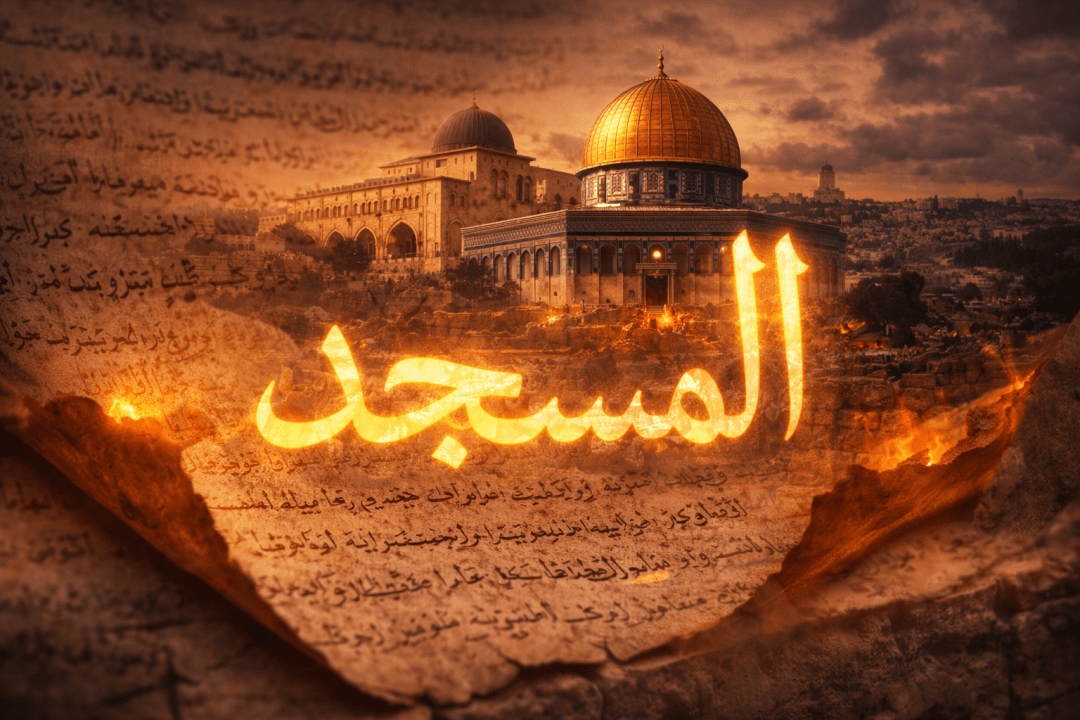
Few passages in the Quran are as historically charged—or as theologically unsettling—as the seven verses that open The Children of Israel (Banî Israel). They contain what presents itself as a divine address to the Children of Israel, delivered in the scripture, predicting not one but two moments of catastrophic moral collapse, each followed by foreign conquest and devastation. The first, most scholars agree, maps onto a well-documented event in ancient history. The second has yet to fully resolve—or, depending on how one reads the grammar, may already have.
The First Corruption and the Babylonian Shadow
The passage opens with God reminding the Children of Israel that they were given the scripture and warned against setting up idols beside Him. Then, in verses 4 through 6, the divine address turns explicitly predictive:
We addressed the Children of Israel in the scripture: “You will commit gross evil on earth, twice. You are destined to fall into great heights of arrogance. When the first time comes to pass, we will send against you servants of ours who possess great might, and they will invade your homes. This is a prophecy that must come to pass. Afterwards, we will give you a turn over them, and will supply you with a lot of wealth and children; we will give you the upper hand.” (17:4–6)
The first corruption and its consequence—an invading force entering homes, followed by a period of restored prosperity—correspond with striking precision to the Babylonian conquest of Jerusalem in 586 BCE. Under Nebuchadnezzar II, the Babylonian army breached the walls of the city, destroyed Solomon’s Temple, and deported much of the Judean population to Babylon. The Hebrew scriptures document the moral collapse that preceded it: the prophets Isaiah, Jeremiah, and Ezekiel had spent decades cataloguing the apostasy, injustice, and political corruption of the Israelite elite. The invasion was not experienced as mere military misfortune but as divine retribution—precisely the interpretive framework the Quran is invoking.
The restoration promised in verse 6 maps cleanly onto the Persian period. When Cyrus the Great conquered Babylon in 539 BCE, he issued an edict permitting the Jewish exiles to return to their land and rebuild their temple. The subsequent Achaemenid era saw a genuine demographic and cultural recovery—”wealth and children” is not a poetic flourish but an accurate description of the repopulation and economic restoration of Judea under Persian patronage, documented both in the books of Ezra and Nehemiah and in Persian administrative records.
So far, the Quranic account aligns with history as preserved in multiple independent traditions. What makes the passage theologically remarkable is not its historical accuracy but its framing: the corruption was presented not as an unexpected punishment but as a prophecy delivered in advance, embedded in the very scripture given to Israel. The exile was not an interruption of the covenant but a consequence written into it.
One detail in verse 5 requires particular care: the invading forces are described as “servants of ours who possess great might.” This phrase has sometimes been read as an honorific—as if God were endorsing the character or righteousness of the instruments He deploys. The Quran does not support that reading. Elsewhere, the text makes plain that every created being is a servant of God, willingly or not:
“Glorifying Him are the seven universes, the earth, and everyone in them. There is nothing that does not glorify Him, but you do not understand their glorification. He is Clement, Forgiver.” (17:44)
Say, “My Lord is the One who controls all provisions; He increases the provisions for whomever He chooses from among His servants, or reduces them. Anything you spend (in the cause of God), He will reward you for it; He is the Best Provider.” (34:39)
What we revealed to you in this scripture is the truth, consummating all previous scriptures. GOD is fully Cognizant of His servants, Seer. (35:31)
Servitude, in this Quranic sense, is a condition of existence, not a certificate of virtue. Nebuchadnezzar was no more morally endorsed by his role in the exile than a flood is endorsed by its role in washing away a corrupted settlement. The Hebrew scriptures themselves use precisely this logic: in Isaiah 44–45, Cyrus the Great is called God’s “shepherd” and even His “anointed”—not because Cyrus was righteous by Israelite standards, but because he was the instrument through which the divine purpose moved.
The same pattern appears throughout the Deuteronomistic history: the Midianites, the Philistines, the Arameans, the Moabites and Ammonites—all are presented in Judges and Kings as forces God permitted or directed against Israel as consequences of moral failure, without any implication that those forces were themselves acting from righteous motives (Judges 6:1–6, 13:1; 2 Kings 13:3; Judges 10:6–7). The instrument of punishment is not thereby made innocent; it is simply made useful. When the Quran says “servants of ours,” it is describing the relationship of all creation to God—not singling out a particular nation for divine approval.
“The Israelites did evil in the eyes of the Lord, and for seven years he gave them into the hands of the Midianites… they cried out to the Lord for help.” (Judges 6:1, 6)
“Again the Israelites did evil in the eyes of the Lord. They served the Baals and the Ashtoreths… because the Israelites forsook the Lord and no longer served him. He became angry with them; he sold them into the hands of the Philistines and the Ammonites” (Judges 10:6–7)
“Again the Israelites did evil in the eyes of the Lord, so the Lord delivered them into the hands of the Philistines for forty years.” (Judges 13:1)
“So the anger of the Lord burned against Israel, and for a long time he kept them under the power of Hazael king of Aram… But the Lord was gracious to them and had compassion… they turned back to him.” (2 Kings 13:3, 23)
“The king of Assyria invaded the whole land, marched against Samaria and laid siege to it for three years… All this took place because the Israelites had sinned against the Lord their God… They worshiped other gods.” (2 Kings 17:5–7)
The Temple and the Mosque
Verse 7, where the second corruption and its consequences are described, introduces a detail that has received less attention than it deserves:
“If you work righteousness, you work righteousness for your own good, but if you commit evil you do so to your own detriment. Thus, when the second time comes to pass, they will defeat you and enter the masjid, just as they did the first time. They will wipe out all the gains you had accomplished.” (17:7)
The word used for the sacred site is not bayt al-maqdis (the House of Holiness, a common Quranic and early Islamic designation for the Jerusalem Temple) nor al-haykal (temple), but al-masjid—the mosque, or more literally, the place of prostration. This is the same root used throughout the Quran for Muslim houses of worship. Moreover, today, in place of the Temple in Jerusalem, stands the Dome of the Rock, built by Abd al-Malik ibn Marwan (r. 685 to 705 CE) in 692 CE—a masjid occupying the supposed footprint of the Temple.
What makes the word choice analytically decisive is that the Quran demonstrably knows the difference between these terms and deploys them with precision. In 22:40, the text lists the sacred spaces of multiple religious communities that would be destroyed were it not for God’s sustaining of one people against another:
“…monasteries, churches, synagogues (وَصَلَوَٰتٌ, salawāt), and masjids—where the name of God is commemorated frequently—would have been destroyed.” (22:40)
In a single verse, four distinct terms are used for four distinct types of sacred space: sawāmiʿ (monasteries), biyaʿ (churches), salawāt (synagogues—a term derived from the Hebrew ṣəlōt, cognate with prayer), and masājid (mosques). The Quran is not working with a vague, interchangeable vocabulary for holy places. It has a precise lexical inventory and uses each term with awareness of the tradition it names. When 17:7 chooses masjid to describe what will be entered during the second punishment—a punishment addressed directly to the Children of Israel—the choice cannot be attributed to imprecision or loose usage. The Quran knew the word for a Jewish house of worship and for the Temple, yet it chose not to use it.
The shift is not incidental. When describing the first invasion—the Babylonian assault—the passage says the enemies “invaded your homes,” using domestic language that corresponds to their exile from the land. When describing the second, it says they will enter the masjid. A mosque did not exist in Jerusalem at the time of the first destruction, nor at the time of the Roman destruction of the Second Temple in 70 CE, which many commentators associate with the second corruption. The word choice either reflects anachronism—the Quran projecting an Islamic frame backward onto a Jewish sanctuary—or it is deliberately pointing toward a future moment in which a mosque will be the defining feature of what is violated.
This ambiguity is not a flaw in the text. The Quran frequently operates on multiple registers simultaneously, and the choice of masjid over salawāt or haykal appears to be the kind of deliberate lexical precision that rewards sustained attention.
The Grammar of Time: Prophetic Past Tense and the Open Future
There is a further complication that Islamic exegetes have long recognized but that general readers often miss. Arabic, like Hebrew, possesses a rhetorical device known as the prophetic past tense—using a perfect (completed) verb form to describe a future event in order to convey its certainty. When God speaks in the Quran of something that has not yet occurred but is as certain as if it had, it may appear grammatically completed even when its referent remains in the future.
The ambiguity in 17:7 operates along this axis. The verse can be read in two ways simultaneously. In the first reading, it is a description of the Roman destruction of Jerusalem in 70 CE—a past event by the time the Quran was revealed in the seventh century—in which Titus’s legions demolished the Second Temple and scattered the Jewish population across the Mediterranean world. This reading treats both corruptions as historically completed, offering a retrospective theological interpretation of Jewish history.
In the second reading, the second corruption has not yet fully occurred. The period of “wealth and children” and restored dominance described in verse 6 is not only the Persian restoration but also—or instead—the modern State of Israel, established in 1948, which represents by any measure a remarkable return to prosperity, military power, and demographic consolidation in the land. If the second corruption is still ongoing or approaching its culmination, then verse 7 is not narrating history but predicting it—describing a coming defeat and a violation of the sacred site in Jerusalem that remains, at the time of writing, unrealized.
The prophetic past tense does not resolve this ambiguity; it sustains it. The Quran, on this reading, has embedded a double prophecy inside a single passage, one arm of which has been confirmed by history and one of which either already happened or is yet to happen.
The Second Corruption and the Present Moment
Which reading one adopts has obvious implications for how the current geopolitical moment is interpreted by those who take the Quranic text seriously. If the second corruption is a future event—and the “turn” given to Israel (verse 6) corresponds to the establishment of the modern state in 1948—then Israel’s current moral and political trajectory becomes relevant to the prophecy’s fulfillment.
The conflict between Israel and Iran, which has moved from proxy skirmishes and covert operations to direct military exchanges, represents the most dangerous escalation in the region’s recent history. Iran’s stated ideological position frames its opposition to Israel in explicitly eschatological terms, drawing on traditions within Shia Islam that connect the end of Israeli political dominance in Palestine to prophetic fulfillment. Israel, in turn, has moved toward a form of ethno-religious nationalism—particularly since 2023—that its critics describe as precisely the kind of “great heights of arrogance” the Quranic passage names.
To say that we may be approaching the fulfillment of the second prophecy is not to celebrate the prospect. The verse offers no comfort to those who would gloat at destruction. It speaks of “all the gains you had accomplished” being wiped out—a deeply sorrowful image, not a triumphalist one. And it frames the disaster, as it does the first, as a consequence of choices made by those who had been warned.
The Quran’s address throughout this passage is to the Children of Israel as a moral community, not as an ethnic category beyond redemption. The structure of the prophecy—corruption, consequence, restoration, corruption again—implies a cycle driven by human choices, not divine predetermination. The tragedy, if it is approaching, is not inevitable in some fatalistic sense; the verse itself contains within it the alternative: “if you work righteousness, you work righteousness for your own good.”
What the passage refuses to offer is comfort built on false premises. The shift from bayt (house, temple) to masjid in verse 7 signals something significant about what Jerusalem will look like when the second reckoning arrives. Whether that signal points to a past Roman desecration, a future violation of Al-Aqsa, or both, the Quran’s lexical precision suggests the question is worth taking seriously—far more seriously than the geopolitical noise ordinarily permits.

 Quran Talk Blog