
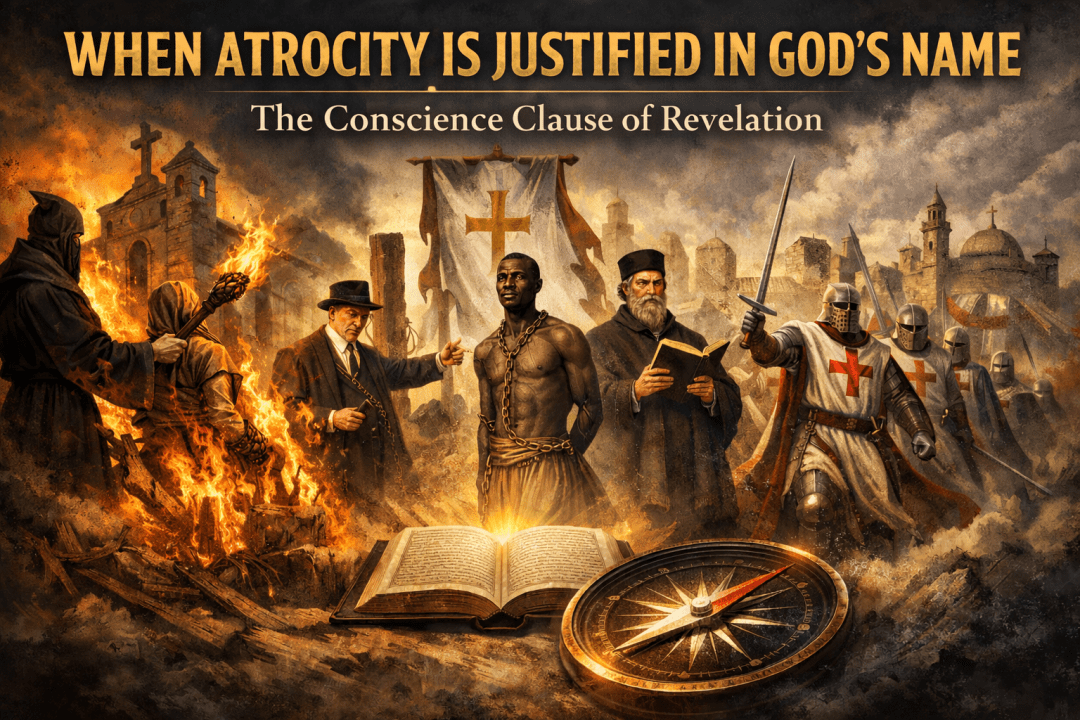
Throughout history, the worst atrocities have often been committed in public, with ceremony, with the sanction of institutions, and frequently with the explicit blessing of religious authority. The slave trade was defended from pulpits. Inquisitors tortured in the name of mercy, persuading themselves that burning the body was a kindness to the soul. Colonizers dismantled civilizations while citing scripture. People were publicly executed for accusations of witchcraft. Genocides have been blessed, apartheid has been consecrated, and crusades have marched beneath banners embroidered with holy symbols. In each case, those responsible were not unusually cynical—many were devout. They were not concealing their actions from God; they believed God approved.
This recurring pattern forces a question that cannot be avoided: is religion itself dangerous? Does the claim to divine authority, by its very structure, produce a kind of moral blindness in which any act can be justified so long as it can be attributed to God’s command?
The question deserves a serious answer rather than a reassuring one. And the answer embedded in Quranic revelation is surprising in its directness: not only does the pattern exist, but God anticipated it and built a safeguard against it into the architecture of revelation itself. That safeguard is the human moral conscience—not as a mere supplement to divine law, but as a condition of its correct reception. To understand how this works requires tracing two threads, one from explicit Quranic principle and one from narrative, and then recognizing that they weave together into a single argument.
The Pattern God Named
The Quran does not pretend that religious abuse is a modern problem or a failure unique to other traditions. It names the pattern with clinical precision:
“They commit a gross sin, then say, ‘We found our parents doing this, and God has commanded us to do it.’ Say, ‘God never advocates sin. Are you saying about God what you do not know?'” (7:28).
What makes this verse so structurally important is that it is not primarily a condemnation of sin. It is a condemnation of a specific way of narrating sin—the attribution of human vice to divine command. The people addressed here are not atheists dismissing the concept of God. They are believers who have convinced themselves, apparently sincerely, that God has sanctioned what they are doing. They appeal to tradition and to revelation in the same breath. They are doing what religious communities have done in every era: using the authority of the sacred to close down moral questioning.
God’s response is not to enumerate why their particular sin is wrong. Instead, He states a foundational principle: He never commands sin. Not this sin, not any sin. The principle is categorical and without qualification. Whatever the tradition that has been inherited, whatever the interpretation of sacred text that has been passed down, if it portrays God as commanding vice, it is wrong. Not incomplete, not in need of refinement—wrong. The error is not in the text but in the reading.
This verse establishes what might be called a first-order constraint on all interpretation of revelation. It means that no reading of any sacred text that produces a morally monstrous conclusion can be accepted as correct, because such a reading would contradict something God has stated explicitly about Himself. The principle does not resolve every ambiguous case, but it eliminates an entire category of error: the error of assuming that divine command transcends moral evaluation entirely, that if something is attributed to God then moral questioning becomes impious.
The verse also contains a devastating diagnostic embedded in its final question: “Are you saying about God what you do not know?” The problem is not just that these people are sinning. It is that they are speaking falsely about God—projecting their own behavior onto Him, dressing their desires in divine authority, and in doing so corrupting the very concept of God’s will. This is a form of blasphemy that proceeds from religious devotion rather than irreligion. It is possible to honor God with language while dishonoring Him with the content of what one attributes to Him.
The Compass God Installed
If the first principle tells us what God does not command, a second principle explains why human beings are capable of recognizing this. The soul is not a blank slate that receives divine instruction passively. According to the Quran, it comes pre-equipped with something:
“The soul and Him who created it—then showed it (fa-alhamahā )what is evil and what is good” (91:7–8).
The Arabic verb here carries enormous weight. Fa-alhamahā fūjūrahā wa-taqwāhā—God has inspired, instilled, implanted within the soul its awareness of moral distinction. The root ilhām means a direct bestowal of knowledge, something closer to endowment than education. It is not that human beings have been told about the difference between right and wrong through external instruction alone. The capacity for moral recognition has been placed inside them by the same act of creation that brought the soul into existence.
This is not a claim that human moral intuition is infallible. It is not a license for moral autonomy in the sense of doing whatever feels right. It is something more specific: the claim that God, when He created human beings, gave them the internal equipment necessary to recognize justice and injustice when they encounter it. A person who has been morally deformed by trauma, ideology, or sustained self-deception may have that compass distorted—but its distortion is not the original condition. The original condition is awareness.
The implications for how revelation is received are profound. If God has placed moral awareness within every soul, then the proper reception of divine law is not passive acceptance but engaged discernment. The believer brings to revelation a conscience that God Himself has endowed. When a law is recognized as just, that recognition is not external to the act of faith—it is part of it. And when a proposed interpretation of divine law strikes the conscience as deeply unjust, that discomfort is not automatically evidence of weakness of faith. It may be the moral compass God installed performing exactly the function it was designed to perform.
The relationship between revelation and conscience is therefore not one of simple hierarchy in which revelation overrides conscience at every point. It is more like the relationship between a text and the reader God prepared to receive it. A morally conscious reader brings something essential to the act of reading. The Quran’s own insistence that God never commands vice is itself an instruction on how to read: if your reading produces a God who commands vice, you have misread.
Obedience With Conditions
This architecture of conscience-as-safeguard shows up with remarkable clarity in a verse about pledges of allegiance to the Prophet. It states:
O you prophet, when the believing women (who abandoned the disbelievers) to seek asylum with you pledge to you that they will not set up any idols besides God, nor steal, nor commit adultery, nor kill their children, nor fabricate any falsehood, nor disobey your righteous orders, you shall accept their pledge, and pray to God to forgive them. God is Forgiver, Most Merciful. (60:12)
The crucial phrase “will not disobey your righteous orders” seems unremarkable until one pauses over it. The pledge is not simply to obey the Prophet. It is to obey his righteous orders. The word is not decorative. It carries a condition. Obedience is owed to the messenger, but that obedience is qualified by the moral character of what is commanded. The believing women are not simply to comply with whatever instruction comes from prophetic authority; they are to obey the Prophet insofar as his orders are righteous.
This presupposes something significant about the people receiving the command: that they are capable of recognizing righteousness. Otherwise, the condition would be meaningless—a caveat attached to an obligation that no one could ever apply. The fact that obedience is conditioned on righteousness means that believers are expected, not merely permitted, to evaluate what they are being asked to do against their own moral understanding. The condition exists because God expects it to be applied.
This does not, of course, authorize frivolous refusal. There is an obvious difference between a genuine moral objection to a command that appears deeply unjust and a merely inconvenient command that one prefers to avoid. The Quranic framework distinguishes between wisdom one does not yet understand—in which case one obeys and trusts—and injustice one clearly perceives, in which case the moral obligation runs in the other direction. Blind obedience is not piety; it is the abdication of the conscience God gave.
The verse goes further than merely permitting moral evaluation, however. Consider what the conditional structure actually implies in the most demanding hypothetical case: if a prophet authorized by God were to issue a command that a recipient understood as unrighteous, the verse’s own grammar would grant that person the standing to withhold compliance without incurring sin. This is not a loophole or a concession reluctantly inserted. It is the logical consequence of God choosing to frame the pledge in these terms rather than in terms of unconditional obedience.
The authority for this autonomy does not come from the believer’s judgment alone; it comes from the structure of the verse itself. God is the one who conditioned obedience on righteousness—which means that when a recipient, in good conscience and genuine moral perception, identifies a command as unrighteous, they are not defying God by declining to follow it. They are applying the condition God built in. The believer’s conscience, endowed by God and invoked here by God’s own phrasing, becomes the operative instrument. This is a significant theological point: it means no human authority, however exalted, can override God’s nature that He does not command immorality or vice.
Moses and the Teacher: A Narrative Illustration
Abstract principles require concrete illustration before they become real. The Quran provides exactly this in one of its most enigmatic and carefully constructed narratives: the encounter between Moses and the mysterious servant of God in Surah Al-Kahf.
The story is unusual from its opening. Moses, despite being a prophet of extraordinary standing—the one to whom God spoke directly, the one who led an entire people out of bondage—is told to seek out a figure more knowledgeable than himself (18:60–65). He sets out with his young companion, finds the man, and asks to follow him and learn. The teacher agrees, on one condition: Moses must not question him about anything until the teacher himself chooses to explain.
It is a test of obedience. Moses agrees to the terms.
What follows is a sequence of three actions, each more disturbing than the last—at least as they appear on the surface.
First, they board a boat belonging to poor fishermen. The teacher deliberately damages it, boring a hole in the hull. Moses’ reaction is immediate and explicit:
“Did you bore a hole in it to drown its people? You have committed something terrible” (18:71).
The teacher reminds him of his promise. Moses acknowledges his fault and asks to be forgiven his forgetfulness.
Second, they encounter a young boy, and the teacher kills him. Moses’ reaction is stronger still:
“Why did you kill such an innocent soul, who did not kill another soul? You have committed something horrendous” (18:74).
Again, the teacher issues the reminder, and again, Moses asks to be forgiven.
Third, they enter a town whose people refuse them hospitality. The teacher repairs a crumbling wall for these same inhospitable people, refusing any payment. Moses’ response this time is different:
“You could have demanded a wage for that!” (18:77)
This third reaction deserves attention. Moses does not accuse the teacher of injustice. He does not protest a moral wrong. He merely notes that the teacher has passed up a practical opportunity—that he could have charged for the labor. It is a comment about economics, not ethics. Unlike the first two occasions, Moses does not say “you have done something terrible” or “you have done something horrendous.” He says, in effect, this seems impractical.
The distinction matters enormously. It reveals that Moses’ objections to the first two actions were not mere impatience or failure to trust. They were expressions of moral conscience. When a boat was damaged, he feared innocent lives would be lost. When a boy was killed, he saw the death of an innocent soul without apparent cause. These were not small matters of preference. They were violations of justice as Moses understood it, and he said so.
This is precisely consistent with Moses’ character as established elsewhere in the Quran. Years before this encounter, Moses had accidentally killed an Egyptian in defense of an Israelite. His reaction is telling: he immediately acknowledged it as a wrong act, sought forgiveness, and made a vow—
“My Lord, for all You have blessed me with, I will never be a supporter of the guilty” (28:17)
Moses had staked his moral identity on a refusal to side with wrongdoing. When the teacher’s actions appeared to him as wrongdoing, Moses was not failing his vow. He was keeping it.
The story’s resolution confirms that the teacher’s actions had hidden wisdom that Moses could not perceive. The damaged boat was to protect its owners from an approaching king who was seizing every intact vessel. The killed boy was destined to become a source of grief and disbelief for his righteous parents, and God would replace him with a better child. The repaired wall concealed a treasure left for two orphaned boys by their righteous father, which would have been stolen had the wall collapsed before they came of age. Each apparent injustice was, in a context Moses could not see, an act of mercy.
But here is what the narrative does not say: that Moses was wrong to object. The teacher does not rebuke Moses for his moral alarm. He explains the hidden reasons. There is a difference between “you were right to object based on what you could see, but there was more you couldn’t see” and “your moral objection itself was a failure.” The Quran presents the former. Moses’ instinct to protest perceived injustice was not a flaw to be corrected; it was the moral equipment of a righteous man operating as it should. The deeper lesson is not that prophets should suppress their conscience in deference to authority. It is that sometimes the wisdom behind a command exceeds immediate human perception—while simultaneously showing that when something appears wrong, saying so is not only acceptable but consistent with the character God values in His servants.
The narrative functions as a kind of thought experiment about the relationship between obedience and conscience. It does not resolve this tension by eliminating one pole. Moses’ conscience was right to fire. The teacher’s actions were right despite appearing wrong. Both things are true, and their coexistence is the point. Revelation does not ask for the suspension of moral awareness. It asks for humility about the limits of human perspective—which is different, and significantly less demanding, than asking people to stop caring about justice.
The Hardest Case: Conscience and the Command to Fight
An objection presents itself at this point, and it is better to confront it directly than to leave it hovering. Everything argued so far concerns commands that appear unjust in the conventional sense—oppression, theft, killing the innocent. But what about the commands that are most frequently cited to justify violence in God’s name? What about war? The Quran does not only permit fighting; it calls believers to it, describes a bargain in which God purchases the lives and property of the faithful in exchange for paradise (9:111), and condemns those who hang back from striving in His cause. Does the framework of conscience and conditioned obedience simply collapse when the subject is combat?
The answer requires looking at how the Quran actually frames the permission and obligation to fight, rather than how those passages are frequently deployed.
The foundational principle is stated in 2:190–193. The permission to fight is explicitly tied to being fought against:
You may fight in the cause of GOD against those who attack you, but do not aggress. GOD does not love the aggressors. (2:190)
The verse does not authorize aggression. It authorizes defense. The limits it imposes are not rhetorical decoration—the immediate context goes on to prohibit initiating hostilities and to condition the cessation of fighting on the cessation of persecution. Verses 2:191–193 make the moral purpose explicit: fighting is permitted until “there is no more persecution and religion is for God.” The goal is the removal of coercion, not its exercise. The non-aggression principle is therefore not a secondary qualification added to soften a broader license for warfare; it is the very basis on which fighting is permitted at all.
You may kill those who wage war against you, and you may evict them whence they evicted you. Oppression is worse than murder. Do not fight them at the Sacred Mosque (Masjid), unless they attack you therein. If they attack you, you may kill them. This is the just retribution for those disbelievers. If they refrain, then GOD is Forgiver, Most Merciful. You may also fight them to eliminate oppression, and to worship GOD freely. If they refrain, you shall not aggress; aggression is permitted only against the aggressors. (Q2:191-193)
This is reinforced by one of the most structurally important statements in the Quran on the subject of religious coercion:
“There shall be no compulsion in religion” (2:256).
The verse appears in close proximity to the war-permissions and is not in tension with them once the underlying logic is grasped. Force may be used to remove the conditions under which people cannot freely choose their religion. Force may not be used to determine what religion people choose. The two principles work in tandem: fight to end persecution, but never fight to impose belief. A war conducted to force conversion would contradict 2:256 so directly that no appeal to any other verse could sanction it. The moral compass is again embedded in the command itself.
The verse that most sharply identifies the moral stakes of fighting is 4:76:
Those who believe are fighting for the cause of God, while those who disbelieve are fighting for the cause of tyranny (tāghūt). Therefore, you shall fight the devil’s allies; the devil’s power is nil. (4:76)
The word translated “tyranny” here is tāghūt—a multimeaning word that the Quran uses for both tyranny and idol worship. Fighting for God is defined in contrast to fighting for tyranny. This is not incidental framing. It establishes that the moral character of the cause—whether it is oriented toward freedom or toward domination—is the essential criterion for whether fighting falls within God’s sanction at all. A person who genuinely could not determine whether a war was for God or for tāghūt would, on this verse’s own logic, have grounds for moral hesitation. The verse presupposes that believers can make this distinction.
What, then, of the people the Quran does condemn for failing to fight? Surah Al-Ahzab provides a precise portrait. These are people who, having pledged to fight alongside the Prophet, retreated when the moment came—some fleeing the battle, others paralyzed by fear, others seeking permission to withdraw on pretextual grounds. Their condemnation is specific: they had made a prior commitment which they broke out of fear, and they craved the security of their homes when striving was required.
O you who believe, remember GOD’s blessing upon you; when soldiers attacked you, we sent upon them violent wind and invisible soldiers. GOD is Seer of everything you do. When they came from above you, and from beneath you, your eyes were terrified, your hearts ran out of patience, and you harbored unbefitting thoughts about GOD. That is when the believers were truly tested; they were severely shaken up. The hypocrites and those with doubts in their hearts said, “What GOD and His messenger promised us was no more than an illusion!” A group of them said, “O people of Yathrib, you cannot attain victory; go back.” Others made up excuses to the prophet: “Our homes are vulnerable,” when they were not vulnerable. They just wanted to flee. Had the enemy invaded and asked them to join, they would have joined the enemy without hesitation. They had pledged to GOD in the past that they would not turn around and flee; making a pledge with GOD involves a great responsibility. Say, “If you flee, you can never flee from death or from being killed. No matter what happens, you only live a short while longer.” Say, “Who would protect you from GOD if He willed any adversity, or willed any blessing for you?” They can never find, beside GOD, any other Lord and Master. GOD is fully aware of the hinderers among you, and those who say to their comrades, “Let us all stay behind.” Rarely do they mobilize for defense. Also, they are too stingy when dealing with you. If anything threatens the community, you see their eyes rolling with fear, as if death had already come to them. Once the crisis is over, they whip you with sharp tongues. They are too stingy with their wealth. These are not believers, and, consequently, GOD has nullified their works. This is easy for GOD to do. They thought that the parties might come back. In that case, they would wish that they were lost in the desert, asking about your news from afar. Had the parties attacked you while they were with you, they would rarely support you. (33:9-20)
The Quran describes them as offering hollow excuses and spreading despondency among the ranks. What it does not describe is people who raised a principled moral objection to the campaign. The category being condemned is cowardice and comfort-seeking dressed up in religious language—the very same pattern as 7:28 but inverted: rather than projecting vice onto God’s command, these people are projecting their fear onto a claim of conscientious concern.
The distinction matters enormously. The Quran’s critique of those who fail to fight is not a critique of moral questioning. It is a critique of moral evasion. The person who genuinely perceives a command as unrighteous is in a different position from the person who simply prefers the safety of home but cannot admit it. The Quran’s portraits of condemned abandonment are consistently of the latter: people motivated by fear, comfort, or self-interest who dress their reluctance in the language of principle. The existence of this category does not eliminate the category of genuine moral objection. It clarifies it by contrast.
Read together, these passages describe a coherent position: God calls believers to fight, but only in defense of freedom against aggression and persecution, never in service of compulsion or tyranny. The moral purpose is built into the command. A fight for domination is not, by the Quran’s own definition, a fight in the cause of God—and no amount of religious rhetoric can transform it into one. The compass remains operative even here, perhaps especially here, because the stakes are highest.
The Same Pattern Preached by Jesus
The Quran’s insistence on conscience as a condition of valid obedience is not, it turns out, an isolated position within the Abrahamic tradition. The same structure appears, from a different angle and in a different idiom, in the teachings attributed to Jesus.
The Jesus of the Gospels operates within a specific legal context—the complex framework of first-century Jewish law, as administered by scribes and Pharisees who combined genuine learning with, in Jesus’ assessment, a certain species of spiritual deformation. His response to this situation is revealing precisely because he does not simply reject the law. He engages with it more deeply, pressing it toward its own interior purposes and exposing the gap between legal compliance and the moral reality the law was meant to serve.
When he heals on the Sabbath, he does not deny that the Sabbath law exists. He uses the law’s own embedded exceptions to argue that saving a life takes precedence over ritual rest—and presses further to ask, if you would rescue an animal on the Sabbath, how much more obviously should you rescue a human being? He is not discarding the law but demanding that it be applied with the moral reasoning that generated it, rather than reduced to mechanical compliance that produces outcomes the law itself would condemn.
Despite not being found in the earliest manuscripts, the same pattern appears in his encounter with those who would stone the adulteress. “Let him who is without sin cast the first stone.” He does not argue that the law against adultery is wrong or that she should not be punished according to Torah. Instead, he invokes another principle from within the same legal tradition: that judges must themselves be righteous, that the community executing judgment must be fit to do so. By holding up the mirror of the law’s own standards to those wielding it, he reveals the hypocrisy of selective enforcement and self-righteous judgment. This technique works equally well in any legal system where those who enforce laws are themselves subject to them.
The same logic runs through his most compressed formulation of Jewish law: that everything hangs on loving God with all one’s being and loving one’s neighbor as oneself. This is not a simplification that discards legal detail. It is an identification of the moral principle from which legal specificity derives its authority. Law commands certain things because love requires them. When the specific command is applied in a way that defeats love, something has gone wrong—not with the principle, but with the application.
His instruction to obey the scribes and Pharisees who sit in Moses’ seat, while not imitating their example, captures this with particular sharpness. The legal content is legitimate. The problem is the consciousness with which it is administered and followed. Legal correctness has become, for these authorities, an end in itself—something to be performed, cataloged, and used to establish superiority—rather than a structure through which genuine love of God and neighbor flows. Jesus does not say the law is wrong. He says it is being used in a way that defeats its own purpose, and that people of genuine conscience should be able to tell the difference. That the letter of the law should never override the spirit of the law.
There is an evident family resemblance here with the Quranic principle that obedience is owed to righteous orders. Both traditions are saying that the moral purpose behind a law is not separable from the law’s authority. A law becomes authoritative not merely because it has been decreed by the right source but because it embodies something genuinely just. When law and justice part company—when the letter of the command is used against the spirit that gave it life—the morally conscious person is expected to notice and respond.
What This Means for Immorality Carried Out in the Name of Religion
Return now to where we began: the long, terrible history of atrocities committed in God’s name.
The Quranic framework sketched here offers a precise diagnosis of what goes wrong in these cases. It is not that God’s law is dangerous. It is that a particular deformation of religious obedience occurs when the moral conscience is deliberately suppressed in the name of faith—when asking “is this just?” comes to be seen as itself a sin, as evidence of insufficient trust in divine authority. This deformation inverts the actual structure of revelation. It treats blind compliance as the highest form of piety, when the actual text of revelation treats it as a failure to use the very equipment God provided.
The inquisitor who tortured people in the name of mercy had not simply misread a text. He had disabled the function that would have allowed him to recognize the misreading—namely, the innate awareness of injustice that God placed within every soul. The colonizer who cited scripture to justify dispossession had done the same. The community that endorses oppression on the grounds that their tradition permits it is doing what the Quran describes in 7:28: attributing their own behavior to God, projecting their desires onto divine command, and in doing so slandering the very God they claim to serve.
This is why the principle that God never commands vice is not a soft reassurance but a structural rule. It closes the interpretive space within which atrocities dress themselves as piety. If God never commands vice, then any reading that produces a divine command to commit vice is automatically a misreading—regardless of how old the tradition is, regardless of how many authorities have endorsed it, regardless of how confidently it is proclaimed. The moral compass is not merely a supplement to revelation that can be overridden when revelation seems to point elsewhere. It is a co-condition of revelation’s correct reception. God built it into human beings precisely because He knew what revelation would face.
The failure, when religious communities commit or sanction injustice, is not in the religion. It is in the abandonment of what the religion itself requires: a morally engaged conscience that brings genuine awareness of right and wrong to the act of interpretation, that takes seriously the first principle that God never commands sin, and that is therefore equipped to say—as Moses said, as Jesus said—when something appears deeply wrong, no matter the authority behind it.
This is, at its root, a statement about what kind of being God chose to create. The Quran describes God breathing His own spirit into the human form, endowing the soul with moral awareness, and placing human beings as stewards on earth—not as automatons executing instructions, but as morally conscious agents capable of distinguishing right from wrong and bearing responsibility for that distinction. A robot cannot be held accountable. A being with no genuine moral autonomy cannot meaningfully choose God; it can only be programmed to simulate the choice. The entire architecture of divine accountability—judgment, reward, consequence—presupposes a creature that could have done otherwise, that evaluated and chose rather than merely responded. The moral compass God installed is not incidental to human nature. It is the faculty that makes human beings the kind of creature for whom revelation makes sense at all.
Revelation was never intended to produce people who follow commands without moral awareness. It was intended to produce people whose moral awareness has been deepened, clarified, and oriented toward God—people who obey righteous commands because they recognize their righteousness, and who raise their voices against apparent injustice not in spite of their faith but as an expression of it. The compass is not an obstacle to following God. It is the instrument by which God’s way can be distinguished from what people merely wish God’s way to be.

 Quran Talk Blog