
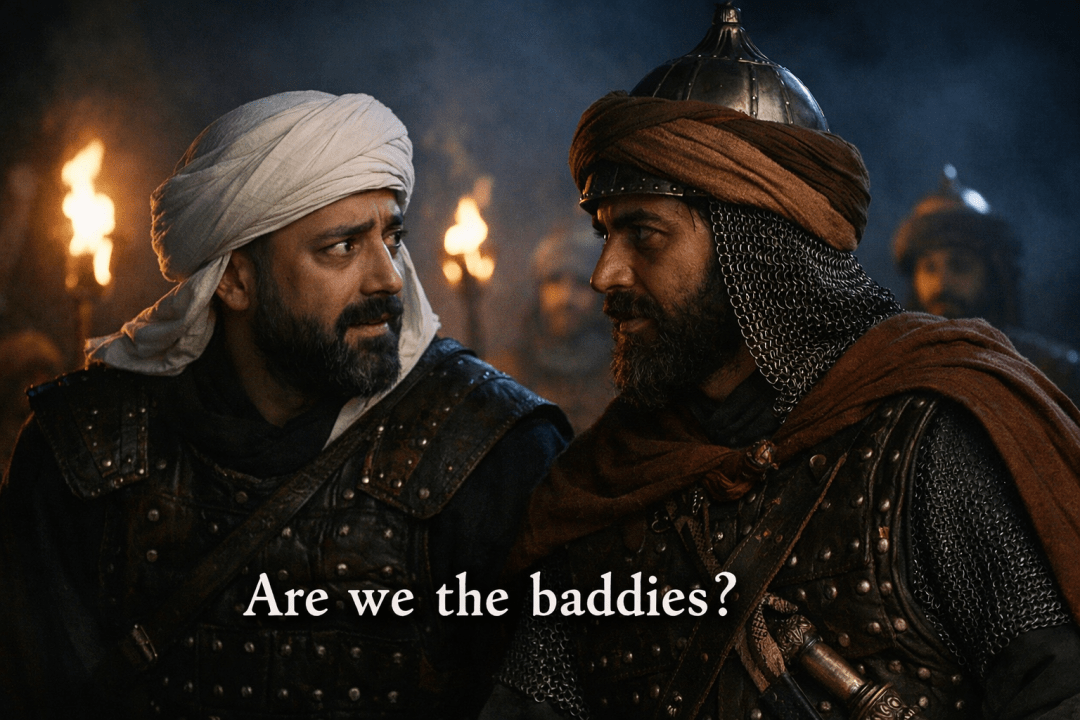
There is a famous comedy sketch by Mitchell and Webb in which two Nazi soldiers, mid-battle, pause to notice the skull-and-crossbones insignia on their helmets. One turns to the other and asks the question that has apparently never occurred to them before: “Are we the baddies?”
It is a devastatingly simple joke. But it captures something profound about how ideologies sustain themselves—by ensuring that their adherents never stop to ask the obvious question. The same question, it turns out, has pressing relevance for a tradition within Islam that holds the killing of apostates to be a religious obligation.
The Quran’s Clear Principle: No Compulsion in Religion
The Quran is not ambiguous on the question of religious coercion. It states plainly:
There shall be no compulsion in religion: the right way is now distinct from the wrong way. Anyone who denounces the devil and believes in GOD has grasped the strongest bond; one that never breaks. GOD is Hearer, Omniscient. — Quran 2:256
This is not a peripheral verse or a contextually narrow ruling. It is a declaration of divine design. The right way and the wrong way have been made clear; human beings are left to choose between them. The logic is reinforced elsewhere, where God addresses the Prophet directly:
Had your Lord willed, all the people on earth would have believed. Do you want to force the people to become believers? — Quran 10:99
The rhetorical force here is withering. If God himself—omnipotent, capable of making every soul a believer in an instant—chose not to compel belief, what would it mean for human beings to do so in His name? The question answers itself. Forced belief is not belief at all; it is theater performed under threat of death, and God, the Quran reminds us, is not interested in theater.
The Quran goes further still. It does not merely instruct believers to tolerate disbelievers in silence—it commands the Prophet to address them directly and acknowledge their right to their own path:
Say, “O you disbelievers. I do not worship what you worship. Nor do you worship what I worship. Nor will I ever worship what you worship. Nor will you ever worship what I worship. To you is your religion, and to me is my religion.” — Quran 109:1-6
This is remarkable. God is not merely permitting disbelief to exist—He is instructing His prophet to speak to disbelievers with dignity, to draw a clean line between the two paths, and to leave each party to its own. There is no ultimatum here, no threat, no deadline for conversion. The separation is peaceful, mutual, and final. “To you is your religion, and to me is mine” is not a reluctant concession; it is a divine declaration of the terms on which human beings are meant to share the world.
The Quran’s Moral Map: Who Does the Coercing?
With this framework established, a striking pattern emerges throughout the Quran. When we survey its narratives of persecution, coercion, and violence over matters of faith, we consistently find the same configuration: it is the disbelievers—the idol worshippers, the tyrants, the rejectors of the prophets—who threaten, banish, and kill those who change their religion or speak the truth.
The Quran makes this alignment explicit:
Those who believe are fighting for the cause of GOD, while those who disbelieve are fighting for the cause of tyranny (l-ṭāghūti). Therefore, you shall fight the devil’s allies; the devil’s power is nil. — Quran 4:76
The word tāghūt is significant. It carries the double meaning of both idol worship and tyranny—the domination of human beings by false gods and false rulers. Those who oppress others for their beliefs are, in the Quran’s moral vocabulary, servants of tāghūt, regardless of what name they give to their god.
Now consider the examples the Quran itself provides.
The Sleepers of the Cave are young men who flee their community because they worship God alone. Their fear is not of divine punishment—it is of their own people:
“If they discover you, they will stone you, or force you to revert to their religion, then you can never succeed.” — Quran 18:20
Note the pairing: stoning or forced reversion. The Quran presents violent death and coerced return to paganism as two faces of the same evil.
Pharaoh, upon learning that his court magicians have come to believe in Moses, does not debate them, nor does he allow them to leave in peace:
“Did you believe in him without my permission? He must be your chief; the one who taught you magic. I will surely sever your hands and feet on alternate sides. I will crucify you on the palm trunks.” — Quran 20:71
Belief without the sovereign’s permission. The very framing reveals the nature of the crime: it is not theological error that offends Pharaoh, but the insubordination of conscience.
Abraham’s own father threatens him for abandoning the family’s idols:
“Have you forsaken my gods, O Abraham? Unless you stop, I will stone you. Leave me alone.” — Quran 19:46
Noah faces the same ultimatum from his people:
“Unless you refrain, O Noah, you will be stoned.” — Quran 26:116
So do Lot, Shu’aib, and unnamed messengers in Sura 36—each confronted with threats of violence, banishment, or death for their beliefs or their preaching. The message, the mob, and the threat are remarkably consistent across prophet after prophet: stop speaking, or we will kill you.
They said, “We consider you bad omens. Unless you refrain, we will surely stone you, or afflict you with painful retribution.” — Quran 36:18
The Hadith and Its Terrible Irony
Now consider the tradition recorded in Sunan an-Nasa’i, attributed to Ibn Abbas, in which the Prophet is reported to have said:
“Whoever changes his religion, kill him.” — Hadith Sunan an-Nasa’i 4059
This hadith has served as the textual foundation for the apostasy laws found in traditional Islamic jurisprudence across the major legal schools. Under these laws, a Muslim who leaves Islam—who does precisely what the Sleepers of the Cave, the magicians of Pharaoh, and Abraham himself did—is to be put to death.
Stop. And look at what the Quran has shown us.
Every figure who changes religion in the Quran is a hero. The Sleepers of the Cave are protected by divine miracle. Pharaoh’s magicians become martyrs of faith. Abraham becomes the “friend of God.” They each abandon the religion of their fathers—or the religion of their rulers—and the Quran celebrates them for it.
And in every case, who threatens to kill them for it? The pagans. The tyrants. The servants of tāghūt.
The traditionalist position on apostasy does not merely sit in tension with these Quranic narratives. It mirrors the position of the villains within them. Those who would kill a person for changing their religion are, according to the Quran’s own moral logic, doing what Pharaoh did. What the people of Noah did. What the persecutors of the Sleepers of the Cave intended to do.
The skull-and-crossbones is on the helmet. The question must be asked.
Faith Cannot Be Compelled
There is a deeper theological point beneath the legal one. The Quran’s rejection of religious compulsion is not merely a pragmatic concession to human diversity. It flows from the nature of faith itself.
Belief, in the Quranic framework, is an act of the heart—a genuine orientation of the soul toward truth. God could have created human beings incapable of rejecting Him. He did not. The capacity to disbelieve, to doubt, to choose, is built into the human condition deliberately. The trial of this life depends on it. A faith produced by the sword is not faith; it is compliance, and God is not deceived by compliance.
To kill someone for leaving a religion is not to protect the faith. It is to demonstrate that you have no confidence the faith can survive free inquiry. It is to admit, at the point of the blade, that the truth you claim to possess cannot stand on its own.
The Quran does not require this admission. It makes the opposite claim: that truth has been made clear, that the right path is distinct from the wrong one, and that human beings are fully capable of finding it—if left free to look.
Conclusion
The pattern the Quran traces is unmistakable. Across its narratives of prophets, believers, and tyrants, one behavior consistently marks those on the wrong side of God’s favor: the use of violence and coercion to control what people believe. From Pharaoh’s courtroom to the cave where young men hide for their lives, the instrument of compulsion belongs to the enemies of truth, not its servants.
A tradition that sentences apostates to death does not inherit the mantle of the prophets. It inherits the logic of those who persecuted them.
The Mitchell and Webb question is not rhetorical. It demands an answer. And the Quran, read carefully, provides one.
Related Articles

 Quran Talk Blog