
There are multiple Sahih narrations claiming the Prophet commanded ablution (wudu) after eating food touched by fire:
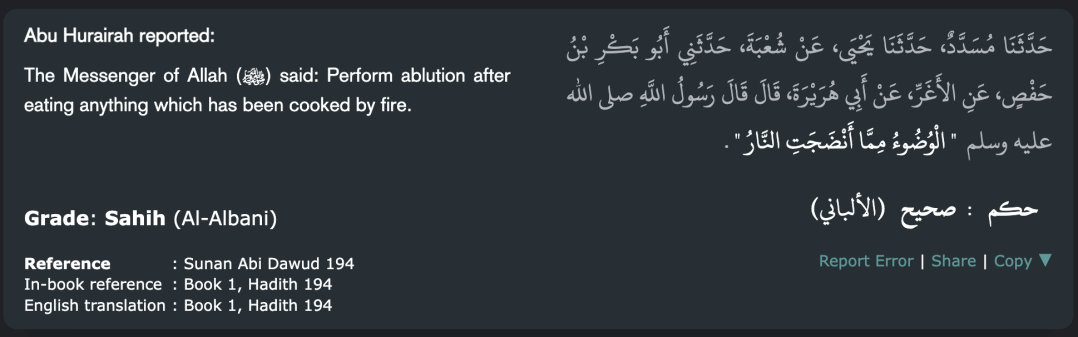
Abu Hurairah reported: The Messenger of Allah (ﷺ) said: Perform ablution after eating anything which has been cooked by fire.
حَدَّثَنَا مُسَدَّدٌ، حَدَّثَنَا يَحْيَى، عَنْ شُعْبَةَ، حَدَّثَنِي أَبُو بَكْرِ بْنُ حَفْصٍ، عَنِ الأَغَرِّ، عَنْ أَبِي هُرَيْرَةَ، قَالَ قَالَ رَسُولُ اللَّهِ صلى الله عليه وسلم “ الْوُضُوءُ مِمَّا أَنْضَجَتِ النَّارُ ” .
Sunan Abi Dawud 194
https://sunnah.com/abudawud:194
However, all Sunni schools of thought universally agree that this commandment was abrogated. But in none of the transmissions do the narrators ever state that this practice had been cancelled.
Keep in mind, these narrations weren’t transmitted “live” during the Prophet’s lifetime like a social media feed. As Sunnis concede, these narrations were made many years after his death. Therefore, the companions who lived with the Prophet until the end of his mission and are attributed with transmitting these reports would have certainly known if the practice had been cancelled.
And that raises the central question:
Why would a companion transmit a ruling he knew was cancelled, without clarifying that it no longer applied?
Contradictions Upon Contradictions
As seems to be typical for every hadith, there appears to be another hadith crafted to contradict it.
Take, for example, the following Hadith attributed to Ibn ‘Abbas:
Ibn ‘Abbas said: The Messenger of Allah (ﷺ) took (the meat of) a (goat’s) shoulder and offered prayer and did not perform ablution.
حَدَّثَنَا عَبْدُ اللَّهِ بْنُ مَسْلَمَةَ، حَدَّثَنَا مَالِكٌ، عَنْ زَيْدِ بْنِ أَسْلَمَ، عَنْ عَطَاءِ بْنِ يَسَارٍ، عَنِ ابْنِ عَبَّاسٍ، أَنَّ رَسُولَ اللَّهِ صلى الله عليه وسلم أَكَلَ كَتِفَ شَاةٍ ثُمَّ صَلَّى وَلَمْ يَتَوَضَّأْ .
Sunan Abi Dawud 187
https://sunnah.com/abudawud:187
Not only does this narration contradict the Hadith regarding commanding the performance of ablution after eating food touched by fire, but one also has to ask: who in their right mind would think it was important to record the obscure detail that the Prophet once ate a goat’s shoulder and then prayed without ablution? This kind of narration only makes sense as a polemic — an attempt to counter the other narration — not as an independent memory worth preserving.
Abu Hurairah vs. Ibn ‘Abbas
The contradiction even becomes apparent in the dialogue between these two supposed transmitters of these conflicting Hadith:
Ibn ‘Abbas said: “Should I perform Wudu’ after eating food that I see in the Book of Allah is permissible because fire has touched it?” Abu Hurairah gathered some pebbles and said: “I bear witness (as many times as) the number of these pebbles, that the Messenger of Allah (ﷺ) said: ‘Perform Wudu’ from that which has been touched by fire.'”
أَخْبَرَنَا إِبْرَاهِيمُ بْنُ يَعْقُوبَ، قَالَ حَدَّثَنَا عَبْدُ الصَّمَدِ بْنُ عَبْدِ الْوَارِثِ، قَالَ حَدَّثَنَا أَبِي، عَنْ حُسَيْنٍ الْمُعَلِّمِ، قَالَ حَدَّثَنِي يَحْيَى بْنُ أَبِي كَثِيرٍ، عَنْ عَبْدِ الرَّحْمَنِ بْنِ عَمْرٍو الأَوْزَاعِيِّ، أَنَّهُ سَمِعَ الْمُطَّلِبَ بْنَ عَبْدِ اللَّهِ بْنِ حَنْطَبٍ، يَقُولُ قَالَ ابْنُ عَبَّاسٍ أَتَوَضَّأُ مِنْ طَعَامٍ أَجِدُهُ فِي كِتَابِ اللَّهِ حَلاَلاً لأَنَّ النَّارَ مَسَّتْهُ فَجَمَعَ أَبُو هُرَيْرَةَ حَصًى فَقَالَ أَشْهَدُ عَدَدَ هَذَا الْحَصَى أَنَّ رَسُولَ اللَّهِ صلى الله عليه وسلم قَالَ “ تَوَضَّئُوا مِمَّا مَسَّتِ النَّارُ ” .
Sunan an-Nasa’i 174
https://sunnah.com/nasai:174
Here, Ibn ‘Abbas questions Abu Hurairah on the very matter, and Abu Hurairah doubles down on his narration, never once adding that the ruling was abrogated. Again, this exchange was transmitted decades after the Prophet’s death. If the practice had truly been cancelled during his lifetime, why the complete silence about it? If Ibn ‘Abbas knew the ruling was abrogated, why did he not add this to the commentary since he is the one who is attributed with narrating this Hadith? If Abu Hurairah knew it was cancelled, why insist on it so dramatically?
Two Possibilities
This leaves us with only two possible explanations. The first, if one accepts the validity of Hadith, is that the ruling was never actually abrogated, and the idea of abrogation was a later invention by jurists who needed a way to harmonize the obvious contradictions between the different hadith. In this paradigm, the companions transmitted what they believed to be binding law, and later scholars retrofitted the doctrine of naskh (abrogation) to patch over the inconsistencies. In which case, the companions themselves had no clue what was actually abrogated or not, and this was to be resolved hundreds of years later by future generations.
The second possibility is even more troubling yet more consistent with the overall evaluation of the Hadith corpus: that the Prophet never made such statements at all, and these narrations were fabrications attributed to him after the fact. If that is the case, then these narrations were either not transmitted by actual companions or some of the companions were transmitting false reports. Whichever it is, the outcome is the same: the hadith corpus cannot be relied upon as a legitimate source of divine law.
Conclusion
It makes no sense that companions would narrate a command they knew had been abrogated, without saying so. The very existence of these conflicting narrations proves either that abrogation is a later invention or that the Prophet never uttered these words.
Either way, the case of “wudu after eating cooked food” demonstrates the absurdity of building a legal system on hadith.

 Quran Talk Blog