
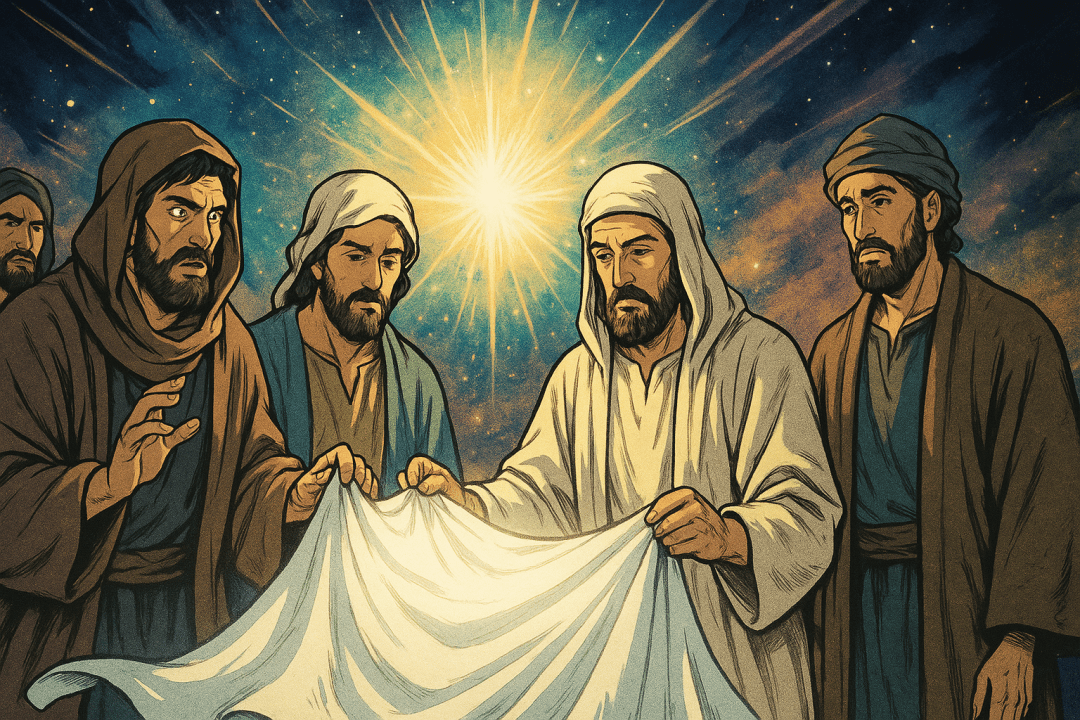
The Quran refers to the disciples of Jesus with the term ḥawāriyūn (ٱلْحَوَارِيُّونَ), which appears five times across four verses:
| 3:52:12 | l-ḥawāriyūna | ٱلْحَوَارِيُّونَ | the disciples |
| 5:111:4 | l-ḥawāriyīna | ٱلْحَوَارِيِّـۧنَ | the disciples |
| 5:112:3 | l-ḥawāriyūna | ٱلْحَوَارِيُّونَ | the disciples, |
| 61:14:12 | lil’ḥawāriyyīna | لِلْحَوَارِيِّـۧنَ | to the disciples, |
| 61:14:18 | l-ḥawāriyūna | ٱلْحَوَارِيُّونَ | the disciples, |
The term is derived from the root “ḥ-w-r” ( ح و ر ), and one of the meanings of this root is to wash or, more specifically, whiten garments or clothes. This connection has led to debate and some ambiguity: how did a word associated with whitening clothes become the Quranic designation for the closest followers of Jesus?
The Syriac Connection
Interestingly, in the Syriac Christian tradition—the dominant language of early Near Eastern Christianity—the disciples of Jesus were also referred to as ḥawārē (ܚܘܪ̈ܝܐ). This word also originates from the same Semitic root ḥ-w-r, which in Syriac conveys the meanings of “to be white, to be radiant” and, by extension, “to be pure.”
Most scholars agree that the Quranic ḥawāriyūn is a loan translation (calque) from Syriac, absorbed into Arabic during the centuries when Christian communities flourished in Arabia and the Levant. What is distinctive in Arabic, however, is the additional resonance with laundering clothes—a concrete, everyday image that reinforced the idea of purification. This gave Muslim exegetes room to interpret the term in two directions:
- As a loanword directly from Syriac, meaning “the pure ones.”
- As a native Arabic image, linked to launderers and the whitening of garments, symbolizing spiritual cleansing.
Thus, the Quranic term stands at the crossroads of Syriac Christian tradition and Arabic linguistic creativity.
Whiteness and Purity in Biblical Tradition
The imagery of purification through whitened garments is not unique to Syriac Christianity. It has deep roots in the Hebrew Bible and continues into the New Testament, where it becomes a powerful symbol of redemption.
One of the clearest examples comes from the prophet Isaiah:
“Though your sins are like scarlet, they shall be as white as snow; though they are red as crimson, they shall become like wool.” — Isaiah 1:18
Here, forgiveness and transformation are portrayed as a change of fabric color — from stained red to bright white. The association of sin with staining and of righteousness with whiteness sets the stage for later theological imagery where God Himself is likened to a fuller (a launderer or cloth-cleanser).
This imagery resurfaces in the Book of Revelation, where the faithful are described as clothed in white, symbolizing purity, victory, and eternal life.
“The one who is victorious will be clothed like them in white garments; and I will never blot out that person’s name from the book of life.” — Revelation 3:5
These passages show that the act of whitening garments was a well-established biblical metaphor for spiritual purification. When read alongside the Syriac ḥawārē (“pure ones”), they provide a natural bridge to the Quranic designation of the disciples as ḥawāriyūn. Both traditions employ the language of clothing, washing, and whitening to describe the transformation of the believer from impurity to purity, from the profane to the sacred.
Gospel of Philip
The Gospel of Philip is a non-canonical Gnostic text discovered in 1945 among the Nag Hammadi library in Egypt. Composed in Coptic but originally written in Greek around the third century CE, it does not follow the narrative form of the four canonical gospels. Instead, it offers a series of mystical reflections, sayings, and interpretations centered on sacramental theology—especially themes of marriage, baptism, and the soul’s union with the divine.
One of the most striking features of the text is its symbolic use of light, purity, and clothing imagery. These motifs consistently frame spiritual transformation in terms of whiteness and radiance, echoing the broader Semitic root ḥ-w-r, which connotes both whiteness and purity. In this sense, the Gospel of Philip provides an important backdrop for understanding how some early Christian thought employed imagery of dyeing, laundering, and whitening as metaphors for divine purification—concepts that may resonate with the Quranic designation of Jesus’ disciples as ḥawāriyūn.
Two passages in particular stand out:
“God is a dyer. Just as the good dyes, said to be genuine dyes, dissolve into what is dyed in them, so also those whom God dyes become immortal through his colors, for his dyes are immortal. And God baptizes those to be baptized in water.” — God the Dyer (61, 12–20)
Here, God is imagined as a divine launderer or dyer, imparting His immortal purity to those He “colors.” The act of baptism is framed not only as washing but as a transformation into incorruptibility.
“The master went into the dye works of Levi, took seventy-two colored cloths, and threw them into a vat. He drew them out and they all were white. He said, ‘So the son of man has come as a dyer.’” — The Dye Works of Levi (63, 25–30)
In this vision, the seventy-two colored cloths most likely represent the seventy-two nations, as described in Jewish lore. Christ himself is depicted as a master dyer who takes diversity (the many colors of cloth) and transforms it into absolute purity and whiteness. The image connects the act of salvation directly with cleansing and whitening, a theme inseparable from the linguistic and symbolic world of the root ḥ-w-r.
Taken all together, these passages suggest that the imagery of whitening cloth was not merely a linguistic coincidence in Arabic but part of a broader Christian symbolic repertoire. When the Quran refers to Jesus’ disciples as al-ḥawāriyūn, Muslim audiences familiar with Syriac Christian traditions may have heard not only “the pure ones” but also echoes of this vivid imagery of purification—disciples as those “whitened” and made pure by their devotion and by Christ’s transforming presence.
God’s Baptismal Dye in the Quran
These passages also connect with the following verse from the Quran, and specifically the word “ṣib’ghatan” ( صِبْغَةً ).
[2:138] Such is GOD’s system, and whose system is better than GOD’s? “Him alone we worship.”
صِبْغَةَ ٱللَّهِ وَمَنْ أَحْسَنُ مِنَ ٱللَّهِ صِبْغَةً وَنَحْنُ لَهُۥ عَـٰبِدُونَ
| 1 | ṣib’ghata | صِبْغَةَ | (This is the) code of law / religion / system |
| 2 | l-lahi | ٱللَّهِ | (of) God! |
| 3 | waman | وَمَنْ | And who (is) |
| 4 | aḥsanu | أَحْسَنُ | better |
| 5 | mina | مِنَ | than |
| 6 | l-lahi | ٱللَّهِ | God(‘s) |
| 7 | ṣib’ghatan | صِبْغَةً | code of law / religion / system? |
| 8 | wanaḥnu | وَنَحْنُ | And we (are) |
| 9 | lahu | لَهُۥ | to Him |
| 10 | ʿābidūna | عَـٰبِدُونَ | worshipers. |
The word “ṣib’ghatan” ( صِبْغَةً ) comes from the root “ṣ-b-gh (صبغ), and has the following derivative meanings:
code of law; religion; nature; dye; colour; baptize; dip; immerse; assume the attribute; condiment; sauce; relish
The only other place this word is used is in 20:30, where it refers to the food “relish.” Thus, in both occurrences, the root carries the idea of immersion or baptism that changes the thing immersed: fabric dipped into dye becomes permanently colored; bread dipped into relish is flavored, transformed, and preserved. By invoking this word, the Quran presents God’s system as an all-encompassing matrix into which all of life is immersed.
Every human being lives within this dye; it saturates existence itself. But the distinction lies in conscious participation: Those who ignore it remain bound to their superficial worldly lives, never recognizing the divine pattern in which they are immersed. However, others who understand and align with God’s laws are able to navigate life skillfully within this matrix, transcending the perishable flesh and living as truly spiritual beings.
In this sense, ṣibghat Allāh is an ontological condition: God’s dye is already around us, in us, and upon us. The only question is whether we acknowledge it and worship Him alone, thereby allowing the dye to transform and preserve us.
Children of Light: Biblical and Early Christian Imagery
Another possible connection to the term lies in a well-known metaphor among early Christians: becoming Children of Light. In this imagery, the purpose of Jesus’ teachings was not merely moral instruction but the transformation of his followers — guiding them to strip away the perishable “garments” of the flesh and to recognize their true selves as beings of divine light.
In the Canocial gospels, Jesus himself identified his followers as children of light:
“While you have the light, believe in the light, that you may become sons of light.” — John 12:36
“The master commended the dishonest manager because he had acted shrewdly. For the people of this world are more shrewd in dealing with their own kind than are the people of the light.” — Luke 16:8
Paul also uses this terminology in two places within his letters:
“For once you were darkness, but now you are light in the Lord. Walk as children of light.” — Ephesians 5:8–9
“You are all children of light, children of the day. We are not of the night or of darkness.” — 1 Thessalonians 5:5
This imagery of light was not unique to Christianity. The 2nd-century BCE writings of the Essenes at Qumran, preserved among the Dead Sea Scrolls, also contrasted the “sons of light” with the “sons of darkness” (1QM, War Scroll). To belong to God was to dwell in light, while estrangement from Him was to remain in darkness. This apocalyptic framework formed the cultural soil in which Jesus’ words and the earliest Christian imagery of light and darkness took root.
Additionally, the non-canonical writings of the second century take the theme further, presenting discipleship as the realization of one’s true self as light.
In the Gospel of Thomas, it states:
“There is light within a person of light, and it shines on the whole world. If it does not shine, it is dark.” — Saying 24
“We have come from the light, from the place where the light came into being by itself… If they say to you, ‘Who are you?’ say, ‘We are its children.’” — Saying 50
Here, disciples are not merely those who follow Jesus, but those who discover their origin and identity in divine light.
The Gospel of Truth echoes this:
“He enlightened those who were in darkness because of forgetfulness… He discovered them in himself, and they discovered him in themselves.” — 22:10–30
And in its striking clothing imagery:
In the Gospel of Truth, in the section The Living Book Is Revealed (19, 34–21, 25), it states
Jesus appeared,
put on that book,
was nailed to a tree,
and published the Father’s edict on the cross. Oh, what a great teaching!
He humbled himself even unto death, though clothed in eternal life.
He stripped off the perishable rags
and clothed himself in incorruptibility, which no one can take from him.
For the authors of these texts, the work of Jesus was to awaken humanity from ignorance and fleshly perishable existence, revealing their true garment of light — incorruptible, eternal, and radiant.
Final Thoughts
When the Quran speaks of the disciples as ḥawāriyūn, its resonance with this long tradition becomes clear. Across prophetic, apostolic, apocalyptic, and mystical texts, discipleship was pictured as a process of being washed, whitened, purified, and illuminated. Whether in Isaiah’s promise of sins made white, the Gospel’s depiction of “children of light,” or Thomas and Truth’s radiant self-discovery, the same motif runs like a thread: the followers of Jesus were considered those who have been transformed into light, clothed in purity, and awakened to their true selves.
Related Article:

 Quran Talk Blog
One thought on “Possible Origins of the word Ḥawāriyūn (Disciples)”