
Few figures in history have shaped Christianity more than Paul. Yet his dominance was not inevitable. In the earliest decades after Jesus, Paul was only one voice among many—sometimes controversial, sometimes ignored, and often overshadowed by the Jerusalem leaders like Peter and James.
So how did Paul come to stand at the center of Christianity, with his letters forming the backbone of the New Testament and his theology shaping doctrines of salvation, law, and grace? The answer lies not only in Paul’s missionary zeal and prolific correspondence, but in a complex interplay of history, controversy, and canon formation.
Marcion and the Pauline Revolution
When asking how Paul rose from a disputed voice to the dominant interpreter of Christianity, one name cannot be ignored: Marcion of Sinope (d. 160 CE). Emerging in the mid–2nd century, Marcion was perhaps the most influential “heretic” the early church ever faced.
Marcion was born around 85 CE in Sinope, a port city on the Black Sea in Asia Minor. Ancient sources suggest his father was a bishop in the local church, with some claims that he was one of the “Seventy” disciples sent out by Jesus (Luke 10:1)—a detail historians debate as legendary. What we can say with more confidence is that Marcion was wealthy, educated, and deeply dissatisfied with the emerging fusion of Christianity and Jewish tradition. He arrived in Rome around 140 CE, where his teaching quickly attracted followers but also fierce opposition, leading to his excommunication.
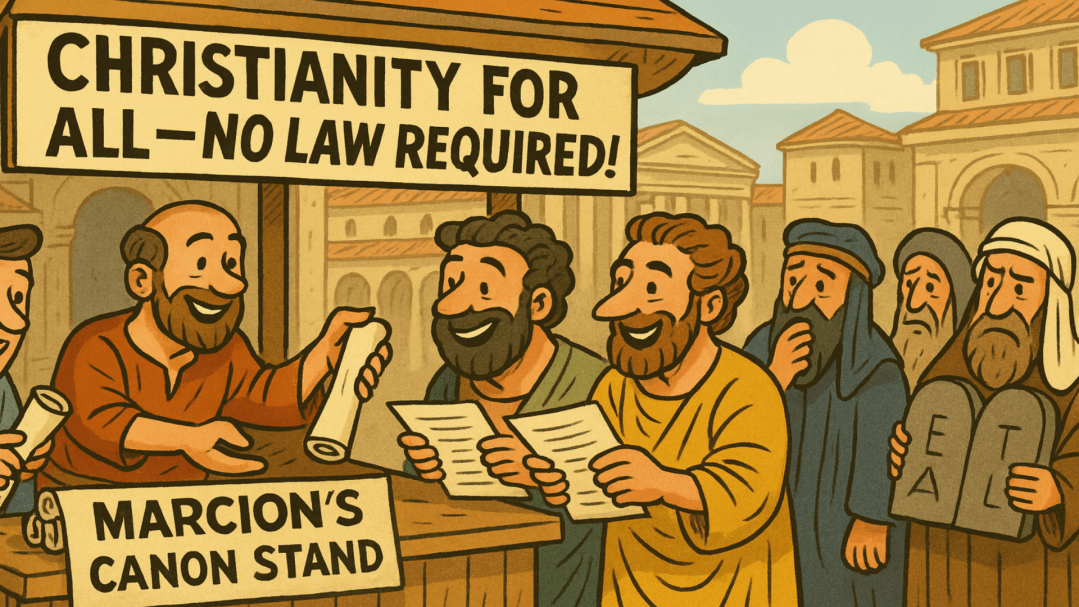
Marcion’s greatest innovation was his canon—the first Christian attempt to define a fixed body of scripture. It consisted of two collections. The first he called the Evangelion, a word meaning “Gospel” or “Good News.” While earlier historians thought this was simply a shortened and edited version of Luke, more recent research suggests it may have been a proto-version of Luke’s Gospel, circulating before the form of Luke that we know today.
The second collection was the Apostolikon, made up of ten letters that Marcion attributed to Paul at the time, which were all attributed to Paul: Galatians, 1 Corinthians, 2 Corinthians, Romans, 1 Thessalonians, 2 Thessalonians, Laodiceans (likely Ephesians under a different name), Colossians, Philippians, and Philemon. He excluded the Pastoral epistles (1 & 2 Timothy, Titus) as well as Hebrews, believing them to be later corruptions. By elevating these writings, Marcion presented Paul as the only true apostle who understood Jesus’ message, dismissing the authority of Peter, James, and John as compromised by their attachment to the Jewish Law.
At the heart of Marcion’s theology was a stark dualist worldview, one that shared certain themes with contemporary Gnostic movements though it was not identical to them. Like the Gnostics, Marcion drew a sharp line between the visible, material world and the higher spiritual reality revealed in Christ. He taught that the God of the Old Testament was not the Father of Jesus but a lesser deity—the harsh and legalistic demiurge who created the material world and bound humanity under the Law of Moses.
In contrast, the God revealed through Jesus was utterly different: previously unknown, merciful, and entirely detached from the Law. Where Gnostics often emphasized secret knowledge (gnōsis) and complex cosmologies of emanations, Marcion simplified the picture into a radical contrast between Law and Grace, Justice and Love, the Creator and the Redeemer. This sharp dichotomy had him reframe his understanding of the Hebrew Scriptures altogether, and to insist that the church must sever its ties with Judaism if it was to remain faithful to Christ.
This theology naturally led Marcion to champion Paul above all other apostles. Unlike Peter, James, and John—who were still wedded to the Jewish Law—Paul preached a message of liberation from the Law and justification by faith alone. Paul’s sharp contrasts between Law and Grace, flesh and spirit, aligned perfectly with Marcion’s dualist framework.
For Marcion, Paul was the only apostle who truly understood Jesus’ revelation of the loving, previously unknown God, while the others remained compromised by their allegiance to the Creator of Israel. By building his canon around Paul’s letters, Marcion not only reinforced his own theology but also elevated Paul’s writings to a central place in Christian identity, a move that would have lasting consequences even among those who rejected Marcion’s conclusions.
Marcion’s movement spread rapidly across the Roman Empire, rivaling the emerging “orthodox” church in size and influence. His insistence on a canon forced the broader church to define its own—ironically ensuring the preservation of the very writings he championed. Paul, whom earlier church fathers had cited sparingly or ignored, suddenly became unavoidable. Even though Marcion’s theology was rejected, his Pauline canon was absorbed, with the church reinterpreting Paul rather than discarding him.
In this way, Marcion was both rejected as a heretic and acknowledged as a catalyst. His radical reliance on Paul’s letters made them central to Christian identity. Without Marcion, Paul may never have become the pillar of orthodoxy he is today.
From Silence to Centrality: Paul in the Church Fathers
In the earliest Christian writings outside the New Testament, Paul is surprisingly absent. Texts like the Didache (c. 70–100 CE), the Epistle of Barnabas (c. 100–120 CE), and the Shepherd of Hermas (c. 100–140 CE) make no reference to Paul at all, despite their wide circulation in early churches. Where he is mentioned—such as in 1 Clement (c. 95 CE), Ignatius of Antioch (c. 110 CE), and Polycarp of Smyrna (c. 110–135 CE)—the references are brief and reverential, but never central. Even Justin Martyr (c. 150–160 CE), one of the most influential apologists of the second century, does not cite Paul in his defenses of the faith. This pattern shows that in the century after Jesus, Paul was far from being treated as the defining voice of Christianity.
The shift begins only after Marcion elevated Paul as the sole true apostle. In reaction, later church fathers began to cite Paul extensively—not to discard him, but to reinterpret him. Irenaeus of Lyons (c. 180 CE) turned to Paul’s letters repeatedly in Against Heresies to combat Gnosticism and to present a unified vision of scripture that included both Old and New Testaments. Tertullian (c. 200 CE) went further, writing a five-book refutation Against Marcion that relied heavily on Paul, showing how his letters could be harmonized with the Old Testament rather than set against it. By the end of the second century, Paul had been fully absorbed into the core of Christian orthodoxy—not because he had always been central, but because the church, in important respects, shared elements of Marcion’s reading of Paul even while rejecting his radical conclusions.
Paul’s Theology and the Gentile Shift
If Marcion was the catalyst for making Paul prolific among Christian converts, it was Paul’s own theology that ultimately secured his dominance. Unlike Jesus, who preached repentance, righteous works, and faithfulness to God’s Law, Paul offered a radically different path—one that proved far more attractive to the waves of Gentile converts entering the church.
By detaching salvation from the covenantal obligations of Torah and recasting it as faith in Christ alone, Paul made Christianity accessible, even palatable, to a pagan world. His message was universal, simple, and flexible, aligning more naturally with Greco-Roman culture than the rigor of Jewish law ever could. What began as a message of covenant obedience in Jesus’ teaching was reworked by Paul into a faith unbound from the Law, reshaping Christianity into something Gentiles could embrace that was separate from Judaism.
Missionary Reach and Gentile Focus
The Jerusalem apostles, led by James and Peter, largely stayed among the Jewish population, emphasizing continuity with the Law and the Prophets. Paul, however, broke decisively with this pattern. He took his message directly into Gentile territory, deliberately targeting the cities of Asia Minor, Greece, and eventually Rome. By framing faith in Christ as something independent of the Jewish Law, Paul removed the requirement for Gentile converts to embrace circumcision, food laws, and Temple observance. For Greeks and Romans accustomed to a pantheon of gods, philosophical schools, and mystery religions, Paul’s universal Christ made Christianity look less like a Jewish sect and more like a new, global faith. Yet in doing so, he stripped away the covenantal framework of obedience to God’s Law that Jesus himself had upheld and fulfilled (Matthew 5:17–20).
Theological Simplicity and Flexibility
Paul’s gospel distilled salvation into a single, easily repeatable formula: faith in Christ. Unlike Jesus, who demanded repentance, righteous works, and devotion to God’s commandments, Paul claimed that justification came “apart from works of the Law” (Romans 3:28). This made Christianity dramatically more accessible to pagans who might be attracted to its moral vision but were unwilling to undergo circumcision or adopt Jewish purity codes. Moreover, Paul’s flexible reading of the Hebrew Scriptures allowed him to reinterpret Israel’s story in allegorical and universal terms—turning Abraham into the father of “all who believe” (Romans 4:11), rather than the patriarch of a covenant people bound by Torah. This theological reductionism made the new faith portable and adaptable, but at the cost of discarding the very works-centered obedience that Jesus preached as essential to entering the kingdom of God.
Strategic Use of Roman Infrastructure
As a Roman citizen educated in both Jewish law and Hellenistic thought, Paul occupied a unique cultural position. He was able to move freely across the empire, taking advantage of Roman roads, trade routes, and cities as hubs of influence. By establishing connections with churches in strategic locations, Paul built a network of communities that mirrored the empire’s own infrastructure. He reinforced these ties through his letters, which functioned as both pastoral advice and theological manifestos. This networking gave Gentile Christianity the appearance of an organized, expanding movement, even while Jesus’ original disciples remained rooted in Jerusalem. Paul’s empire-wide vision appealed to Gentiles as something bigger than a sectarian offshoot of Judaism, but it also moved Christianity away from the local, law-centered obedience to God that Jesus had emphasized.
Letters as Foundational Scripture
Unlike Jesus, of whom we have no writings, Paul’s preserved correspondence became the first “scriptural” backbone of Christianity. These letters addressed practical disputes, moral crises, and doctrinal debates, giving them immediate relevance to communities across the empire. For Gentile converts used to philosophical letters and written teachings, Paul’s epistles felt familiar and authoritative. Over time, they were copied, collected, and circulated more widely than oral traditions of Jesus’ teachings. This textual dominance meant Paul’s voice increasingly drowned out the sayings of Jesus preserved in oral form or in Jewish-Christian circles. The irony is that while Jesus preached obedience to God’s Law as the path to eternal life, it was Paul’s written insistence on faith alone that became codified as the bedrock of Christian theology.
The Fall of Jerusalem (70 CE)
The destruction of the Temple by Rome in 70 CE was a turning point. The Jerusalem church, led by James and deeply rooted in Jewish tradition, was scattered and largely silenced. Their vision of Christianity as a fulfillment of the Law was crippled by the loss of their sacred center. By contrast, Paul’s Gentile churches—already decentralized and independent of Jewish institutions—survived and even thrived. The power vacuum left by Jerusalem’s fall cleared the way for Paul’s brand of Christianity to define the faith going forward. For Gentiles, this meant a version of Christianity detached from the obligations of Torah, one that no longer looked like Judaism at all.
Compatibility with Imperial Christianity
When Constantine and later emperors adopted Christianity, Paul’s universalist, law-free gospel proved ideal for an empire. A religion centered on circumcision, dietary laws, and Jewish customs would have remained sectarian and alien. Paul’s message, however, was adaptable to Greek philosophy and Roman political ideals: a faith unbound from Torah, open to all, and easily harmonized with imperial order. Doctrines of grace and faith could be universalized across cultures, while the sharp demands of Jesus—forsaking wealth, living in radical obedience, and repenting in fear of God’s judgment—were softened or reinterpreted. In effect, Paul’s theology became the theological backbone of “official” Christianity, precisely because it was more palatable to a pagan audience and more compatible with empire.
Conclusion
Paul’s rise to dominance in Christianity was not the natural outgrowth of Jesus’ original teaching, but the result of historical circumstance, theological adaptation, and the controversies that shaped the church’s identity. In the earliest generations, Paul was a marginal and often contested voice—occasionally cited, but never central. Only with the challenge of Marcion, who elevated Paul above all others, did the broader church feel compelled to grapple with his writings. In rejecting Marcion, the church paradoxically enshrined Paul, preserving his letters and weaving them into the very fabric of Christian orthodoxy.
What gave Paul lasting traction, however, was how well his theology suited the needs of a Gentile audience. By redefining salvation in terms of faith apart from works of the Law, Paul stripped away the covenantal demands of Torah that Jesus upheld, making Christianity accessible to pagans without requiring them to become Jews. His portable, universal message traveled easily across the empire, carried by Roman roads, urban networks, and eventually his own letters, which became the first layer of a Christian canon. When Jerusalem fell and its Law-centered leadership was scattered, Paul’s decentralized Gentile churches filled the void. And when emperors later sought a unifying religion for the empire, Paul’s law-free, universalist gospel proved far more adaptable to Greek philosophy and Roman administration than the radical call of Jesus to repentance, obedience, and self-denial.
In this way, Paul came to dominate Christianity—not because he had always been the church’s central voice, but because his theology aligned with the cultural, political, and institutional needs of a Gentile movement that outgrew its Jewish roots. The cost, however, was profound. Christianity was reshaped from a covenantal path of righteousness, repentance, and obedience to God’s Law, into a religion of belief and grace, detached from its original foundation. The faith in Jesus’s words and teachings became the faith in Paul’s Christ.

 Quran Talk Blog