

For centuries, Hadith has been the bedrock of Sunni Islamic law and theology. But what happens when one of Sunni Islam’s most prominent voices admits that this foundation doesn’t stand up to scrutiny?
In a recent interview on the Sképsislamica podcast, promoting his new book “Understanding Salafism,” Yasir Qadhi made a startling admission:
“Nobody in the academy affirms the Muslim Sunni science of Hadith. Nobody. It is considered to be completely discredited. I’m just being factual.”
Why Hadith Cannot Be Verified
Unlike the Quran—which can not only stand on its own per God’s divine guarantee (15:9), it can also be traced back to the prophet, both via manuscripts and the historical record—Hadith rests entirely on spotty oral transmission that wasn’t even formally written down till the second century Hijri. The earliest manuscript evidence for Hadith is a partial folio of the Muwatta of Imam Malik (d. 179 AH) from the late second century Hijri. The most well-known Hadith compilations (e.g., Bukhari and Muslim) were not written down until the 3rd century Hijri, with most extant manuscripts appearing centuries after that.
Because of this gap, the Hadith corpus depends entirely on the integrity of the supposed chain of transmitters (isnād) and the reliability of those transmitters. Now, aside from the fact that anyone at the time could have fabricated a chain of transmitters and there were even accounts of people creating multiple corroborating chains to give the illusion that particular Hadith were sound, the strength of those chains hinges on one critical assumption: that the Prophet’s companions were universally reliable and above reproach.
In traditional Hadith science, once a narration is traced back to a companion, it is considered inherently credible and no longer open to scrutiny. This status holds even if the companion never directly heard the Hadith from the Prophet himself. For instance, Ibn Abbas was only a child during the Prophet’s lifetime and is persumed to have received many of his narrations from other companions—but it is not required to disclose these sources. Similarly, Abu Hurayrah joined the Prophet less than a couple years before his death, yet he is among the most prolific narrators. Despite this, Hadith methodology does not demand he clarify the intermediaries from whom he heard specific reports. In fact, this is common across the Hadith tradition: many narrations attributed to companions are likely second-hand, passed through unnamed intermediaries, but the original source is often omitted—leaving the impression of direct transmission where none may exist.
To resolve this obvious dilemma, Hadith scholars introduced a blanket principle: all companions are deemed trustworthy by default. This doctrine, known as ʿadālat al-ṣaḥāba, means that once a companion’s name appears in the isnād, their reliability is no longer questioned. Whether or not the companion directly heard the statement from the Prophet—or even understood its context—becomes irrelevant. Their mere inclusion in the chain is treated as sufficient validation, effectively shielding the transmission from further scrutiny.
Therefore, if the reliability of the companions is questioned—even the possibility that they could be dishonest, mistaken, or hypocritical—the entire Hadith framework collapses. There is no external verification. Only trust. Much like a house of cards, if even one companion is compromised, the whole structure falls apart. And all this is built upon the assumption that the chain of narrators itself is authentic to begin with.
Why Blind Faith in the Companions Is Necessary
This theological dependence on the companions is not incidental—it is essential. The Hadith corpus is only as strong as its narrators, and those narrators begin with the companions. If their integrity is in question, then so too is the entire structure built upon their words.
This is why even the most villainous figures like Muawiyah ibn Abu Sufyan must be defended at all costs—not because their actions are above critique, but because the Hadith tradition cannot afford for them to be seen as hypocrites.
In a recent talk titled “In Defence of the Companion Muawiyah ibn Abu Sufyan,” Adnan Rashid openly admits that defending Muawiyah is not about moral character, but about preserving the reliability of the Hadith framework.
To understand the problem, consider who Muawiyah was based on the sanitized history that Sunni Muslims attribute to him. Muawiyah was the son of Abu Sufyan, the Prophet’s arch-nemesis, who was his chief opponent at every battle. Muawiyah’s mother, Hind, is remembered for mutilating the Prophet’s uncle Hamza, attempting to eat his liver, and cutting off the appendages of the martyred believers after battle to wear them as jewelry. Yet, we are to believe that after they were conquered by the believers, they all became righteous believers.
Under Uthman, who was also an Umayyad like Muawiyah, Muawiyah became governor of Damascus, and after Uthman’s assassination, he refused to pledge allegiance to Ali—the Prophet’s cousin and appointed Caliph—choosing instead to wage war against him. Then, after Ali’s assassination, he fractured the unity of the believers and transformed the caliphate into a hereditary monarchy. His final act was appointing his son, Yazid, who would go on to massacre the Prophet’s family at Karbala.
Yet, despite this legacy, he is still revered by Sunnis as a sincere companion and as Adnan calls him, “the uncle of the believers”—and therefore a reliable transmitter of Hadith and a legitimate ruler—because acknowledging otherwise would shake the foundations of Sunni orthodoxy. To discredit Muawiyah as a companion would not only invite doubt on the narrations and legal precedents linked to him but also upon the corpus as a whole.
This is not a one-off case. During the Abbasid era, similar concerns surrounded figures like Abu Hurayrah. While questions were raised about his late conversion and prolific output of Hadith, these critiques were suppressed because they threatened to undermine the Shariah framework built on his narrations.
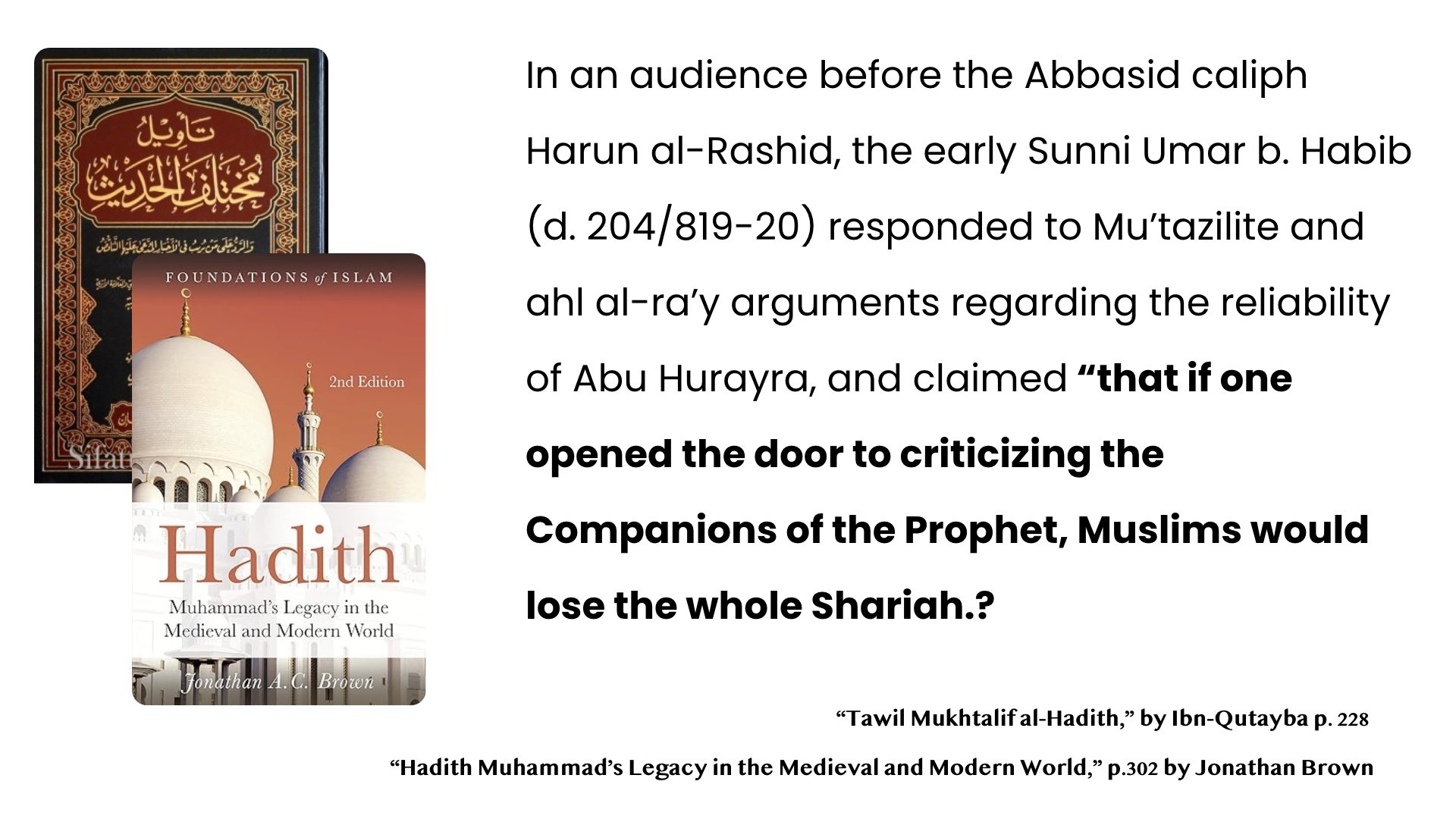
In an audience before the Abbasid caliph Harun al-Rashid, the early Sunni Umar b. Habib (d. 204/819–20) responded to Muʿtazilite and ahl al-raʾy arguments regarding the reliability of Abu Hurayra, and claimed: “that if one opened the door to criticizing the Companions of the Prophet, Muslims would lose the whole Shariah.”
— “Tawil Mukhtalif al-Hadith,” by Ibn-Qutayba p. 228
— “Hadith: Muhammad’s Legacy in the Medieval and Modern World,” p. 302 by Jonathan Brown
As Shabir Ally explained in a recent episode of Let the Quran Speak, the entire Hadith system relies on one principle: you cannot question the companions.
Without this blanket trust, the Hadith corpus cannot stand.
It is from this ideology that we get Hadith like the following:
Narrated ‘Abdullah bin Mughaffal: that the Messenger of Allah (ﷺ) said: “Allah! Allah regarding my Companions! “Allah! Allah regarding my Companions! Do not make them objects of insults after me. Whoever loves them, it is out of love of me that he loves them. And whoever hates them, it is out of hatred for me that he hates them. And whoever harms them, he has harmed me, and whoever harms me, he has offended Allah, and whoever offends Allah, [then] he shall soon be punished.”
حَدَّثَنَا مُحَمَّدُ بْنُ يَحْيَى، قَالَ حَدَّثَنَا يَعْقُوبُ بْنُ إِبْرَاهِيمَ بْنِ سَعْدٍ، قَالَ حَدَّثَنَا عَبِيدَةُ ابْنُ أَبِي رَائِطَةَ، عَنْ عَبْدِ الرَّحْمَنِ بْنِ زِيَادٍ، عَنْ عَبْدِ اللَّهِ بْنِ مُغَفَّلٍ، قَالَ قَالَ رَسُولُ اللَّهِ صلى الله عليه وسلم “ اللَّهَ اللَّهَ فِي أَصْحَابِي اللَّهَ اللَّهَ فِي أَصْحَابِي لاَ تَتَّخِذُوهُمْ غَرَضًا بَعْدِي فَمَنْ أَحَبَّهُمْ فَبِحُبِّي أَحَبَّهُمْ وَمَنْ أَبْغَضَهُمْ فَبِبُغْضِي أَبْغَضَهُمْ وَمَنْ آذَاهُمْ فَقَدْ آذَانِي وَمَنْ آذَانِي فَقَدْ آذَى اللَّهَ وَمَنْ آذَى اللَّهَ فَيُوشِكُ أَنْ يَأْخُذَهُ ” . قَالَ أَبُو عِيسَى هَذَا حَدِيثٌ حَسَنٌ غَرِيبٌ لاَ نَعْرِفُهُ إِلاَّ مِنْ هَذَا الْوَجْهِ .
Jami` at-Tirmidhi 3862
https://sunnah.com/tirmidhi:3862
The Quranic Reality: Hypocrites Among the Companions
Despite the insistence of Hadith traditionalists on the unquestionable integrity of all companions, the Quran paints a very different—and far more sobering—picture.
Sura 9, one of the final revelations of the Quran—revealed after the conquest of Mecca and near the end of the Prophet’s life—explicitly states that there were hypocrites among the Prophet’s companions, including those living in Medina, the very heart of the Muslim community.
[9:101] Among the Arabs around you, there are hypocrites. Also, among the city dwellers, there are those who are accustomed to hypocrisy. You do not know them, but we know them. We will double the retribution for them, then they end up committed to a terrible retribution.
This verse is critical. It tells us that not even the Prophet knew who the hypocrites were among his companions. They lived alongside the believers, posed as companions, and were embedded so deeply that their identities were hidden from everyone but God. This completely undermines the assumption that just because someone was close to the Prophet—or recorded as such—they must have been sincere.
The warning goes further. A few verses later, we are told that some of these hypocrites even established masjids—not to serve God, but to promote division, idol worship, and opposition to the messenger under the guise of piety.
[9:107] There are those who abuse the masjid by practicing idol worship, dividing the believers, and providing comfort to those who oppose GOD and His messenger. They solemnly swear: “Our intentions are honorable!” GOD bears witness that they are liars.
[9:108] You shall never pray in such a masjid. A masjid that is established on the basis of righteousness from the first day is more worthy of your praying therein. In it, there are people who love to be purified. GOD loves those who purify themselves.
This means that, at the end of the Prophet’s mission, there were still hypocrites operating masjids—posing as believers while secretly working against him. These individuals were not marginal figures. They were embedded in the religious infrastructure, leading congregations, and shaping public religious life.
If this was the case during the Prophet’s lifetime—when divine revelation was still active—what makes anyone believe that these same individuals, or their ideological descendants, were suddenly exposed and expelled the moment the Prophet died? The Quran offers no such conclusion.
This raises an urgent question: If the Prophet himself didn’t know who among his companions were sincere, how could the compilers of Hadith—living two to three centuries later in distant lands—possibly have the insight to determine who was trustworthy, let alone the writers of the biographies who lived after them?
Even Hadith Confirms Corrupt Companions
Ironically, even the Hadith corpus—despite being built on the presumed reliability of the companions—contains narrations that directly contradict this foundational assumption.
In Sahih al-Bukhari, which is considered the second most authoritative book after the Quran for Sunni Muslims, the Prophet is reported to have warned that some of his own companions will be turned away from him on the Day of Judgment:
Narrated Anas: The Prophet (ﷺ) said, “Some of my companions will come to me at my Lake Fount, and after I recognize them, they will then be taken away from me, whereupon I will say, ‘My companions!’ Then it will be said, ‘You do not know what they innovated (narrated) in the religion after you.“
حَدَّثَنَا مُسْلِمُ بْنُ إِبْرَاهِيمَ، حَدَّثَنَا وُهَيْبٌ، حَدَّثَنَا عَبْدُ الْعَزِيزِ، عَنْ أَنَسٍ، عَنِ النَّبِيِّ صلى الله عليه وسلم قَالَ “ لَيَرِدَنَّ عَلَىَّ نَاسٌ مِنْ أَصْحَابِي الْحَوْضَ، حَتَّى عَرَفْتُهُمُ اخْتُلِجُوا دُونِي، فَأَقُولُ أَصْحَابِي. فَيَقُولُ لاَ تَدْرِي مَا أَحْدَثُوا بَعْدَكَ ”.
Sahih al-Bukhari 6582
https://sunnah.com/bukhari:6582

This Hadith confirms three devastating realities:
- Some individuals who were recognized by the Prophet as companions will face divine punishment.
- Their crime is that they innovated or altered the religion after his death.
- Even the Prophet himself will be surprised by their fate—mirroring the Quran’s statement in 9:101 that he did not know who the hypocrites were.
What makes this even more revealing is the verb used in this Hadith: aḥdathū (أَحْدَثُوا)—“they innovated” or “introduced something new.” This word comes from the same triliteral root “ḥ-d-th” (ح د ث) as the word Hadith itself, which literally means something new, an occurrence, or a narration. In other words, the very term used to describe what these companions did—introducing innovations—is etymologically tied to the concept of Hadith.
And yet, Sunni orthodoxy still demands that we treat these same companions as infallible transmitters of Hadith and legal rulings.
This contradiction is never addressed directly. Instead, it is papered over by the convenient doctrine of al-ʿadāla—the idea that all companions are inherently upright and cannot be questioned. But the Quran refutes this notion, as does their own Hadith.
This is not a fringe issue. It strikes at the very heart of Hadith reliability. If even one major companion—let alone many—was engaged in distortion or religious innovation, then the integrity of the entire Hadith structure collapses.
The Quran Is Sufficient: Deserting the Revelation
When all is said and done, the real crisis isn’t just historical—it’s theological. Sunni Islam demands blind faith in a fragile oral tradition dependent on unverifiable human chains, while the Quran—a text preserved, complete, and fully detailed—has been sidelined.
The Quran warns repeatedly against following Hadith other than itself in religious matters:
[6:114–115] “Shall I seek other than GOD as a source of law, when He has revealed to you this book fully detailed?… The word of your Lord is complete in truth and justice.”
[45:6] “These are GOD’s revelations that we recite to you truthfully. In what Hadith other than GOD and His revelations do they believe?”
[77:50] “Then in what Hadith after this will they believe?”
Rather than serving as a companion to the Quran, the Hadith literature not only contradicts the Quran and itself, but it also depicts an entirely new religion that was never authorized by God, often introducing new laws, rituals, and theology not found in the Quran. And the entire edifice depends on the assumption that the companions, despite both an external and internal critique, show evidence to the contrary, were uniformly righteous.
This is why the Prophet, according to the Quran, will testify against his own people:
[25:30] “The messenger said, ‘My Lord, my people have deserted this Quran.'”
They did not deny the Prophet’s mission—but they abandoned the revelation God gave him, replacing it with the unverified narrations of men, some of whom the Quran identifies as hypocrites, and some of whom—even by Hadith standards—will be condemned for altering the religion.
This is not a call to reject the Prophet like Sunnis make it out to be. It is a call to return to what he was commanded to deliver: the Quran alone. To let the book speak for itself. To heed its warnings. To trust God’s testimony over that of fallible men.
[6:19] Say, “Whose testimony is the greatest?” Say, “GOD’s. He is the witness between me and you that this Quran has been inspired to me, to preach it to you and whomever it reaches. Indeed, you bear witness that there are other gods beside GOD.” Say, “I do not testify as you do; there is only one god, and I disown your idolatry.”

 Quran Talk Blog
One thought on “Companion Hypocrisy and the Hadith & Sunnah House of Cards”