
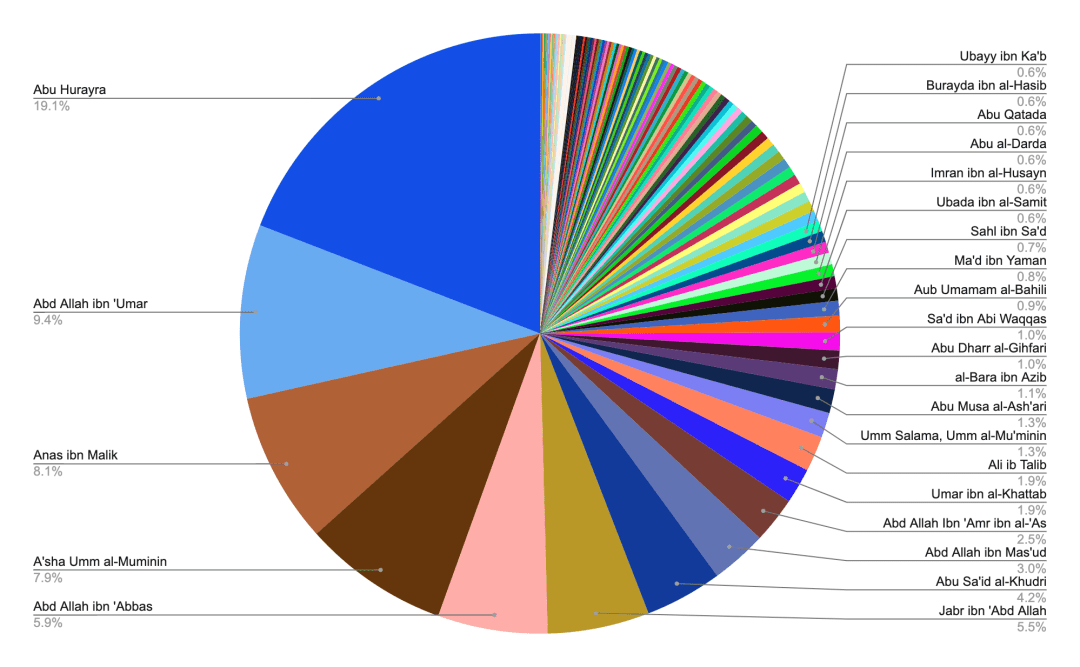
The prophet was said to have had over 100,000 companions (ṣaḥābī) according to sources like Abū Zurʿa al-Rāzī, with some sources indicating that 114,000 companions performed the pilgrimage with the Prophet after their conquest of Mecca. Despite their large number, most companions did not transmit hadith, even though prophetic Hadith could be simply observing something the prophet did or didn’t do. According to the Musnad of Abū ʿAbd al-Raḥmān—considered the most extensive collection of hadith—only about 1,300 companions are reported to have transmitted any traditions. Ibn al-Jawzī offers a more conservative figure, listing about 1,060 companions who transmitted hadith, along with the number of narrations attributed to each.
The data shows a steep drop-off:
- 500 companions are attributed with transmitting only one hadith each.
- 132 companions are attributed with transmitting two.
- A small cluster transmitted between 5–9 hadiths each.
- 60 companions are attributed with transmitting 10–20 hadiths.
- 55 companions are attributed with 100 or more hadiths.
- Of these, only eleven are said to have transmitted more than 500 hadiths each.
This stark distribution reveals that the bulk of hadith literature relies on the supposed testimonies of a tiny fraction of companions.
The pattern holds across the major compilations:
- Muwaṭṭaʾ of Imām Mālik includes traditions from only 98 companions.
- Musnad of al-Ṭayālisī cites 281 companions.
- Musnad of Aḥmad ibn Ḥanbal includes about 700 companions.
- Ṣaḥīḥ al-Bukhārī and Ṣaḥīḥ Muslim contain traditions from 208 and 213 companions, respectively, with 149 companions in common between them.
These figures challenge the common assumption that the hadith tradition reflects a broad-based, community-wide transmission. In reality, the overwhelming majority of hadiths are attributed to a very small subset of the Prophet’s companions. Even using the most generous estimates from the largest hadith compilations, only ~1% of the reported 100,000+ companions are credited with transmitting any hadith at all—and most of those only narrated a single report. If we limit our scope to the more authoritative collections, such as Ṣaḥīḥ al-Bukhārī or Ṣaḥīḥ Muslim, that percentage drops even further to around 0.2%. This raises important questions about historical transmission, narrative selectivity, and whose voices ultimately shaped the legacy of the prophetic tradition.
| Number of Companions | # of Hadith Narrated | % |
| 100,000 | 0 | 98.95% |
| 500 | 1 | 0.49% |
| 132 | 2 | 0.13% |
| 80 | 3 | 0.08% |
| 52 | 4 | 0.05% |
| 32 | 5 | 0.03% |
| 26 | 6 | 0.03% |
| 27 | 7 | 0.03% |
| 18 | 8 | 0.02% |
| 11 | 9 | 0.01% |
| 60 | 10-20 | 0.06% |
| 123 | 20+ | 0.12% |
*Note: The numbers above are based on 100,000 companions, even though the estiamte indicates this is the lower bound of the estimate.
It is worth noting that the most commonly reported hadith in the entire corpus is the following warning from the Prophet:
Narrated `Ali: The Prophet (ﷺ) said, “Do not tell a lie against me for whoever tells a lie against me then he will surely enter the Hell-fire.“
حَدَّثَنَا عَلِيُّ بْنُ الْجَعْدِ، قَالَ أَخْبَرَنَا شُعْبَةُ، قَالَ أَخْبَرَنِي مَنْصُورٌ، قَالَ سَمِعْتُ رِبْعِيَّ بْنَ حِرَاشٍ، يَقُولُ سَمِعْتُ عَلِيًّا، يَقُولُ قَالَ النَّبِيُّ صلى الله عليه وسلم “ لاَ تَكْذِبُوا عَلَىَّ، فَإِنَّهُ مَنْ كَذَبَ عَلَىَّ فَلْيَلِجِ النَّارَ ”.
Sahih al-Bukhari 106
https://sunnah.com/bukhari:106
Ironically, this hadith is also cited as the very reason many companions refrained from narrating anything at all. In another report, even a close companion like al-Zubayr ibn al-ʿAwwām expressed hesitation:
Narrated `Abdullah bin Az-Zubair: I said to my father, ‘I do not hear from you any narration (Hadith) of Allah’s Apostle as I hear (his narration) from so and so?” Az-Zubair replied. l was always with him (the Prophet), and I heard him saying, “Whoever tells a lie against me then let him occupy his seat in Hellfire.
حَدَّثَنَا أَبُو الْوَلِيدِ، قَالَ حَدَّثَنَا شُعْبَةُ، عَنْ جَامِعِ بْنِ شَدَّادٍ، عَنْ عَامِرِ بْنِ عَبْدِ اللَّهِ بْنِ الزُّبَيْرِ، عَنْ أَبِيهِ، قَالَ قُلْتُ لِلزُّبَيْرِ إِنِّي لاَ أَسْمَعُكَ تُحَدِّثُ عَنْ رَسُولِ اللَّهِ صلى الله عليه وسلم كَمَا يُحَدِّثُ فُلاَنٌ وَفُلاَنٌ. قَالَ أَمَا إِنِّي لَمْ أُفَارِقْهُ وَلَكِنْ سَمِعْتُهُ يَقُولُ “ مَنْ كَذَبَ عَلَىَّ فَلْيَتَبَوَّأْ مَقْعَدَهُ مِنَ النَّارِ ”.
Sahih al-Bukhari 107
https://sunnah.com/bukhari:107
This grave warning may well explain why the vast majority of companions did not narrate hadith, and why hadith transmission became concentrated in the hands of a very small number. Out of the 100,000 estimated companions, only 123 are attributed with narrating 20 or more hadiths.
| Ranking | Name | # Narrated |
| 123 | Abu Shurayh al-Kabi | 20 |
| 122 | Abd Allah ibn Jarrad | 20 |
| 121 | Musawwir ibn Makhrama | 20 |
| 120 | Amr ibn Umayya al-Damrl | 20 |
| 119 | Amr ibn Umayya (another) | 20 |
| 118 | Safwan ibn ‘Assal | 20 |
| 117 | Sa’d ibn ‘Ubada | 21 |
| 116 | al-Rabi | 21 |
| 115 | al-Sa’ib | 22 |
| 114 | Qurra | 22 |
| 113 | ‘Umayr ibn Rabi’a | 22 |
| 112 | Umm Qays | 24 |
| 111 | Laqit ibn ‘Amir | 24 |
| 110 | al-Sharid | 24 |
| 109 | Rifa’a ibn Rafi’ | 24 |
| 108 | Abd Allah ibn Unays | 24 |
| 107 | Aws ibn Aws | 24 |
| 106 | al-Fadl ibn ‘Abbas | 24 |
| 105 | Abu Waqid al-Laythi | 24 |
| 104 | Abu Talha al-Ansari | 25 |
| 103 | Abd Allah ibn Salam | 25 |
| 102 | Sahil ibn Abi Hathma (Haythama?) | 25 |
| 101 | Abu al-Mulayh al-Hudhali | 25 |
| 100 | Abd Allah ibn Ja’far | 25 |
| 99 | Ya’la ibn Murra | 26 |
| 98 | Abu Humayd al-Sa’idi | 26 |
| 97 | Abu Malik al-Ash’ari | 27 |
| 96 | Abd Allah ibn Buhayna | 27 |
| 95 | Abu Usayd al-Sa’idi | 28 |
| 94 | Utba ibn ‘Abd | 28 |
| 93 | Ya’la ibn Umayya | 28 |
| 92 | Uthman ibn Abi’l-‘As | 29 |
| 91 | Umm al-Fadl bint al-Harith | 30 |
| 90 | Suhayb | 30 |
| 89 | Iyad ibn Himir (Hammad?) | 30 |
| 88 | Mu’adn ibn Anas | 30 |
| 87 | Irbad ibn Sariya | 31 |
| 86 | Khubab ibn al-Aratt | 32 |
| 85 | Abd Allah ibn al-Zubayr | 33 |
| 84 | Fatima bint Qays | 34 |
| 83 | Ma’qil ibn Yasar | 34 |
| 82 | al-‘Abbas ibn ‘Abad al-Muttalib | 35 |
| 81 | Amir ibn ‘Abasa | 38 |
| 80 | Khuzayma ibn Thabit | 38 |
| 79 | Talha ibn ‘Abd Allah | 38 |
| 78 | al-Zubayr ibn al-‘Awwam | 38 |
| 77 | Amir ibn al-‘As | 39 |
| 76 | Umm ‘Atiyya | 40 |
| 75 | Abu Tha’laba al-Khushani | 40 |
| 74 | Hakim ibn Hizam | 40 |
| 73 | Sahl ibn Hunayf | 40 |
| 72 | Mu’awiya ibn Hayda | 42 |
| 71 | al-Miqdad | 42 |
| 70 | Abd Allah ibn Mughfil | 43 |
| 69 | Jundab ibn ‘Abd Allah | 43 |
| 68 | Bilal al-Habashi | 44 |
| 67 | Abu Juhayfa | 45 |
| 66 | Umm Hani | 46 |
| 65 | Abu Barza | 46 |
| 64 | Ka’b ibn Ujra | 47 |
| 63 | al-Miqdam | 47 |
| 62 | Abd Allah ibn Zayd | 48 |
| 61 | Sa’d ibn Zayd ibn ‘Amr | 48 |
| 60 | Abd Allah ibn Bishr | 50 |
| 59 | Shaddad ibn Aws | 50 |
| 58 | Asma’ bint Abi Bakr | 58 |
| 57 | Asma’ bint ‘Umays | 60 |
| 56 | Hafsa Umm al-Mu’minin | 60 |
| 55 | Jubayr ibn Mut’im | 60 |
| 54 | Salman al-Farisi | 60 |
| 53 | Amr ibn Awf | 62 |
| 52 | Ammar ibn Yasir | 62 |
| 51 | Abd al-Rahamn ibn ‘Awf | 65 |
| 50 | Umm Habiba Umm al-Mu’minin | 65 |
| 49 | Adi ibn Hatim | 66 |
| 48 | Abu Rafi | 68 |
| 47 | Zayd ibn Arqam | 70 |
| 46 | Wa’il ibn Hujr | 71 |
| 45 | Maymuna Umm al-Mu’minin | 76 |
| 44 | Salama ibn al-Akwa’ | 77 |
| 43 | Rafi’ ibn Khudayj | 78 |
| 42 | Zayd ibn Khalid | 81 |
| 41 | Zayd ibn Thabit | 92 |
| 40 | Abd Allah ibn Abi Awfa | 95 |
| 39 | Jabir ibn ‘Abd Allah | 100 |
| 38 | Abu Mas’ud al-Ansari | 102 |
| 37 | Samura ibn Jundab | 123 |
| 36 | Thawban | 128 |
| 35 | Usama ibn Zayd | 128 |
| 34 | Abu Bakra Nufay’ | 132 |
| 33 | al-Mughira ibn Shu’ba | 136 |
| 32 | al-Nu’man ibn Bashir | 144 |
| 31 | Abu Bakr al-Siddiq | 142 |
| 30 | Jabir ibn Samura | 146 |
| 29 | Uthman ibn ‘Affan | 146 |
| 28 | Abu Ayyub al-Ansari | 155 |
| 27 | Mu’adh ibn Jabal | 157 |
| 26 | Mu’awiya ibn Abi Sufyan | 163 |
| 25 | Ubayy ibn Ka’b | 164 |
| 24 | Burayda ibn al-Hasib | 167 |
| 23 | Abu Qatada | 170 |
| 22 | Abu al-Darda | 179 |
| 21 | Imran ibn al-Husayn | 180 |
| 20 | Ubada ibn al-Samit | 181 |
| 19 | Sahl ibn Sa’d | 188 |
| 18 | Ma’d ibn Yaman | 225 |
| 17 | Aub Umamam al-Bahili | 250 |
| 16 | Sa’d ibn Abi Waqqas | 271 |
| 15 | Abu Dharr al-Gihfari | 281 |
| 14 | al-Bara ibn Azib | 305 |
| 13 | Abu Musa al-Ash’ari | 360 |
| 12 | Umm Salama, Umm al-Mu’minin | 378 |
| 11 | Ali ib Talib | 536 |
| 10 | Umar ibn al-Khattab | 537 |
| 9 | Abd Allah Ibn ‘Amr ibn al-‘As | 700 |
| 8 | Abd Allah ibn Mas’ud | 848 |
| 7 | Abu Sa’id al-Khudri | 1170 |
| 6 | Jabr ibn ‘Abd Allah | 1540 |
| 5 | Abd Allah ibn ‘Abbas | 1660 |
| 4 | A’sha Umm al-Muminin | 2210 |
| 3 | Anas ibn Malik | 2286 |
| 2 | Abd Allah ibn ‘Umar | 2630 |
| 1 | Abu Hurayra | 5374 |

According to the book, Tawil Mukhtalif al-Hadith by Ibn Qutaybah (d. 889 CE), he highlights that many of the closest companions were apprehensive to narrate any Hadith, such as Sa’id Zayd ibn ‘Amir ibn Nufayl, who did not narrate any hadith despite being supposedly one of the ten who were promised Paradise.

Source: “Hadith Literature, Its Origin, Development & Special Features” by Muhammad Zubayr Siddiqi p.15-18

 Quran Talk Blog