
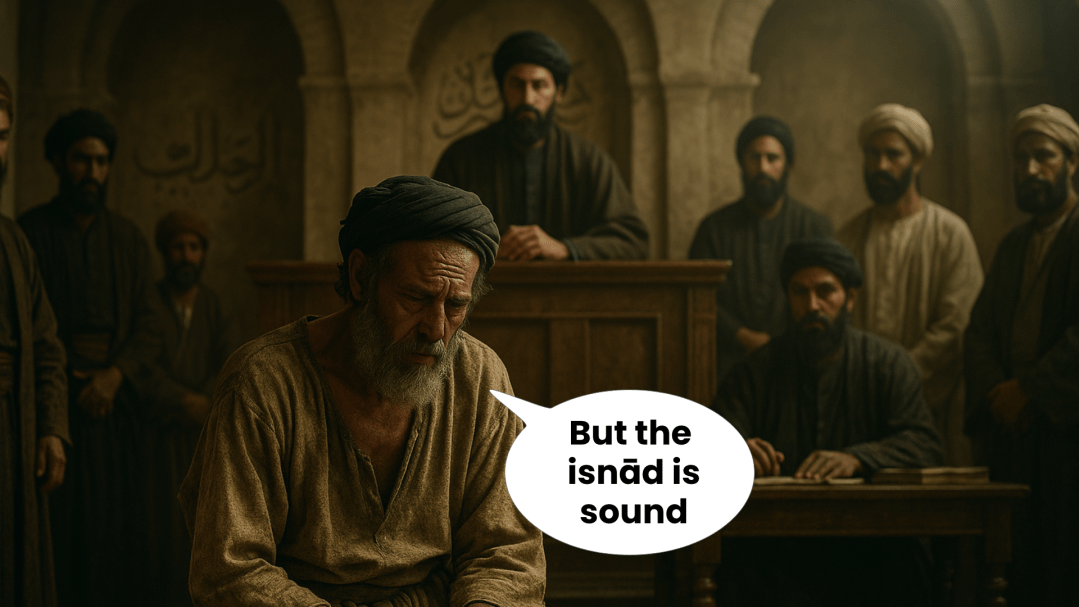
Abū al-Ḥasan Ibn Shanabūdh (d. 328/939) was a prominent Qurʾān reciter, scholar of Arabic language, and prayer leader based in Baghdad during the Abbasid era. Renowned for his deep knowledge of variant Qurʾānic readings (qirāʾāt) and for his extensive travels to study with leading Qurʾān masters, Ibn Shanabūdh enjoyed a respected scholarly reputation among his contemporaries. He was widely recognized for his piety, meticulousness, and trustworthiness in transmission.
Yet despite these credentials, Ibn Shanabūdh’s commitment to preserving and publicly reciting variant readings transmitted through sound isnāds—many of which differed from the now-canonical ʿUthmānic codex—ultimately placed him at odds with the emerging orthodoxy. His refusal to subordinate oral tradition to the authority of the written text would lead to his prosecution, public humiliation, and historical condemnation, making his story a pivotal example of the clash between oral transmission and written standardization in Islamic history.
The Trial: Isnād vs. the ʿUthmānic Codex
In 323/935, in the heart of the Abbasid capital, Ibn Shanabūdh was brought to trial for publicly reciting Qur’anic variants attributed to early companions such as Ibn Masʿūd and Ubayy b. Kaʿb—readings that diverged from the accepted ʿUthmānic recension. The driving force behind his prosecution was Ibn Mujāhid (d. 324/936), a key figure who is often credited with founding the canonical system of the Seven Readings (al-qirāʾāt al-sabʿ). Determined to enforce textual uniformity around the ʿUthmānic codex, Ibn Mujāhid considered the public recitation of anomalous readings a direct threat to the religious and social order.
Ibn Shanabūdh defended himself by arguing that every reading he recited had been transmitted through impeccable chains of narration. Yet his appeals to oral authenticity were ultimately disregarded. The reality made plain in his trial was that isnād—however sound—could not stand against the authority of the written text once consensus had been established. After being convicted, Ibn Shanabūdh was stripped, flogged, forced to publicly repent, and compelled to pledge that he would henceforth adhere strictly to the rasm of the ʿUthmānic codex. A formal document recording his retraction was prepared and witnessed the very next day.
Supremacy of the Written Text Over Oral Tradition
The ordeal of Ibn Shanabūdh reveals several layers of significance. Most crucially, it demonstrates that in practice, the written standard took precedence over oral transmission, regardless of the strength of its isnād. The broader Qurʾānic community (Qurrāʾ) rallied around the codified text, marginalizing any readings—even technically sound ones—that conflicted with the orthodoxy anchored in the written recension. In this environment, oral diversity was not seen as a sign of richness but as a destabilizing force that had to be suppressed to preserve a singular, authorized version of the sacred text.
Final Thoughts: A Challenge to Sunni Claims
The case of Ibn Shanabūdh offers a sobering reminder that religious orthodoxy in Islamic history was not simply the product of sound transmission (isnād), but was often forged through coercion, institutional pressure, and evolving consensus. Although Ibn Shanabūdh was widely respected for his immense knowledge of Qur’anic recitation and Arabic linguistics, his insistence on preserving variant readings through sound oral chains ultimately led to his downfall. His trial underscores the supremacy of the written text over oral tradition, the fragility of scholarly standing when challenged by institutional authority, and the uneasy relationship between textual preservation and theological conformity.
Most importantly, his inquisition reveals that even impeccable oral transmission could be—and was—rejected when it conflicted with the established consensus centered on the ʿUthmānic codex. This directly challenges the traditional Sunni claim that isnād alone guarantees authenticity. The story of Ibn Shanabūdh thus exposes the deeper tensions between oral and written transmission, the narrowing limits of tolerated diversity, and the powerful role of governmental enforcement in defining and preserving religious orthodoxy.
Sources:
Shady H. Nasser, The Second Canonization of the Qurʾān (324–635/936–1237): Ibn Mujāhid and the Founding of the Seven Readings (Leiden: Brill, 2020), 141–143.
Suheil I. Laher, Tawātur in Islamic Thought: Transmission, Certitude and Orthodoxy (Leiden: Brill, 2023), 1–2.
Related Articles:

 Quran Talk Blog
Salam,
You’ve brought up some very interesting things related to the quran, as an undergrad in Islamic studies, I mainly focus mainly on the Quran, judging by your posts I wanted to ask a few questions
-what’s your thoughts on the works of Shady H. Nasser?, do you find his work a bit problematic due to it being highly cited by polemicists
-are you perhaps aware of revisionist scholars such as Crone, cook, Wansborough etc?
-Do you perhaps have any book recommendations for someone who wants to look at the Quran seriously with an academic research lens, just so you know, I’m not really interested in traditional scholars like Muhammad Al azami
LikeLike
Join our discord server and God willing we can discuss. If you go on the voice channel you can ask one of the members to ping me or Hadith Critic if I’m not on.
https://discord.gg/submission
LikeLike
Salam,
Judging by your posts, as an undergrad in Islamic studies, I wanted to ask a few questions,
-what are your thoughts on the notion the Quran supposedly “plagerized” earlier sources, due to the multiple parallels of the Quran with earlier stories (such as the 7 sleeper stories, which is found in early Syriac Christian writing)
-do you perhaps know any book recommendations for someone wanting to look at the Quran with a critical historical academic lens?.. I don’t mind non Muslim scholars
-what are your thoughts on the works of Shady Nasser?, his work is highly weaponized by many Anti Islamic polemicists to discredit Islam,
LikeLike
Peace brother – excellent questions. You should join us on our discord server and we can discuss. We are usually pretty active on the voice chats but you can ask whoever is on to ping me or Hadith Critic and can discuss this in detail God wiling.
https://discord.gg/submission
LikeLike