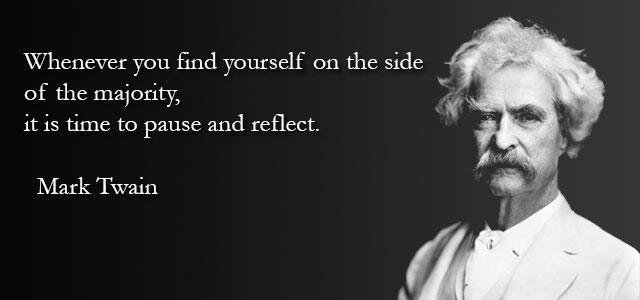
Mark Twain once remarked,
“Whenever you find yourself on the side of the majority, it is time to pause and reflect.”
While often cited as a critique of herd mentality, this principle is echoed repeatedly in the Quran—where majority opinion is not only unreliable, but a known path to misguidance.
The Quran Warns Against Following the Majority
The Quran explicitly states:
[12:103] Most people, no matter what you do, will not believe.
وَمَآ أَكْثَرُ ٱلنَّاسِ وَلَوْ حَرَصْتَ بِمُؤْمِنِينَ
This is not a minor warning—it is a divine statement about the nature of human civilization: the truth will always be held by a minority.
But it goes further. Even among those who profess belief, most do so while committing shirk (idolatry):
[12:106] The majority of those who believe in GOD do not do so without committing idol worship.
وَمَا يُؤْمِنُ أَكْثَرُهُم بِٱللَّهِ إِلَّا وَهُم مُّشْرِكُونَ
This dismantles the illusion that belief in God is sufficient for salvation, as James 2:19 in the Bible states.
19 You believe that there is one God. Good! Even the demons believe that—and shudder.
Sunni Islam Appeals to Majority—But God Warns Against It
Sunni Islam is the largest sect in the world, with nearly 2 billion followers, and often they cite their majority status as proof that they are divinely guided. Yet this is the very logic the Quran dismantles. The Quran directly warns:
[6:116] If you obey the majority of people on earth, they will divert you from the path of GOD. They follow only conjecture; they only guess.
وَإِن تُطِعْ أَكْثَرَ مَن فِى ٱلْأَرْضِ يُضِلُّوكَ عَن سَبِيلِ ٱللَّهِ إِن يَتَّبِعُونَ إِلَّا ٱلظَّنَّ وَإِنْ هُمْ إِلَّا يَخْرُصُونَ
The Quran doesn’t merely discourage following the majority—it condemns it as a path to misguidance. If truth was determined by numbers, then historically Christianity and Hinduism would have been more valid than Islam. The logic implodes on itself.
The Foundation of Sunni Islam: Guesswork and Contradiction
The Quran not only declares itself as the sole source of divine legislation (6:114–115), but it also explicitly warns against the fabrication of hadith-like narratives to mislead (6:112–113). Moreover, it provides a clear litmus test for truth:
[4:82] Why do they not study the Quran carefully? If it were from other than GOD, they would have found in it numerous contradictions.
أَفَلَا يَتَدَبَّرُونَ ٱلْقُرْءَانَ وَلَوْ كَانَ مِنْ عِندِ غَيْرِ ٱللَّهِ لَوَجَدُوا۟ فِيهِ ٱخْتِلَـٰفًا كَثِيرًا
This verse offers a simple, powerful test: God’s revelation is free from contradiction; falsehood is not. By this standard, the Quran stands unmatched. The Hadith corpus, by contrast, collapses under the weight of its own inconsistencies.
Sunni Islam has abandoned this Quranic criterion by elevating Hadith—texts written down centuries after the Prophet—as a parallel source of law. The result is a religion riddled with contradictions, both internal and external. Not only do Hadith frequently contradict the Quran, but they also contradict each other. This supports the well-known maxim: For every Hadith, there is an equal and opposite Hadith.
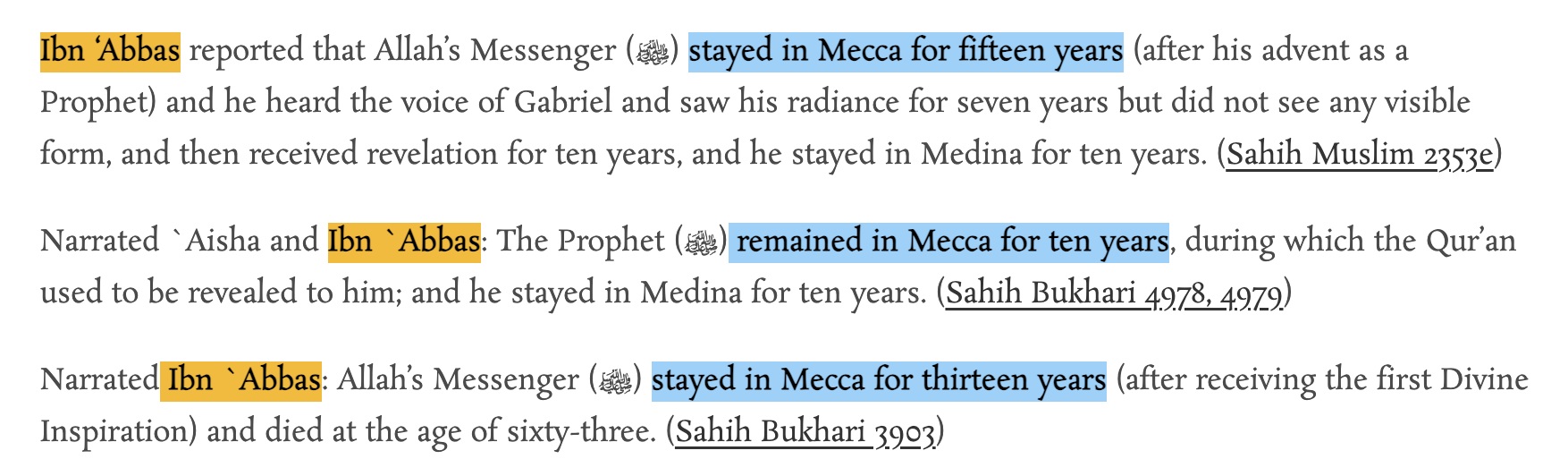
Take the question of how long the Prophet stayed in Mecca. Sahih narrations claim fifteen years, thirteen years, and ten years—all attributed to the same companion, Ibn ‘Abbas. Which is true? If these reports were divinely preserved, such discrepancies would not exist.
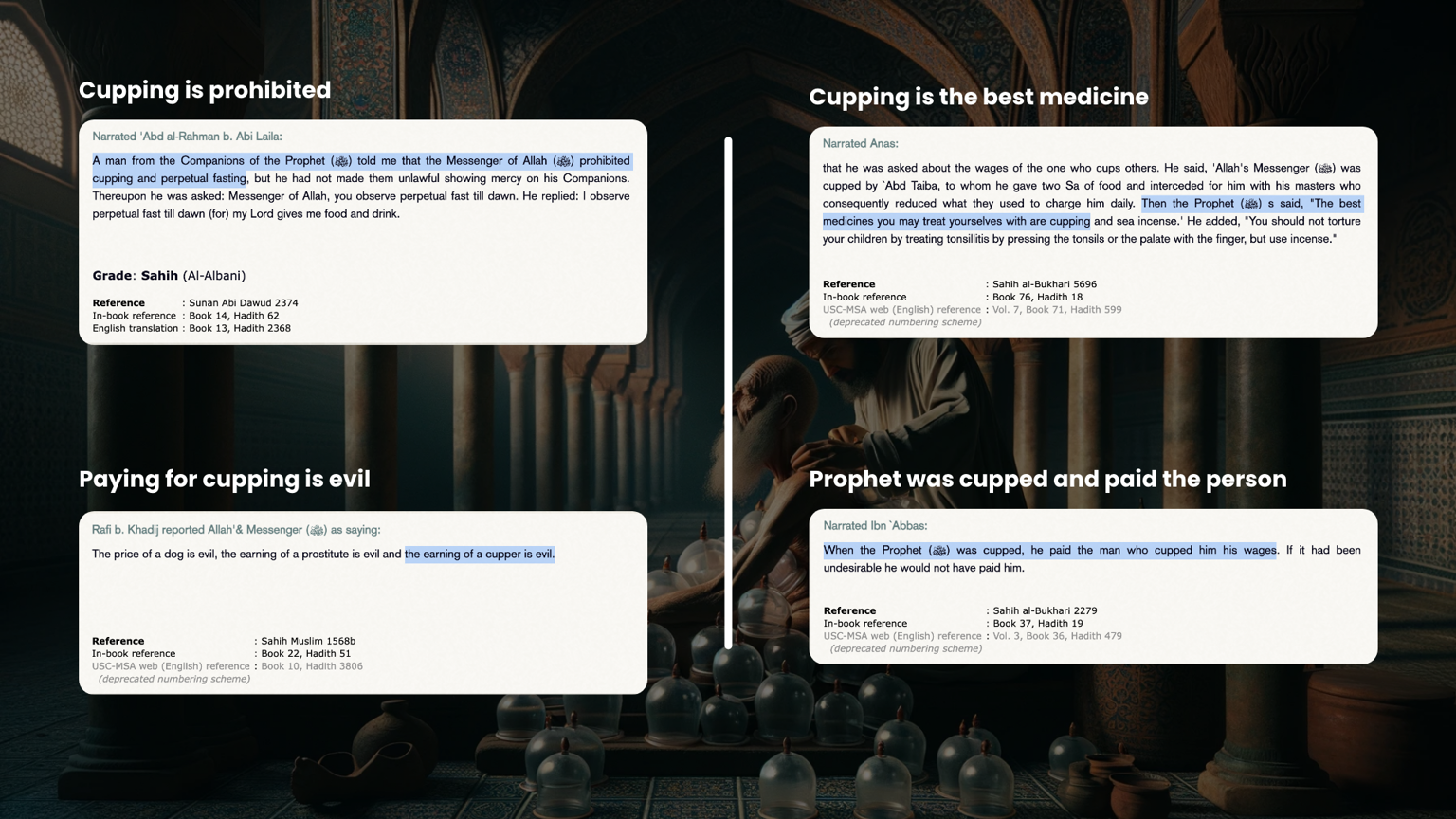
Or consider the practice of cupping (ḥijāmah). One Hadith states that the Prophet prohibited it. Another declares it the best medicine. One Hadith says paying for cupping is evil, while another says the Prophet paid the person who cupped him. These are not minor variations—they are direct contradictions.
Beyond internal inconsistency, Hadith routinely contradict clear Quranic laws. The Quran mentions only four dietary prohibitions (2:173, 5:3, 6:145, 16:115), yet Hadith layers on an ever-expanding list of forbidden foods. The Quran prescribes 100 lashes for adultery (24:2), while Hadith calls for stoning to death—a punishment never mentioned in God’s Book. The Quran says, “There is no compulsion in religion” (2:256), yet Hadith commands the execution of apostates.
These are not harmless differences. They are theological fractures—clear evidence that Hadith cannot be from God. And if they are not from God, then they must be rejected.
Shirk Isn’t Just Idolatry—It’s Taking Others as Lawgivers Besides God
Many Sunnis mistakenly believe that shirk (idol worship) is limited to bowing before statues or worshiping physical idols. However, the Quran offers a much broader—and more penetrating—definition: shirk includes elevating the rulings or opinions of others above the words of God.
[9:31] They have set up their religious leaders and scholars as lords, instead of GOD. Others deified the Messiah, son of Mary. They were all commanded to worship only one god. There is no god except He. Be He glorified, high above having any partners.
ٱتَّخَذُوٓا۟ أَحْبَارَهُمْ وَرُهْبَـٰنَهُمْ أَرْبَابًا مِّن دُونِ ٱللَّهِ وَٱلْمَسِيحَ ٱبْنَ مَرْيَمَ وَمَآ أُمِرُوٓا۟ إِلَّا لِيَعْبُدُوٓا۟ إِلَـٰهًا وَٰحِدًا لَّآ إِلَـٰهَ إِلَّا هُوَ سُبْحَـٰنَهُۥ عَمَّا يُشْرِكُونَ
This verse shows that setting up religious leaders as authorities in place of God’s own commandments constitutes a form of idolatry—even if unintentionally. It is not the act of worship alone, but obedience in contradiction to divine law that constitutes shirk.
[6:121] Do not eat from that upon which the name of GOD has not been mentioned, for it is an abomination. The devils inspire their allies to argue with you; if you obey them, you will be idol worshipers.
وَلَا تَأْكُلُوا۟ مِمَّا لَمْ يُذْكَرِ ٱسْمُ ٱللَّهِ عَلَيْهِ وَإِنَّهُۥ لَفِسْقٌ وَإِنَّ ٱلشَّيَـٰطِينَ لَيُوحُونَ إِلَىٰٓ أَوْلِيَآئِهِمْ لِيُجَـٰدِلُوكُمْ وَإِنْ أَطَعْتُمُوهُمْ إِنَّكُمْ لَمُشْرِكُونَ
The warning is explicit: obedience to any authority that contradicts God’s command is shirk. To follow the rulings of scholars, jurists, or Hadith that override or oppose the Quran is to elevate those human sources to the level of divine authority.
This is exactly what Hadith-based Islam does. It introduces a parallel legal system beside God’s perfected Book—often contradicting it—thereby falling squarely into the very definition of shirk that the Quran warns against.
The Truth is Never Popular
The Quran’s message is consistent, repeated, and unflinching: truth has never been with the majority. The righteous have always been few, the grateful even fewer:
[34:13] “Very few of My servants are appreciative.”
وَقَلِيلٌ مِّنْ عِبَادِىَ ٱلشَّكُورُ
So the fact that Sunni Islam is the largest sect in the world isn’t a sign of divine approval—it’s a fulfillment of divine warning.
The truth is not voted into existence, nor determined by the majority.
The Quran doesn’t call us to follow the crowd.
It calls us to follow the light.
The Other Extreme: Following The Religion of One
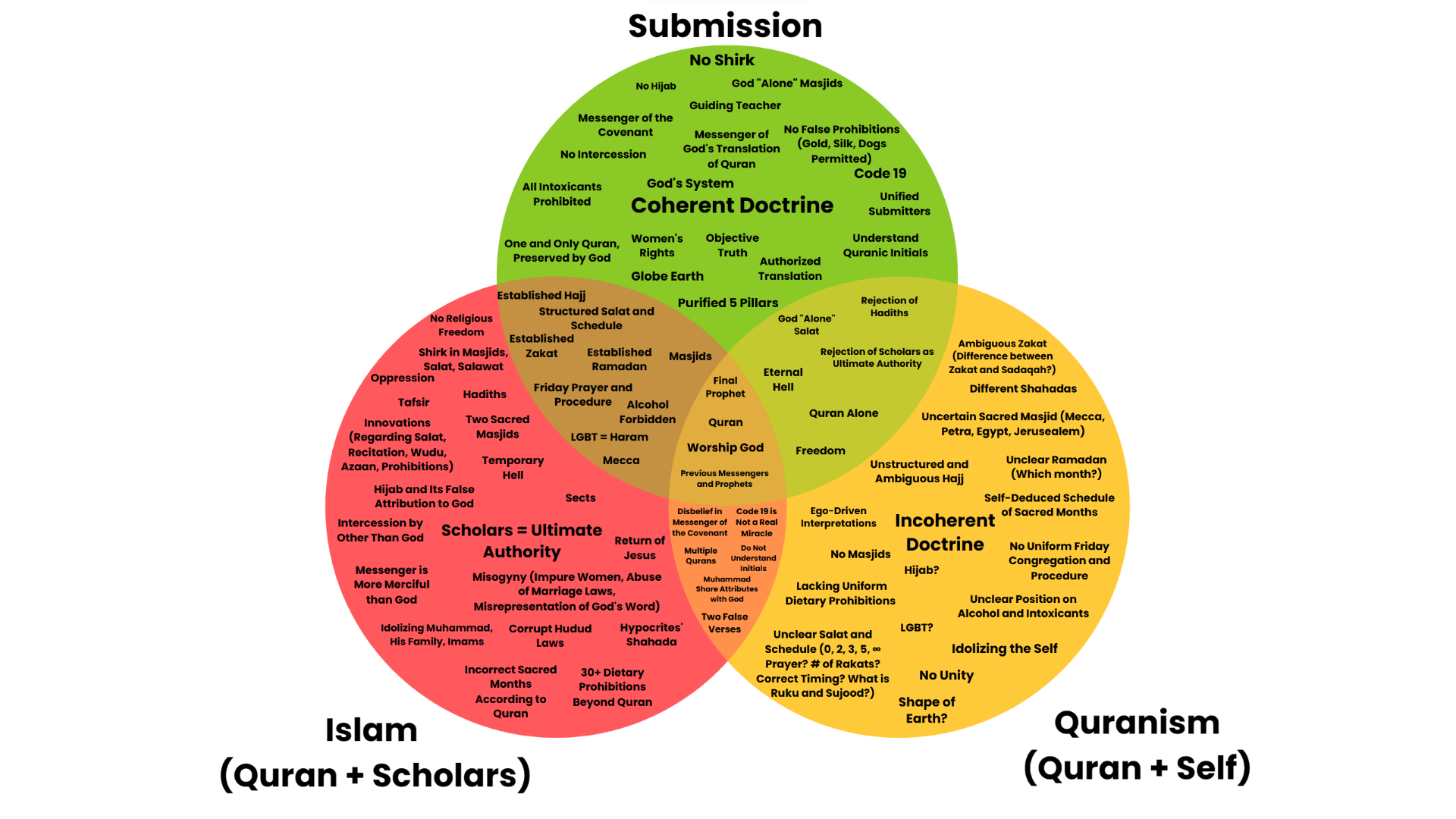
So, while questioning when one finds themselves on the side of the majority is often necessary, there is also another extreme that is just as dangerous: the worship of one’s own opinion.
If blindly following the crowd is a path to misguidance, then blindly following one’s own opinion is also a path to ruin. The Quran repeatedly condemns those who elevate their own egos, whims, and personal interpretations over the truth:
[25:43] Have you seen the one whose god is his own ego? Will you be his advocate?
أَرَءَيْتَ مَنِ ٱتَّخَذَ إِلَـٰهَهُۥ هَوَىٰهُ أَفَأَنتَ تَكُونُ عَلَيْهِ وَكِيلًا
[45:23] Have you noted the one whose god is his ego? Consequently, GOD sends him astray, despite his knowledge, seals his hearing and his mind, and places a veil on his eyes. Who then can guide him, after such a decision by GOD? Would you not take heed?
أَفَرَءَيْتَ مَنِ ٱتَّخَذَ إِلَـٰهَهُۥ هَوَىٰهُ وَأَضَلَّهُ ٱللَّهُ عَلَىٰ عِلْمٍ وَخَتَمَ عَلَىٰ سَمْعِهِۦ وَقَلْبِهِۦ وَجَعَلَ عَلَىٰ بَصَرِهِۦ غِشَـٰوَةً فَمَن يَهْدِيهِ مِنۢ بَعْدِ ٱللَّهِ أَفَلَا تَذَكَّرُونَ
This is the other side of the spectrum: those who fabricate a new religion—not because they were misled by tradition or society, but because they crowned their own intellect as divine. And one of the clearest signs of this ego-worship is when a person’s interpretation of the Quran is so uniquely personalized that no other human being, past or present, shares it. If no prophet, no messenger, no generation, and no believer throughout history has held that view, it’s a serious red flag.
This is the trap many Quranists have fallen into. While some began with sincere intentions—rejecting Hadith to purify their practice—they ended up unraveling even the most universally understood pillars of Submission. They begin by discarding unreliable traditions, but some go on to reinterpret foundational terms like Salat and Zakat into something unrecognizable.
Yet these are not obscure doctrines—Salat and Zakat are the most mass-transmitted religious practices in the history of humanity. Every prophet after Abraham performed them. Every nation of believers practiced them. In fact, these rituals are more mass-transmitted than the Quran itself—because while not every believer memorized or transcribed the full Quran, every believer prayed the Contact Prayer (Salat) and gave the Obligatory Charity (Zakat). If such practices are doubted, how can the meaning of any term in the Quran be trusted?
Despite the Quran’s repeated command to establish Salat and give Zakat, some modern Quranists claim that Salat is not a ritual prayer at all, or that Zakat is not a financial obligation. New, self-invented theories arise. And the result? Total disunity where you won’t find two Quranists on Earth who perform Salat the same way—or even agree on what it is. That level of fragmentation isn’t enlightenment. It’s chaos masquerading as scholarship.
In their zeal to reject tradition, many fall into the inverse trap: assuming that whatever the traditionalists do must be wrong, and therefore the opposite must be right. The irony is striking: in fleeing from the errors of majority rule, they have landed in the pitfall of individual egoism—a privatized religion untethered from any reality.
Quranist Claim Reformation When In Reality It is Distortion
One of the most striking warnings in the Quran is not just about those who follow the crowd, but about those who corrupt the truth under the guise of reform.
[2:8] Then there are those who say, “We believe in GOD and the Last Day,” while they are not believers.
[2:9] In trying to deceive GOD and those who believe, they only deceive themselves without perceiving.
[2:10] In their minds there is a disease. Consequently, GOD augments their disease. They have incurred a painful retribution for their lying.
[2:11] When they are told, “Do not commit evil,” they say, “But we are reformers!”
[2:12] In fact, they are evildoers, but they do not perceive.
[2:13] When they are told, “Believe like the people who believed,” they say, “Shall we believe like the fools who believed?” In fact, it is they who are fools, but they do not know.
[2:14] When they meet the believers, they say, “We believe,” but when alone with their devils, they say, “We are with you; we were only mocking.”
[2:15] GOD mocks them, and leads them on in their transgressions, blundering.
[2:16] It is they who bought the straying, at the expense of guidance. Such trade never prospers, nor do they receive any guidance.(٨) وَمِنَ ٱلنَّاسِ مَن يَقُولُ ءَامَنَّا بِٱللَّهِ وَبِٱلْيَوْمِ ٱلْـَٔاخِرِ وَمَا هُم بِمُؤْمِنِينَ
(٩) يُخَـٰدِعُونَ ٱللَّهَ وَٱلَّذِينَ ءَامَنُوا۟ وَمَا يَخْدَعُونَ إِلَّآ أَنفُسَهُمْ وَمَا يَشْعُرُونَ
(١٠) فِى قُلُوبِهِم مَّرَضٌ فَزَادَهُمُ ٱللَّهُ مَرَضًا وَلَهُمْ عَذَابٌ أَلِيمٌۢ بِمَا كَانُوا۟ يَكْذِبُونَ
(١١) وَإِذَا قِيلَ لَهُمْ لَا تُفْسِدُوا۟ فِى ٱلْأَرْضِ قَالُوٓا۟ إِنَّمَا نَحْنُ مُصْلِحُونَ
(١٢) أَلَآ إِنَّهُمْ هُمُ ٱلْمُفْسِدُونَ وَلَـٰكِن لَّا يَشْعُرُونَ
(١٣) وَإِذَا قِيلَ لَهُمْ ءَامِنُوا۟ كَمَآ ءَامَنَ ٱلنَّاسُ قَالُوٓا۟ أَنُؤْمِنُ كَمَآ ءَامَنَ ٱلسُّفَهَآءُ أَلَآ إِنَّهُمْ هُمُ ٱلسُّفَهَآءُ وَلَـٰكِن لَّا يَعْلَمُونَ
(١٤) وَإِذَا لَقُوا۟ ٱلَّذِينَ ءَامَنُوا۟ قَالُوٓا۟ ءَامَنَّا وَإِذَا خَلَوْا۟ إِلَىٰ شَيَـٰطِينِهِمْ قَالُوٓا۟ إِنَّا مَعَكُمْ إِنَّمَا نَحْنُ مُسْتَهْزِءُونَ
(١٥) ٱللَّهُ يَسْتَهْزِئُ بِهِمْ وَيَمُدُّهُمْ فِى طُغْيَـٰنِهِمْ يَعْمَهُونَ
(١٦) أُو۟لَـٰٓئِكَ ٱلَّذِينَ ٱشْتَرَوُا۟ ٱلضَّلَـٰلَةَ بِٱلْهُدَىٰ فَمَا رَبِحَت تِّجَـٰرَتُهُمْ وَمَا كَانُوا۟ مُهْتَدِينَ
These verses capture the spiritual delusion of those who alter the religion of God while convincing themselves they are purifying it. They strip away inherited practices, uproot universally understood terms like Salat and Zakat, and rebuild the religion based solely on their own isolated interpretations. They call it reform. But the Quran calls it corruption.
This is the tragic irony: those who believe they are enlightened reformers are, in fact, the very corrupters the Quran describes—those who trade guidance for misguidance, and truth for delusion.
Rather than following the path of the believers, they isolate themselves and construct an entirely privatized religion. In this process, even the most basic pillars of submission are reinvented to the point of being unrecognizable. The religion they now follow bears little resemblance to what God actually revealed. And in doing so, they become the very people God warned us about.
The problem is not in questioning Hadith or rejecting sectarian tradition—those are legitimate and necessary endeavors. The problem is when such critique is taken so far that it becomes a justification to rebuild the religion from scratch, according to one’s own opinion, without divine authority.
The Quran is an Owner’s Manual, Not A DIY Manual
One of the greatest areas of confusion—among both Sunni traditionalists and Quranists—is the practice of Salat (the Contact Prayer). The error, however, is not always in what is believed, but in how the Quran is approached.
A common mistake made by many Quranists is treating the Quran like a Do-It-Yourself manual—as if every single practice must be reconstructed from scratch using only what’s written in its pages. They argue that unless the Quran explicitly details every component of an act, the act cannot be part of God’s religion. But this is a faulty assumption. The Quran was not sent to create a new religion from the ground up—it was sent to purify an already existing one, passed down from Abraham and known among the believers.
[16:123] Then we inspired you (Muhammad) to follow the religion of Abraham, the monotheist; he never was an idol worshiper.
ثُمَّ أَوْحَيْنَآ إِلَيْكَ أَنِ ٱتَّبِعْ مِلَّةَ إِبْرَٰهِيمَ حَنِيفًا وَمَا كَانَ مِنَ ٱلْمُشْرِكِينَ
In truth, the Quran functions not as a DIY manual, but as an owner’s manual. It assumes the existence of certain practices, terminology, and religious structures—and corrects them where they’ve been distorted. It does not pause to define every concept because it speaks to an audience that already possesses that foundational framework. For example, there are hundreds of words in the Quran that appear only once. Many of them cannot be cross-referenced internally, which indicates that the text presupposes the reader’s preexisting understanding of language and context. Occasionally, the Quran will introduce a term and then define it—“Do you know what Sijjeen is?” (83:8) or “Do you know what al-Tareq is?” (86:2)—but these are exceptions, not the rule.
Thus, when the Quran commands believers to establish the Salat, it does so without explanation, because the act of Salat was already established. The Quran is not trying to reinvent the wheel. It is here to remove the rust.
[16:64] We have revealed this scripture to you, to point out for them what they dispute, and to provide guidance and mercy for people who believe.
وَمَآ أَنزَلْنَا عَلَيْكَ ٱلْكِتَـٰبَ إِلَّا لِتُبَيِّنَ لَهُمُ ٱلَّذِى ٱخْتَلَفُوا۟ فِيهِ وَهُدًى وَرَحْمَةً لِّقَوْمٍ يُؤْمِنُونَ
The Sunni Misstep: Incomplete and Contradictory Reliance on Hadith
On the other end of the spectrum, Sunnis claim that the details of Salat come from Hadith. But this is both historically and logically flawed. Nowhere in the vast Hadith corpus is there a single authentic narration that outlines Salat from start to finish. Even if one were to stitch together the scattered narrations on prayer, the result would be a conflicting patchwork. For example, scholars disagree on whether the Basmala should be recited aloud, silently, or omitted altogether when reciting Surah Al-Fātiḥah.
This renders the common Sunni challenge to Quran-alone followers—“How do you pray without Hadith?”—deeply ironic. Because even with Hadith, they still don’t agree on how to perform Salat.
Worse still, even when the Quran explicitly details part of the practice—such as ablution in 5:6—Sunnis ignore it in favor of contradictory Hadith, exposing the true motivation behind their objection: it’s not about precision, it’s about allegiance to inherited tradition, not the Quran. As the Quran states:
[25:30] The messenger said, “My Lord, my people have deserted this Quran.”
وَقَالَ ٱلرَّسُولُ يَـٰرَبِّ إِنَّ قَوْمِى ٱتَّخَذُوا۟ هَـٰذَا ٱلْقُرْءَانَ مَهْجُورًا
The Middle Path: Restoration, Not Reinvention
The proper approach is not to discard Salat or reinvent it from the ground up, nor is it to blindly follow contradictory Hadith. Rather, we return to the Quran to purify and realign the inherited practice with divine standards.
Therefore, we begin with what is already universally established, which is performed by the masses, and then we utilize the Quran to purify this practice. For example:
- Salat must be dedicated to God alone (Q6:162), unlike Sunni practices that include the Prophet (e.g., Tirmidhi 2457).
- Recitation should be in a moderate tone (Q17:110), not silent during noon and afternoon prayers as Sunnis practice.
- The full Fateah, including the Basmalah, must be recited, which Sunnis omit.
- The proper Shahada is recited that of God, the angels, and the knowledgeable is that there is no god beside God (Q 3:18), and this was the Shahadah of Muhammad (Q 47:19). Therefore, the Shahada should only include God and exclude the Prophet or others.
- No other entities should be invoked during Salat (Q72:18–20); this eliminates calling upon the prophet or any other entities besides God. Like when Sunnis say: as-salāmu ʿalayka ʾayyuhā n-nabiyyu (Peace be upon you, O Prophet)
In every case, the Quran restores purity to what has been altered. It does not deconstruct Salat; it reorients it—removing human innovations and re-centering the practice around God alone.
For a more detailed instruction on the Salat based on the Quran alone check out the following resource.
Conclusion
Truth is not with the majority simply because they are many. Nor is it with the isolated individual simply because he is different. Both extremes are condemned by the Quran: the blind follower who surrenders his mind to inherited conjecture, and the arrogant thinker who exalts his own opinion as the ultimate authority.
The Quran urges us to neither idolize the masses nor deify ourselves.
On one side are those who follow religious leaders, books of Hadith, and inherited law even when it contradicts the clear verses of God’s Book. They appeal to their numbers, tradition, and authority. But the Quran tells us: “If you follow the majority of those on Earth, they will divert you from the path of God.” (6:116)
On the other side are those who tear down tradition only to replace it with personal innovation—those who, rejecting falsehood, go so far as to redefine even the most foundational aspects of Submission. They claim reform, but what they offer is often distortion born of ego. And the Quran warns us: “Have you seen the one who takes his own desire as his god?” (25:43)
The path of truth is not found in extremes—it is found in sincere submission to God alone, guided by His Book, with humility and continuity. The Quran is our only divine authority. But it must be read in light of the truth God already established in His scripture, not through the fickle whims of the crowd or the isolated ego of the individual.
God’s path is the middle path (2:143). It is walked not by the masses, nor by the self-exalted, but by those who tremble before Him, study His word with reverence, and live by it in spirit and in truth.
[6:153] This is My path—a straight one. You shall follow it, and do not follow any other paths, lest they divert you from His path. These are His commandments to you, that you may be saved.
وَأَنَّ هَـٰذَا صِرَٰطِى مُسْتَقِيمًا فَٱتَّبِعُوهُ وَلَا تَتَّبِعُوا۟ ٱلسُّبُلَ فَتَفَرَّقَ بِكُمْ عَن سَبِيلِهِۦ ذَٰلِكُمْ وَصَّىٰكُم بِهِۦ لَعَلَّكُمْ تَتَّقُونَ
So if you find yourself aligned with the Sunni majority, that alone should prompt serious re-examination—because the Quran warns repeatedly against following the majority. But on the other hand, if you find yourself in a religion of one—holding beliefs that no one else in the world shares—then unless you believe that you alone have been chosen by God to the exclusion of all others, it is a clear sign that you are following your ego, not divine guidance.

 Quran Talk Blog