
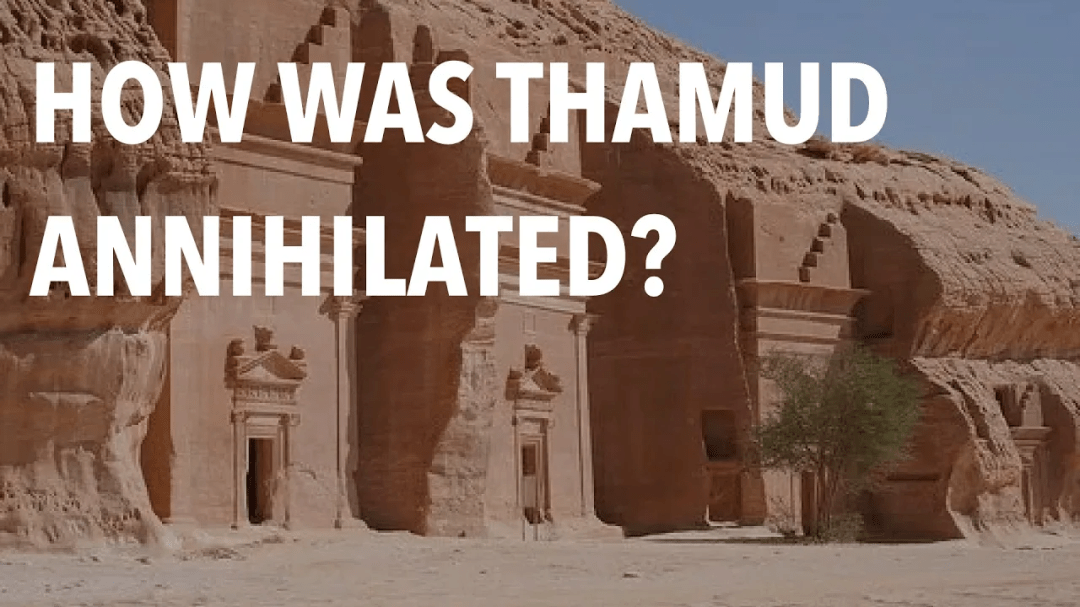
The Quran recounts the annihilation of five ancient communities who had gone so far astray that redemption was no longer an option. These societies all shared a common pattern: they rejected the “3 Ms”: the messenger, the message, and the miracle God provided. Among these communities were the people of Noah, Hud, Ṣāliḥ, Lot, and Shuʿaib—their destruction, in this exact order, is recounted together in Surahs 7, 11, and 26.
Each case represents a unique form of divine retribution. Noah’s people were drowned in a flood. The people of ʿĀd were wiped out by a furious windstorm. Lot’s people perished under a rain of stones. Shuʿaib’s people fell in a violent earthquake. But what about Thamud—the people of Ṣāliḥ? What exactly destroyed them?
The Quran appears to describe multiple, seemingly distinct phenomena: a quake, a blast, lightning, and a morning disaster. At first glance, these might seem inconsistent. But taken together—and understood in light of modern physics and geology—they point to a single, extraordinary natural event.
Warnings Ignored
Ṣāliḥ was sent to Thamud with a message of reform. He urged them to turn to God, to cease their corruption, and reminded them of their blessings: gardens, springs, and homes carved securely into mountain rock. He brought a miracle—a camel that was not to be harmed. But they rebelled. Thus, Thamud’s downfall followed a familiar pattern. The arrogant leaders dismissed Ṣāliḥ’s message, attempted to destroy his miracle, and demanded punishment if he was truthful.
[11:65] They slaughtered her. He then said, “You have only three days to live. This is a prophecy that is inevitable.”
فَعَقَرُوهَا فَقَالَ تَمَتَّعُوا۟ فِى دَارِكُمْ ثَلَـٰثَةَ أَيَّامٍ ذَٰلِكَ وَعْدٌ غَيْرُ مَكْذُوبٍ
This countdown would mark the end of their civilization.
Thamud’s Account Based on Sura 7, 11, & 26
[7:73] To Thamûd we sent their brother Sãleh. He said, “O my people, worship GOD; you have no other god beside Him. Proof has been provided for you from your Lord: here is GOD’s camel, to serve as a sign for you. Let her eat from GOD’s land, and do not touch her with any harm, lest you incur a painful retribution. [7:74] “Recall that He made you inheritors after ‘Ãd, and established you on earth, building mansions in its valleys, and carving homes from its mountains. You shall remember GOD’s blessings, and do not roam the earth corruptingly.” [7:75] The arrogant leaders among his people said to the common people who believed, “How do you know that Sãleh is sent by his Lord?” They said, “The message he brought has made us believers.” [7:76] The arrogant ones said, “We disbelieve in what you believe in.” [7:77] Subsequently, they slaughtered the camel, rebelled against their Lord’s command, and said, “O Sãleh, bring the doom you threaten us with, if you are really a messenger.” [7:78] Consequently, the quake annihilated them, leaving them dead in their homes. [7:79] He turned away from them, saying, “O my people, I have delivered my Lord’s message to you, and advised you, but you do not like any advisers.”
[11:61] To Thamûd we sent their brother Sãleh. He said, “O my people, worship GOD; you have no other god beside Him. He initiated you from the earth, then settled you in it. You shall seek His forgiveness, then repent to Him. My Lord is always near, responsive.” [11:62] They said, “O Sãleh, you used to be popular among us before this. Are you enjoining us from worshiping what our parents are worshiping? We are full of doubt concerning everything you have told us.” [11:63] He said, “O my people, what if I have solid proof from my Lord, and mercy from Him? Who would support me against GOD, if I disobeyed Him? You can only augment my loss. [11:64] “O my people, this is GOD’s camel to serve as a proof for you. You shall let her eat from GOD’s earth, and do not touch her with any harm, lest you incur an immediate retribution.” [11:65] They slaughtered her. He then said, “You have only three days to live. This is a prophecy that is inevitable.” [11:66] When our judgment came, we saved Sãleh and those who believed with him by mercy from us, from the humiliation of that day. Your Lord is the Most Powerful, the Almighty. [11:67] Those who transgressed were annihilated by the disaster, leaving them in their homes, dead. [11:68] It was as if they never lived there. Indeed, Thamûd have rejected their Lord. Absolutely, Thamûd have incurred their annihilation.
[26:141] Thamûd disbelieved the messengers. [26:142] Their brother Sãleh said to them, “Would you not be righteous? [26:143] “I am an honest messenger to you. [26:144] “You shall reverence GOD, and obey me. [26:145] “I do not ask you for any wage; my wage comes only from the Lord of the universe. [26:146] “Do you suppose you will be left forever, secure in this state? [26:147] “You enjoy gardens and springs. [26:148] “And crops and date palms with delicious fruits. [26:149] “You carve out of the mountains luxurious mansions. [26:150] “You shall reverence GOD, and obey me. [26:151] “Do not obey the transgressors. [26:152] “Who commit evil, not good works.” [26:153] They said, “You are bewitched. [26:154] “You are no more than a human like us. Produce a miracle, if you are truthful.” [26:155] He said, “Here is a camel that will drink only on a day that is assigned to her; a day that is different from your specified days of drinking. [26:156] “Do not touch her with any harm, lest you incur retribution on an awesome day.” [26:157] They slaughtered her, and thus incurred sorrow. [26:158] The retribution overwhelmed them. This should be a lesson, but most people are not believers. [26:159] Most assuredly, your Lord is the Almighty, Most Merciful.
Multiple Descriptions, One Catastrophe
The Quran describes their annihilation using several terms:
A powerful earthquake:
[7:78] Consequently, the quake annihilated them, leaving them dead in their homes.
فَأَخَذَتْهُمُ ٱلرَّجْفَةُ فَأَصْبَحُوا۟ فِى دَارِهِمْ جَـٰثِمِينَ
A lightning strike:
[51:44] They rebelled against the command of their Lord. Consequently, the lightning struck them as they looked.
فَعَتَوْا۟ عَنْ أَمْرِ رَبِّهِمْ فَأَخَذَتْهُمُ ٱلصَّـٰعِقَةُ وَهُمْ يَنظُرُونَ
| 1 | faʿataw | فَعَتَوْا۟ | But they rebelled |
| 2 | ʿan | عَنْ | against |
| 3 | amri | أَمْرِ | (the) command |
| 4 | rabbihim | رَبِّهِمْ | (of) their Lord, |
| 5 | fa-akhadhathumu | فَأَخَذَتْهُمُ | so [it] struck them |
| 6 | l-ṣāʿiqatu | ٱلصَّـٰعِقَةُ | the lightning |
| 7 | wahum | وَهُمْ | while they |
| 8 | yanẓurūna | يَنظُرُونَ | [they] look. |
A thunderous blast:
[69:5] As for Thamûd, they were annihilated by the devastating (quake).
فَأَمَّا ثَمُودُ فَأُهْلِكُوا۟ بِٱلطَّاغِيَةِ
| 1 | fa-ammā | فَأَمَّا | So as for |
| 2 | thamūdu | ثَمُودُ | Thamud, |
| 3 | fa-uh’likū | فَأُهْلِكُوا۟ | so they were annihilated |
| 4 | bil-ṭāghiyati | بِٱلطَّاغِيَةِ | by the thunderous blast / lightning. |
In the early morning:
[15:83] The disaster (blast) hit them in the morning.
فَأَخَذَتْهُمُ ٱلصَّيْحَةُ مُصْبِحِينَ
| 1 | fa-akhadhathumu | فَأَخَذَتْهُمُ | So [it] struck them |
| 2 | l-ṣayḥatu | ٱلصَّيْحَةُ | [the] blast / disaster |
| 3 | muṣ’biḥīna | مُصْبِحِينَ | (at) early morning, |
Leaving their bodies like dried hay:
[54:31] We sent upon them one blow, whereupon they became like harvested hay.
إِنَّآ أَرْسَلْنَا عَلَيْهِمْ صَيْحَةً وَٰحِدَةً فَكَانُوا۟ كَهَشِيمِ ٱلْمُحْتَظِرِ
| 1 | innā | إِنَّآ | Indeed, [we] |
| 2 | arsalnā | أَرْسَلْنَا | we sent |
| 3 | ʿalayhim | عَلَيْهِمْ | upon them |
| 4 | ṣayḥatan | صَيْحَةً | blast / blow |
| 5 | wāḥidatan | وَٰحِدَةً | single, |
| 6 | fakānū | فَكَانُوا۟ | and they became |
| 7 | kahashīmi | كَهَشِيمِ | like dry twig fragments / harvested hay |
| 8 | l-muḥ’taẓiri | ٱلْمُحْتَظِرِ | (used by) the fence builder / the one who builds enclosures. |
They died instantly, within their homes, at dawn, and their bodies were completely desiccated, leaving their mountain-carved residences eerily untouched.
Summary of what we know
- They were in their homes (11:67)
[11:67] Those who transgressed were annihilated by the disaster, leaving them in their homes, dead.
- Their homes were carved in mountains (7:74)
[7:74] “Recall that He made you inheritors after ‘Ãd, and established you on earth, building mansions in its valleys, and carving homes from its mountains.
- The quake annihilated them (7:78)
[7:78] Consequently, the quake annihilated them, leaving them dead in their homes.
- The event occured in the morning (15:83)
[15:83] The disaster hit them in the morning.
- But before they were annihilated, they saw lightning (51:44)
[51:44] They rebelled against the command of their Lord. Consequently, the lightning struck them as they looked.
- Their homes survived because we have their ruins (29:38)
[29:38] Similarly, ‘Ãd and Thamûd (were annihilated). This is made manifest to you through their ruins.
- And whatever the event was left them like dried harvested hay (54:31)
[54:31] We sent upon them one blow, whereupon they became like harvested hay.
The picture is precise: a sudden, deadly event occurred in a specific type of geological environment, reducing the people to dried husks while preserving the structures around them.
Clues in the Ground: Geology and Ancient Architecture
Modern geology helps us interpret these signs. In recent decades, scientists have studied a phenomenon known as earthquake lights—flashes of light or glowing orbs that appear before or during seismic events. These are thought to result from intense electric fields produced when tectonic stress builds and fractures the rock.
Additionally, the region associated with Thamud—Mada’in Ṣāliḥ (Al-Ḥijr)—is composed of quartz-rich sandstone, a material known for its piezoelectric properties. Quartz produces an electric charge when subjected to mechanical stress, such as the intense pressures of tectonic movement.
In the case of Thamud, their homes were literally carved into this type of stone. On the morning of their destruction, the natural condensation and moisture inside these rock-hewn dwellings would have made the environment and their homes highly conductive.
Electrified Annihilation: The Scientific Explanation
Put the details together:
- The people were inside quartz-lined rock homes at dawn.
- The surfaces were likely damp with morning condensation.
- A powerful earthquake triggered by tectonic stress struck the region.
- This stress generated intense electric fields through the piezoelectric effect.
- These fields discharged, creating lightning-like arcs, electrical surges, and blasts of sound.
The electrical energy passed through the moist rock and into the bodies of the inhabitants, cooking them alive from the inside out. Like victims of modern electrocution, their bodies would have rapidly desiccated due to thermal energy, leaving behind dry, brittle remains.
Like an electric chair, the energy would pass through the moisture in the body, converting it into thermal energy, literally cooking them from within. Historical electrocutions show that victims’ bodies can retain enough heat to cause burns even minutes later. In extreme cases, bodies may catch fire, or become completely desiccated—just as the Quran describes the people of Thamud becoming like “harvested hay” (54:31).
Their homes, once their source of protection, became deadly traps, conduits for a thermal and electrical catastrophe.
The Quran also mentions ṣāʿiqah—a thunderous blast, or stunning sound (51:44, 41:17). The Arabic term comes from a root that can imply thunder, lightning, or something that stuns. When high-voltage arcs or explosions occur in enclosed, rocky spaces, the acoustic shockwaves can be as devastating as the heat.
This would explain the auditory trauma and instant death, leaving them motionless in place—“They could never get up, nor were they helped.” (51:45)
Conclusion: A Divine Punishment, a Natural Mechanism
The Quran describes Thamud’s annihilation using multiple terms: an earthquake, a lightning strike, a thunderous blast, and a morning disaster. While these may initially appear to be separate phenomena, when viewed through the lens of modern geology and material science, they converge into a single catastrophic event. This event likely involved a powerful earthquake in a quartz-rich region which, under tectonic stress, generated intense electrical charges. The moisture within Thamud’s rock-carved dwellings acted as a conductor, turning their homes into lethal enclosures that electrocuted the inhabitants alive. Their bodies, dehydrated by internal heat, were left like brittle harvested hay—while their homes remained eerily intact.
Thamud’s destruction was not a contradiction of multiple punishments—it was a complex, natural convergence of geological and atmospheric forces: earthquake, piezoelectric discharge, and thermal-electrical trauma. It was an event that entirely aligns with what we know about earthquakes and piezoelectric material—yet perfectly aligned with divine justice.
The miracle was not just the warning delivered by Ṣāliḥ or the sign of the camel, but also the precise timing and nature of the catastrophe itself. Like the people of Sheba, whose fertile lands were destroyed by the very floodwaters that once sustained them, or Pharaoh’s people, who drowned in the sea over which he claimed dominion, God’s retribution came through the very blessings He had bestowed. These gifts, when met with arrogance and ingratitude, became the instruments and curse of their destruction.
The story of Thamud is a reminder. It is not only about their destruction—but about the predictable consequences of arrogance, ingratitude, and rebellion against truth. Their ruins remain as a sign: God’s justice leaves traces—both moral and material—for those who reflect.
Originally Published 2019

 Quran Talk Blog