
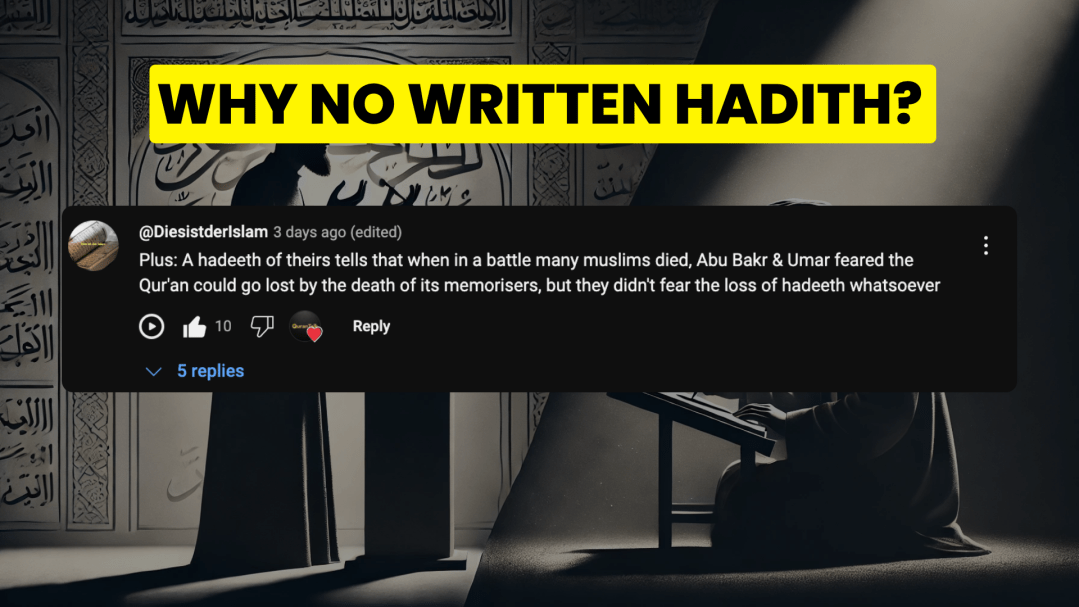
A user on YouTube pointed out an interesting observation in response to a video on why the Islamic state did not attempt to write down, catalog, and preserve the Hadith for the first hundred years after the Prophet’s death.

The background here concerns the actions of Abu Bakr and Umar ibn al-Khattab following the Battle of Yamama. According to Sahih Bukhari, during the Apostate Wars under Abu Bakr’s leadership, a significant number of Quran memorizers (Qurra’) were killed in battle. This alarming loss made Abu Bakr and Umar fear that a large portion of the Quran could be lost forever if more had died. So, in response, they commissioned Zaid ibn Thabit to compile the Quran into a single written mushaf.
Regardless of the questionability regarding the historical accuracy of this specific account, it raises a critical and revealing question: Why was their sole concern focused on preserving the Quran while showing no urgency whatsoever regarding the preservation of Hadith?
This distinction is striking. If the Hadith had any religious authority as the Quran, their loss would have signified some concern—if not more so, considering that Hadith were scattered across individual memories without a universally memorized corpus. Unlike the Quran, which was widely memorized among Muslims, Hadith were known only to certain individuals, making them far more vulnerable to loss. Yet, not only is there is no historical record of Abu Bakr, Umar, or the leading companions making any effort to collect, document, or standardize Hadith, there is no record of them lamenting the loss of the Hadith narrations by the companions who died or were killed after the prophet’s death. There were no commissions, no urgent councils, no appointed scribes—only a systematic effort to preserve the Quran.
This absence of concern for Hadith preservation suggests that the earliest generation of Muslims did not view them as divinely mandated texts requiring safeguarding. If the Hadith had been considered essential to Islam in the way later generations came to believe, then their loss would have been an equally dire crisis. Instead, their exclusive focus on the Quran strongly implies that it was regarded as the sole authoritative text of Islam, with Hadith playing no role that warranted preservation.
This historical reality stands in stark contrast to later Islamic scholarship, which elevated the Hadith status above the Quran with such maxims as:
“The Quran needs the Saunnah more than the Sunnah needs the Quran.”1 and “The Sunnah came to rule over the Qur’ān, it is not the Qur’ān that rules over the Sunnah.“2
If the earliest and closest companions of the Prophet saw no need to compile Hadith, how can later generations claim that they are indispensable to the faith? The fact that Abu Bakr and Umar took drastic action to preserve the Quran while completely ignoring the Hadith is not just an omission—it is a deliberate prioritization, revealing their understanding of what truly constituted divine guidance and revelation.
Narrated Zaid bin Thabit: Abu Bakr As-Siddiq sent for me when the people of Yamama had been killed (i.e., a number of the Prophet’s Companions who fought against Musailima). (I went to him) and found Umar bin Al-Khattab sitting with him. Abu Bakr then said (to me), “Umar has come to me and said: “Casualties were heavy among the Qurra’ of the Qur’an (i.e. those who knew the Qur’an by heart) on the day of the Battle of Yamama, and I am afraid that more heavy casualties may take place among the Qurra’ on other battlefields, whereby a large part of the Qur’an may be lost. Therefore, I suggest you (Abu Bakr) order that the Qur’an be collected.” I said to Umar, “How can you do something which Allah’s Apostle did not do?”Umar said, “By Allah, that is a good project.” Umar kept on urging me to accept his proposal till Allah opened my chest for it, and I began to realize the good in the idea which Umar had realized.” Then Abu Bakr said (to me). ‘You are a wise young man, and we do not have any suspicion about you, and you used to write the Divine Inspiration for Allah’s Messenger (ﷺ). So you should search for (the fragmentary scripts of) the Qur’an and collect it in one book.” By Allah, If they had ordered me to shift one of the mountains, it would not have been heavier for me than this ordering me to collect the Qur’an. Then I said to Abu Bakr, “How will you do something which Allah’s Messenger (ﷺ) did not do?” Abu Bakr replied, “By Allah, it is a good project.” Abu Bakr kept on urging me to accept his idea until Allah opened my chest for what He had opened the chests of Abu Bakr and Umar. So I started looking for the Qur’an and collecting it from (what was written on) palm stalks, thin white stones, and also from the men who knew it by heart, till I found the last Verse of Surat at-Tauba (Repentance) with Abi Khuzaima Al-Ansari, and I did not find it with anybody other than him. The Verse is: ‘Verily there has come unto you an Apostle (Muhammad) from amongst yourselves. It grieves him that you should receive any injury or difficulty..(till the end of Surat-Baraa’ (at-Tauba) (9.128-129). Then, the complete manuscripts (copy) of the Qur’an remained with Abu Bakr till he died, then with Umar till the end of his life, and then with Hafsa, the daughter of `Umar.
حَدَّثَنَا مُوسَى بْنُ إِسْمَاعِيلَ، عَنْ إِبْرَاهِيمَ بْنِ سَعْدٍ، حَدَّثَنَا ابْنُ شِهَابٍ، عَنْ عُبَيْدِ بْنِ السَّبَّاقِ، أَنَّ زَيْدَ بْنَ ثَابِتٍ ـ رضى الله عنه ـ قَالَ أَرْسَلَ إِلَىَّ أَبُو بَكْرٍ مَقْتَلَ أَهْلِ الْيَمَامَةِ فَإِذَا عُمَرُ بْنُ الْخَطَّابِ عِنْدَهُ قَالَ أَبُو بَكْرٍ ـ رضى الله عنه ـ إِنَّ عُمَرَ أَتَانِي فَقَالَ إِنَّ الْقَتْلَ قَدِ اسْتَحَرَّ يَوْمَ الْيَمَامَةِ بِقُرَّاءِ الْقُرْآنِ وَإِنِّي أَخْشَى أَنْ يَسْتَحِرَّ الْقَتْلُ بِالْقُرَّاءِ بِالْمَوَاطِنِ، فَيَذْهَبَ كَثِيرٌ مِنَ الْقُرْآنِ وَإِنِّي أَرَى أَنْ تَأْمُرَ بِجَمْعِ الْقُرْآنِ. قُلْتُ لِعُمَرَ كَيْفَ تَفْعَلُ شَيْئًا لَمْ يَفْعَلْهُ رَسُولُ اللَّهِ صلى الله عليه وسلم قَالَ عُمَرُ هَذَا وَاللَّهِ خَيْرٌ. فَلَمْ يَزَلْ عُمَرُ يُرَاجِعُنِي حَتَّى شَرَحَ اللَّهُ صَدْرِي لِذَلِكَ، وَرَأَيْتُ فِي ذَلِكَ الَّذِي رَأَى عُمَرُ. قَالَ زَيْدٌ قَالَ أَبُو بَكْرٍ إِنَّكَ رَجُلٌ شَابٌّ عَاقِلٌ لاَ نَتَّهِمُكَ، وَقَدْ كُنْتَ تَكْتُبُ الْوَحْىَ لِرَسُولِ اللَّهِ صلى الله عليه وسلم فَتَتَبَّعِ الْقُرْآنَ فَاجْمَعْهُ فَوَاللَّهِ لَوْ كَلَّفُونِي نَقْلَ جَبَلٍ مِنَ الْجِبَالِ مَا كَانَ أَثْقَلَ عَلَىَّ مِمَّا أَمَرَنِي مِنْ جَمْعِ الْقُرْآنِ قُلْتُ كَيْفَ تَفْعَلُونَ شَيْئًا لَمْ يَفْعَلْهُ رَسُولُ اللَّهِ صلى الله عليه وسلم قَالَ هُوَ وَاللَّهِ خَيْرٌ فَلَمْ يَزَلْ أَبُو بَكْرٍ يُرَاجِعُنِي حَتَّى شَرَحَ اللَّهُ صَدْرِي لِلَّذِي شَرَحَ لَهُ صَدْرَ أَبِي بَكْرٍ وَعُمَرَ ـ رضى الله عنهما ـ فَتَتَبَّعْتُ الْقُرْآنَ أَجْمَعُهُ مِنَ الْعُسُبِ وَاللِّخَافِ وَصُدُورِ الرِّجَالِ حَتَّى وَجَدْتُ آخِرَ سُورَةِ التَّوْبَةِ مَعَ أَبِي خُزَيْمَةَ الأَنْصَارِيِّ لَمْ أَجِدْهَا مَعَ أَحَدٍ غَيْرَهُ {لَقَدْ جَاءَكُمْ رَسُولٌ مِنْ أَنْفُسِكُمْ عَزِيزٌ عَلَيْهِ مَا عَنِتُّمْ} حَتَّى خَاتِمَةِ بَرَاءَةَ، فَكَانَتِ الصُّحُفُ عِنْدَ أَبِي بَكْرٍ حَتَّى تَوَفَّاهُ اللَّهُ ثُمَّ عِنْدَ عُمَرَ حَيَاتَهُ ثُمَّ عِنْدَ حَفْصَةَ بِنْتِ عُمَرَ ـ رضى الله عنه ـ.
Sahih al-Bukhari 4986
https://sunnah.com/bukhari:4986
- Sa’id ibn Mansur narrated on the authority of ‘Isa ibn Yunus on the authority of al-Awza’i on the authority of Makhul ↩︎
- Related by al-Awza’i on the authority of Yahya ibn Abi Kathir, ↩︎
Related Articles:

 Quran Talk Blog