
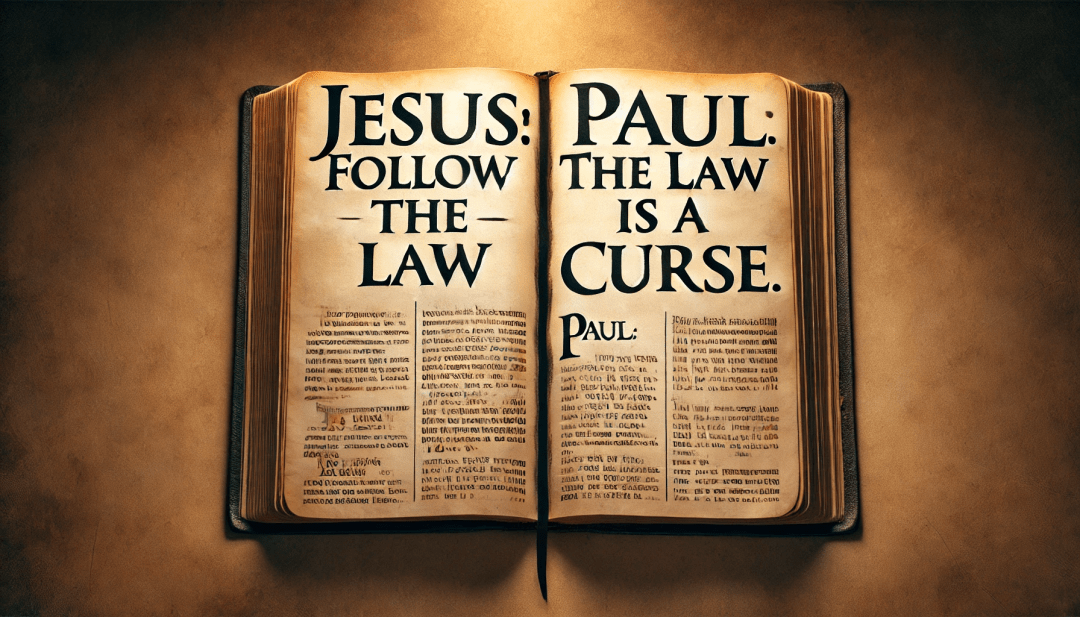
Jesus & The Law
One of the most striking tensions in the New Testament is the difference between Jesus’ teachings on the Law (Torah) and Paul’s theology of faith over works. Jesus consistently affirmed the validity of the Torah, instructing his followers to observe and uphold its commandments. In Matthew 5:17-19, he explicitly states, “Do not think that I have come to abolish the Law or the Prophets; I have not come to abolish them but to fulfill them.” He goes further, warning that whoever sets aside even the least of the commandments will be least in the kingdom of heaven, making it clear that obedience to the Torah remains essential.
In Matthew 23:2-3, Jesus commands his followers to obey the Pharisees because they sit in Moses’ seat, reinforcing that the Law is still in effect. He further emphasizes in Luke 16:17 that “it is easier for heaven and earth to disappear than for the least stroke of a pen to drop out of the Law.” When asked about the path to eternal life, Jesus replies in Matthew 19:16-17, “If you want to enter life, keep the commandments.” Jesus even follows this in 19:26 when questioned about this by his disciples after giving the parable of the camel passing through the eye of the needle in 19:24 by stating, “With men, this is impossible, but with God, all things are possible.” His response leaves no ambiguity—obedience to the Law is necessary and achievable. Even when summarizing the greatest commandments in Mark 12:28-31, Jesus draws directly from the Torah, citing Deuteronomy 6:4-5 (Love the Lord your God with all your heart) and Leviticus 19:18 (Love your neighbor as yourself), further reinforcing that Torah law remains the foundation of righteousness.
Paul & The Law
However, Paul takes a drastically different approach. In Galatians 3:10-13, Paul argues that those who rely on the Law are under a curse and that salvation comes through faith, not Torah observance. He claims that Jesus “redeemed us from the curse of the Law,” suggesting that the very Law Jesus upheld is now obsolete.
If Jesus affirmed Torah observance, why did Paul insist that it was no longer necessary? This article will explore how Paul’s reinterpretation of the Law not only deviates from Jesus’ teachings but also contradicts the Torah’s own statements about obedience being both possible and required.
One of the central claims of Pauline theology is that the Torah is an unbearable burden—impossible to fully obey—and that it brings a curse upon those who try to uphold it. In Galatians 3:10-13, Paul argues that no one can be justified by the Law and that faith in Jesus is the only path to righteousness. But is this what the Torah itself actually teaches? A closer look at the Hebrew Scriptures reveals a very different message.
10 For all who rely on the works of the law are under a curse, as it is written: ‘Cursed is everyone who does not continue to do everything written in the Book of the Law.’” 11 Now it is evident that no man is justified before God by the law; for “He who through faith is righteous shall live”; 12 but the law does not rest on faith, for “He who does them shall live by them.” 13 Christ redeemed us from the curse of the law, having become a curse for us—for it is written, “Cursed be every one who hangs on a tree”— Galatians 3:10-13
The Torah Says Obedience is Achievable
Contrary to Paul’s argument, the Torah repeatedly affirms that following God’s commandments is not too difficult and that human beings are fully capable of obeying them. One of the clearest statements comes from Deuteronomy 30:11-14:
“For this commandment that I command you today is not too difficult for you, nor is it far off… But the word is very near you, in your mouth and in your heart, so that you may do it.”
This passage makes it abundantly clear that God does not impose an impossible burden on His people. If the Law were truly impossible to follow, as Paul suggests, why would God declare that it is within reach and doable?
Keeping the Law Leads to Life and Righteousness
The Torah doesn’t just say that obedience is possible—it also states that it is the path to righteousness and life. Leviticus 18:5 reinforces this idea:
“You shall therefore keep my statutes and my rules; if a person does them, he shall live by them: I am the LORD.”
This stands in stark contrast to Paul’s reinterpretation of this verse in Galatians 3:12, where he argues that the Law does not rest on faith and implies that it is a burden rather than a source of life. Yet, the Torah itself teaches that obedience leads to divine favor, blessings, and righteousness.
The Torah Links Righteousness to Obedience
Another direct contradiction to Paul’s theology appears in Deuteronomy 6:25:
“And it will be righteousness for us, if we are careful to observe all this commandment before the LORD our God, as He has commanded us.”
Here, righteousness is explicitly linked to observing the Law—not faith alone. This completely undermines Paul’s core argument in books like Romans and Galatians, where he insists that righteousness comes only through faith in Jesus.
The Ability to Resist Sin and Choose Righteousness
Beyond this, the Torah presents human beings as fully capable of resisting sin and choosing righteousness. In Genesis 4:7, God tells Cain:
“If you do well, will you not be accepted? And if you do not do well, sin is crouching at the door. Its desire is for you, but you must rule over it.”
This passage establishes that sin is not an unavoidable force, but something that humans have the power to resist. If Torah observance were impossible, why would God tell Cain that he has control over his actions?
Paul vs. the Torah: A Clear Conflict
The idea that the Torah is a curse or an impossible standard comes not from the Hebrew Bible itself, but from Paul’s theology, which sought to remove Torah obligations for Gentile converts. However, the Torah never portrays itself as an impossible burden. Instead, it declares:
- God’s commandments are achievable (Deuteronomy 30:11-14).
- Keeping the Law leads to blessings and life (Leviticus 18:5).
- Righteousness is tied to obedience, not just faith (Deuteronomy 6:25).
- Human beings have the ability to resist sin and follow God’s will (Genesis 4:7).
| Torah’s Teaching | Paul’s Claim (Galatians 3:10-13) |
|---|---|
| The Law is not too difficult (Deut. 30:11-14). | The Law brings a curse because no one can follow it completely. |
| Keeping the Law leads to blessings (Deut. 28:1). | Righteousness is through faith, not the Law. |
| Doing the commandments gives life (Lev. 18:5). | The Law does not rest on faith, but on works. |
| Righteousness comes through obedience (Deut. 6:25). | No one is justified by the Law. |
Paul’s reinterpretation of the Law contradicts these explicit statements. While his teachings became dominant in mainstream Christianity, they stand in direct opposition to what the Torah actually says.
If the Torah itself insists that obedience is possible, expected, and rewarded, then Paul’s claim that the Law is an unachievable curse is simply not supported by the very scriptures he references. This raises an important question: Which view aligns with the message of the Hebrew Bible—the teachings of Jesus, who upheld the Law, or the teachings of Paul, who dismissed it?
Related Articles:

 Quran Talk Blog
3 thoughts on “Paul Contradicts Jesus & Torah on the Law”