The most prolific narrator of Hadith was Abu Hurairah, whose name translates to Father of a Kitten. He is said to have narrated 5374 Hadith, which equates to ~20% of the entire Hadith corpus.1
To put in perspective how many more Hadith Abu Hurairah narrated compared to what is attributed to the other more prominent companions, consider that the first Caliph (r. 632-634), Abu Bakr, the prophet’s closest companion and father-in-law, only had 142 traditions attributed to him, according to Al-Nawawi in his al-Tadhib. So Abu Hurayra narrated ~38 times more traditions than Abu Bakr.
Umar was also one of the closest companions to the prophet. It is stated in the following Hadith:
“”I and an Ansari neighbor of mine from Bani Umaiya bin Zaid who used to live in `Awali Al-Medina, used to visit the Prophet (ﷺ) in turns. He used to go one day, and I another day. When I went I would bring him the news of what had happened that day regarding the instructions and orders and when he went, he used to do the same for me.”
In addition to these frequent visits, he was the prophet’s father-in-law and the second Calipha (r. 634-644). Despite all this, it is estimated that 537 traditions are directly attributed to Umar. So Abu Hurayra narrated over ten times more traditions than Umar.
Ali was Muhammad’s nephew, lived in the same household as the prophet, was with him for 32 years, and was the first male to accept the message. In a hadith, it is claimed that Muhammad thought of him as his Aaron in relation to Moses.
And narrated Sad that the Prophet (ﷺ) said to ‘Ali, “Will you not be pleased from this that you are to me like Aaron was to Moses?”
حَدَّثَنِي مُحَمَّدُ بْنُ بَشَّارٍ، حَدَّثَنَا غُنْدَرٌ، حَدَّثَنَا شُعْبَةُ، عَنْ سَعْدٍ، قَالَ سَمِعْتُ إِبْرَاهِيمَ بْنَ سَعْدٍ، عَنْ أَبِيهِ، قَالَ النَّبِيُّ صلى الله عليه وسلم لِعَلِيٍّ “ أَمَا تَرْضَى أَنْ تَكُونَ مِنِّي بِمَنْزِلَةِ هَارُونَ مِنْ مُوسَى ”.
Despite this, there are 586 hadiths attributed directly to Ali. Therefore, Abu Hurairah narrated 9x more traditions than Ali.
It is staggering if we look at how many more traditions Abu Hurairah narrated compared to the closest companions.
Narrator
# of Traditions
Compared to Abu Hurayra %
Abu Hurayra
5374
–
Abu Bakr
142
2.64%
Umar
537
10%
Ali
586
2.7%
Uthman
146
0.28%
al-Zubayr
10
0.19%
Talhah
4
0.07%
Abd al-Rahman
9
0.17%
Ubayy ibn Ka’b
60
1.12%
Zayd ibn Thabit
13
0.24%
Salman al-Farsi
3
0.06%
It is particularly questionable how this one individual was able to narrate so many Hadith than the closest companions despite only being a companion of the prophet for one to three years before the prophet passed. Even while he was with the prophet, it was clear that he was not a close companion or even looked at in a favorable light.
In Ibn Kathir’s book, “The Caliphate of Banu Umayyah,” under the section on the year 59 AH, he narrates that the Prophet beat Abu Hurairah with a rod. And that when Abu Hurairah was on his deathbed, he confessed uncertainty as to whether he was destined for Paradise or Hellfire.
One of the criticisms that Abu Hurairah claims the other companions had against him was that he narrated too many Hadith.
Narrated Abu Huraira: The people say that Abu Huraira narrates too many narrations. In fact Allah knows whether I say the truth or not. They also ask, “Why do the Muhajiriin and the Ansar not narrate like his Hadith?” In fact, my emigrant brethren were busy trading in the markets, and my Ansar brethren were busy with their properties. I was a poor man keeping the company of Allah’s Messenger (ﷺ) and was satisfied with what filled my stomach. So, I used to be present while they (i.e. the emigrants and the Ansar) were absent, and I used to remember while they forgot (the Hadith). One day the Prophet (ﷺ) said, “Whoever spreads his sheet till I finish this statement of mine and then gathers it on his chest, will never forget anything of my statement.” So, I spread my covering sheet which was the only garment I had, till the Prophet (ﷺ) finished his statement and then I gathered it over my chest. By Him Who had sent him (i.e. Allah’s Apostle) with the truth, since then I did not forget even a single word of that statement of his, until this day of mine. By Allah, but for two verses in Allah’s Book, I would never have related any narration (from the Prophet). (These two verses are): “Verily! Those who conceal the clear signs and the guidance which we have sent down …..(up to) the Merciful.’ (2.159-160)
حَدَّثَنَا مُوسَى بْنُ إِسْمَاعِيلَ، حَدَّثَنَا إِبْرَاهِيمُ بْنُ سَعْدٍ، عَنِ ابْنِ شِهَابٍ، عَنِ الأَعْرَجِ، عَنْ أَبِي هُرَيْرَةَ ـ رضى الله عنه ـ قَالَ يَقُولُونَ إِنَّ أَبَا هُرَيْرَةَ يُكْثِرُ الْحَدِيثَ. وَاللَّهُ الْمَوْعِدُ، وَيَقُولُونَ مَا لِلْمُهَاجِرِينَ وَالأَنْصَارِ لاَ يُحَدِّثُونَ مِثْلَ أَحَادِيثِهِ وَإِنَّ إِخْوَتِي مِنَ الْمُهَاجِرِينَ كَانَ يَشْغَلُهُمُ الصَّفْقُ بِالأَسْوَاقِ، وَإِنَّ إِخْوَتِي مِنَ الأَنْصَارِ كَانَ يَشْغَلُهُمْ عَمَلُ أَمْوَالِهِمْ، وَكُنْتُ امْرَأً مِسْكِينًا أَلْزَمُ رَسُولَ اللَّهِ صلى الله عليه وسلم عَلَى مِلْءِ بَطْنِي، فَأَحْضُرُ حِينَ يَغِيبُونَ وَأَعِي حِينَ يَنْسَوْنَ، وَقَالَ النَّبِيُّ صلى الله عليه وسلم يَوْمًا ” لَنْ يَبْسُطَ أَحَدٌ مِنْكُمْ ثَوْبَهُ حَتَّى أَقْضِيَ مَقَالَتِي هَذِهِ، ثُمَّ يَجْمَعَهُ إِلَى صَدْرِهِ، فَيَنْسَى مِنْ مَقَالَتِي شَيْئًا أَبَدًا ”. فَبَسَطْتُ نَمِرَةً لَيْسَ عَلَىَّ ثَوْبٌ غَيْرَهَا، حَتَّى قَضَى النَّبِيُّ صلى الله عليه وسلم مَقَالَتَهُ، ثُمَّ جَمَعْتُهَا إِلَى صَدْرِي، فَوَالَّذِي بَعَثَهُ بِالْحَقِّ مَا نَسِيتُ مِنْ مَقَالَتِهِ تِلْكَ إِلَى يَوْمِي هَذَا، وَاللَّهِ لَوْلاَ آيَتَانِ فِي كِتَابِ اللَّهِ مَا حَدَّثْتُكُمْ شَيْئًا أَبَدًا {إِنَّ الَّذِينَ يَكْتُمُونَ مَا أَنْزَلْنَا مِنَ الْبَيِّنَاتِ} إِلَى قَوْلِهِ {الرَّحِيمُ}
Additionally, even the companions who lived with Abu Hurairah considered him a liar. In the following Hadith, Abu Hurairah admits this and then goes on to narrate a statement that he attributes to the prophet that is later ridiculed by other believers, including ‘Aisha.
Abu Razin reported: Abu Huraira came to us and he struck his forehead with his hand and said: You narrate that I lie about the Messenger of God(ﷺ) (certain things) so that you may be guided and I may go astray. Listen. I bear testimony to the fact that I heard Allah’s Messenger (ﷺ) saying: When the thong of any one of you is broken, he should not walk in the second one until he has got it repaired.
حَدَّثَنَا أَبُو بَكْرِ بْنُ أَبِي شَيْبَةَ، وَأَبُو كُرَيْبٍ – وَاللَّفْظُ لأَبِي كُرَيْبٍ – قَالاَ حَدَّثَنَا ابْنُ إِدْرِيسَ، عَنِ الأَعْمَشِ، عَنْ أَبِي رَزِينٍ، قَالَ خَرَجَ إِلَيْنَا أَبُو هُرَيْرَةَ فَضَرَبَ بِيَدِهِ عَلَى جَبْهَتِهِ فَقَالَ أَلاَ إِنَّكُمْ تَحَدَّثُونَ أَنِّي أَكْذِبُ عَلَى رَسُولِ اللَّهِ صلى الله عليه وسلم لِتَهْتَدُوا وَأَضِلَّ أَلاَ وَإِنِّي أَشْهَدُ لَسَمِعْتُ رَسُولَ اللَّهِ صلى الله عليه وسلم يَقُولُ “ إِذَا انْقَطَعَ شِسْعُ أَحَدِكُمْ فَلاَ يَمْشِ فِي الأُخْرَى حَتَّى يُصْلِحَهَا ” .
One of the most famous and widely transmitted Hadith that is the posterchild of a mutawatir Hadith and the reliablity of Hadith transmissions attributes the prophet stating:
Narrated ‘Abdullah [bin Mas’ud]: that the Messenger of Allah (ﷺ) said: “Whoever lies upon me, then let him take his seat in the Fire.”
حَدَّثَنَا أَبُو هِشَامٍ الرِّفَاعِيُّ، حَدَّثَنَا أَبُو بَكْرِ بْنُ عَيَّاشٍ، حَدَّثَنَا عَاصِمٌ، عَنْ زِرٍّ، عَنْ عَبْدِ اللَّهِ بْنِ مَسْعُودٍ، قَالَ قَالَ رَسُولُ اللَّهِ صلى الله عليه وسلم “ مَنْ كَذَبَ عَلَىَّ مُتَعَمِّدًا فَلْيَتَبَوَّأْ مَقْعَدَهُ مِنَ النَّارِ ” .
Despite this warning, Abu Huraira blatantly fabricated Hadith and attributed them to the prophet. The clearest example of this is in the following Hadith, where Abu Hurairah attributes a Hadith to the prophet, but when pressed on the matter, he admits that he made it up.
Narrated Abu Huraira: “The Prophet (ﷺ) said, ‘The best alms is that which is given when one is rich, and a giving hand is better than a taking one, and you should start first to support your dependents.’ A wife says, ‘You should either provide me with food or divorce me.’ A slave says, ‘Give me food and enjoy my service.” A son says, “Give me food; to whom do you leave me?” The people said, “O Abu Huraira! Did you hear that from Allah’s Messenger (ﷺ) ?” He said, “No, it is from my own self.”
حَدَّثَنَا عُمَرُ بْنُ حَفْصٍ، حَدَّثَنَا أَبِي، حَدَّثَنَا الأَعْمَشُ، حَدَّثَنَا أَبُو صَالِحٍ، قَالَ حَدَّثَنِي أَبُو هُرَيْرَةَ ـ رضى الله عنه ـ قَالَ قَالَ النَّبِيُّ صلى الله عليه وسلم “ أَفْضَلُ الصَّدَقَةِ مَا تَرَكَ غِنًى، وَالْيَدُ الْعُلْيَا خَيْرٌ مِنَ الْيَدِ السُّفْلَى، وَابْدَأْ بِمَنْ تَعُولُ ”. تَقُولُ الْمَرْأَةُ إِمَّا أَنْ تُطْعِمَنِي وَإِمَّا أَنْ تُطَلِّقَنِي. وَيَقُولُ الْعَبْدُ أَطْعِمْنِي وَاسْتَعْمِلْنِي. وَيَقُولُ الاِبْنُ أَطْعِمْنِي، إِلَى مَنْ تَدَعُنِي فَقَالُوا يَا أَبَا هُرَيْرَةَ سَمِعْتَ هَذَا مِنْ رَسُولِ اللَّهِ صلى الله عليه وسلم. قَالَ لاَ هَذَا مِنْ كِيسِ أَبِي هُرَيْرَةَ.
In the following example, Abu Hurairah states that the messenger said, “There is no transitive disease.” Yet, when he was pressed on this, he denied making the statement.
Narrated Abu Hurairah: The Messenger of Allah (ﷺ) as saying: There is no transitive disease, no evil omen, or serpent in a hungry belly, and no hamah. A nomadic Arab asked: How is it that when camels are in the sand as if they were gazelles and a mangy camel comes among them and it gives them mange ? He replied: Who infected the first one ? Ma’mar, quoting al-Zuhri said: A man told me that Abu Hurairah narrated to him saying that he heard the Prophet (ﷺ) say: A diseased camel should not be brought with a healthy camel to drink water. He said: The man then consulted him and said: Did you not tell us that Prophet (ﷺ) had said: There is no transitive disease, no serpent in a hungry belly and no hamah? He replied: I did not transmit it to you. Al-Zuhri said: Abu Salamah said: He had narrated it and I did not hear that Abu Hurairah had ever forgotten any tradition except this one.
In another example, Abu Huraira says that if someone is in a state of junub, they cannot observe fasting, which was again disproven as a fabrication by other companions.
Abu Bakr (he is Abu Bakr b. Abd al-Rahman b. Harith) reported: I heard Abu Huraira (Allah be pleased with him) narrating that he who is overtaken by dawn in a state of seminal emission should not observe fast. I made a mention of it to ‘Abd al-Rahman b. Harith (i. e. to his father) but he denied it. ‘Abd al-Rahman went and I also went along with him till we came to ‘A’isha and Umm Salama (Allah be pleased with both of them) and Abd al-Rahman asked them about it. Both of them said: (At times it so happened) that the Messenger of Allah (ﷺ) woke up in the morning in a state of junub (but without seminal emission in a dream) and observed fast He (the narrator) said: We then proceeded till we went to Marwan and Abd al-Rahman made a mention of it to him. Upon this Marwan said: I stress upon you (with an oath) that you better go to Abu Huraira and refer to him what is said about it. So we came to Abu Huraira and Abu Bakr had been with us throughout, and ‘Abd al-Rahman made a mention of it to him, whereupon Abu Huraira said: Did they (the two wives of the Holy Prophet) tell you this? He replied: Yes Upon this (Abu Huraira) said: They have better knowledge. Abu Huraira then attributed what was said about it to Fadl b. ‘Abbas and said: “I heard it from Fadl and not from the Messenger of Allah (ﷺ).” Abu Huraira then retracted from what he used to say about it. Ibn Juraij (one of the narrators) reported: I asked ‘Abd al-Malik, if they (the two wives) said (made the statement) in regard to Ramadan, whereupon he said: It was so, and he (the Holy Prophet) (woke up in the) morning in a state of junub which was not due to the wet dream and then observed fast.
In the following Hadith, we see that Aisha disapproved of the Hadith that Abu Huraira was narrating, stating that the messenger did not narrate the Hadith Abu Huraira did.
‘A’isha reported: Don’t you feel surprised at Abu Huraira? He came (one day) and sat beside the nook of my apartment and began to narrate (the hadith of Allah’s Apostle). I was hearing while I was engaged in extolling Allah (reciting Subhan Allah) constantly. He stood up before I finished my repetition of Subhan Allah. If I were to meet him, I would have warned him in stern words that Allah’s Messenger (ﷺ) did not narrate the Hadith as you narrate.
وَحَدَّثَنِي حَرْمَلَةُ بْنُ يَحْيَى التُّجِيبِيُّ، أَخْبَرَنَا ابْنُ وَهْبٍ، أَخْبَرَنِي يُونُسُ، عَنِ ابْنِ، شِهَابٍ أَنَّ عُرْوَةَ بْنَ الزُّبَيْرِ، حَدَّثَهُ أَنَّ عَائِشَةَ قَالَتْ أَلاَ يُعْجِبُكَ أَبُو هُرَيْرَةَ جَاءَ فَجَلَسَ إِلَى جَنْبِ حُجْرَتِي يُحَدِّثُ عَنِ النَّبِيِّ صلى الله عليه وسلم يُسْمِعُنِي ذَلِكَ وَكُنْتُ أُسَبِّحُ فَقَامَ قَبْلَ أَنْ أَقْضِيَ سُبْحَتِي وَلَوْ أَدْرَكْتُهُ لَرَدَدْتُ عَلَيْهِ إِنَّ رَسُولَ اللَّهِ صلى الله عليه وسلم لَمْ يَكُنْ يَسْرُدُ الْحَدِيثَ كَسَرْدِكُمْ .
In the book Ta’wil Mukhtalif al-Hadith by Ibn Qutaybah (828-890 CE/213-276 AH), on page 70 of the Annotated Translation, Ibn Qutaybah says regarding Ali, ‘Aisha, and ‘Umar’s view on Abu Hurarirah:
‘A’ishah was the most abrasive among those (companions) who rejected him [Abu Hurairah] and this ill-wind continued until the end of their lives. And so did ’Umar, who was abrasive against whoever transmitted numerous ahadith or reported information related to judicial judgment without any witness. He used to order (the narrators) to reduce the number of narrations so that the masses will not be confused or corrupted by falsehood.
Abu Hurairah also had an ongoing dislike by the companions as they complained he narrated too many Hadith and was lying about the prophet. This feud is also cited in the above book by Ibn Qutaybah on pages 50-51 by al-Nazzam, who cited the following Hadiths criticizing Abu Hurairah. It is worth noting that Ibn Qutaybah doesn’t refute these claims but acknowledges a known feud between the closest companions and Abu Hurairah.
“Discussing Abu Hurayrah, (al-Nazzam) criticized:..He used to report a hadith by walking with only a shoe and this was related to ‘A’ishah. She then started to walk with one shoe only and said: [I want to be different from Abu Hurayrah.]
“(Abu Hurayrah) reported that a dog, a woman and a donkey would nullify a prayer. And ‘A’ishah said: [The prophet performeda prayer in the middle of (our_ bed while I was lying on (the same) bed, (barricading) himself from the Qiblah.]”
“(Al-Nazzam) said: [‘Ali was informed that Abu Hurayrah began his ablution with the right side. (‘Ali) in the same clothing headed for some water and started to take ablution beginning with his left side and then said: [I want to be different from Abu Hurayrah.]”
“(Abut Hurairah) used to say: [My dear friend told me…my dear friend said…I saw my dear friend…!] And ‘Ali said to him: [Since when did the prophet become your dear frien, O Abu Hurayrah?]
“(Al-Nazzam) sadi that Abu Hurayrah has reported [Whoever was in the state of janabah (major impurity) by (the early part of) the day time should not fast.] On this matter, Marwan sent a messenger to ask ‘A’ishah and Hafsah, they replied: [The Prophet was in the state of janabah by (the early part of) day time and was also in the state of ihtilam (wet dream) but he performed his fasting.] (Marwan) then said to the messenger: [Go and tell Abu Hurayrah of this information!] Abu Hurayrah replied: [Indeed I have narrated this hadith and so did al-Fadl ibn al-‘Abbas, the martyr.] But the masses doubted that (Abu Hurayrah) has heard this (information) from the Prophet.”
In the next two narrations, we have Abu Huraira fabricating what the messenger stated nullifies Salat, and ‘Aisha rebuking him for this.
Abu Huraira reported: The Messenger of Allah (ﷺ) said: A woman, an ass and a dog disrupt the prayer, but something like the back of a saddle guards against that.
Masruq reported: It was mentioned before’A’isha that prayer is invalidated (in case of passing) of a dog, an ass and a woman (before the worshipper, when he is not screened). Upon this ‘A’isha said: You likened us to the asses and the dogs. By Allah I saw the Messenger of Allah (ﷺ) saying prayer while I lay on the bedstead interposing between him and the Qibla. When I felt the need, I did not like to wit to front (of the Holy Prophet) and perturb the Messenger of Allah (ﷺ) and quietly moved out from under its (i. e. of the bedstead) legs.
In the book Ta’wil Mukhtalif al-Hadith by Ibn Qutaybah (828-890 CE/213-276 AH), on page 150 of the Annotated Translation, Ibn Qutaybah cites the following Hadith regarding the controversy between Abu Hurairah and ‘A’ishah and the above Hadith.
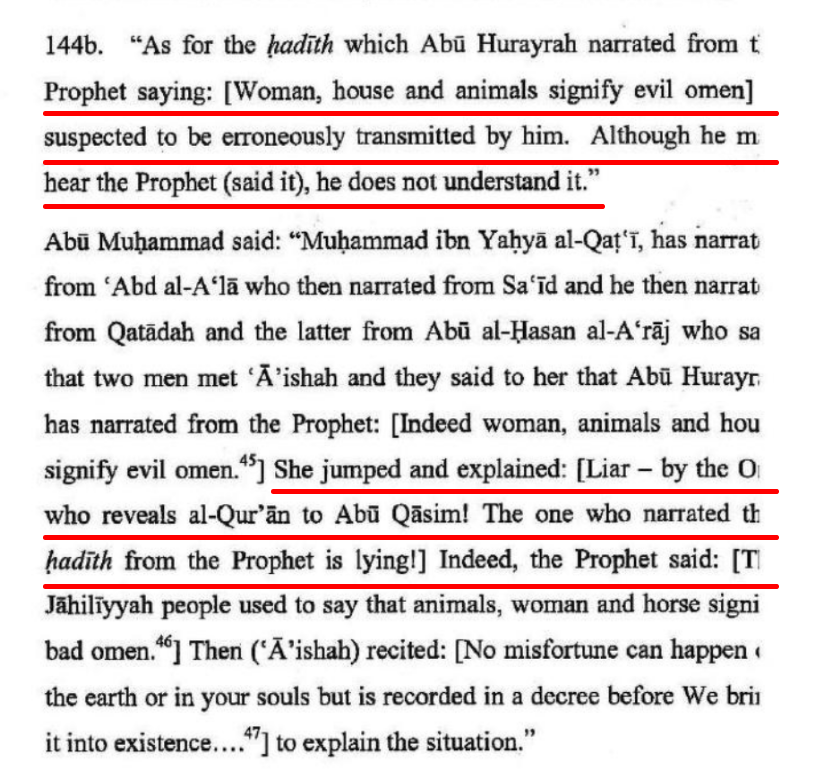
Abu Muhammad [Ibn Qutaybah] said: “Muhammad ibn Yahya al-Qart’i, has narrated from ‘Abd al-A’la who then narrated from Sa’id and he then narrated from Qatadah and the latter from Abu al-Hasan al-A’raj who said that two men met ‘A’ishah and they said to her that Abu Hurayrah has narrated from the Prophet: [Indeed woman, animals and house signify evil omen.] She jumped and explained: [Liar — by the One who reveals al-Qur’an to Abu Qasim [the Prophet]! The one who narrated this hadith from the Prophet is lying!] Indeed, the Prophet said: [That Jahiliyyah people used to say that animals, woman and horse signal bad omen.] Then (‘A’ishah) recited: [No misfortune can happen on the earth or in your souls but is recorded in a decree before We bring it into existence….[Quran 57:22] to explain the situation.”
This Hadith can also be found in “Al-Mustakrak, 2:479; Kunz al-‘Ummal, 10:11 (No. 28557), 10:116 (No. 28585); Al-Sunan al-Kubra, 1:124; Majama’ al-Zawa’id, 5:124 (No. 8405).
Ibn Qutaybah also had the following commentary from Abu Hurairah himself, referenced on the same page as the excerpt above:
“As for the hadith which Abu Hurayrah narrated from the Prophet saying: [Woman, house, and animals signify evil omen] suspected to. be erroneously transmitted by him. Although he may hear the Prophet (said it), he does not understand it.”
Conclusion
So, despite all the overwhelming evidence that the Sunni’s most prolific narrator is entirely unreliable, why does the ulema refuse to budge on this matter? The answer is that they know if their most prolific narrator is a sham, then so is their entire foundation of traditions. This has been known even before the compilations of Bukhari and Muslim that the whole Sunnah rested on maintaining the integrity of the companions. It is documented in the books “Tawil Mukhtalif al-Hadith” by Ibn-Qutayba p. 228, and “Hadith Muhammad’s Legacy in the Medieval and Modern World,” p. 302 by Jonathan Brown, that in an audience before the Abbasid caliph Harun al-Rashid, the early Sunni Umar b. Habib (d. 204/819-20) responded to Mu’tazilite and Ahl al-ra’y arguments regarding the reliability of Abu Hurayra and claimed “that if one opened the door to criticizing the Companions of the Prophet, Muslims would lose the whole Shariah.“
assalam alaikum. I’m a muslim with severe doubt in my faith and need your help interpreting a verse. I sent you a email on the email you have on the about me section on your blog
Abu Hurairah said: “One day, the Messenger of Allah ﷺ raised a rod over me to strike me with it, and had he struck me with it, it would have been more beloved to me than owning red camels.”





assalam alaikum. I’m a muslim with severe doubt in my faith and need your help interpreting a verse. I sent you a email on the email you have on the about me section on your blog
LikeLike
I noticed a mistranslated paragraph of “Ibn Kathir’s notes” on the year 59 H:
قَالَ أَبُو هُرَيْرَةَ لَقَدْ رَفَعَ عَلَيَّ رَسُولُ اللَّهِ ﷺ يَوْمًا الدِّرَّةَ لِيَضْرِبَنِي بِهَا، لَأَنْ يَكُونُ ضَرَبَنِي بِهَا أَحَبُّ إِلَيَّ مِنْ حُمْرِ النَّعَمِ
The correct translation would be:
Abu Hurairah said: “One day, the Messenger of Allah ﷺ raised a rod over me to strike me with it, and had he struck me with it, it would have been more beloved to me than owning red camels.”
This means that he was not beaten by it!
LikeLike