
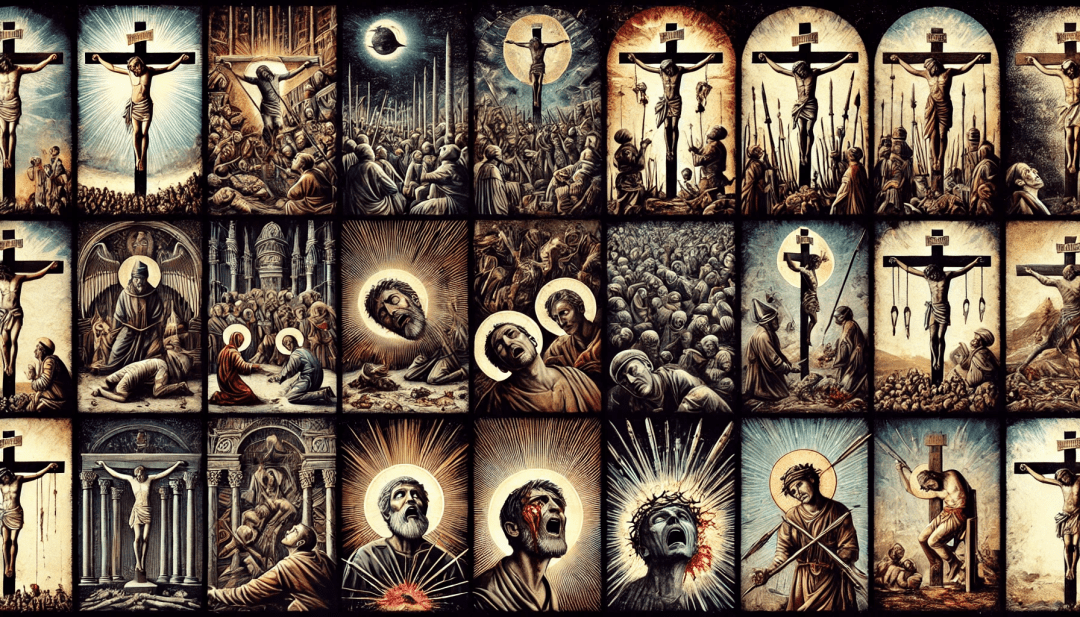
Many Christians argue that the willingness of Jesus’ disciples to die for their belief in his resurrection serves as powerful proof of the truth of Christianity. The reasoning goes that people would not willingly suffer martyrdom for something they knew to be false. While this may seem compelling at first glance, closer scrutiny reveals several reasons why this argument is problematic and ultimately fails to provide solid evidence for the truth of Christian claims. Below, we explore these issues in detail and address specific cases to highlight the flaws in this line of reasoning.
Lack of Contemporary Evidence for Martyrdom
One of the most significant issues with the claim that all or most of the disciples were martyred is the lack of contemporary, reliable evidence to support it. Aside from James, son of Zebedee, whose death is mentioned in Acts 12:2, the New Testament provides no details about how the other disciples died. Additionally, Acts itself is not considered a reliable historical source due to its inconsistencies with the writings of Paul and the Gospels. This includes even the Gospel of Luke, which is attributed to being the same author as Acts. For example, in the Gospel of Luke (24:50-51), Jesus ascends to Heaven on the same day as his resurrection. However, Acts 1:3 states that Jesus stayed with the disciples for days.
If widespread martyrdom of the apostles occurred, it would be reasonable to expect it to be recorded in early Christian texts, yet these events are conspicuously absent. This silence raises questions about whether such martyrdoms actually happened or if they are later fabrications.
Moreover, the earliest detailed accounts of apostolic martyrdoms come from centuries after their supposed deaths. For example, the writings of Eusebius of Caesarea in the 4th century are often cited, but by that time, oral traditions and legends had ample opportunity to evolve and become embellished. Without corroboration from earlier, independent sources, these later accounts lack historical reliability.
Contradictions and Variability in Traditions
Another major issue is the inconsistency in the martyrdom stories of the apostles. For instance, traditions about Thomas’ death vary widely, with some claiming he was speared in India and others suggesting a peaceful death. Similarly, Bartholomew’s death is described in conflicting ways, including being flayed alive, crucified, or decapitated. Such discrepancies undermine the credibility of these accounts and suggest that they were shaped more by theological motivations than historical facts.
The lack of a unified tradition for many of the apostles’ deaths suggests that these stories were not based on eyewitness testimony but rather evolved over time to serve the needs of a growing Christian movement. Competing accounts also indicate that different communities created their own versions of apostolic deaths, further calling into question their historical authenticity.
Theological Motivations Behind Martyrdom Narratives
Martyrdom was a powerful symbol in early Christianity, representing ultimate faith and devotion. Stories of apostles dying for their beliefs served as inspirational tools to encourage perseverance among believers facing persecution. However, this also means that such stories were prone to embellishment or fabrication to achieve their intended effect. Theological motives often took precedence over historical accuracy, making these accounts unreliable as evidence for the apostles’ actual fates.
For example, martyrdom narratives often emphasize miraculous or dramatic elements, such as apostles preaching while being crucified or angels intervening. These embellishments align more with the purpose of bolstering faith than providing an accurate historical record. Such stories were likely crafted to portray the apostles as heroic figures rather than to document their lives and deaths.
Doubts About James’ Martyrdom
Even the account of James’ death, which is the most explicitly mentioned in the New Testament, is not without its problems. Acts 12:2 states that King Herod Agrippa had James killed with the sword, but this passage provides no additional context or corroborating details. Moreover, the brevity of this account leaves room for speculation about its historicity.
Skeptics have noted that the early church often used martyrdom narratives to legitimize its leaders and draw parallels to Jesus’ own suffering. Thus, even the account of James’ death could have been shaped or emphasized to serve this purpose. The absence of independent, non-Christian sources confirming James’ martyrdom further weakens its reliability as evidence.
Psychological and Social Factors
The argument that people would not willingly die for something they knew to be false assumes that the apostles were in a position to know definitively whether their beliefs were true or false. However, belief is not necessarily tied to objective truth. People have historically been willing to die for all kinds of religious and ideological causes, many of which are demonstrably false or contradictory. The willingness to face death often stems from deeply held convictions, social pressures, or a desire for meaning, rather than direct knowledge of factual events.
For example, many Muslims have faced martyrdom with similar resolve, yet Christians do not take these examples as evidence of the truth of those religions. The apostles’ willingness to suffer—if it even occurred as described—proves only their sincerity, not the accuracy of their beliefs.
Lack of External Corroboration
If the apostles’ martyrdoms were as dramatic and widespread as later traditions claim, it is surprising that no contemporary Roman or Jewish historians, such as Josephus or Tacitus, recorded these events. Early Christian persecution is occasionally mentioned in non-Christian sources, but these references are vague and do not provide specific details about the apostles. This lack of external corroboration raises doubts about whether such events occurred on the scale often suggested by later traditions.
Conclusion
The claim that the apostles’ martyrdom provides proof of Jesus’ resurrection and the truth of Christianity does not hold up under scrutiny. The lack of contemporary evidence, contradictions in later traditions, theological motives behind martyrdom narratives, and the absence of external corroboration all undermine the reliability of these accounts. Additionally, the willingness to die for a cause is not unique to Christianity and does not constitute evidence of the truth of the apostles’ beliefs. While the stories of the apostles’ martyrdoms may inspire faith, they should not be treated as historical proof of Christianity’s claims.

 Quran Talk Blog